O2 Boost 4G and 5G Cover Across Over 40 Major UK Motorways and A Roads | ISPreview UK

Original article ISPreview UK:Read More

Mobile operator O2 (Virgin Media) has revealed that they’ve recently boosted 4G and 5G based mobile (mobile broadband) coverage across 590 miles of road in the UK (i.e. major motorways and A roads, including the M1, M4, M6, M8 and M25). The move aims to improve network reliability and help drivers with navigation, charging apps and calls to breakdown services etc.

As part of the network optimisation work, many routes have received upgrades including a 4G boost for 311 sites and 338 brand-new 5G builds, “significantly enhancing network performance and reliability for road users“. Further improvements are also being planned for the A14 (Rugby–Ipswich), the M20 (London–Folkestone) and the A75 (Gretna–Stranraer).

At the same time, the Liberty Global-backed EV charge point operator, Believ, is installing up to 30,000 new public charging points nationwide to expand its charging footprint, including in areas where O2 has recently boosted mobile coverage.

In addition, VMO2 recently commission Strand Partners to conduct a nationally representative online survey of 1,000 people, including a sub-sample of 298 EV drivers between 29/08/2025 – 01/09/2025. This revealed that 76% of EV drivers worry about losing mobile connectivity, which can also make it difficult to access charging apps (you can usually charge without these, but some services adopt a subscription).

Jeanie York, Chief Technology Officer at VMO2, said:

“Connectivity underpins a huge part of the driving experience today, but particularly for EVs. By optimising coverage on more than 40 motorways and A roads as part of our £700 million investment in our Mobile Transformation Plan, we’re helping make every journey safer and more reliable. Alongside Believ’s new charging points, this is about removing barriers so more people can make the switch to electric with confidence.”

The upgrades form part of VMO2’s wider £700m Mobile Transformation Plan, which is expanding 4G and 5G coverage, rolling out Small Cells in dense urban areas, and tackling persistent network pain points along railways, airports, stadiums and now main roads.

Microsoft launches Project Gecko to produce AI systems in low-resourced languages | Total Telecom

Original article Total Telecom:Read More

brown and white lizard on brown wooden surface

News

Microsoft has unveiled Project Gecko, a research-driven initiative aimed at producing cheaper, localised generative AI systems for populations under‑represented in current models , starting with smallholder farmers in Kenya and India.

The project, led by Microsoft Research with contributions from Microsoft Research Africa in Nairobi, Microsoft Research India, the Microsoft Research Accelerator in the US and partners including agri‑tech NGO Digital Green, seeks to tackle the language, cultural and infrastructure barriers that limit AI uptake in low‑resource settings.

At the centre of the effort is the MultiModal Critical Thinking Agent (MMCTAgent), a multimodal system that ingests speech, images, and video to produce context‑rich, locally grounded answers. Microsoft says MMCTAgent can break complex queries into sub‑questions, verify its own outputs, and anchor responses in community‑generated practice captured in videos and transcripts.

The system is available on Azure AI Foundry Labs and its code has been published on GitHub.

Agriculture is Project Gecko’s first focus because of its economic weight in countries such as Kenya and India, where millions of smallholders work plots of under five acres. Microsoft and partners argue that existing AI tools often fail farmers because models are trained predominantly on English data, do not handle local dialects, and do not reflect region‑specific agronomic terms or practices. Farmers commonly rely on oral instruction and video demonstrations, both of which are channels that conventional text‑centric models struggle to exploit.

Project Gecko builds on Digital Green’s FarmerChat platform, which already serves millions of farmers and holds more than 10,000 agricultural videos in over 40 languages and dialects. Microsoft says Project Gecko enables a farmer in Nyeri County, for example, to ask a question verbally in Kikuyu and receive a text, audio, or video response, including a jump to the precise timestamp in a training clip. Field studies in Kenya and India reportedly show improved accuracy, usability and trust compared with generic AI systems.

A key technical strand of the work is creating speech infrastructure for under‑served languages. The team has collected roughly 3,000 hours of crowd‑sourced Kenyan speech and expanded support to Swahili, Kikuyu, Kalenjin, Dholuo, Maa, and Somali. To run on the low‑cost devices typical in rural areas, the project uses small language models (SLMs) and is preparing a public leaderboard to benchmark African language performance.

Microsoft plans to broaden Project Gecko beyond agriculture into healthcare, education, and retail, and will publish a multilingual playbook for developers.

While major challenges still remain for the project, including limited connectivity for the target consumers and sparse datasets for many languages, Project Gecko represents a significant attempt to bridge the rapidly growing digital divide.

Also in the news
Connected Britain Award winners 2025 announced!
Netomnia announces ‘powerful and ambitious’ rebrand ahead of Connected Britain
VodafoneThree drops Samsung, relies on Nokia and Ericsson for £2bn network upgrade

Survey Claims to Reveal Worst 10 UK Locations for Broadband Overspend | ISPreview UK

Original article ISPreview UK:Read More

New research from Broadband Genie, which recently interviewed 3,997 broadband bill payers over a 4-month period, claims to have identified the “worst” ten locations in the UK for “broadband overspend” (i.e. where consumers are out of contract and thus paying more than if they were to switch ISP for a better deal). Wolverhampton tops the table with an overspend of £292.56.

The study compares the average spend in each area with the hypothetical savings customers could make over a 12-month period. On average, broadband customers overspend £183.60 and over the Black Friday period, this can top £230. Annually, this is claimed to equate to £2 billion a year. Across the UK, some 8.8 million customers are estimated by the study to be out of contract and thus free to switch to something cheaper.

NOTE: City overspend on broadband was calculated by taking the average monthly subscription cost of an out-of-contract customer and the difference over a 12-month period compared to the cheapest broadband deal on the market above 100Mbps download speed. Locations were ordered descending by average annual overspend.

The somewhat anecdotal results found that Wolverhampton bill payers overspend the most for broadband than any other area in the UK (£292.56), although the differences between the listed locations were overall found to be fairly small (possibly reflecting some differences in network and ISP availability).

Top 10 cities which overpay the most on broadband

City How much are they overspending?
Wolverhampton £292.56
Wrexham £280.32
Liverpool £278.88
Gloucester £276.36
Exeter £276.24
Birmingham £269.76
Manchester £269.52
Cambridge £269.16
Hull £267.24
Leeds £263.52

As usual, we feel it’s important to take opinion surveys like this with a fairly big pinch of salt, since they often reflect highly subjective analysis that doesn’t consider the wider context for each consumer decision. How we all value our broadband package and ISP tends to differ, and many of us value quality and support over getting the cheapest price. Likewise, not all ISPs play the post-contract price hikes game.

Suffice to say that how each of us chooses to value the service we receive is different and can’t always be whittled down to an assumption of “overspend” vs the cheapest available deal from another provider. On the other hand, it’s always wise to keep your options open and do a bit of research to identify comparable providers and packages that might suit.

The alternative avenue, which tends to be more viable with the largest providers, is to try haggling for a better deal – see our Retentions Tips article for some help on that. The above survey doesn’t seem to have considered whether those they questioned had already secured a better deal with their existing ISP.

Ofcom – Gigabit Broadband Covers 87 Percent of UK as 5G Hits 97 Percent | ISPreview UK

Original article ISPreview UK:Read More

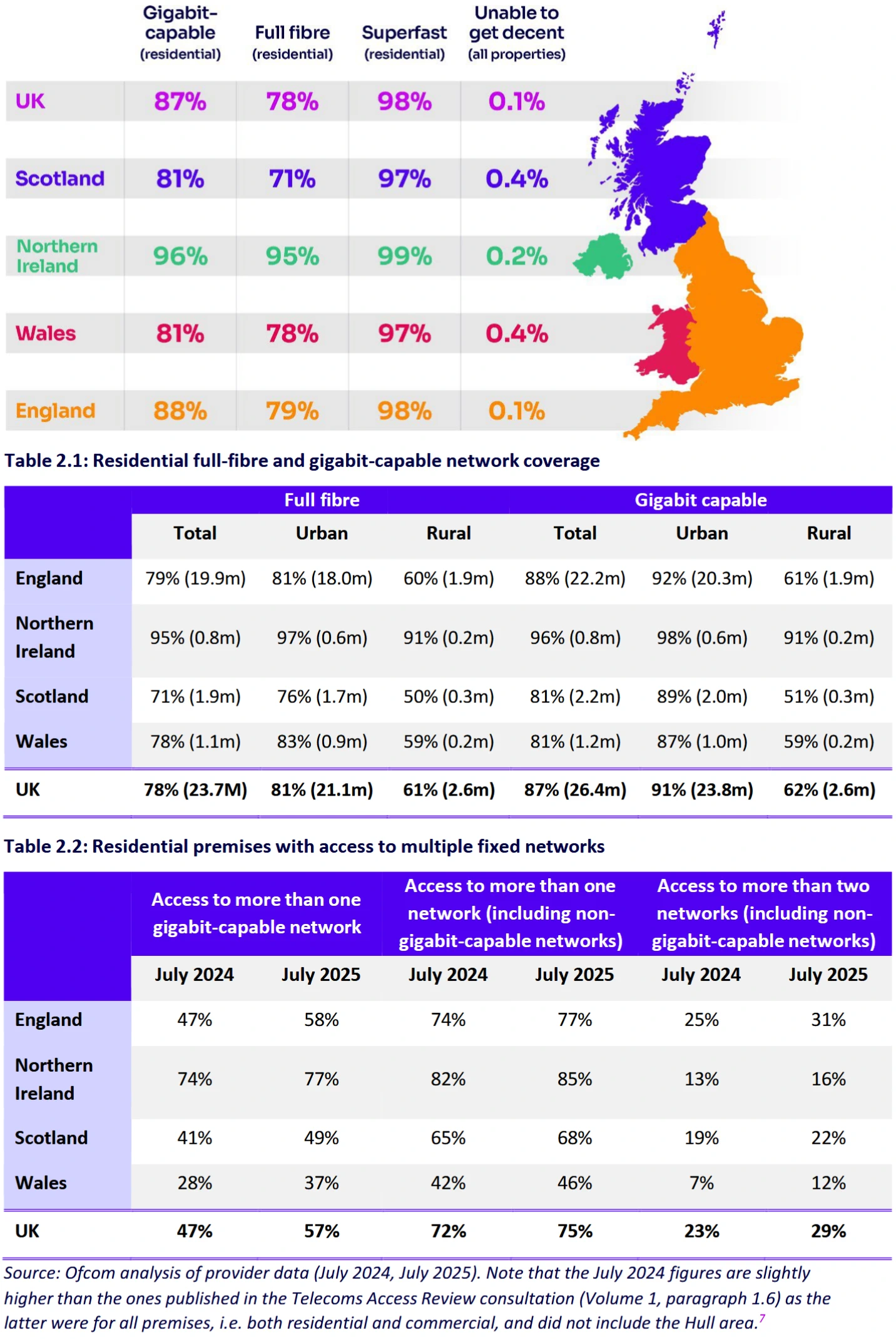
Ofcom has today released their Connection Nations 2025 digital infrastructure report earlier than usual, which reveals that residential gigabit-capable broadband ISP networks now cover 87% of the UK (up from 84% in 2024), while outdoor 5G coverage from at least one mobile operator is available to 97% of premises (up from 95%). But rural cover remains weaker.

The latest CN2025 report typically offers a general overview of fixed line broadband and mobile network availability, as well as related service take-up and data usage from across England, Scotland, Wales and Northern Ireland, which is largely based off data that was gathered during July 2025 (varying between the results).

Before we begin, it’s important to note how Ofcom defines the different broadband performance classes. For example, “Decent Broadband” means a 10Mbps+ download speed with 1Mbps+ uploads (i.e. the Universal Service Obligation), while “Superfast” is 30Mbps+, “Gigabit” equates to 1Gbps+ (1000Mbps+) and “Full Fibre” essentially means a pure Fibre-to-the-Premises (FTTP/B) network (these are also gigabit capable).

As usual, we’ve split our summary of the key results from this report into categories for fixed line broadband and mobile networks.

Fixed Line Broadband Coverage

The rapid deployment of “full fibre” broadband networks by various providers continues to be the main area of growth and change during 2025 (Summary of UK Full Fibre Build Progress), which predominantly reflects the efforts of commercial investment in urban areas. But that is starting to change due to the Government’s £5bn state aid funded Project Gigabit programme.

The project, which aims to make gigabit speeds available “nationwide” (c.99%) by 2032, is starting to convert contract awards into tangible build activity across various rural areas. Admittedly, its impact is still small to modest, but it’s growing and the focus on rural connectivity is helping to lift some of the figures in this report. Upgrades via Project Gigabit can also lead to additional commercial coverage in nearby areas.

Overall, the picture today is that “full fibre” network coverage has risen from 10% of the UK in 2019 (3 million premises), then 18% (5.1m) in 2020, 28% (8.2m) in 2021, 42% (12.4m) in 2022, 57% (17.1m) in 2023, 69% (20.7m) in 2024 and now stands at 78% (23.7m) for 2025. As for “gigabit” coverage, which is driven by both FTTP and Virgin Media’s HFC network (there’s a lot of urban overbuild between these two), that has grown from 84% (25m) last year to 87% now (26.4m).

Elsewhere, “superfast” coverage has risen to 29.7m premises or 98% (up from 29.4m last year), which falls to 91% in rural areas (up from 89%). But the number of premises that cannot get a “decent broadband” service is 44,000 premises (down from 58,000 last year). But this includes 4G and fixed wireless coverage into the figure too, which reaches 1% (340,000 premises) when you only look at fixed lines (down from 385,000 in 2024).

Sadly, many of those that remain in sub-10Mbps areas are often too expensive for even the USO to fix (here and here), but this gap continues to fall. Ofcom predicts that the number of premises unable to get 10Mbps (decent) broadband could fall to around 36,000 by the end of 2026, mostly as a result of upgrades via publicly funded schemes (connection vouchers, project gigabit contracts etc.).

Ofcom also provides some useful data on the rural vs urban coverage split for superfast, decent broadband, full fibre and gigabit lines below – split by region.

Ofcom-Connected-Nations-2025-UK-Fixed-Broadband-Coverage

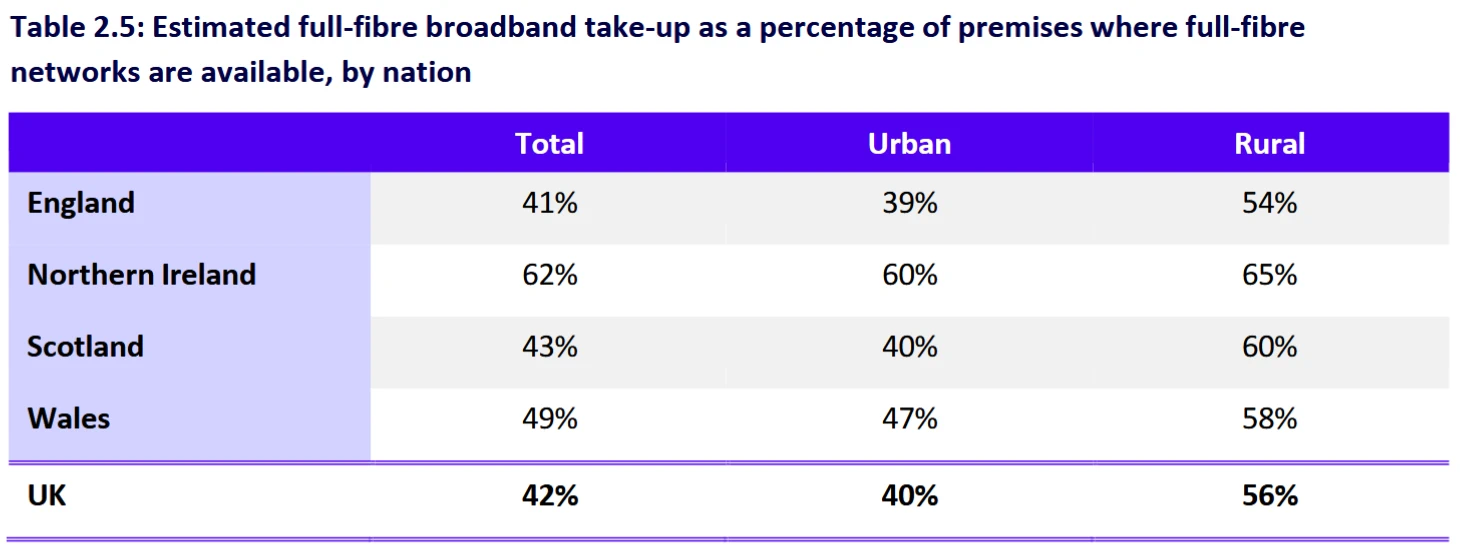
In terms of take-up, some 42% or 10.6 million premises have now taken up a “full fibre” network (up from 35% and 7.5m last year). But it’s also noted that 56% of premises in rural areas have taken full fibre (up from 52%), compared to 40% in urban area (up from 32%). The take-up of services on gigabit-capable networks, where they are available, is now at 56% (up from 49%). Over time, the gigabit and full fibre figures should align, once Virgin Media fully migrates from coax to FTTP.

Ofcom-Connected-Nations-2025-UK-Full-Fibre-Takeup

Breaking news.. more to follow..

Progress as CityFibre Integrates Connexin’s UK FTTP Broadband Network | ISPreview UK

Original article ISPreview UK:Read More

Network operator CityFibre appears to be getting close to completing the integration of Connexin’s 10Gbps capable full fibre (FTTP) broadband infrastructure, which is present across parts of East Yorkshire (Hull etc.), Nottinghamshire and Lincolnshire (England), into their national UK network.

In case anybody has forgotten. CityFibre announced the acquisition of Connexin’s broadband network back in March 2025 (here). The deal included Connexin’s built network assets of more than 80,000 premises passed, as well as work-in-progress to a further 20,000 premises and options to extend further throughout Hull over time. PATRIZIA’s European Infrastructure Fund II also became a minority shareholder in CityFibre.

NOTE: CityFibre is owned by Antin Infrastructure Partners, Goldman Sachs, Mubadala Investment Company, Interogo Holding etc. The network is supported by UK ISPs such as Vodafone, TalkTalk, Zen Internet, Sky Broadband and more (local ISP availability does vary). Some 730,000 customers use the network, which as of Oct 2025 covers 4.6 million UK premises (4.3m RFS).

The acquisition also saw CityFibre take on responsibility for Connexin’s £58.6m (public subsidy) Project Gigabit contract for rural parts of Nottinghamshire and West Lincolnshire (Lot 10), which has been stuck in a state of limbo since the agreement but originally aimed to cover 34,320 hard to reach premises (this will also make it possible to reach over 50,000 non-subsidised premises in the target regions).

Overall, CityFibre expected the deal to eventually enable a total expansion of their existing FTTP footprint by “up to185,000 premises, while the associated retail customer base would remain controlled by Connexin as a now independent retail ISP. At the time CityFibre said they expected to complete the integration of Connexin’s network “later this year“.

The latest development, as spotted by Thinkbroadband, is that Connexin’s main footprint in Hull is now starting to come up via CityFibre’s availability checker, which suggests that the network integration work is starting to make some real progress. But at present Connexin is the only ISP on CityFibre’s wholesale-only network able to serve this; it’s unclear if this is related to a degree of time-limited wholesale exclusivity (they’ve done that before) or just the fact that other ISPs haven’t had a chance to expand into it yet.

However, some testing reveals that not all of Connexin’s network patch has been integrated yet, since we saw positive results for tests with the HU5 2JN postcode area and others, but negative ones when testing a few like HU7 5DF and HU8 9PD (those two do come up as positive via Connexin’s website, but not CityFibre’s checker). Clearly there’s still some work left to do.

Take note that we didn’t check the status of Connexin’s other FTTP builds in Tickton, Leven, Brandesburton, North Frodingham and Beeford. We have asked CityFibre if they could provide a progress update on their network integration work and will hopefully be able to share their response later today.

Many telecoms power full steam ahead with CPQ transformations | Total Telecom

Original article Total Telecom:Read More

News

Leading telecom organisations are on track for digital transformations and, with it, the benefits that the best CPQ software can provide.

By: Brad Randall, Broadband Communities

The wrong configure, price and quote (CPQ) system can send a company off the rails. It’s a fact that VicTrack, an Australian company operating rail assets in Victoria, knew all too well.

Once upon a time, VicTrack (with a portfolio that includes dark fibre and managed telco services) was struggling with pricy manual quoting. Even worse, the organisation found themselves unable to take on multiple projects efficiently or cost effectively.

Said plainly, the company needed a CPQ system that could simplify processes.

VicTrack’s decision to act has yielded results.

Today, the company reports a monumental 30% improvement in design and run time processes and offers over 1,800 miles of network to its public transport servicing partners. It also was able to consolidate its products, from hundreds to dozens, and now conducts 30% of transactions via digital channels. Bruce Moore, the executive GM for telecommunications at VicTrack, said they chose wisely in their journey for the right CPQ system.

“This is more than a transaction, it’s a partnership. CSG has gone above and beyond.” Sean Casey, during a recent appearance on Beyond the Cable, spoke to why CPQ systems prove so crucial in the current climate.

“While (traditional CPQs) can manage those (leads and sales) pipelines well and manage longer term sales engagements, they fall apart in the telecom and cable world,” Casey said.

He also said traditional CPQs not built for the telecom industry can add immense costs to the operations of communications service providers.

Not just a trend

As Casey points out, digital transformations like the one undertaken by VicTrack aren’t just a trend, they’re a necessity.

In July, Orange Business became one of the clearest examples of a large company coming to this realisation. That’s when they announced that they’d be switching to a catalog-driven CPQ solution, aimed at simplifying the quote-to-cash process.

At the time, John Marcus, a senior principal analyst with GlobalData, said Orange Business’ announcement represents “a strategic shift toward a platform-driven, innovative approach that aligns well with enterprise customer expectations.”

“Our transformation is not just about technology: it’s about how we create radically better experiences for our customers,” said Hriday Ravindranath, the chief technology and information officer for Orange Business. “By partnering with industry leaders, we are building a next-generation, fully digital, and AI-native Orange Business.”

The solution Orange Business settled on, CSG Quote & Order, “enables faster, error-free product configuration and order fulfilment,” according to Orange Business.

CSG Quote & Order is tailored to telco-specific complexities, creating faster time to revenue and improved process speeds.

Some main factors to consider

When it comes to choosing the right CPQ, CSG lists several main factors of consideration:

  • Centralised and rules-based cataloging
  • Seamless integration capabilities
  • Dynamic pricing
  • Margin analysis
  • Mobile compatibility

2024 whitepaper from Appledore Research highlights the point. The survey that led to the whitepaper’s findings talked to 50 senior executives across 23 countries about their CPQs, mostly at tier-1 and selected tier-2 CSPs.

According to Appledore, 85% of respondents confirmed that their existing CPQ systems meet fewer than three quarters of their requirements.

The survey also reported that 60% of those questioned said their current CPQ was meeting less than half of their organisation’s requirements.

The CPQ systems falling short, also known as legacy or incumbent systems, as described in the whitepaper, leave CSPs with a lack of automation, delayed response times, and qualification inaccuracies. A lack of clarity on margins in real-time and poor financial capabilities is also symptomatic of legacy CPQ systems, the whitepaper says.

Telecoms face a split in the tracks

The paper also ends with a dilemma, painting a picture of a telecom industry at a critical juncture.

“The enterprise segment represents a crucial growth frontier, with connectivity serving as the foundation for modern business services,” the whitepaper’s author, John Abraham, a principal analyst at Appledore, concludes. “However, capturing this opportunity requires CSPs to overcome significant challenges in offer complexity, competitive differentiation, and time-to-market. Specialised CPQ systems emerge as a vital enabler in this transformation, particularly for enterprise market success.”

Abraham further continues with his findings.

“While CPQ systems alone cannot address all transformation challenges, they provide a critical foundation for modernising sales operations and accelerating go-to-market capabilities,” Abraham writes. “CSPs that invest in these specialised platforms position themselves to capitalise on enterprise opportunities more effectively, with the agility and precision required in today’s competitive landscape.”

Subscribe to the Broadband Communities newsletter!

Competition Tribunal Allows UK Mobile Handset Overcharging Case to Proceed | ISPreview UK

Original article ISPreview UK:Read More

The Competition Appeal Tribunal (CAT) has allowed a class action claim – originally worth “at least” £3.285bn – against EE (BT), Vodafone (Three UK) and O2 (Virgin Media) to move forward, albeit with limitations. The case, brought by Justin Gutmann and law firm Charles Lyndon, accuses the operators of overcharging for mobile handsets beyond the end of their contractual term.

Just to recap. Mobile operators often offer a choice of either SIM Only (airtime) plans or bundles that include those in with a handset (e.g. Smartphone). However, the legal case itself centres around bundles, which tend to cost more because you’re also spreading the cost of the handset across the contract term. But issues often arise when some operators maintain the same monthly charge even after your contract ends (i.e. you effectively keep paying for the handset, which has already been paid off).

NOTE: Ofcom previously estimated (2018) that c.1.4 million UK consumers were out of their contract and still paying instalments towards a handset that had already been paid off (here).

Savvy consumers impacted by this would just switch to a SIM-Only option on a different operator or re-contract to a new plan, but not everybody does that (some people just forget or don’t realise). Ofcom has since put pressure on the mobile operators to mend their ways and in recent years there have been improvements (with mixed success), but the aforementioned class action claim is more concerned with historic “overcharging“.

Back in 2023 Justin Gutmann, the former Head of Research and Insight at Citizens Advice, and law firm Charles Lyndon launched class action proceedings (here) against the major mobile operators (Loyalty Penalty Claim). The case alleged that the operators had been “abusing their dominant positions” by charging a “loyalty penalty,” in which long-standing customers were overcharged for handsets beyond the end of their contract.

The case claims that operators have overcharged on up to 28.2 million contracts and, as a result, would be seeking damages of at least £3.285 billion. If successful, someone who held a contract with just one of the mobile operators could receive as much as £1,823. Many consumers are expected to have claims against more than one mobile operator and so could, hypothetically, receive more than this, if it succeeds.

NOTE: The class actions have been filed in the Competition Appeal Tribunal (CAT) in London. This is an opt-out claim, which means qualifying consumers will be automatically included on the claim at no cost, unless they specifically opt-out.

What’s the latest?

Back in April 2025 we reported that the mobile operators were attempting to get the case dismissed (here). The operators argued that the lawsuit was fundamentally flawed, not least because they say it alleges anti-competitive behaviour “in an industry renowned for its competitiveness” and because large parts of the case (dating back to 2007) were raised too late. They added that it would also be “extraordinarily difficult” for them to identify eligible class members.

The Competition Appeal Tribunal (CAT) has now ruled that claims for damages arising before 1st October 2015 in the Vodafone, EE, Three UK and O2 Proceedings are “struck out“. The operators had also sought to do the same for all claims for losses that arose between 1st October 2015 and 8th March 2017, but the court “refused” that part of the request and allowed it to proceed.

The Tribunal also ruled that they were “satisfied that the Eligibility and Authorisation Conditions were met and granted the CPO Applications in all four proceedings“, which is despite the mobile operators raising questions over Gutmann’s (Proposed Class Representative – PCR) ability to fund future proceedings and to fairly represent claimants. But the tribunal did direct the PCR to inform them “immediately of any material development in respect of his funding arrangements” and to provide them with an update on his current funding position in advance of the next case management conference.

In short, the case can proceed, albeit now with a much more limited scope and doubts remain over its prospects for success. A spokesperson for O2 separately told The Register (credits for spotting this development): “We maintain that there is no merit to Mr Gutmann’s case for the remaining period and will continue to robustly defend our position as it proceeds.”

A spokesperson for EE similarly echoed O2’s remarks and said they “do not accept the substantive allegations of the claim” and that their “priority is, and always will be, to provide a great experience for our customers“.

Big legal cases like these often have to grapple with complex issues, such as with respect to how the law approaches consumer choice, package / brand value and ignorance of contract details. At the same time mobile operators also have the freedom to set retail pricing however they so choose, albeit often restricted by the realities of natural competition (i.e. making your service too expensive can be counter-productive).

Lest we forget that the separate Collective Action on Land Lines (CALL) campaign recently tried and failed to argue a different class action case against BT (here), which related to the alleged overcharging of several million landline-only phone customers. The court ultimately dismissed the case and found that BT’s “prices were not unfair, and therefore there was no abuse of dominant position.”

Outage of Cloudflare Content Delivery Network Disrupts Major Internet Sites UPDATE4 | ISPreview UK

Original article ISPreview UK:Read More

The American content delivery network (CDN) and IT service management company, Cloudflare, appears to be suffering from a major global outage. This is currently disrupting connectivity to some of the internet’s most popular websites (e.g. X, ChatGPT, Digital Scotland, Tinyurl.com’s anti-abuse system etc.) and many smaller online services too.

The situation, which appears to have started at around 11:20am today, has been steadily propagating sporadically across the internet and causing websites that use Cloudflare’s services to spit out Error 500 (Internet Server Errors) messages on a holding page (pictured), albeit not due to the website itself but rather a failure within Cloudflare’s platform.

According to Cloudflare’s service status page: “Cloudflare is experiencing an internal service degradation. Some services may be intermittently impacted. We are focused on restoring service. We will update as we are able to remediate. More updates to follow shortly.” But at 12:21pm, the provider added that they were starting to “see services recover, but customers may continue to observe higher-than-normal error rates as we continue remediation efforts“.

The situation bears some similarities to last month’s major global outage of the Amazon Web Services (AWS) cloud-platform (here), although at first glance the disruption doesn’t appear to have lasted as long or been as disruptive as that. But that may depend upon how things progress over the next few minutes or hours.

UPDATE 1:07pm

A number of websites and services did briefly come back to life for a few minutes, before promptly falling over again just a moment ago. The impacts appear to be quite sporadic and variable.

UPDATE 1:17pm

The latest update from Cloudflare suggests some progress is being made.

Update – Nov 18, 2025 – 13:13 UTC

We have made changes that have allowed Cloudflare Access and WARP to recover. Error levels for Access and WARP users have returned to pre-incident rates.
We have re-enabled WARP access in London.

We are continuing to work towards restoring other services.

UPDATE 2:25pm

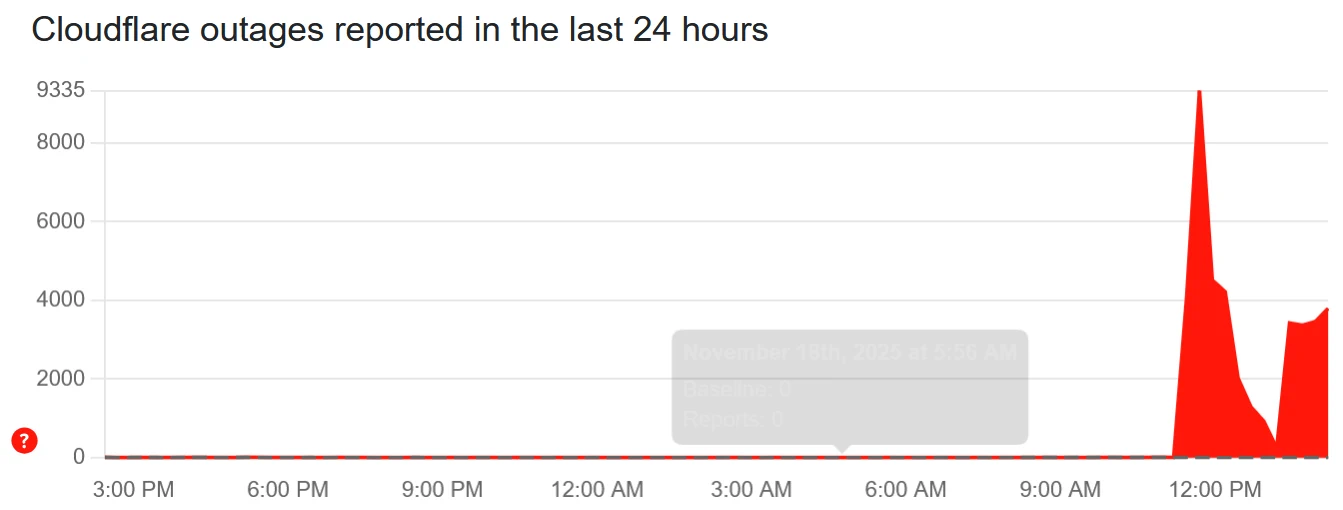
Cloudflare has just said they’re “continuing to work on a fix for this issue“, which over the past hour seems to have returned yet again for many sites and online services. For those who can’t access DownDetector‘s website due to the same problem, here is the current graph of reports:

Cloudflare-outage-downdetector-screenshot

UPDATE 2:42pm

Quite a few websites just returned to life and Cloudflare has posted the following update: “A fix has been implemented and we believe the incident is now resolved. We are continuing to monitor for errors to ensure all services are back to normal.”

The catch is that some customers may be still experiencing issues logging into or using the Cloudflare dashboard.

Openreach Update on Progress of Project Gigabit Builds in Scotland | ISPreview UK

Original article ISPreview UK:Read More

Network access provider Openreach (BT) has issued a progress update on their deployment of a new Fibre-to-the-Premises (FTTP) based broadband ISP network across rural parts of Scotland. This forms part of their £157m (public subsidy) Project Gigabit contract (here) with the UK government to upgrade 65,000 premises (albeit managed by the Scottish Government).

Just to recap. Openreach has previously been chosen to deliver all of Project Gigabit’s Cross-Regional (Type C) procurements (here, here and here) via a Single Supplier Framework agreement (here) – currently reflecting £745m in total public subsidy to help upgrade 297,000 premises to full fibre technology in some of the hardest to reach parts of rural England, Scotland and Wales (i.e. premises with no prior access to gigabit connectivity). The value of this could also be raised up to £1.2bn in the future as more builds are added (here).

NOTE: Project Gigabit aims to help extend gigabit broadband (1000Mbps+) ISP networks to “nationwide” coverage (c.99% of UK premises) by 2032, focusing mostly on the final 10-20% in hard-to-reach areas. Some 88% of premises can already access such a network (here) and Ofcom are forecasting a range of 91-97% (homes) by January 2028 (here).

The areas covered by these Type C contracts typically reflect locations where no or no appropriate market interest had previously been expressed before to the Government’s Building Digital UK (BDUK) agency, or areas that have been de-scoped or terminated from a prior plan. Areas like the ones above are often skipped due to being too expensive (difficult) for smaller suppliers; all the other contracts have gone to smaller alternative networks.

Openreach has today issued a few additional progress updates on their related Project Gigabit contract for Scotland (Call off 6), which reveals that their engineers have now started deploying in Aboyne, Dunure, Fisherton, Aberfoyle, Balfron, Drymen and Killearn. More than 1,600 properties across Aberfoyle, Balfron, Drymen and Killearn already have access to Full Fibre broadband, plus a further 1,400 properties in the Aboyne if we include their separate commercial investment.

Scotland’s Business Minister, Richard Lochhead, said:

“Bringing faster broadband across Scotland is a key priority for the Scottish Government, and it’s encouraging to see Project Gigabit starting to make real progress alongside our £600 million R100 programme.

Fast, reliable internet is essential for modern life – it supports businesses, enables remote working and attracts new opportunities for our rural economy. We will continue to work closely with partners to maximise the impact of public investment and deliver these benefits to every part of Scotland.”

The new service, once live, can be ordered via various ISPs, such as BT, Sky Broadband, TalkTalk, Vodafone and more (Openreach FTTP ISP Choices) – it is not currently an automatic upgrade, although some providers have started to do free automatic upgrades as older copper-based services and lines are slowly withdrawn. But it’s important to reflect that Openreach won’t always reach 100% of premises in every location they target on the first pass.

NOTE: The responsibility for broadband in Scotland is reserved to Westminster, but that doesn’t stop local and devolved authorities from making their own investments, which we’ve previously seen via the R100 programme (Reaching 100% – superfast broadband coverage).

YouGov Survey Claims to Find High Level of Trust in European Routers | ISPreview UK

Original article ISPreview UK:Read More

A new YouGov survey of 5,209 participants from the UK, Austria, Switzerland, the Netherlands, and Italy, which was conducted during August 2025 and commissioned by FRITZ! (somewhat of a vested interest), claims to have found that users regard European brands of broadband router as the “most trustworthy“.

According to the results, only 10% of respondents said they distrust European router manufacturers, which compares well with 48% for Chinese and 55% for Russian brands. Almost all participants also named reliability, speed and security as the most important purchase criteria.

However, this is hardly a surprising outcome and if Chinese respondents were, for example, asked the same question, then they’d probably trust their own brands more. Curiously, there’s no mention in the press release of the USA (Cisco, Netgear, eero etc.) or Taiwan (e.g. ASUS, D-Link etc.), which are home to many key router brands.

In addition to features such as Wi-Fi coverage and speed, consumers in the UK and Europe also placed great importance on aspects like security (e.g. a powerful firewall or encryption), reliability, or price, performance, and service. Over 90% of all participants rated these aspects as important or very important.

The above is relevant as the EU is currently meeting in Berlin to find ways for how Europe can become less reliant on tech giants from the US and China.

Jan Oetjen, CEO of FRITZ!, said:

The security of routers is directly linked to digital sovereignty in Europe. An increasing amount of sensitive data – from online banking to tax returns – is transmitted via our home network. Compromised routers therefore pose an immense threat, as they can be misused as weapons for cyberattacks and malicious traffic is hardly distinguishable from legitimate traffic. Similar to the decisions made in the 5G sector, we must ensure that our routers are secure and remain in European hands to protect our digital freedom.”

Naturally, no survey commissioned by a party with a vested interest in the outcome would be complete without a bit of self-promotion. Across all countries surveyed, FRITZ!Box routers are separately claimed to have achieved the highest Net Promoter Score (i.e. a gauge of how likely participants are to recommend their router). But no comparative details were provided for rival brands.