STC, Mobily, and OneWeb NEOM among winners at inaugural Connected World KSA Awards | Total Telecom

Original article Total Telecom:Read More

Press Release

Riyadh, Saudi Arabia – 18 November 2025 – Connected World KSA is proud to reveal the winners of its first-ever Connected World KSA Awards, presented today during the event at Riyadh Front Exhibition & Conference Center. The awards recognise organisations and initiatives driving innovation, connectivity, and digital transformation across the Kingdom.

The 2025 winners are:

  • Digital Infrastructure Innovation: OneWeb NEOM
  • Borderless Connectivity: STC & Ciena
  • Smart Society: Mobily
  • Next-Gen Talent & Inclusion: Zain KSA
  • AI for Operations: Nokia

“These awards highlight the organisations and projects shaping the future of connectivity and digital innovation in Saudi Arabia,” said Edwards Haines, Project Director of Connected World KSA. “We are proud to recognise the achievements of this year’s winners, who exemplify the vision, ingenuity, and commitment required to drive digital transformation in the region.”

The inaugural Connected World KSA Awards reflect the Kingdom’s growing role as a hub for technology innovation and its commitment to building a smarter, more connected society. Winners were selected by a panel of industry experts and leaders, acknowledging outstanding contributions to infrastructure, connectivity, AI, and talent development.


For media enquiries, interviews, or additional information, please contact:

Teresa Leese, Senior Marketing Manager Teresa.leese@terrapinn.com

About Connected World KSA

Connected World KSA is Saudi Arabia’s premier conference and exhibition dedicated to digital transformation, connectivity, AI, and next-generation infrastructure. The event brings together global technology leaders, innovators, and decision-makers to explore the future of a connected world.

Germany to lose 700 jobs as Nokia preps to close Munich site | Total Telecom

Original article Total Telecom:Read More

aerial photo of cityscape during nighttime

News

The move comes as part of long-term restructuring underway since 2023

According to reports, Nokia is set to close its site in Munich by 2030, a move that will see 700 jobs cut or relocated.

Around 300 of these jobs are to be cut in 2026, with the remainder taking place by the end of 2030.

The closure is part of Nokia’s major restructuring announced back in 2023, aimed at streamlining the company and reducing costs. Part of this plan is a reduction of the company’s workforce by between 9,000 and 14,000 jobs cut by the end of 2026. This, the company said, will help it cut costs by between €800 million and €1.2 billion. Around €400 million of these savings were planned to be reached in 2024, and a further €300 million in 2025.

Nokia currently employs 2,500 people across Germany, including its additional sites in Düsseldorf, Stuttgart, Ulm, and Nuremberg. All these sites, Nokia says, will be affected by the nationwide headcount reduction in 2026, but will not be closed.

“This will strengthen our capacity for long-term growth and customer loyalty, while ensuring that our teams have the framework conditions necessary for their success,” said the company in a statement.

The trade union IG Metall, however, has described the decision to close the Munich site as ‘disastrous’.

“Especially in times of geopolitical challenges, it is a fatal signal when a key company scales back its presence in Germany,” said Daniele Frijia, managing director of IG Metall Munich and member of Nokia’s German supervisory board, speaking to heise online.

“Instead of cutting jobs, Nokia should invest in the future,” she added.

But it is not all doom and gloom for Munich’s relationship with tech giants.

Earlier this month, Deutsche Telekom announced a deal with Nvidia to build a new ‘AI factory’ in Munich, seeking to meet not only Europe’s demand for AI computing but also its desire for data sovereignty. Similarly, AI company Anthropic has shown interest in the city, announcing plans to open a new office in Munich, alongside another in Paris.

It would appear that Munich’s position as a European tech hub is not at risk just yet.

Connected Germany 2025 is taking place right now! Get your ticket here

Also in the news
Connected Britain Award winners 2025 announced!
Netomnia announces ‘powerful and ambitious’ rebrand ahead of Connected Britain
VodafoneThree drops Samsung, relies on Nokia and Ericsson for £2bn network upgrade

Virgin Media UK and Nexfibre Build Full Fibre to 6,000 Homes in Ripon | ISPreview UK

Original article ISPreview UK:Read More

UK ISP Virgin Media (O2) and network partner nexfibre, which enjoy some of the same parentage, have today announced that they’ve expanded the reach of their 2Gbps (symmetric) speed Fibre-to-the-Premises (FTTP) broadband network to reach more than 6,000 homes in the North Yorkshire (England) based Cathedral City of Ripon.

The city, which is home to a population of around 17,000, currently only has some very limited gigabit speed full fibre coverage from Openreach and other alternative networks (CityFibre, Quickline etc.). Suffice to say that nexfibre’s new deployment covers most of the urban area and should thus come as a welcome development for local homes and businesses.

NOTE: Virgin Media and giffgaff are currently the only major retail players on nexfibre’s open access XGS-PON FTTP network, but all share some of the same parentage.

Nexfibre reflects a £4.5bn joint venture between Telefónica, Liberty Global and InfraVia Capital Partners (here). This has so far already covered around 2.4 million premises across the UK with their new full fibre network, which is being built by Virgin Media’s engineers. But the operator’s original plan to cover “up to” 7 million UK homes (starting with 5m by 2026) in areas NOT currently served by Virgin Media’s network of 16m+ premises was recently dealt a blow by Telefonica’s strategic review (here).

The network operator currently only expects to reach 2.5 million UK premises by the end of 2025 and uncertainty remains over what comes next. But Virgin Media has recently announced the creation of a new fixed wholesale unit, which will enable retail ISPs to harness both of their FTTP networks (here) – currently available to a combined 7 million UK premises.

Study Examines Impact of Solar Storms on Starlink Broadband Performance | ISPreview UK

Original article ISPreview UK:Read More

A new study from a team of three researchers working out of the University of California (USA) has taken a “deep dive” into the impact of solar storms on Starlink’s global network of ultrafast broadband satellites in Low Earth Orbit (LEO). The results uncovered some “previously overlooked patterns” of vulnerability and suggest that “more adaptive, region-aware mitigation strategies” may be needed.

The Starlink constellation currently has around 8,990 satellites in orbit (c.5,470 are v2 / V2 Mini) – mostly at altitudes of c.500-600km. Residential customers in the UK usually pay from £75 a month, plus £299 for hardware (currently free for many areas) on the ‘Standard’ unlimited data plan (kit price may vary due to different offers) directly from Starlink, which promises UK latency times of 26-33ms, downloads of 116-277Mbps and uploads of 17-32Mbps. Cheaper, albeit more restrictive (data capped), options also exist for roaming users (e.g. £50 per month for 50 GigaBytes of data).

NOTE: By the end of 2024 Starlink’s global network had 4.6 million customers (up from 2.3m in 2023) and 87,000 of those were in the UK (up from 42,000 in 2023) – mostly in rural areas. As of July 2025 Starlink has grown to a total of more than 6 million customers.

Prior studies have confirmed that such networks do suffer a “modest but noticeable impact” on their performance during solar storms (when intense solar wind interacts with Earth’s magnetosphere). This typically manifests as an immediate rise in packet loss and a sustained increase in round-trip time (RTT / latency).

Such radiation can sometimes damage satellites, not only directly but also by spawning shifting currents and plasmas, which may cause the atmosphere to warm a little and atmospheric density to increase. In order to mitigate against the risk that this may stress related hardware systems and affect satellite trajectories (in extreme cases it may even result in satellite loss), SpaceX will often raise the altitude of their satellites a bit to avoid the extra drag. But these satellites will usually return to their original altitude within 1–2 days.

The new study (credits The Register) investigates how atmospheric drag from geomagnetic disturbances affects different parts of the LEO constellation during such events, and in turn, network performance. The study notes that the corrective action SpaceX takes triggers a “cascading effect“, with orbital adjustments propagating across neighbouring satellites in both spatial and temporal dimensions.

Full stabilization of the orbit often takes 3–4 days. These dynamic adjustments can disrupt satellite links and routing paths, contributing to performance issues such as a sustained increase in round-trip time (RTT),” said the report.

Study Findings

By localizing the impact of increased atmospheric drag at the level of individual satellites and orbits, we reveal significant heterogeneity in how different parts of the network are affected. We find that the degree of performance degradation varies significantly across geographic regions, depending on satellite positioning during the storm.

Specifically, we find that (i) not all satellite orbits are equally vulnerable, (ii) within a given orbit, certain satellites experience disproportionate impact depending on their position relative to geomagnetic conditions, and (iii) autonomous maneuvering of satellites might be a cause of the sustained increase in RTT.

Our findings uncover previously overlooked patterns of vulnerability in LEO satellite constellations and highlight the need for more adaptive, region-aware mitigation strategies to address space weather-induced network disruptions.

However, while the study doesn’t really provide much data in terms of the performance impact, it does look as if the negative impacts are fairly small in the sense of their impact upon real-world usability (i.e. you might not even notice it). Crucially, Starlink also kept operating during several of the examined solar storm events, although we would have liked to know if there was any impact on data speeds too etc.

While this study focuses on Starlink, which has the largest LEO constellation currently in operation, the methodology can also be extended to analyse other similar networks, such as OneWeb (Eutelsat) and Amazon Leo (formerly Kuiper).

House of Lords Report Calls for UK Broadband Investment to Boost Home Working | ISPreview UK

Original article ISPreview UK:Read More

The cross-party Home-based Working Committee (Lords Select Committee) has published its report on remote and hybrid working in the UK, which among other things finds that the government should “increase long-term investment in digital infrastructure, particularly broadband” in order to properly support such working.

Currently, over 88% of UK premises can already access a 1000Mbps+ (gigabit) capable broadband network (here), while Ofcom separately forecasts that this may reach between 91% to 97% of homes by January 2028 (here). Most of this has been delivered by commercial builds (predominantly focused on urban and semi-urban areas), but there are some areas in the final 10-20% of premises that are simply too expensive for commercial providers.

NOTE: The project is technology neutral, although Fibre-to-the-Premises (FTTP) is preferred.

The government’s £5bn Project Gigabit scheme was thus established in 2021 to help extend gigabit broadband ISP networks to achieve “nationwide” coverage (c.99%) by 2030 2032 (here) – focusing on the commercially unviable areas (usually rural and semi-rural locations).

However, while the new report does recognise the aforementioned project (‘Is working from home working?‘), it also calls on the government to “increase long-term investment in digital infrastructure” and to “clearly articulate how it will deliver its targets and commit to funding it further into the future“.

The report goes on to recommend that the government should develop a long-term plan for improvements to business connectivity, including in rural areas with limited access to digital infrastructure.

Baroness Scott of Needham Market, Chair of the Committee, said:

“The extraordinary circumstances of the pandemic transformed working from home into a ‘new normal’ for many workers. Our report represents a comprehensive examination of all aspects of home working based on a thorough consideration of the available evidence.

The increased flexibility of remote and hybrid working can be especially beneficial to people with disabilities and to parents or carers, and may help them to work where they couldn’t previously. If the Government wants to encourage more people back into work, then it should look into the potential of remote and hybrid working alongside existing back to work initiatives.

While we don’t expect the Government to legislate further on a subject that is best handled by employers and workers, it should provide relevant guidance and promote already existing guidance more widely. As it implements the Employment Rights Bill, it should ensure its changes to flexible working requests do not put undue pressure on the employment tribunal system.

The recommendations in our report are practicable and deliverable and we look forward to receiving the Government’s response in due course. We urge the Government to work towards implementation, including cross departmental data gathering so that current trends can be tracked, analysed and put to good use when developing policy in the future.”

Paddy Paddison, Chief Executive of INCA, said:

“This report recognises that access to fast, reliable broadband is fundamental to people’s ability to work, learn and participate in society. The ability to work from home depends entirely on the strength of the UK’s digital infrastructure, and we welcome the Lords Committee’s call for greater long-term investment and a clear plan to deliver on Project Gigabit’s 99% coverage target.

Across the country, over 100 Altnets now serve more than 16.4 million homes and have attracted more than £17 billion in private investment since 2020 – averaging over £1,000 invested per premises passed. This level of commitment has transformed connectivity in towns, cities and rural areas alike.

That progress is not guaranteed. It relies on fair competition and a regulatory environment that allows independent networks to continue investing. The digital divide affects opportunity as much as connectivity, and the UK’s ambition for a modern, flexible workforce depends on getting this right.”

The full summary of what the report says on technology and digital infrastructure can be found below (it also coves many other areas). But we note that their recommendations for broadband somewhat fail to spell out much in the way of any specifics for how the proposed additional investment should be used, or even how much extra funding may be required.

At present, the public subsidy available under Project Gigabit should be enough to help do most of the job in terms of network coverage, although a question mark does exist over the final c.1% of very hard to reach premises (i.e. the bits that are too expensive for even Project Gigabit). Satellite and fixed wireless (FWA) solutions may be able to plug some of this gap, but these are not always perfect solutions and won’t work for every single location or building. Ofcom’s related Universal Service Obligation (USO) for broadband is also overdue for a review.

Chapter 8: Technology

75. The Government should increase long-term investment in digital infrastructure. While we welcome Project Gigabit, the Government should clearly articulate how it will deliver its targets and commit to funding it further into the future. It should develop a long-term plan for improvements to business connectivity, including in rural areas with limited access to digital infrastructure. In doing so, it should draw on international best practice such as from Sweden, Spain, and Norway.

IS WORKING FROM HOME WORKING?

76. The Government should improve digital access and the development of digital skills. It should communicate the benefits which improved connectivity can confer to businesses and communities through the Digital Inclusion Action Plan. It should promote the development of employment skills for young people, such as using computers to perform tasks which may be challenging with smartphones. This includes assisting employers with providing digital training for their staff, while communicating that employers should take responsibility for developing workers’ skills and adapt to a generation which prefers to use smartphones.

77. Digital technology and software are critical for facilitating remote and hybrid working. Having a broadband connection in offices and homes is an essential requirement. There is a range of software available to enable better project management and collaboration, but some of this may be under-utilised, particularly when it operates on a relatively small scale.

78. Some technology, such as surveillance software, may not achieve meaningful benefits, since it does not necessarily track useful outcomes. It may even be harmful due to the demands it can place on workload and availability.

79. Remote and hybrid working do not necessarily pose widespread additional cybersecurity risks, provided proper procedures are understood and followed. The cybersecurity training and systems required are widely available. We welcome the guidance provided by the National Cyber Security Centre, including the advice tailored for SMEs. The National Cyber Security Centre should continue to treat remote and hybrid working as a priority as it develops and communicates this guidance.

The Government should further promote the guidance of the National Cyber Security Centre on cybersecurity, particularly as it relates to remote and hybrid working. It should consider how this can be incorporated into its existing activity in the area, including engagement with industry and the forthcoming national cyber strategy.

Broadband ISP TalkTalk Increases UK Mid-Contract Price Hikes to £4 | ISPreview UK

Original article ISPreview UK:Read More

Perhaps inevitably, TalkTalk has today become the latest internet and phone provider to increase the customer cost impact of their existing mid-contract pricing policy, which will be introduced from 16th November 2025. But the price increase itself won’t hit until April 2026.

Just to recap. At the start of 2025 Ofcom began requiring telecoms providers to adopt a new approach to mid-contract price hikes, which did away with the old percentage and inflation-based model – replacing it with one that sets out such price hikes “clearly and up-front, in pounds and pence, when a customer signs up” (here). This made annual price hikes clearer and more transparent, but not necessarily cheaper.

NOTE: The Consumer Price Index (CPI) level of inflation started the year at 3% (Jan 2025) and has since crept up to 3.8%. But last year it was originally forecast to be closer to 2% by now and many telecoms providers will have initially set their policies based, in part, on that expectation.

In response, many providers later followed BT’s lead by setting out a new pricing policy that would increase the monthly price that broadband customers pay by a flat £3 extra from March or April each year (this can vary a bit between providers). However, inflation has remained higher than originally anticipated and, partly as a result of that, BT (inc. EE and Plusnet), Virgin Media, Vodafone and O2 have since announced that they will increase their annual hikes (e.g. both BT and Virgin increased it from £3 to £4 on their broadband plans).

Suffice to say it was only a matter of time until TalkTalk, which had previously adopted a £3 increase like some of the other providers, followed and introduced a similar change. The bad news is that they’ve now done this and decided to adopt the same £4 increase as BT and Virgin Media etc.

TalkTalk Price Increase Statement

From 16 November 2025 we’re changing our annual price increases on broadband plans to a flat rate of £4.

Any planned increases will be applied each April, starting in 2026. The £4 price increase applies to new customers and existing customers who take out a new contract after 16 November 2025 and will be clearly shown when customers sign up or renew their contract.

So, if you sign up to a 24-month price of £28 on or after 16 November 2025, it will increase to £32 from April 2026 and then increase to £36 from April 2027, continuing until you end that contract.

For those customers who joined us between 12 August 2024 and 15 November 2025, your broadband plan will continue to be subject to the annual price increase of £3.

For those customers who joined us before 12 August 2024, your broadband plan will continue to be subject to the old system of price increases based on the variable Consumer Price Index (CPI), plus 3.7%. For example, in 2024, the CPI rate that we used to calculate our price change was 4%, so the total increase was 7.7% of the contract price. So, each year we adjust the monthly amount you pay for your broadband and increase your price by the Consumer Price Index (CPI) rate of inflation plus 3.7%.

The CPI rate that we use is announced in January each year and we will adjust your bill by this amount, plus an additional 3.7%. This change will only apply to our broadband packages purchased before 12 August 2024. (some exemptions apply).

We adjust the amount our customers pay each year, alongside the rest of the sector – including network builders and broadband providers, to manage increased wholesale and running costs. This also enables us to continue investing in our services to manage the growing demand for faster speeds and enhanced reliability, so we can offer resilient, totally unlimited usage as standard.

Price hikes like this are sadly nothing new in this market. Often there are legitimate reasons for prices to go up, not least because providers are frequently adding all sorts of new services (e.g. 5G SA, FTTP), developing new systems, facing higher charges from suppliers or energy, implementing costly new Ofcom rules or other legislation and dealing with tax hikes from the government etc.

Nevertheless, there is a growing feeling that telecoms providers are becoming increasingly unfair in their pricing practices, and often hitting those who can least afford it the hardest (e.g. somebody on the cheapest package gets hit with the same £4 rise as those on the most expensive plans).

So far, Ofcom’s policy has thus succeeded in making mid-contract price hikes more transparent for consumers, albeit seemingly at the same time forcing them to pay more – often well above the current and forecast levels of CPI inflation. But the government do now seem to be pushing for a change (here).

Full Fibre’s Impact – Fibrus Report Makes Three Predictions for UK Rural Areas in 2025 | ISPreview UK

Original article ISPreview UK:Read More

Infracapital-backed alternative broadband ISP Fibrus, which is building a full fibre network across parts of Cumbria (England) and Northern Ireland, has published a new report that outlines three predictions for how the UK’s rural areas might look in 2050 and highlights the “extraordinary potential” of such communities as engines of growth.

The new ‘Future of Rural‘ report, which was commissioned by Fibrus and authored by “leading Applied Futurist“, Tom Cheesewright, looks ahead to 2050 and uses scenario planning and the latest data projections to explore how rural areas could “lead the way in economic, environmental, and social transformation“.

NOTE: Fibrus is backed by a total investment of around £893m, including £320m of committed debt, £200m in current and committed equity funding and £373m of government funding (e.g. £23m FFNI, £200m Project Stratum – 81,000+ premises in N.Ireland – and the c.£150m Project Gigabit contract for 53,500 premises in Cumbria – Hyperfast GB).

The report, which offers a fairly high-level view of the subject (i.e. limited details and statistics), indicates that with targeted investment, “particularly in connectivity and infrastructure“, the UK’s rural communities could help address some of the nation’s biggest challenges, from demographic change to climate resilience. It also outlines three predictions for how the UK’s rural areas might look in 2050:

Three Predictions for UK Rural Areas in 2025

The Remote Revolution:

While 2025 has seen reports of bosses demanding workers back to the office, the Future of Rural report has this as a temporary blip. By 2050, workers will have pushed for much greater flexibility to WFH. Advances in the metaverse digital infrastructure, AI and modern management techniques coupled with ubiquitous full fibre broadband will enable the shift back to remote working and a resurgence of rural lifestyles as the disadvantages of distance continue to diminish.

High Tech Harvest:

By 2050, the UK countryside could become ‘Silicon Valleys’, driven by a wave of new start-ups and clusters, spinning out of technology-focused agricultural educational institutions at the intersection of bio-science, robotics, energy and agriculture. Farming will become increasingly high-tech, with the use of human-scale androids, laser weeders and robot farm assistants piloted by smart glasses.

Destination UK:

As climate change alters global tourism patterns, the UK’s rural and coastal communities become sought-after destinations for visitors across Europe and America. AI powered translators and 3D avatar tour guides reshape tourist experiences, and artificial lakes and inland beaches give holidaymakers the quintessential beach holiday.

Naturally, all of this somewhat feeds into the vested interests of those deploying full fibre broadband and faster mobile technologies, such as Fibrus. So, take with the usual pinch of salt, as accurately predicting the future of such a long span of time is one of the hardest things to get right.

On the other hand, there’s little doubt that improving digital infrastructure in such areas does tend to deliver various economic and social benefits (here, here, here and here), while at the same time opening up lots of new opportunities for residents and businesses. But figuring out the reality of quite how much things will change is much harder.

Dominic Kearns, CEO and Co-Founder of Fibrus, said:

“At Fibrus, we set out to transform connectivity in rural areas, bringing them out of the digital dark ages and into a future of high-speed, reliable broadband. This report reinforces our commitment to those communities, highlighting their immense potential and the vital role they play in the UK’s growth.”

Too often, the UK’s urban areas and capital cities dominate when it comes to policy, pounds and progress, yet we have seen first-hand the level of entrepreneurship and agricultural best practice that is powering the nation from a grassroots level through improved digital access. We will not stop championing rural communities and driving progress until every home and business is truly connected”

Tom Cheesewright said:

“Many would be surprised at the extent to which the UK’s rural communities are already engines of growth. Even more would be surprised at their potential by 2050. With this report, we hope to inform and inspire, increasing the chance of these positive futures becoming reality.”

The provider’s Fibre-to-the-Premises (FTTP) broadband network has so far covered 440,000 UK premises and is home to 130,000 customers.

Nokia Interview – 6G to Focus on Efficiency More than Mobile Broadband Speed | ISPreview UK

Original article ISPreview UK:Read More

The Head of Standards at Nokia Technologies, Peter Merz, has today told ISPreview – as part of our latest interview – that they’re conscious of wanting to avoid what mobile operators call “G-fatigue” (over-hyping) with their development of future 6G mobile (broadband) technology, which he says will be more about “intelligence and efficiency” than raw data throughput.

The future 6G standard is currently still in the early Research and Development (R&D) phase, and most observers don’t expect to see the first commercial network builds surfacing until around 2030 (note: some countries do expect early field trials around 2028). Suffice to say that a lot of work is currently ongoing to help produce the final standard and develop prototype solutions, which is where Nokia Technologies plays a big role.

NOTE: 3GPP currently aim to complete the specs for 6G networks and terminals by 2029.

The next gen mobile technology is currently thought to be aiming for theoretical peak data rates of up to 1Tbps (Terabits per second) and may be able to harness radio spectrum up to the TeraHertz (THz) bands, while also using AI optimisations, new antenna designs and other changes to improve network efficiency. By comparison, 5G was designed to work between 450MHz and 52GHz, with top theoretical speeds of up to 20Gbps (Gigabits per second).

However, in practical terms, it’s worth noting that the final 6G technology will almost certainly end up being constrained by the real-world restrictions of existing data capacity and spectrum availability, with most UK mobile operators preferring to harness more economically viable lower and mid-band spectrum between 700MHz and 4GHz.

Naturally, you can get faster data speeds from using even higher frequencies, but this tends to make the signals very weak and offers poor coverage. However, there remain various unknowns about what the final 6G standard will actually deliver.

Nokia, alongside Ericsson, is currently one of the European market’s largest suppliers of mobile network technologies and related services. Suffice to say that they, via Nokia Technologies, have a lot of input into how the new standard is developing and naturally ISPreview wanted to understand more about what it might actually mean for consumers.

The good news, as Peter Merz says, is that 6G’s “defining feature isn’t raw throughput – it’s intelligence and efficiency“. Peter has been at Nokia for nearly 19 years and is responsible for shaping the evolution of access and core network technologies, as well as spearheading innovations across the automation and service delivery layers. So who better to answer some of our questions about the future mobile technology.

The Peter Merz (Nokia Technologies) Interview

1. Over the past few years we’ve heard about a number of technological enhancements being associated with 6G, such as the ability to harness Terahertz (THz) spectrum bands (i.e. 100GHz to 10THz) – potentially pushing data speeds of up to 100Gbps as a theoretical peak, as well as new antenna designs and so forth.

Now we’re also getting closer to the development of an early draft technical standard for 6G. Can Nokia provide a simple summary of the five main technological enhancements that you expect 6G to include and explain why they’re beneficial, as well as how fast the theoretical speeds might become for different environments?

Peter Merz said:

At Nokia we define 6G as the next-generation system that fuses the physical, digital and human worlds, moving networks beyond connectivity into platforms enabling sensing, intelligence, and immersive interaction.

In our work architecting 6G, we’re ensuring 6G standardization includes the following major technological enhancements:
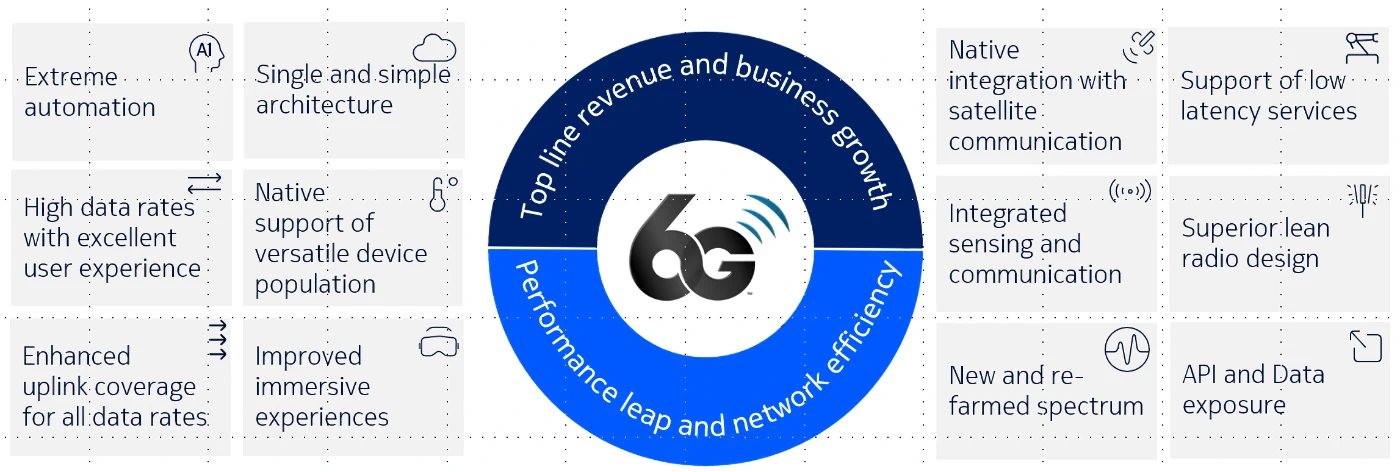
Nokia 6G Enhancements

1. AI-native by design: Unlike previous generations, we’re designing 6G with intelligence built in from day one – you can’t bolt intelligence on, it has to be included from the start. This will enable radios, protocols, and network functions to adapt in real-time, ensuring predictable performance, lower energy consumption, and autonomous operations. This reduces complexity for operators and enables networks to essentially manage themselves.

2. Modular, future-proof standalone architecture: We are advocating for a single, modular, and future-proof 6G architecture specifically to avoid unnecessary complexity, support modular deployment, and enable long-term sustainability and ROI for operators. We see this as ensuring 6G can co-exist with existing 5G assets and allow for smoother migration paths with the ability to scale networks as needed. This sustainable approach also maximizes the lifecycle of the existing infrastructure. In terms of speeds, modular architectures will be capable of supporting tailored deployments, with speeds optimized for specific environments—ranging from multi-gigabit connections in urban areas to hundreds of Mbps in remote regions.

3. Lean, scalable, and implementation-friendly system design: It’s important the 6G radio interface avoids the fragmentation challenges we have seen in 5G. A single, scalable technology stack for devices, RAN, and core networks will ensure faster adoption, and cost-efficient development and deployment across the ecosystem. Not only does this simplify integration for device manufacturers and operators, but it will also reduce time-to-market and lower operational costs.

4. Continuous learning and optimization: AI-native 6G networks are being designed for continuous learning and dynamic adaptation. This means that both user equipment (UE) and network-side machine learning (ML) models can evolve autonomously, utilizing real-time data to optimize performance. The benefit comes from eliminating the need for frequent specification updates, making the network more agile and future-proof.

By learning from data and adapting, 6G networks can self-optimize, which reduces the operational complexity for operators while delivering superior performance for users. This means that networks can adapt to changing demands, including varying traffic patterns or use cases.

This continuous optimization could enable peak speeds in localized hotspots, such as stadiums or event venues, while stable and reliable performance is maintained in suburban and rural areas delivering consistent connectivity across diverse environments.

5. Predictability, explainability, trust, and fit for the future: Our work is leading the development of frameworks to validate AI/ML behavior post-deployment to ensure predictability, explainability, and trust in 6G networks. This includes aligning AI cycles with Telco cycles to maximize technology developments.

By ensuring AI systems are transparent and explainable, we aim to build trust among operators, users, and regulators. This is critical for enabling the widespread adoption of future AI-driven networks while also ensuring compliance with emerging global standards.

2. In the past, the development and introduction of a new Generation (G) of mobile technology has often been accompanied by a ridiculous amount of hype, which seems to get worse with every new generational update, and yet the real-world experiences don’t always live up to that. In fairness, this often just as much of an issue for local market regulation, network capacity and spectrum management as it is one of technology.

Regardless, we’re expecting the same hype train again for 6G, which is likely to boast some wild capabilities that perhaps won’t always end up being widely adopted or which could have been done similarly well by the previous generation (5G SA, 5G or even 4G etc.), without the need for 6G. Are you expecting something like this for 6G too, or is it likely to be more of an evolution than a revolution this time around?

Peter Merz said:

It’s true that every new “G” has been accompanied by a wave of expectations, and sometimes the reality takes longer to catch up. We’re very conscious of avoiding what operators call “G-fatigue.” That’s why we’re shaping 6G as a smooth evolution of 5G.

The 6G radio interface is being designed to be lean, implementation-friendly and scalable. This avoids the fragmentation seen in 5G and supports high performance with minimal complexity, enabling faster deployment and broader adoption.

Nokia is advocating for a single, scalable architecture that avoids unnecessary complexity. This supports modular deployment, reuse, and coexistence—critical for long-term sustainability and operator benefits (ROI).

Nokia’s 6G architecture embeds AI/ML natively from day one across radio, core, and edge. This enables real-time adaptation, predictive performance, and autonomous operation, rather than bolting AI on top of legacy systems.

This modular by design, future-proof by nature approach means operators can protect investments while steadily upgrading.

The step-change isn’t just about higher peak speeds – it’s about AI-native design, automation, and sensing that will make networks smarter, greener, and more adaptable from day one. – AI-Native by Design, Not Retrofit

While some futuristic capabilities will be showcased, we expect 6G’s true impact to come from practical improvements (see chart)- lower energy per bit, more predictable performance, and new applications in healthcare, transport, and immersive collaboration.

There will always be bold claims. The difference this time is that 6G is being designed with today’s and future operator realities in mind. We’re delivering a smoother, more cost-efficient migration path rather than a hype-fuelled revolution that risks overpromising.

3. Speaking of which, we note how the next generation of wireless Wi-Fi 8 (802.11bn – Ultra High Reliability) networking technology is going in a bit of a different direction. Put another way, if Wi-Fi 7 was – and I’m over simplifying here – more about pushing ever faster peak speeds, then Wi-Fi 8 seems to be aiming to focus more on pulling greater network reliability, efficiency and congestion management from a finite amount of spare radio spectrum. More than a few people have suggested that this should be the focus for 6G development too, would you agree?

Peter Merz said:

While new spectrum and higher peak speeds will always be part of the story, 6G’s defining feature isn’t raw throughput – it’s intelligence and efficiency.

Operators tell us they need networks that behave more like utility/critical infrastructure – consistent, predictable, secure and resilient. That’s why 6G networks won’t just run, they’ll learn, continuously optimising performance in real time.

Like Wi-Fi 8, 6G will squeeze more value out of finite spectrum through sharing, aggregation, and adaptive radios, ensuring operators can deliver more without exponential new deployments. Where Wi-Fi 8 focuses on reliability in the local domain, 6G extends that principle globally – integrating terrestrial, satellite, and sensing capabilities so performance is consistent at scale, not just in hotspots.

So yes, we agree, 6G is about smarter, greener, and more reliable networks, not just faster ones. Peak speeds matter, but the real breakthrough will networks that adapt intelligently to whatever the world throws at them.

Please flick over to Page 2 in order to finish reading the interview.

Ofcom Consult on Impact of Openreach PIA on the UK Leased Line Market | ISPreview UK

Original article ISPreview UK:Read More

The UK telecoms regulator, Ofcom, has today opened a “narrow consultation” that proposes to amend their leased line access (LLA) market analysis for the ongoing Telecoms Access Review 2026 (TAR) to reflect a “greater potential impact” from Openreach’s Physical Infrastructure Access (PIA) product (this allows rivals to run new fibre via existing cable ducts and poles).

The regulator has already recognised that competitive conditions are different across the UK for the supply of high-capacity leased line (Ethernet) services to businesses and network operators. Ofcom has thus already proposed different market boundaries compared to wholesale broadband services, reflecting differences in how the markets has developed since 2021 (i.e. this approach sorts postcodes into ‘Areas’ based on the presence of competing networks). The existing TAR proposals already split this as follows:

NOTE: This new consultation also includes some “technical adjustments” to Ofcom’s cost modelling and proposed charge controls for PIA, LLA and Inter-exchange Connectivity (IEC) services.

Different Regulation in Different Areas (original proposal)

• High Network Reach (HNR) area, where there is significantly more leased lines network competition, but BT still has SMP [Significant Market Power]. In this area, which covers 9% of UK postcode sectors, we propose that Openreach should provide access to its leased lines services at fair and reasonable prices.

• Area 2 where there is, or there is likely to be the potential for, material and sustainable competition. In this area, which covers 42% of UK postcode sectors, we propose to continue to require Openreach to provide access to its active leased lines services, and to set flat, inflation-adjusted price caps.

• Area 3 where there is not, and there is unlikely to be potential for, material and sustainable competition. In this area, which covers 46% of UK postcode sectors, we propose to continue to require Openreach to provide dark fibre and to set prices based on its reasonable costs. In addition, we propose to continue to require Openreach to provide access to its active leased lines services. For higher bandwidth active services, we propose to maintain flat, inflation-adjusted price caps while the market transitions to dark fibre. For lower bandwidth active services (1 Gbit/s and below), we propose to reduce prices in line with costs as dark fibre is a less attractive alternative than we expected in 2021.

The main focus of today’s new mini-consultation is on how Ofcom defines Area 2, which requires Openreach to follow a more specific pricing policy at wholesale. “In light of responses to our March consultation and new evidence we have received in relation to the use of PIA by competing networks, we are consulting on a proposal to extend the ‘buffer distance’ we use to identify areas where there is or there is likely to be the potential for material and sustainable competition (known as ‘LLA Area 2’),” said Ofcom.

Ofcom originally felt that a 50 metre buffer distance was an appropriate proxy to capture cases where networks are already fibre-connected to, or are a short distance from, demand sites, and that LLA providers would typically find it economic to dig only short distances for customer-specific network extensions. But PIA has the potential to increase the distance over which an LLA provider can extend their network to connect and compete for customers, with the regulator now suggesting a distance of 75m or 100m for Area 2.

The proposed change would have the effect of increasing the size of Area 2 since their March 2025 Consultation, “supporting further competition and investment in these places“. Ofcom’s illustrative analysis shows that this could increase the size of Area 2 from 42% of postcode sectors to a maximum of 50%.

Ofcom’s Full Proposal(s)

• Leased Lines Access market definition – we are consulting on a proposal to extend the buffer distance, which we use to define the boundaries between the LLA Area 2 and LLA Area 3 markets. This reflects new evidence that PIA could have a greater potential impact on providers’ ability to build customer-specific network extensions than we had previously assumed in our modelling. In response to stakeholder comments, we are also clarifying our view on the potential impact of altnet consolidation on LLA competitive conditions in this review period.

• PIA pricing – we are consulting on a change to the way we calculate the simplified lead-in duct rental charge. We are proposing to update our approach to how we apply discount rates to certain components.

• Fibre cost reallocations – we are consulting on a proposal to incorporate certain fibre cost reallocations which BT plans to capture in its 2026 RFS in our charge control modelling for the TAR Statement. This proposal impacts our proposed cost-based charge controls for leased line access services up to and including 1Gbit/s sold in LLA Area 3, and dark fibre services sold in LLA Area 3 and in SMP exchanges (i.e. BT Only exchanges and BT+1 exchanges) within the IEC market. As a consequence of this, we are also proposing to amend the sub-cap on each Main Link service charge within each of the Ethernet charge control baskets in the LLA and IEC markets, from CPI-0% to CPI+5%.

• Low Bandwidth (LBW) services cost-based charge control in LLA Area 3 – we are consulting on a proposal to adopt an updated glidepath that allows Openreach to maintain national LLA pricing at CPI-0% for a one-year transition period, followed by a glidepath down to cost-based prices by the end of the TAR period.

• Dark fibre cost modelling – we are consulting on a proposal to change the treatment of Openreach sales product management component costs within our dark fibre cost modelling. This change follows on from BT’s recent amendments to its cost allocation methodology for this component, which took effect in BT’s 2025 RFS.

Ofcom’s final decision on all this will be published in March 2026 and the above consultation will remain open until 17th December 2025.

Great Western Railway Pilots Hybrid Network to Boost Onboard Wi-Fi | ISPreview UK

Original article ISPreview UK:Read More

The Great Western Railway (GWR), which operates most train services across the Great Western Main Line (GWML) – the rail line in England that runs between London Paddington and Bristol Temple Meads, has joined with Peninsula Transport, Network Rail and Motion Applied to pilot faster on-board broadband (WiFi) using “technology from the world of Formula 1“.

At present the technical details of the project remain very limited and it’s unclear exactly which aspect of it involves technology that is specific to “Formula 1“, but we believe it may be the use of 5G Edge Active Antennas. Something similar was used in F1, although it’s been used plenty of times elsewhere too.

In short, the new setup involves a hybrid of trackside 5G mobile infrastructure on the ground and ultrafast broadband satellites in Low Earth Orbit (LEO); it’s not stated if they’re using Starlink or OneWeb (Eutelsat) for this. This is an approach that has also been used on other trains before.

The official GWR website mentions that this is being piloted (started mid-November) for 60 days on a single 9-car Intercity Express Train (look out for train 802101 on their network, aka – “Nancy Astor CH“). The effort looks as if it could be part of, or may complement, the Government’s new Project Reach, which reflects a public-private partnership that aims to deploy “ultra fast fibre optic cable” (via Neos Networks) across 1,000km of major rail lines to help “eliminate mobile signal blackspots” in tunnels on “key rail routes” up and down the country (possibly extending to 5,000km in the future).

The Government’s recently published 10 Year Industrial Strategy did similarly pledge £41m to help introduce Low Earth Orbit (LEO) broadband satellite connectivity “on all mainline trains” in order to help tackle the above issue.