Nov 2025 Contract Delivery Progress for UK Project Gigabit Broadband Rollout | ISPreview UK

Original article ISPreview UK:Read More

The Government’s Building Digital UK agency has today published their November 2025 update on the delivery progress of contracts that have been awarded under their £5bn Project Gigabit broadband rollout scheme, which among other things reveals that some 167,770 contracted premises (up from 150.7k in Oct 2025) have been covered out of a planned total of 1,002,210.

Just to be clear. The figures in this update are not directly comparable to the figures published in BDUK’s general statistics releases. Today’s report tracks the number of contracted premises to which the supplier has delivered a subsidised gigabit-capable connection, whereas the official statistics report on the number of premises that have received a gigabit-capable connection as a result of any public BDUK subsidy (i.e. that covers other schemes too, like vouchers etc.).

NOTE: Project Gigabit is technology neutral, although full fibre (FTTP) is preferred.

At present over 88% of UK premises can already access a gigabit-capable network (here) and Ofcom separately forecasts that this could reach between 91-97% by January 2028 (here). Most of this has been delivered by commercial deployments (predominantly focused on urban and semi-urban areas), but there are some areas in the final 10-20% of premises that are simply too expensive for commercial providers to tackle.

Project Gigabit was originally established in 2021 to help extend broadband ISP networks capable of delivering download speeds of at least 1000Mbps (1Gbps) to achieve “nationwide” coverage (c.99%) by 2030 2032 (here) – focusing on the commercially unviable areas (usually rural and semi-rural locations). The project has already committed most of its budget up to 2030, but there are still some contracts yet to be awarded and others that have been scaled-back or switched suppliers (here, here, here and here).

At this point it’s worth remembering that all of the listed contracts below were awarded at different times. For example, Openreach’s cross-regional (Type C) deployments are some of the most recent ones – awarded between 2024 and 2025, while the contracts for North Dorset (Wessex Internet), Teesdale (GoFire) and a few others are the oldest and awarded all the way back in 2022. In short, they’re all at different stages of development.

Project Gigabit – Contracted Premises and Built Premises by Contract (Nov 2025)

Contract Supplier Contracted premises Built contracted premises
Bedfordshire, Northamptonshire and Milton Keynes CityFibre 21,030 1,580
Bucks, Herts and East of Berks CityFibre 19,090 2,510
CO1 Lancashire, West Berkshire, Staffordshire, Surrey, Hertfordshire, Wiltshire and Gloucestershire Openreach 54,340 6,530
CO2 Devon, Mid Wales and South East Wales Openreach 42,270 4,560
CO3 North Herefordshire, North Wales, Shropshire and South West Wales Openreach 52,060 50
CO4 South Devon, Mid Devon and North Somerset Openreach 37,110 150
CO5 Essex and North East England Openreach 24,710 300
CO6 Rest of Scotland Openreach 65,070 290
CO7 Worcestershire Openreach 22,600 0
Cambridgeshire CityFibre 39,070 6,830
Central Cornwall Wildanet 9,720 6,720
Cornwall and Isle of Scilly Wildanet 14,540 2,090
Cumbria Fibrus 53,540 24,270
Derbyshire Connect Fibre 12,500 330
Dorset and South Somerset Wessex Internet 7,240 1,470
Durham GoFibre 4,460 4,440
East Gloucestershire Gigaclear 3,550 450
East and West Sussex CityFibre 41,940 1,280
Hampshire CityFibre 55,570 4,690
Kent CityFibre 46,080 1,410
Leicestershire and Warwickshire CityFibre 38,230 5,350
Lincolnshire and East Riding Quickline Communications 47,800 10,610
New Forest Wessex Internet 15,120 7,740
Norfolk CityFibre 48,890 9,640
North Dorset Wessex Internet 6,710 6,490
North East Staffordshire Connect Fibre 5,960 1,080
North Oxfordshire Gigaclear 4,180 2,910
North Shropshire Freedom Fibre 3,410 3,410
Northern North Yorkshire Quickline Communications 33,810 4,230
Northumberland GoFibre 3,830 3,830
Nottinghamshire and West Lincolnshire CityFibre 27,820 0
South Oxfordshire Gigaclear 5,310 1,610
South West Cornwall Wildanet 11,120 6,300
South Wiltshire Wessex Internet 18,240 3,610
South Yorkshire Quickline Communications 13,290 6,660
Suffolk CityFibre 65,710 13,210
West and Parts of North Yorkshire Quickline Communications 26,310 11,150
TOTAL   1,002,210 167,770

We should point out that CityFibre’s progress under the £58.6m (public subsidy) contract for rural parts of Nottinghamshire and West Lincolnshire (Lot 10) needs to be taken in context, since Connexin originally held this until only a few months ago when they were acquired by CityFibre. Connexin only began the build phase at the end of last year (here), thus its delivery has been stuck in limbo due to that consolidation.

The above is an example of why it’s important to understand the context behind each contract before judging its delivery progress, since a face-value assessment will overlook various realities. Speaking of which, some of the contracted figures may differ from the original announcements, which reflects the usual contract modifications (i.e. the scope of delivery can increase or decrease, such as due to commercial networks going further than expected or builds costing more than expected etc.).

In addition, several of the contracts have now complete, such as the ones for North Dorset and Northumberland. For some extra context, you can check out the previous figures for October 2025 (here).
BT Claim Investing in UK Connectivity Could Offset Sick Leave for Businesses | ISPreview UK

Original article ISPreview UK:Read More

A new study from broadband ISP BT Business has today claimed that businesses could gain “an extra nine days of productivity per employee” by 2030 through boosting investment in UK connectivity, which might potentially offset the 9.4 days of sick leave each employee is estimated to take annually (almost double pre-pandemic levels).

The ‘Future Unlocked‘ report suggests technology and strategic investment can help businesses tackle burnout, while also potentially unlocking £179bn in UK economic value between 2025 and 2030. A total of 243,000 jobs are currently said to be supported annually by connectivity investments.

The “report“, which seems to be more of a vague high-level survey, calls for the connected technology businesses use in the workplace to be upgraded, although it’s quite vague on the details. The results stem from an Opinion research survey, which was conducted with 2,000 employees in four sectors (retail, banking & finance, healthcare and the public sector) to assess employee expectations on the future of workplace technologies.

On top of that, they also surveyed 2,000 consumers to assess the future expectations of the digital experiences with the organisations they interact with. But there’s naturally an element of vested interest here, with BT Business being keep to entice customers toward their own solutions.

Key Findings

➤ Mental health accounted for 41% of long-term absences and a third of short-term leave.

➤ 79% of employees report moderate-to-high levels of stress at work.

➤ 1 in 4 employees say they have quit, or at least considered it, due to tech frustrations in the workplace.

➤ 71% of UK workers think innovations like AI will drive efficiency in the workplace, while 66% believe it will help them improve their work-life balance.

➤ 97% of C-Suite leaders in finance believe nearly half of tasks will be automated by 2030, two in five within retail describe their current workplace systems as “basic”.

➤ 7% of UK employees view their workplace technology as leading edge, while 77% believe their employers must radically step up training and upskilling to prepare for the AI revolution.

➤ 97% of senior finance leaders report positive experiences with workplace technology, yet 59% say they have not received enough training to make the most of tools like AI, and 44% of lower management fear it could take their job.

➤ C-Suite retail leaders expect AI and automation to help them claw back an average of 11 hours a week in efficiency savings by 2030. On the shop floor, however, 19% of retail workers have considered quitting due to tech frustrations, such as insufficient training on new systems, outdated devices, and unreliable connectivity.

➤ The shift from analogue to digital is a cornerstone of the NHS 10 Year Plan and 60% of healthcare workers back their organisation to be future-ready by 2030. However, staff report losing 5 hours a week on average to disconnected or unreliable tools and 23% of worker says they left or are considering leaving their organisation due to IT frustrations.

Chris Sims, Chief Commercial Officer at BT Business, said: “Unlocking productivity gains across the business community is one of the biggest challenges we face if we’re to deliver sustained economic growth nationwide. We live in an increasingly digital age; only by embracing modern technologies such as AI & the cloud, and enabling them with fast, secure and reliable connectivity, will we see a healthy productivity boost.”

Wessex Internet Complete Project Gigabit Broadband Rollout for North Dorset UK | ISPreview UK

Original article ISPreview UK:Read More

Rural broadband ISP and alternative network builder Wessex Internet, which have built a mix of Fibre-to-the-Premises (FTTP) and fixed wireless (FWA) networks across Southern England, has today announced the completion of their £6m publicly funded Project Gigabit contract for North Dorset (Lot 14.01) – extending fibre to 6,490 hard-to-reach premises.

The 3-year deployment contract, which was first awarded back in 2022, originally indicated that it would complete in 2025, and it appears as if Wessex Internet have remained true to their word on that front. The deployment first connected rural communities like Bishops Caundle in the Blackmore Vale and later expanded across Cramborne, Hazelbury Bryan and East Stour etc.

NOTE: Wessex Internet is backed by abrdn and in late 2023 secured £35m of extra funding (here), then £50m from the NWF in June 2025 (here). The provider’s Project Gigabit contracts include – North Dorset (Lot 14.01 – 7,100 premises, £6m state aid), New Forest (Lot 27.01 – 10,500 premises, £14m), South Wiltshire (Lot 30 – 14,500 premises, £18.8m), Dorset and South Somerset (Lot 14 – 21,400 premises, £33.5m).

The provider also ended up deploying a total of 1,770km worth of fibre optic cables under fields, minimising roadworks and disruption to the local communities. In addition, over 200 meetings, drop-ins and events were held across the 150 rural communities that were connected to help engage, educate and support the local residents and businesses with questions about the new network.

With the largest community being only 507 residents, the network build has provided an “essential, reliable and ultra-fast broadband service to many small communities who desperately needed it“. The provider also connected over 40 local community projects within the contract area, including village halls and churches, at just £1 per month.

Wessex Internet is currently continuing to build gigabit broadband to connect rural premises across South and West Dorset, and South Somerset under 3 additional government contracts totalling £72m and the £50m recently raised from the National Wealth Fund (NWF), which will allow the business to expand this existing network of over 40,000 to approximately 140,000 rural premises.

Hector Gibson Fleming, CEO Wessex Internet, said:

“We are immensely proud to have delivered in rural Dorset — on time and to budget. This is a strong example of how government subsidy can transform communities, bringing world-class connectivity to thousands of homes and businesses that have long been overlooked. For us, the true measure of success is seeing the impact on our customers’ daily lives, and we are excited to continue this journey as we expand our network across the region.”

Telecoms Minister, Liz Lloyd, said:

“Today’s milestone in North Dorset shows we’re delivering the critical infrastructure our country needs. We’re building a stronger Britain where everyone, no matter where they live, can benefit from world class connectivity. Whether you’re running a farm, working from home or helping the kids with homework, lightning-fast broadband removes barriers and creates opportunities.”

Prices for their full fibre packages start at £29 per month for a 100Mbps (15Mbps upload) tier on a 12-month term, but this only comes with a meagre 100GB data allowance (faster tiers include unlimited usage), and you’ll have to pay £49 (one-off) for activation. By comparison, their top unlimited usage plan will give you 900Mbps (450Mbps upload) for £79 per month. Not cheap, but then rural areas cost more to serve.

The announcement follows shortly after GoFibre became the first network operator to complete one of their subsidised roll-out contracts under the Project Gigabit broadband rollout scheme. This related to their £7.3m contract to deploy a full fibre (FTTP) network across 3,750 hard-to-reach premises in North Northumberland (here).

Neos Networks Lays First Fibre Under UK Gov’s Rail Scheme Project Reach | ISPreview UK

Original article ISPreview UK:Read More

Connectivity provider Neos Networks, which operates one of the biggest 34,000km long and 400Gbps capable business fibre optic networks in the UK – spanning 550 exchanges, 90+ data centres and 600+ Points of Presence (PoPs), has completed the first fibre installation under Project Reach to help improve 4G and 5G mobile (broadband) coverage along major rail lines.

Just to recap. The Government’s Project Reach reflects a public-private partnership that aims to deploy “ultra fast fibre optic cable” (via Neos Networks) across 1,000km of major rail lines to help “eliminate mobile signal blackspots” in tunnels on “key rail routes” up and down the country (possibly extending to 5,000km in the future).

In partnership with AmcoGiffen and Network Rail, Neos has already started to install new 432-count fibre cables along the Great Western Main Line (GWML), connecting London (England) to Cardiff (Wales). This first deployment marks the beginning of a nationwide rollout. This is said to be the “UK’s biggest core fibre network deployment in decades“, although Openreach, Virgin Media and others might well dispute that.

For this first phase of fibre deployment, more than 40 specialists worked through overnight windows under tight safety and operational controls to ensure zero disruption to passenger services. The fibre pull was thus completed on time and to the required high safety standards, setting a benchmark for the rollout programme to follow and demonstrating the efficiency of the delivery model.

Lee Myall, CEO of Neos Networks, said:

“The milestone is about more than a successful fibre pull, it’s about building the backbone for Britain’s digital future. AI, cloud and data centres may capture headlines, but they all rely on one thing: fibre. Without it, the UK’s digital ambitions simply can’t be realised. Project Reach is how we make sure the UK stays globally competitive for decades to come.”

Harriet Hepburn, Partnerships and Retail Director at Network Rail, said:

“This first milestone highlights how collaboration between the public and private sectors can deliver tangible national benefits. Project Reach is modernising Britain’s rail communications while laying the foundation for the next phase of digital growth in the UK.”

But it’s not just about boosting mobile coverage. The new infrastructure will support everything from rail operations and transport digitisation to the surging demand created by AI, cloud and data centre expansion. Network Rail’s Wales & Western region is the first in the UK to commence fibre pulls under Project Reach, although additional installations are already scheduled through to the end of the year.

Gov Invest £155m to Improve UK Wireless and Satellite Navigation Signals | ISPreview UK

Original article ISPreview UK:Read More

The UK government, which have long been looking at alternative ways of delivering accurate Positioning, Navigation, and Timing (PNT) solutions to complement GPS (Global Positioning System) – supporting everything from mobile (4G/5G) signals to in-car Sat Nav, has today invested £155m boost the country’s resilience in this critical field.

Almost all of modern society relies on PNT. One example would be the satellite navigation services that help us get from A to B, but these all-important services go much further than that. Another important use is timing signals – without which mobile phones and even stock markets could not function properly,” said the announcement.

NOTE: Research suggests that just a 24-hour outage of satellite navigation services could cost the UK economy £1.4 billion.

However, as vital as PNT is to society and the economy, recent years have revealed growing threats posed by the jamming or spoofing of such services by hostile states and organisations. Not to mention the impact from natural events, such as solar flares from the sun.

The new investment will thus support a programme of work to boost the resilience of UK PNT – including initial work that would provide a PNT solution that is independent of signals from satellites, making it harder to jam or spoof. The key projects being supported are as follows.

The £155m Funding Allocations

➤ £71 million to begin work on a UK National Enhanced Long-Range Navigation (eLoran) programme, providing PNT across land, air and sea that is independent of signals from satellites, and hard to jam or spoof.  

➤ £68 million for further development of the National Timing Centre programme. The National Timing Centre is being delivered by the National Physical Laboratory, to develop the UK’s first nationally-distributed time infrastructure. As well as boosting resilience, it could help with innovative new uses of technologies like 5G, satellite communications, and self-driving vehicles.

➤ £13 million for work on a UK Global Navigation Satellite Systems interference monitoring programme. This will deliver a world-leading capability for the UK to monitor and react to threats to our PNT signals, like jamming and spoofing.

➤ £3 million for the Space Based Time Transfer R&D programme. This will develop the technology required to deliver global timing systems independent of GPS and other Global Navigation Satellite Systems.

The news comes after the Government agreed to closer work with both the US and France around PNT resilience, as part of September’s UK-US Technology Prosperity Deal, and July’s UK-France Summit.

Science Minister, Lord Vallance, said:

“Having resilient and enduring access to Position, Navigation and Timing Services is a critical part of life in today’s world, and a major plank in the UK’s national security. So many of the things we take for granted every day, from using our phones to planning a journey, simply couldn’t happen without it.

The UK is a leader in this field, but in an uncertain world we cannot be complacent. The funding we are announcing today will ultimately help protect Britain from the risks posed to PNT, from both accidental outages and hostile acts, safeguarding everyone’s wealth and wellbeing.”

It’s worth pointing out that a number of satellite broadband networks in Low Earth Orbit (LEO), such as Starlink, OneWeb (Eutelsat) and Amazon Leo, have previously proposed that their own constellations could be used to help support GPS with PNT solutions. At one point the government even seemed to be backing OneWeb’s network to deliver this, although that will largely depend upon the design and ability to launch their future GEN2 spacecraft. But by the sounds of it we may see more than one GPS alternative in the future, and not all of those will be space-based.

Broadband Forum Attempts to Standardise How ISPs Integrate AI | ISPreview UK

Original article ISPreview UK:Read More

The Broadband Forum, which is an industry-driven global standards development organisation, has begun a new industry-led initiative that aims to equip internet providers with “high-level guidance and a holistic vision” of how Artificial Intelligence (AI) can be implemented into their networks.

The ‘AI in Broadband Networks‘ project, which initially and perhaps unusually seems to be entirely backed by Chinese companies (CAICT, China Mobile, China Unicom, Huawei, and ZTE Corporation), intends to outline a framework for internet providers to better develop their services-led broadband networks to align with AI trends, as well as to identify real use cases and gaps.

The work will detail how the likes of AI agents, such as metahuman for “intelligent user support“, can be deployed in broadband networks and enable natural human-computer interactions. It will also advise how the network can support the quality requirements of AI enabled intelligent applications, such as AI training/inferencing.

The report will also discuss how to leverage AI for autonomous networks, including identifying and addressing network faults, predictive maintenance, and energy consumption tuning. The goal is to help ISPs offer intelligent solutions for improved network performance, reliability, and efficiency. Equipment manufacturers will also be provided with guidance on how to incorporate AI into their products.

Hai Ding, Fixed Access Network and Home Networking Expert at China Unicom, said:

“In the long-term, by embracing AI-driven approaches, BSPs can enjoy savings, see a faster time to new revenue, and deliver new applications and services to their customers. The new project aims to offer a strategic insight and provide guidance on the additional value that AI for broadband networks can create for the service provider.”

We’re not sure how this will go down with western operators and governments, many of which seem to be increasingly sceptical of any Chinese involvement in fixed and mobile broadband networks, although hopefully we’ll see more input or leadership from western network operators in this field as the project progresses.

The first phase of the project is set to be finalised by Spring 2026.

Core Part of 2Africa Subsea Fibre Cable Between UK and Africa Completed | ISPreview UK

Original article ISPreview UK:Read More

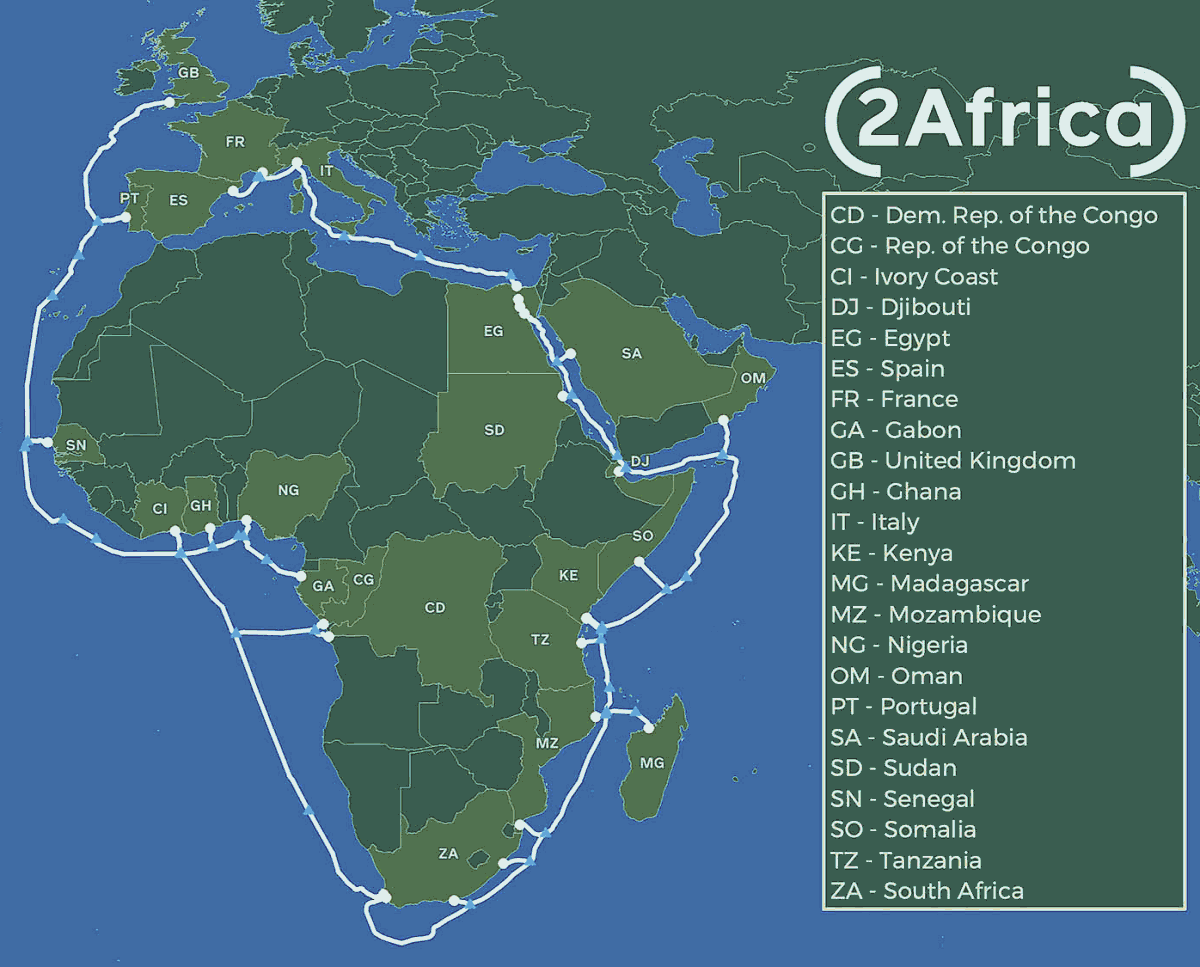
Telecoms giant Vodafone have today confirmed that the long-running 2Africa project, which has spent the past 6 years building a 45,000km long subsea (submarine) fibre optic cable between the United Kingdom and most of coastal Africa, has completed the core part of its cable system.

The new cable network has landings in 33 countries – including one in England at a site in Bude (Cornwall) – and should help to support faster broadband speeds, boosting mobile network capacity and better international internet connectivity. On the West segment – from the UK to South Africa – the cable supports 168Tbps (Terabits per second) of data capacity. In the Mediterranean, shorter distances allow speeds of over 180Tbps.

NOTE: The 2Africa consortium is made up of eight international partners: Bayobab; Center3; China Mobile International; Meta; Orange; Telecom Egypt; Vodafone Group; and WIOCC. Alcatel Submarine Networks was responsible for the manufacture and installation of the cable.

The new cable broadly doubles the internet capacity available to the African continent. Over 35 offshore vessels and extensive local operations were mobilised to lay the cable, with specialist equipment deployed to ensure safe and resilient installation. Cable burial depth was also increased by 50%, reducing the risk of accidental cuts. 2Africa was also carefully routed to avoid seabed hazards like hot brine pools and the fierce currents in the Congo Canyon.

2Africa took nearly six years to build and required constant adaptation to dynamic regulatory landscapes. The project’s success depended on strong partnerships and close collaboration with regulators and policymakers across many countries. Their support was essential in navigating requirements, overcoming challenges, and keeping the project on track,” said Vodafone’s statement.

2Africa map

The leap in capacity is expected to contribute up to US$36.9 billion to Africa’s GDP within the first two to three years of operation, boosting job creation, entrepreneurship, and innovation hubs across the continent.

2025 Local Digital Index Calls for Biz Rates Relief to Boost UK Full Fibre and 5G | ISPreview UK

Original article ISPreview UK:Read More

TechUK, which represents many of the UK’s key technology firms, has today drawn on 23 indicators from across the economy, connectivity, and skills to paint a regional and national picture of the tech ecosystem via their 2025 Local Digital Index. But the report also calls on the government to “fast-track” completion of its broadband and mobile projects to tackle slow spots, ideally alongside relief from business rates.

The new index shows that while the UK tech sector continues to outperform most of the economy – now contributing £101bn in Gross Value Added (GVA) and employing 1.7 million people – growth remains uneven. The index highlights some dramatic progress since 2020, such as in terms of the gigabit broadband roll-out, but it also identifies that growth and investment remain “too heavily concentrated” in London, Oxford, and Cambridge.

NOTE: The Index’s data for broadband and mobile connectivity comes from Ofcom’s older Connected Nations data, which was most recently updated yesterday (here).

Overall growth for the digital sector has a forecast of 8.9%, which is above the general UK average. However, the projected rate has decreased slightly since last year’s index (10%). The report also warns that, despite the improvements in digital infrastructure, “too many communities and business parks still face slow or unreliable connectivity“.

In response, techUK has “urged” the UK Government to treat business connectivity as Critical National Infrastructure (CNI) and to start “fast-tracking” the completion of their £5bn Project Gigabit broadband roll-out and the industry-led Shared Rural Network (SRN) for boosting 4G mobile coverage, while expanding coverage measurements to include commercial sites, not just homes (Ofcom’s reports often focus on residential properties).

Matthew Evans, Director of Markets and COO at techUK, said:

“Our Index shows that there is incredible innovation happening across the whole of the UK. However, only some of the regions are reaping the benefits. We must ensure the benefits of innovation reach every region and community. If we invest now in infrastructure, capital, and skills, we can build a digital economy that delivers growth and prosperity everywhere.”

In fairness, both Project Gigabit and the SRN have so far met their initial targets, although Project Gigabit did recently delay its coverage target (99% of UK premises) from 2030 to 2032 (here). Suffice to say, the notion of “fast-tracking” may not be very realistic; much of this is down to the network operators and their ability to deliver in some very challenging areas, although there’s still some scope for the government to remove red tape (planning / road permissions and MDU access etc.).

Overall, the new report makes three key recommendations for action, and the ones for digital infrastructure are particularly interesting.

The Three Priority Areas for Action

  • Catalyse investment beyond the Golden Triangle:

Investment remains at the heart of innovation; yet capital, both public and private, is still clustered in the South East.

techUK calls for a deliberate effort to channel investment into high-potential regional ecosystems, ensuring that scale-ups from across the UK can access the finance they need to grow. This includes expanding regional investment funds, aligning Innovate UK and the British Business Bank to support early-stage innovation pipelines, and establishing a Digital Technologies Office for Investment to showcase UK strengths to global investors.

  • Accelerate digital infrastructure for business connectivity:
The UK’s digital infrastructure has strengthened significantly since 2020, yet too many communities and business parks still face slow or unreliable connectivity. techUK urges Government to treat business connectivity as critical national infrastructure, fast-tracking the completion of Project Gigabit and the Shared Rural Network while expanding coverage measurement to include commercial sites, not just homes.
 
To incentivise deployment, techUK proposes “targeted business rates relief for next-generation fibre and 5G standalone networks“, alongside support for alternative technologies such as satellite to close the rural gap.
  • Align skills supply and demand to drive regional growth:
The UK produces exceptional digital talent, but the Index shows growing disparities between where people train and where they find work. Some regions risk becoming “training grounds” for talent that relocates elsewhere.
 
techUK calls for a more flexible, regionally empowered approach to digital skills. Reforming the Growth and Skills Levy would allow employers to fund short, modular training aligned with emerging technologies such as AI, semiconductors, and cyber security. Local and devolved authorities should also be empowered to reinvest levy underspends into digital inclusion and community-based upskilling.
 
Universities, meanwhile, should act as anchor institutions for digital adoption, helping local SMEs modernise management practices and embed digital tools across supply chains.

Regular readers will know that the Government has recently been facing heavy criticism from network operators, particularly bigger players like BT and Virgin Media (here and here), over their plans to reform business rates; this may actually increase the tax on broadband operators and at a time when they’re trying to invest in the deployment of new networks.

However, so far, there’s been no indication that the government might consider “targeted business rates relief” for fibre and 5G networks. Failing to address this may thus risk causing a slowdown or even abandonment of some deployment plans, at least that’s what Openreach have been warning (here).

The prospects are better for the government to introduce greater support for alternative rural broadband technologies in rural areas, which could perhaps take the form of a new voucher scheme. The new agreement between BT (EE) and Starlink also looks set to target this area next year (here), although we’re still of the view that foreign owned satellite networks should be considered a stop gap solution, with fibre in the ground remaining the ultimate goal.

The difficulty for the government is that they’re extremely strapped for cash, due to the level of debt and related repayments that has accumulated in recent years. The flexibility may not exist to do everything the industry might want.

Starlink Satellite Broadband Now Live on the Falkland Islands | ISPreview UK

Original article ISPreview UK:Read More

Good news for residents of the remote Falkland Islands, which are a British Overseas Territory off the South American coast. After a long and complex battle, SpaceX’s ultrafast Starlink broadband service has recently gone live and its final pricing appears to closely mirror the standard packages that are available to UK consumers.

The Starlink constellation currently has around 9,000 satellites in orbit (c.5,500 are GEN2) – mostly at altitudes of c.500-600km (Low Earth Orbit). Residential customers in the UK usually pay from £75 a month, plus £299 for hardware (currently free for many areas) on the ‘Standard’ unlimited data plan (kit price may vary due to different offers) directly from Starlink, which promises UK latency times of 26-33ms, downloads of 116-277Mbps and uploads of 17-32Mbps. Cheaper, albeit more restrictive (data capped), options also exist for roaming users (e.g. £50 per month for 50 GigaBytes of data).

NOTE: By the July 2025 Starlink’s global network had 6 million customers and 110,000 of those were in the UK (up from 87,000 in 2024) – mostly in rural areas.

The situation in the Falkland Islands is, however, a little bit different due to the history of local satellite connectivity – the main means of local communication and one that was previously dominated by a slow and expensive solution from Sure (Sure Falklands Islands). But we’d suggest reading the prior article for a history lesson on that and the battle to overturn it (here).

Consumers on the Falkland Islands can now legally sign-up to Starlink and the Standard no-contract Residential package will set you back 75 FKP per month (1FKP is almost identical to £1), plus 300 FKP for the hardware (terminal, router etc.) – or 160 FKP for the Mini kit –  and 20 FKP for shipping (postage). In addition, customers will also need to secure a VSAT licence from the Falkland Islands Government (FIG) – get one here – and provide the related code to Starlink (this costs £180 per year).

Some hidden data selectors on Starlink’s Coverage Map also allow you to see what kind of performance the network can currently deliver across the Falklands. The data suggests that download speeds of between 208-358Mbps, uploads of between 29-45Mbps and latency times of 37-42ms (milliseconds) should be possible. But officially, Starlink’s advertised speeds propose downloads of 135-305Mbps and uploads of 20-40Mbps.

Credits to one of our readers (Danny) for spotting the update on the Open Falklands blog.

NordVPN Launch Call Protection Feature for Android Users in the UK | ISPreview UK

Original article ISPreview UK:Read More

The NordVPN service, which is a familiar Virtual Private Network (VPN) provider, has today announced that they’ve expanded the availability of their Call Protection feature (formerly known as scam call protection) – initially only available across the USA – to also cover Android users in the United Kingdom and Canada. Support for iPhone users is coming soon.

The rebranding to “Call Protection” is said to reflect the provider’s focus on moving beyond scam detection and including more detailed caller identification as part of the service. In short, the feature gives an early warning, notifying the recipient of a potential scam attempt before they can pick up the phone. NordVPN does this by examining “call patterns and metadata to spot potential scams“, without touching your actual conversations.

The feature also runs quietly in the background without needing an active VPN connection. Customers of the NordVPN service in the UK need only open their Android app, navigate to the “Threat Protection” tab, and toggle the feature on. The app will then guide them through updating the necessary Android settings.

In addition, NordVPN are planning to introduce a “user reporting system” in the future, which will let people flag suspicious numbers, helping to strengthen the scam database for everyone.

Domininkas Virbickas, Product Director at NordVPN, said:

“Scam calls are a global problem that requires a global solution. By expanding call protection to the UK and Canada, we’re taking another step toward our goal of making phone communication safer and more transparent for users worldwide. We want to give people the context they need to make informed decisions about every call.”

Admittedly, while such features are always welcome, it’s worth pointing out that many modern Android Smartphones already work with UK mobile operators to provide a user reporting system and most mobile operators have already adopted sophisticated network-level scam call and spam detection systems (these often block such calls before they even reach you).