Openreach’s Essex and North East England Project Gigabit Broadband Contract Expands | ISPreview UK

Original article ISPreview UK:Read More

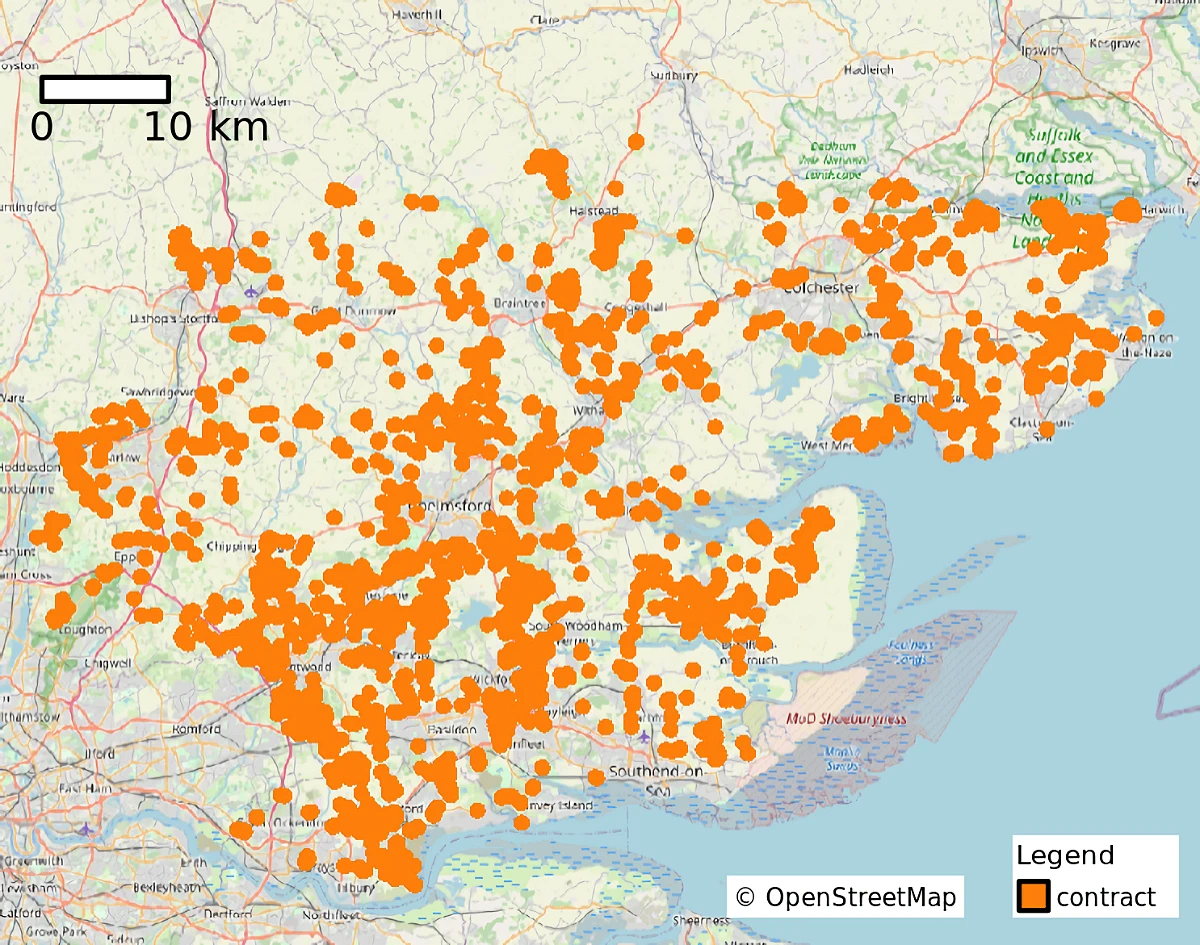
The UK government has posted a Project Gigabit modification for Openreach’s £61.3m (public subsidy) contract to extend the reach of their full fibre (FTTP) based gigabit broadband network across Essex and North East England. This increases the value by £610,393 to £61.92m and will now reach an additional 269 premises in remote rural areas (total target now 24,707 premises).

Just to remind. Project Gigabit’s contracts are not static and their scope, as well as committed levels of public funding, can change over time for a number of different reasons (informed by regular ‘Open Market Reviews’ of existing UK deployment plans). For example, commercial operators may expand or reduce their roll-out plans in the same region, which can reduce or grow the scope for public investment within those same contracted areas.

NOTE: Project Gigabit aims to help extend 1Gbps capable (download) broadband networks to reach “nationwide” UK coverage (c. 99%) by 2032 – the UK is currently at about the 88% coverage mark today (here).

The contracted operator could also find the deployment to be more expensive, or possibly even cheaper, than previously envisaged. Such adjustments may occur due to changes in build costs and interest rates / inflation, as well as any unexpected obstacles to street works or greater efficiencies of build than planned or expected. Suffice to say, there can be various reasons why the contracted scope of related builds and the level of allocated public funding may change over time.

In this case, the government (DSIT) have merely stated that “additional scope” has been added to Openreach’s Type C (Call Off 5) roll-out contract (first awarded Jan 2025) for the hardest-to-reach parts of Essex and North East England, which means that the “awarded premises have increased (rescoped) by 269“. This has pushed the contract value higher by £610,393 (roughly £2.27k per premises added).

The areas covered by Type C (Cross-Regional) contracts typically reflect locations where no or no appropriate market interest had previously been expressed before to the Government’s Building Digital UK (BDUK) agency, or areas that have been descoped or terminated from a prior procurement (i.e. there was a lack of market interest in upgrading them). Such areas are often skipped due to being too expensive (difficult) for smaller suppliers to tackle.

Clearly, in this case, Openreach has identified an ability to reach more premises with their contracted roll-out than previously planned. We don’t currently know whether this represents the addition of a specific community (communities) or whether it’s just a broader increase found across multiple locations. The original roll-out map has yet to be updated for the Call Off 5 changes:

Openreach Call Off 5 Gigabit Broadband Rollout Map (Dec 2024)

Openreach Call Off 5 Project Gigabit Broadband Contract Map

The new service, once live, can be ordered via various ISPs, such as BT, Sky Broadband, TalkTalk, Vodafone and many more (Openreach FTTP ISP Choices) – it is not currently an automatic upgrade, although some providers have started to do free automatic upgrades as older copper-based services and lines are slowly withdrawn.

The roll-out phase of the above contract is set to take another 2-3 years, although the contract itself runs until 30th September 2037; this includes clawback provisions that may return some of the public money that has been invested to conduct the build.

2026 New Year Honours for Building Digital UK’s Strategy Director | ISPreview UK

Original article ISPreview UK:Read More

The UK Government has published their annual New Year Honours List for 2026, which this time saw Matt Agar, Strategy Director for the government’s Building Digital UK agency within DSIT, being named an “Officer of the Order of the British Empire” for “services to Digital Infrastructure and Broadband“.

The King’s New Year Honours list is said to recognise the achievements and public service of people across the UK, from all walks of life. Anyone can nominate someone for an honour, and nominees are then “checked by various government departments to make sure they’re suitable for an honour” (this may include checks by HMRC) and an honour’s committee will also review the nominations.

So far as we could see, Matt seems to be the only one from the broadband and mobile sector to receive an honour this year. In case anybody has forgotten, BDUK has responsibility for delivering gigabit broadband and better mobile connectivity across the nation (e.g. the £5bn Project Gigabit scheme) and Matt has long played a key role in helping to run it.

Broadband ISP Zen Internet Saw UK Network Traffic Grow 21 Percent in 2025 | ISPreview UK

Original article ISPreview UK:Read More

Rochdale-based UK broadband ISP Zen Internet has this morning revealed that average network traffic across their service rose by 21% during 2025, with the highest peak of data usage being set on 11th November 2025 (22% above last year’s peak) – largely driven by live football streaming (this often dominated peak demand).

What distinguishes 2025 is not the existence of such peaks, but how frequently they now occur on top of sustained demand. Zen highlighted how 2025 saw a succession of new network highs with peak traffic up 3% on 2024’s highest peak in February, 9% in March, and 11.5% in April, before rising sharply again in the autumn.

As above, live sport streaming platforms continue to dominate peak demand, with Amazon (Prime Video) traffic showing significant spikes, reaching 85% above a normal average evening on 4th November – during a big football event (Liverpool vs Real Madrid). The UEFA Champions League fixtures in February, March, April, and November all coincided with new peak records, while the Lionesses’ Euros final on 27th July drove an 11% increase in total network traffic compared with the previous day.

Interestingly, video gaming and software releases were described as being “less frequent, short-term contributors” to traffic peaks in 2025. But when they occurred, they generated sharp, time-limited surges on Zen’s network. A surprise game release in April 2025 prompted a noticeable daytime and evening uplift, while beta tests and major updates later in the year also produced clear spikes.

Apple traffic stood out in September 2025, jumping 900%, consistent with a major operating system (iOS) rollout, highlighting how large-scale software distribution can briefly place significant additional demand on the network without altering the underlying baseline trend.

Zen also notes that major global news events were “less likely to create dramatic standalone spikes” than in previous years, suggesting that news consumption is now embedded within everyday internet use. However, select moments still drove measurable increases, such as the US Presidential inauguration in January and the death of Pope Francis in April, which coincided with higher-than-normal traffic to trusted public service platforms such as the BBC. But Zen provided no solid data to substantiate these statements.

John Lyons, Technology Director at Zen, said:

“What this year shows very clearly is that high demand is no longer confined to isolated moments, but is now underpinned by sustained growth. We’re seeing sustained growth in baseline usage alongside repeated record peaks, which requires us to work hard to stay ahead of our growing customer demands. As Zen turns 30, continuing to invest in capacity and resilience is critical to making sure customers experience a reliable service, particularly as demand keeps rising.”

In terms of how all this compares with the wider UK market. Ofcom recently reported that the average monthly data usage per fixed broadband connection is now 583GB (GigaBytes) across “all technologies” (up from 531GB last year), which rises to an average of 738GB for full-fibre connections (oddly this was actually down a bit from 766GB).

However, it’s worth remembering that internet providers use sophisticated Content Delivery Networks (CDN) and systems to help manage the load from big online events, which caches popular content closer in the network to end-users (i.e. improves performance without adding network strain). This in turn lowers the provider’s impact on external links and helps to keep costs down.

Demand for data is of course constantly rising and home broadband connections are forever getting faster, thus new peaks of usage are being set all the time by every ISP. As a side note, Virgin Media and O2 recently reported that they saw an 8% rise in broadband usage (down from 8.1% in 2024) and an 18% rise in mobile traffic through the year (up from 9%) – driven by growing use of AI, live sports and major game releases.

The H2 2025 Top Fastest UK Mobile and Home Broadband ISPs | ISPreview UK

Original article ISPreview UK:Read More

ISPreview has today published our final biannual study of the United Kingdom’s broadband download and upload speeds for 2025, which reveals how the performance of the fastest nationally available fixed line ISPs, mobile network operators and Starlink (satellite) services has changed since H1 (mid-year).

The results in this report stem from web-based speed testing by consumers and are thus inevitably impacted by a number of factors, such as the rising coverage of faster networks (e.g. full fibre and 5G) and the level of take-up by customers. As a result it helps to understand any key changes in network deployments over the same sort of period, which is shown below using the latest Connected Nations 2025 data from Ofcom.

NOTE: The term “gigabit-capable” on fixed lines refers to the combined coverage of Full Fibre (FTTP/B) and Hybrid Fibre Coax (HFC / Virgin Media) networks. Ofcom predicts the UK will achieve gigabit coverage of between 91% and 97% by January 2028 (here).
Connection Type July 2025 Cover January 2025 Cover
% Under 10Mbps (USO) c.1% c.1%
Superfast (30Mbps+) 98% 98%
Gigabit-capable (1000Mbps+) 87% 84%
Full Fibre (FTTP) 78% 69%
4G Geographic 89-90% 88-89%
5G Premises (Outdoor) from at least 1 operator 94-97% 90-95%
5G Outside Premises 64-89% 61-79%

In terms of fixed lines, the primary coverage improvements have continued to come from full fibre broadband networks (Summary of UK FTTP Builds), although ongoing market pressures (high build costs, high interest rates, fierce competition etc.) are continuing to result in many alternative operators (altnets) suffering job losses and a slowdown in their deployments. But the Openreach, Netomnia and others have kept up a good pace.

Full fibre networks are now also the sole driving force behind the rise in gigabit-capable coverage, which continues to be predominantly fuelled by commercial roll-outs in urban areas. Speaking of which, gigabit coverage passed the Government’s first target (85%) under their £5bn Project Gigabit programme earlier this year (focused on the final c.10-20% of poorly served rural premises) and is now aiming to hit c.99% coverage by 2032 (delayed from the original 2030 target – here).

Finally, in terms of mobile networks, there have been further improvements in 4G and 5G (mobile broadband) coverage. Most of this stems from commercial investment, although the industry-led £1bn Shared Rural Network (SRN) project did make good progress on boosting geographic 4G coverage (here).

NOTE: Web-based speedtests can be affected by various issues, such as slow Wi-Fi, limitations of the tester itself, local network congestion and package choice (a lot of people will pick a slower and cheaper plan, even with 1Gbps available). The following results are thus only good for observing general market change over time and MUST NOT be taken as a reflection of ISP capability.

Fastest Major Fixed Broadband ISPs (H2 vs H1 2025)

The data in this report has been gathered from Thinkbroadband’s independent database of speedtests (inc. ISPreview’s Broadband Speedtest). But the table below only includes the largest and most established independent ISPs with strong national availability, although there is a separate table for smaller providers (inc. some altnets) on page 2 – these are difficult to include because such providers don’t produce much test data (fewer users).

Naturally, there are caveats to consider with speedtest based studies like this, not least because the results tend to be more reflective of take-up than network availability. For example, some ISPs may have a much larger proportion of customers on slower copper-based lines (ADSL or FTTC), which can weigh against those on faster FTTP services with the same provider (i.e. pulling average speeds down). The opposite can also be true.

NOTE: The top 10% is the speed experienced by the fastest users on each ISP (below in brackets). The results are averages (median) in Megabits per second (Mbps). The H1 2025 data was processed in late April 2025 and the latest H2 2025 data was extracted during late November 2025.

Average Download Speeds – Top 8

No. Operator H2 – 2025 (Top 10%) H1 – 2025 (Top 10%) Change %
1. Virgin Media 262.9Mbps (774.3Mbps) 264Mbps (767.8Mbps) -0.42%
2. Zen Internet 103.7Mbps (889.6Mbps) 105.6Mbps (904.4Mbps) -1.8%
3. Vodafone 80.3Mbps (548Mbps) 67.9Mbps (463.9Mbps) 18.26%
4. EE 65.6Mbps (900.6Mbps) 75.1Mbps (715.1Mbps) -12.65%
5. BT 62.7Mbps (430.4Mbps) 66.5Mbps (441.1Mbps) -5.71%
6. Sky Broadband 61.1Mbps (231.5Mbps) 55.9Mbps (291.5Mbps) 9.3%
7. Plusnet 52.8Mbps (290.9Mbps) 48.5Mbps (262.2Mbps) 8.87%
8. TalkTalk 41.2Mbps (149.6Mbps) 37.5Mbps (147.6Mbps) 9.87%

Average Upload Speeds – Top 8

No. Operator H2 – 2025 H1 – 2025 Change %
1. Zen Internet 37.2Mbps 46.3Mbps -19.65%
2. Virgin Media 33.9Mbps 33.7Mbps 0.59%
4. Vodafone 19.3Mbps 18.2Mbps 6.04%
3. EE 19.1Mbps 18.4Mbps 3.8%
5. BT 17.5Mbps 17.7Mbps -1.13%
6. Sky Broadband 17.4Mbps 16.1Mbps 8.07%
7. Plusnet 15.4Mbps 13.2Mbps 16.67%
8. TalkTalk 9.9Mbps 9.3Mbps 6.45%

Overall, the average download speed of the top national providers was 91.28Mbps (up from 90.12Mbps) and the average upload speed hit 21.21Mbps (down from 21.61Mbps), which suggests that very little changed across the major national providers over the last half of the year. But we did see a curiously large performance slide at EE and the reverse at Vodafone.

Now flick over to page 2 to continue this summary and see how the fastest satellite (starlink), mobile operators and smaller ISPs all performed.

Virgin Media UK’s Winter Broadband Sale Cuts 2Gbps to £49.99 | ISPreview UK

Original article ISPreview UK:Read More

New customers looking to join Virgin Media (O2) may like to know that they’ve kicked off their Winter Sale today, which will run until 4th February 2026 and offers a variety of discounts across their various broadband packages, TV bundles (these all include Netflix Standard) and triple-play deals with O2’s mobile SIMs.

The new deals aren’t all that different from what we saw around the Black Friday period, although there are a few notable ones. For example, their 2Gbps package (nexfibre areas) has now been reduced in price to just £49.99 per month on a 24-month term with free installation, although it does increase to £53.99 from April 2026 and then £57.99 from April 2027.

NOTE: Virgin Media’s packages adopt mid-contract price hikes that are applied each April (monthly rental prices rise by £4). The operator’s network is currently available to 18.67 million UK premises.

However, the sale announcement does talk a lot about “Netflix Standard” being included with their TV bundles (as well as their 500Mbps and 1Gbps broadband-only packages), although it’s important to be clear that this is “Standard with Ads” (normally £5.99) and not the regular “Standard” (£12.99) plan that’s being bundled.

Customers with an O2 mobile account who add Virgin Media’s broadband to their household services can also enjoy Volt rewards, such as Double mobile data on all eligible O2 mobile Plans, a broadband speed boost (usually double speeds) and their WiFi guarantee (i.e. minimum download speeds of 30Mbps in every room or £100 credit back). Check out Virgin Media’s site for all the new offers.

Community Fibre Drop Mid-Contract Broadband Price Hikes for New UK Customers | ISPreview UK

Original article ISPreview UK:Read More

Alternative network operator and broadband ISP CommunityFibre, which has invested c.£1bn to deploy a 5Gbps speed full fibre (FTTP) network across 1.342 million UK homes (inc. 185k businesses within 200 metres of their network) – mostly in London, has just removed all of their mid-contract price hikes for new customers.

The provider had previously adopted a pricing policy that increased the monthly price that customers pay for their package by £2 each April. But from today that policy has been removed from all of their packages for new customers, and they’re instead now offering a “price lock“, which should remain available to take until 2nd February 2026.

NOTE: Community Fibre is backed by shareholders Warburg Pincus LLC, DTCP, Railpen and NDIF, and its lenders, including recent backers JP Morgan and Barclays etc. The operator’s network is predominantly focused on London.

Prices now start at a flat £19 per month for their 100Mbps (symmetric) speed tier with an included router and free installation on a 24-month minimum term (shorter terms also exist, albeit at extra cost), which rises to £63 per month for their top 5Gbps (5,000Mbps) package; the latter is a premium tier that adds a WiFi 7 router, “guaranteed” whole home wireless coverage, bespoke engineer setup and priority support.

Take note that a basic ‘Essential‘ plan also exists for those on lower incomes (although technically anybody can take it), which costs £12.50 per month on a 12-month term for symmetric speeds of 35Mbps and a very basic WiFi 5 router.

The only thing to be aware of is that, at the end of your contract (applicable to all contracts), the monthly price will still increase by £4 versus your last month (post-contract change rather than mid-contract). But otherwise, it’s nice to see a provider at this scale moving away from mid-contract hikes, even if it might not last. Sadly, existing customers won’t benefit from the change.

Frustrations Over Unreliable FibreNest Broadband on Carlisle Housing Estate | ISPreview UK

Original article ISPreview UK:Read More

Residents of the 100-home Amberwood estate in Carlisle (Cumbria, England), which was originally built by Persimmon Homes and thus served by a single full fibre (FTTP) network from FibreNest (recently acquired by OFNL), have expressed frustration after another protracted broadband outage hit the area – allegedly the latest in a long list of disruptions over the past 6 years.

The latest outage is said to have disrupted internet connectivity for three long days earlier this month, which FibreNest attributed to being caused by “malicious damage to infrastructure owned by its network partner, Virgin Media” (likely a reference to a core fibre link that feeds data capacity to the development).

NOTE: The Amberwood estate is surrounded by rival FTTP networks from Openreach, Virgin Media (inc. nexfibre) and Netomnia. But none of them reach inside the estate. The only alternative fixed line choice for some homes on the estate is Openreach’s slow copper based broadband network.

However, residents told the local News & Star that the latest outage is part of a long-running pattern of unreliable service stretching back more than six years, with complaints highlighting a lack of support from the ISP and the need to spend extra money on 4G/5G based mobile broadband as a backup due to local connectivity being deemed unreliable.

This isn’t a one-off – it’s happening all the time, with days of no internet,” said estate resident Melanie MacPake. Complaints like this have cropped up on other estates where FibreNest / OFNL are present (example) and tend to be exasperated by the fact that the operator is often the only gigabit-capable broadband network present, which in this case stems from the fact that FibreNest used to be part of Persimmon and thus held some degree of exclusivity over the estate.

FibreNest’s dominance of such estates often makes it challenging for rival networks to enter (residents in other areas have previously described this as being similar to a mini “monopoly“). Persimmon Homes did respond to this criticism in 2021 by launching a wholesale product (FibreNest Wholesale) that rival ISPs could harness (here), but this has thus far not been attractive enough to entice any other providers.

The new owner of FibreNest, BUUK Infrastructure (GTC, OFNL – Open Fibre Networks Limited), has said that it plans to introduce customer choice across FibreNest-served developments in 2026. But this is currently only likely to reflect an expanded choice of retail ISPs, albeit via the same underlying network infrastructure (i.e. the ISPs on OFNL’s platform), and should thus not be confused with real competitive infrastructure layer choice. This may also not be enough to address the unreliability of the existing infrastructure.

A spokesperson for FibreNest added that it “strives to deliver the best possible experience for its customers” and “continuously reviews all aspects of its service“. But it’s currently unclear whether they plan to make any changes that might improve the resilience of their underlying network on the estate.

At present situations like this rarely catch the eye of the government and thus wider debate, since they exist at a fairly small scale relative to the wider UK broadband market. But it’s possible that may change as the national deployment of full fibre lines slowly reaches its target of near universal (c.99%) coverage by 2032. This could potentially shift some of the focus back toward resolving infrastructure competition in such niche areas. But hope is not a strategy.

Consolidation Tracker for Alternative UK Gigabit Broadband Networks | ISPreview UK

Original article ISPreview UK:Read More

The past couple of years have been awash with news and predictions about rising consolidation within the UK’s market for alternative fixed broadband networks (altnets). But keeping track of so many developments can be difficult, so ISPreview has decided to start a new tracker, which monitors related announcements since 2020 onwards.

Most altnets across the market are currently looking at consolidation as a way of balancing against the difficult market conditions that have arisen over the past few years. Much of this has been driven by high interest rates, rising build costs and strong competition (i.e. overbuild and the impact on customer take-up) – all of which is making it hard to raise fresh investment and expand networks.

NOTE: Check out our regularly updated Summary of UK Full Fibre Builds for more background. Ofcom currently predicts (here) that gigabit broadband will cover between 91% to 97% of the UK by January 2028 (currently 87%). The government’s £5bn Project Gigabit scheme also aims to extend this to c.99% by 2032 (here).

However, it’s easy to overlook that this squeeze has already resulted in quite a few sizeable consolidation agreements taking place, and many industry observers expect the current crop of c.80 altnets to shrink down into a market dominated by just a handful (or less) of players over the coming years. Suffice to say that we’ve been keeping track of this for a while and thought readers might benefit if we shared our data.

Take note that the table below is purely focused on infrastructure providers – typically those that have been building full fibre networks for consumers to use – and not retail ISPs, although some of the below agreements do include vertically integrated retail ISPs (we’ll mention those where relevant). The list excludes business providers that only offer traditional Ethernet (leased line) services, as they’re somewhat of a different animal and usually focused on site-specific connectivity, rather than wide area coverage of both homes and businesses.

Altnet UK Fibre Consolidation Tracker (Jan 2020 – Dec 2025)

CityFibre agreed a £200m deal to purchase FibreNation (FN) from the TalkTalk group. The FN project had originally aspired to cover 3 million UK premises, but at the time they had only covered c.54,000 premises in York and were working to reach hundreds of thousands more across various other locations. TalkTalk also reached a wholesale wider agreement with CityFibre as part of the deal.

The 4th Utility, which specialised in deploying FTTP to residential properties (mostly new build developments), acquired London focused provider Vision Fibre Media (VFM) for an undisclosed sum. At the time VFM claimed to have connected over 10,000 properties to their own full fibre network.

London-focused network CommunityFibre acquired Box Broadband for an undisclosed sum. At the time Box had a much smaller network (7,000 premises) in parts of Surrey and West Sussex, albeit with plans to expand much further across Southern England.

The Fern Trading backed Swish Fibre stepped in to acquire People’s Fibre for a cash sum of £2.8m after they began to struggle with competition in their build areas. At the start of People’s Fibre’s administration process, the network had built to just 5,293 premises and connected only 150 of those to their service.

The Fern Trading backed altnets of Jurassic Fibre, Swish Fibre and Giganet agreed to merge. The process ultimately didn’t fully complete until June 2025 (here), which resulted in AllPoints Fibre Networks (APFN) managing the wholesale network and Cuckoo becoming their primary retail ISP. As of November 2024 the combined network is estimated to cover c.300k premises.

Nexfibre, which is closely tied by some of the same parentage to Virgin Media (VMO2), acquired Upp from investment firm LetterOne. The deal occurred after a security review by the Government forced the latter into a sale. At the time of the deal, Upp was said to cover 175,000 premises and be home to just 4,000 customers.

Voneus announced a deal to consolidate Broadway Partners, SWS Broadband and Cadence Networks into their network – funded by up to £250m in new capital. The deal reflected an agreement between a consortium of existing investment partners, including Macquarie Capital, Israel Infrastructure Fund (IIF) and Tiger Infrastructure Partners.

Network operator Digital Infrastructure (BeFibre) agreed to merge into FullFibre Limited. Both were backed by investment from Basalt Infrastructure Partners LLP. The consolidation created a single network covering over 250,000 homes, with an ambition to deliver 1 million live premises through a wholesale business model.

Freedom Fibre signs an agreement with InfraBridge-backed VX UK Holdings Ltd (VXFIBER) to combine their respective broadband networks – reflecting a combined total of 285,000 premises passed.

Major wholesale centric altnet operator CityFibre acquires LitFibre’s base of 200,000 premises (inc. 9,000 retailed customers) for c.£80m. CityFibre later splits out LitFibre to operate as an independent retail ISP for the aforementioned customer base.

Network operator Trooli, which was backed by Agnar UK Infrastructure, consolidated Axione UK’s smaller network in rural Scotland into their wider network across England – both operators had some links via French parent investment firm Vauban Infrastructure Partners. Details of the original agreement have not been made public.

Netomnia and Brsk, both of which were backed by investment firm Advencap, agreed to merge and create a combined network covering 1.5 million premises (RFS), including a customer base of 140,000. The deal set a new target of reaching 3 million premises (coverage) by the end of 2025. At the time of the deal, the combined group was worth c.£1.3bn.

The tiny network operator of RunFibre, which largely focused on parts of South Gloucestershire and had only covered around 1,500 premises, found itself being acquired by network and engineering firm the Fibreray Group for an undisclosed sum.

Oaktree Capital backed Zzoomm was consolidated into FullFibre Limited, which itself was backed by Basalt Infrastructure Partners LLP. The deal created a combined group with a network spanning 600,000 premises passed (RFS) and over 65,000 customers. Some reports speculated (unconfirmed) that the combined group could be worth £500m.

CityFibre acquired PATRIZIA-backed Connexin for an undisclosed sum. At the time of the deal, Connexin’s fibre network passed 80,000 premises. The agreement also meant that CityFibre took responsibility for Connexin’s £58.6m (state aid) Project Gigabit contract to reach 34,320 rural premises in Nottinghamshire and West Lincolnshire (Lot 10). Finally, Connexin retained their existing retail base and will act as an independent ISP.

BUUK Infrastructure (aka – Open Fibre Networks Limited – OFNL) acquired FibreNest from Persimmon Homes for a discounted total enterprise value of c. £100m. At the time of the deal, OFNL covered an estimated 170k premises and FibreNest reached around 54,000. Both networks focus on deploying fibre across developments for new build homes.

Ask4, which normally builds networks for the student and rental accommodation sector, acquired ClearFibre – previously part of Elevate (formerly Telcom) – to help grow their position in the UK’s Build-to-Rent (BTR) market. No solid financial or network coverage details were disclosed to the public.

A relatively new network provider called Fibre Nova acquired RunFibre from the Fibreray Group. No financial or updated network coverage figures were released. In August 2024 RunFibre stated that its network had passed “over 1,500 premises“ – mostly in South Gloucestershire.

Truespeed and County Broadband, both of which are backed by Aviva Investors, agreed to merge and created a combined group under the Truespeed Communications Group Ltd – covering 177,000 premises (RFS), with 40,000 customers already connected to the network.

We will add more consolidation agreements to this list as they occur.

Total Agreements by Year

  • 2020: 1
  • 2021: 3
  • 2022: 0
  • 2023: 5
  • 2024: 4
  • 2025: 6
  • 2026: ? (in progress)

2025 vs 2024 – UK Broadband and Mobile Speeds vs the World | ISPreview UK

Original article ISPreview UK:Read More

ISPreview is today ending 2025 by taking our annual look back to see how the United Kingdom’s position, in terms of the top 50 fastest countries for fixed broadband and mobile speeds (4G, 5G), has changed since 2024. Overall, the UK’s global rank for mobile speed is now 59th (down from 53rd last year), while our ranking for fixed broadband is 44th (unchanged).

The following report was created by harnessing data from Ookla’s popular Speedtest.net database for benchmarking internet connections around the world, which admittedly does have its caveats. For example, the data can be impacted by other aspects of the connection (e.g. slow Wi-Fi, local network congestion, the performance of speedtest.net’s own servers and consumer package choice), but these issues are shared by all countries.

NOTE: Data is gathered in November each year and the figures are all ‘median‘ averages.

However, the main differentiator for speeds between countries tends to stem from the balance between network availability and the take-up of faster connection types. For example, countries with a high coverage of gigabit-capable broadband technologies (FTTP, DOCSIS 3.1+) or strong 5G mobile services (ideally with plenty of radio spectrum for them to harness) will naturally rank highest in the table.

In terms of the UK, we’ve seen a strong and continuous improvement in the availability of both faster fixed and mobile networks. For example, Ofcom recently revealed (here) that 1000Mbps (gigabit) capable fixed broadband ISP networks had reached 87% of premises (up from 84% last year), which falls to 78% when only looking at full fibre FTTP lines (up from 69%).

As for 5G mobile, it is now available from at least one MNO (operator) in the vicinity of around 94-97% of UK premises (up from 90-95% last year) or 64-89% when looking at outside areas with availability from all operators combined (up from 61-79%).

UK Broadband and Mobile Stats vs the World – 2025

The data below reveals that fixed line broadband and mobile speeds have continued to improve across the world. But despite some noted improvements in 5G coverage, other countries still seem able to improve their real-world mobile performance at a faster or similar pace. On the flip side, the UK has seen continued growth in the coverage and take-up of full fibre lines, despite a build slowdown among smaller alternative networks.

We’ve summarised some of the key changes below.

UK Fixed & Mobile Speeds vs The World (2025)

Performance Categories 2025 2024
UK Country Rank for Fixed Line 44th 44th
Global Latency – Fixed Line 9ms 9ms
Global Upload – Fixed Line 56.95Mbps 50.26Mbps
Global Download – Fixed Line 106.84Mbps 94.52Mbps
UK Latency – Fixed Line 12ms 13ms
UK Upload – Fixed Line 45.07Mbps 30.28Mbps
UK Download – Fixed Line 147.35Mbps 117.49Mbps
 
UK Country Rank for Mobile 59th 53rd
Global Latency – Mobile 25ms 27ms
Global Upload – Mobile 13.23Mbps 11.33Mbps
Global Download – Mobile 93.47Mbps 59.15Mbps
UK Latency – Mobile 32ms 34ms
UK Upload – Mobile 8.31Mbps 7.64Mbps
UK Download – Mobile 68.46Mbps 56.34Mbps

In addition, it’s worth noting that only two of the UK’s cities appear in Ookla’s list of the top fastest cities in the world. For example, for mobile connections, Manchester delivered the fastest average download speed of 113.67Mbps, but it was only ranked 72nd. After that comes London on 78th, which delivered speeds of 103.36Mbps.

In terms of fixed line connections, Manchester, which ranked 60th in this table, once again came top with a speed of 156.03Mbps and they were followed by London in 65th place and a speed of 144.82Mbps.

Otherwise, the following tables show how the countries compare, using only download speed as the key measure, across the top 50 countries. Sadly, Ookla doesn’t make it easy to do the same table for uploads or latency.

Fastest 50 Countries for Fixed Broadband Speed (DL) in 2025

Country (2025) Mbps Country (2024) Mbps
Singapore  400.68 Singapore  316.99
Chile  352.63 United Arab Emirates  300.54
Hong Kong (SAR)  338.81 Hong Kong (SAR)  296.97
United Arab Emirates  334.13 Chile  279.14
France  316.02 United States  253.34
Macau (SAR)  313.66 France  247.35
United States  289.44 Thailand  236.12
Iceland  271.99 Denmark  230.41
Israel  264.55 Iceland  224.58
Thailand  264.54 Romania  220.66
Vietnam  263.88 Spain  217.92
Taiwan  254.59 Switzerland  214.8
Romania  253.91 Israel  211.64
Switzerland  253.48 Taiwan  208.17
Denmark  246.44 Canada  201.32
Spain  246.24 Macau (SAR)  200.39
Canada  235.57 Kuwait  199.27
South Korea  234.41 Japan  196.27
Kuwait  230.95 China  194.79
Peru  226.36 Netherlands  191.86
Hungary  225.16 Liechtenstein  187.86
Portugal  222.81 Qatar  186.79
Japan  219.31 Hungary  185.94
New Zealand  217.7 Peru  185.54
Netherlands  213.16 Portugal  182.62
Brazil  210.56 New Zealand  180.75
China  205.92 Brazil  180
Qatar  205.59 South Korea  168.13
Colombia  196.6 Poland  167.46
Poland  195.15 Jordan  158.86
Luxembourg  194.25 Uruguay  158.83
Panama  190.24 Panama  158.18
Liechtenstein  189.09 Colombia  157.29
Jordan  188.44 Sweden  154.48
Uruguay  187.49 Vietnam  153.21
Malta  184.34 Luxembourg  152.84
Ireland  173.77 Lithuania  139.37
Sweden  171.92 Ireland  138.96
Malaysia  156.8 Norway  138.36
Moldova  154.35 Malta  129.24
Norway  153.87 Moldova  127.34
Finland  153.1 Finland  124.37
Costa Rica  150.33 Malaysia  120.8
United Kingdom  147.35 United Kingdom  117.49
Bahrain  143.25 Trinidad and Tobago  116.91
Trinidad and Tobago  140.79 Saudi Arabia  114.37
Ecuador  137.22 Belgium  105.21
Saudi Arabia  128.57 Costa Rica  98.16
Cyprus  128.35 Ecuador  94.74
Guyana  127.29 Guyana  94.61

Fastest 50 Countries for Mobile Speed (DL) in 2025

Country (2025) Mbps Country (2024) Mbps
United Arab Emirates  624.87 United Arab Emirates  428.53
Qatar  508.49 Qatar  356.74
Kuwait  411.75 Kuwait  258.51
Brazil  243.62 Denmark  149.73
Bulgaria  229.49 Bulgaria  147.68
Bahrain  227.59 South Korea  146.42
South Korea  227.07 Netherlands  142.84
Brunei  194.18 Norway  139.37
Saudi Arabia  191.4 Luxembourg  127.57
Denmark  178.51 Singapore  123.73
Singapore  173.17 Saudi Arabia  121.94
Netherlands  163.72 United States  116.75
Vietnam  159.57 Bahrain  116.66
United States  158.49 China  115.89
China  156.66 Finland  109.01
North Macedonia  154.4 North Macedonia  106.37
Norway  151.75 France  105.75
Georgia  149.71 Malaysia  104.8
Luxembourg  142.78 Australia  103
Estonia  141.36 Estonia  102.86
Oman  141.07 Sweden  101.84
Malaysia  140.34 Switzerland  99.22
Portugal  138.17 Lithuania  97.76
Slovenia  136.02 Mauritius  97.31
Latvia  132.91 Maldives  95.79
France  131.62 India  95.67
Thailand  129.74 Latvia  94
India  129.65 Taiwan  92.58
Lithuania  127.46 Oman  89.35
Switzerland  126.8 New Zealand  88.39
Malta  125.8 Belgium  86.92
Greece  125.34 Austria  86.64
Australia  124.99 Portugal  85.12
Finland  124.27 Croatia  84.86
New Zealand  123.56 Czechia  83.4
Austria  122.1 Cyprus  82.28
Sweden  120.46 Slovenia  79.8
Taiwan  115.13 Malta  79.29
Belgium  110.53 Canada  79.17
Cyprus  108.48 Brazil  78.2
Croatia  104.45 Greece  77.36
Slovakia  100.97 Georgia  74.47
Albania  100.39 Vietnam  71.23
Poland  95.78 Kosovo  68.24
Czechia  94.89 Hong Kong (SAR)  65.09
Kazakhstan  94.05 Romania  63.44
Hong Kong (SAR)  86.94 Poland  61.66
Canada  86.77 Slovakia  59.85
Chile  86.02 Montenegro  58.33
Italy  85.68 Serbia  58.21

1,000 UK Broadband Users Warned of “Illegal” TV Streaming by FACT | ISPreview UK

Original article ISPreview UK:Read More

The Federation Against Copyright Theft (FACT) has sent a warning message (via email and text) to over 1,000 broadband internet users in the UK that have been identified as using “illegal TV streaming services“, which calls on them to “immediately cease using illegal TV streaming services or face the risk of prosecution“.

People who access illegal TV streaming services are potentially liable to prosecution for criminal offences, including under Section 11 of the Fraud Act 2006. FACT’s latest campaign warns end users that they are not anonymous and that watching unauthorised content carries serious risks,” states the new announcement.

The latest campaign comes shortly after a recent high-profile case involving Jonathan Edge, from Liverpool, who was jailed for his role in running and personally using an illegal streaming service. Edge was sentenced to three years and four months in prison, in a prosecution supported by FACT and Merseyside Police.

Crucially, Edge’s own use of the unauthorised service was “treated as a distinct crime“, leading to a separate concurrent sentence of two years and three months, “highlighting that end users, not just suppliers, can face criminal prosecution for illegal streaming“.

Detective Sergeant Adam Dagnall, Merseyside Police’s Cybercrime Unit, said:

“Merseyside Police takes illegal streaming seriously because it often helps fund organised crime and puts users at real risk. Not only is it a criminal offence, but the unauthorised streaming services frequently contain malware that can compromise personal devices and lead to the loss of information such as banking details, or be used to commit identity fraud.

Legitimate providers have security measures that protect users from these threats. Please don’t be tempted by cheap so-called ‘fully loaded’ or ‘jailbroken’ devices, even as Christmas gifts – you could end up getting more than you bargained for.”

However, it’s worth noting that Edge’s case was rather at the extreme end of things, which in reality means that casual viewing is more likely to be treated like a civil offence (unless you’re also assisting in the distribution of copyright content). The cost and complexity of successfully prosecuting casual viewing usually means that rights holders will adopt other methods, such as warnings and demands for settlement, where viable (e.g. the difficulty of identifying the person who actually committed the offence on a shared internet connection and or whether it was a brief accidental or full viewing).

The example case used above is also much more clear-cut than the casual viewing of a dodgy stream via a random copyright infringing website. This is because the c.1,000 people being contacted reflect those who had purchased access to so-called “loaded” Firesticks, Android, or Kodi devices from Edge. The details were uncovered as part of the police’s investigation into Edge’s operation. Most such viewing on dodgy streaming websites, which rarely keep logs, doesn’t provide such clear and linkable evidence. Lest we forget all the usual challenges from those using proxy servers, VPNs and other methods to mask their activity.