Azerconnect Group introduces bundle-driven prepaid access framework | Total Telecom

Original article Total Telecom:Read More

Azerconnect Group has introduced a bundle-driven prepaid access framework designed to address long-standing structural inefficiencies in prepaid-dominant mobile markets, particularly those characterised by high multi-SIM ownership and low-value usage patterns.

Under the new approach, prepaid SIMs remain active only through the purchase of recurring voice, data, or mixed bundles, rather than minimal balance top-ups. This represents a shift away from balance-centric access models toward usage-aligned connectivity, linking network access more closely to genuine customer engagement.

In many emerging markets, large volumes of prepaid SIMs are maintained primarily for messaging applications, inflating active subscriber metrics while contributing limited commercial value. By tying access to bundle usage, the framework aims to improve visibility into active usage behaviour, reduce long-term SIM dormancy, and support more predictable engagement cycles.

Early implementation signals indicate stronger adoption of mid-tier prepaid bundles and clearer differentiation between active and inactive users, without introducing punitive disconnection mechanisms. The model is positioned as a structural adjustment rather than a short-term commercial initiative.

Commenting on the approach, Mushfig Aliyev, Chief Commercial Officer at Azerconnect Group, said:

“The bundle-driven access model aligns prepaid connectivity with real service usage rather than passive balance maintenance. It is designed to support transparency, sustainability, and healthier engagement dynamics across prepaid ecosystems.”

The framework reflects a broader industry discussion around how prepaid access models can evolve in response to changing digital consumption habits, offering a reference point for operators in other prepaid-dominant regions evaluating alternatives to legacy balance-based access structures.

Freedom Telecom International and e& Sign Strategic MoU to Advance Global Fintech–Telco Collaboration | Total Telecom

Original article Total Telecom:Read More

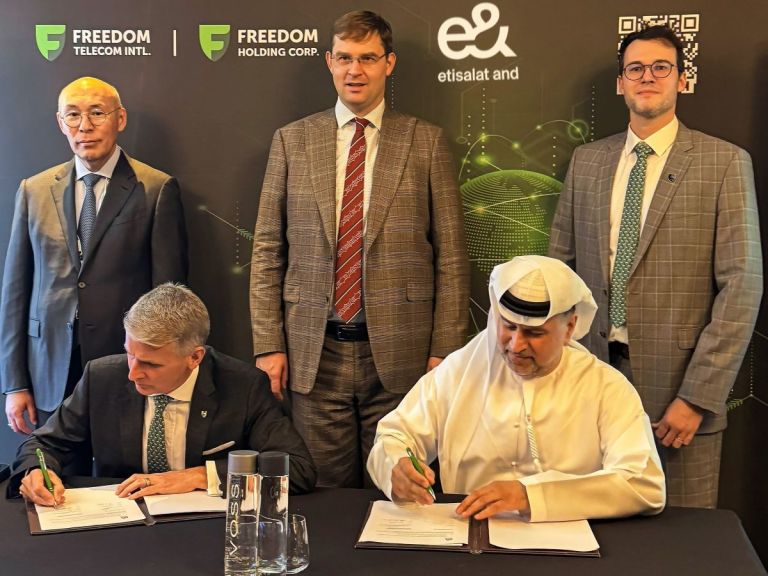
Freedom Telecom International (FTI), a subsidiary of Freedom Holding Corp. (FRHC), and e&, a leading global technology group, have signed a Memorandum of Understanding (MoU) to explore strategic collaboration opportunities at the intersection of telecommunications and financial technology across international markets.

The MoU establishes a high-level framework for cooperation, enabling both organizations to leverage their respective strengths in fintech, digital financial services, and telecom innovation. Through this collaboration, FTI and e& intend to assess opportunities to introduce new digital value propositions, explore advisory capabilities, and examine areas where jointly developed fintech–telco initiatives may create meaningful impact in future partner markets.
Although preliminary by design, the agreement represents a meaningful step toward a broader strategic collaboration. In the spirit of this partnership, both parties will continue exploring ways to deepen their cooperation and unlock joint opportunities across relevant markets.
 
Timur Turlov, Founder & CEO of Freedom Holding Corp., commented:
“Telecommunications development is a core pillar of our long-term strategy. Partnering with such a major global player as e& opens new horizons for Freedom Telecom International’s global growth. The combined strengths of a global telecom ecosystem and a high-growth fintech platform enable us to scale innovation across key markets. We firmly believe that this synergy will create strong competitive advantages and accelerate the implementation of joint initiatives worldwide.”
 
Jasim Abdalla, Head, Partner Markets, e& international, said:
“We see strong potential to work with trusted partners who help us bring more value to customers. This collaboration with FTI builds on our experience serving more than 250 million overall subscribers, including more than 16 million fintech customers across international markets. Together, we aim to expand reliable financial services into new markets and develop offerings that meet real customer needs.”
 
Johannes Hummer, CEO of Freedom Telecom International, commented:
“This MoU marks an important milestone in our relationship with e&. Together, we are exploring how the combined strengths of a global technology group and a high-growth financial technology ecosystem can open new avenues for innovation across diverse markets. Today’s signing is the first step toward building long-term, scalable value for customers and partners worldwide.”

About the Signing Parties

e& is a global technology group committed to shaping the digital future across markets in the Middle East, Asia, Africa, and Europe. In 2024, the group achieved AED 59.2 billion in consolidated revenue and AED 10.8 billion in net profit. e& continues to maintain its position as a financial powerhouse, reflected by its strong credit rating and solid balance sheet.
Founded in Abu Dhabi over 48 years ago, e& has evolved from a telecom pioneer into a technology group. Today, its footprint spans 38 countries, offering a comprehensive portfolio of innovative digital services ranging from advanced connectivity, entertainment, streaming, and financial services to AI-powered solutions, cloud computing, ICT, cybersecurity, and IoT platforms.
The Group is structured around five core business pillars: e& UAE, e& international, e& life, e& enterprise, and e& capital, each catering to distinct customer and market needs. These pillars empower e& to lead in various sectors, from telecom and digital lifestyle to enterprise services and venture investments. The ongoing strategic investments in AI, IoT, 5G, and cloud services reinforce its leadership in the global technology landscape, driving the future of smart connectivity and innovation.
To learn more about e&, visit eand.com.
 
On the other hand, Freedom Telecom International supports global partners in deploying and integrating Freedom Holding Corp’s portfolio of digital financial and lifestyle services. FTI also evaluates and executes investment opportunities in the telecom and fintech sectors, promoting financial and digital inclusion in emerging and frontier markets.
Freedom Holding Corp. is a leading international provider of investment and brokerage services across the markets of Central Asia and Eastern Europe, with more than 16 years of experience in global financial markets. The Holding’s shares are publicly traded on the NASDAQ stock exchange under the ticker FRHC with current market capitalization at USD 8.2 billion, and total assets amounting to USD 10.3 billion. The total number of clients in its digital ecosystem exceeds 11 million.
Freedom Holding Corp. employs over 10,000 professionals who are based in 231 offices in 22 countries, including Kazakhstan, the United States, the United Arab Emirates, Cyprus, Poland, Spain, Uzbekistan, and Armenia. The company’s principal executive office is located in New York City.
To learn more about Freedom Telecom International, visit: freedomtelecominternational.com
To learn more about Freedom Holding Corp., visit: freedomholdingcorp.com
Media Contacts
Freedom Telecom International: contact@freedomtelecominternational.com
e& UAE: mediaoffice@eand.com 

Rural Broadband ISP Quickline Refreshes UK Packages for New Year 2026 | ISPreview UK

Original article ISPreview UK:Read More

Alternative rural broadband ISP Quickline, which is building a new gigabit-capable full fibre (FTTP) and fixed wireless (FWA) network across parts of Yorkshire and Lincolnshire in England (3-Year Rollout Plan), has kicked off the New Year with a mild package refresh that reduces some prices and removes the cheapest entry-level fibre tier.

The most obvious change is the removal of their entry-level “START” package for new customers (no change for existing subscribers), which previously offered broadband speeds of 100Mbps (50Mbps upload) from £22 per month. Instead, the cheapest fixed-line option is now “Full Fibre 200” (previously known as “CONNECT“), which offers symmetric speeds of 200Mbps for £24.99 per month on a 24-month minimum term (reduced from £29.99 before).

NOTE: Quickline is supported by funding of c.£500m from Northleaf Capital Partners, as well as c.£300m of public subsidy from four Project Gigabit contracts (here, here and here), plus c.£225m in term loans and debt guarantees from the National Wealth Fund and a £25m term loan from NatWest.

After that, the 500Mbps tier has also been reduced from £39 to £28.99 per month, while their top 1000Mbps (gigabit) package has been reduced from £49 to £32.99 per month. All packages include a commitment to “no mid-contract price rises“, free install, free router and offers up to £300 in switching credit if you need help to cover the cost of exiting your previous ISP contract early, during a switch.

Quickline is currently aiming to extend gigabit-capable broadband to a further 360,000 UK premises across thousands of rural communities (roughly 170k via publicly funded projects and almost 200k from commercial builds) and the provider was previously aiming to end 2025 with a total of 200,000 premises passed.

O2 Priority Offers Prize to Cover UK Mobile or Broadband Bills for 1 Year | ISPreview UK

Original article ISPreview UK:Read More

Customers of UK ISP Virgin Media and O2’s various broadband and mobile packages may like to know that their ‘Priority‘ app, which rewards existing subscribers with various special offers and discounts, has today announced a bunch of new drops and prizes available as part of its Blue Monday’s initiative through January. One of which will cover your mobile or broadband bills for 12 months.

The latest additions include the “chance” (i.e. you have to open the app and ‘tap to play’ every Monday for a chance to secure one of the offers) for members to have their O2 mobile or Virgin Media broadband bills credited for an entire year, as well as 25% off hair and beauty with Treatwell and 3 months of FREE Super Duolingo etc. “There will be over 160,000 rewards given away to Priority members this January alone,” said VMO2’s announcement.

In terms of the headline offer of 12 months free broadband and mobile. Priority members who win this will have credit for their 12 upcoming monthly bills for either their mobile airtime and device, broadband bill or Volt applied to their account. VMO2 will look at charges for next 12 months and apply one credit value to all months. But we suspect they’ll only be giving a very few of these rewards away.

Business ISP Exascale Launches UK Consumer Broadband Brand | ISPreview UK

Original article ISPreview UK:Read More

Communications provider and UK network builder Exascale, which has deployed their own gigabit speed Fibre-to-the-Premises (FTTP) network to a few thousand premises in part of Telford and Wrekin, has quietly launched a more consumer focused broadband brand that will sell packages via several fibre networks.

The change means that Exascale’s main website has recently switched its focus to sell residential broadband packages, while business and wholesale connections have been separated into their own section. Previously there wasn’t much distinction and the ISP largely adopted more of an overall focus on business connectivity, despite selling some consumer-grade broadband packages.

At present the consumer pricing on their website still only reflects their own-built full fibre (on-net) network. This is priced from £25.99 per month on a 24-month term for symmetric speeds of 50Mbps (inc. free installation, WiFi 6 mesh router and unlimited usage), which rises to £48.99 per month for their top 1000Mbps package. But as above, the coverage of their on-net fibre is very limited.

The good news is that Exascale’s consumer broadband service will shortly be expanded to include packages on several additional full fibre networks, including Openreach, CityFibre (following a recent agreement) and Gigaclear. The online order journey and pricing (yet to be finalised) for these should go live sometime during January 2026, but Exascale hasn’t yet confirmed an exact date to ISPreview.

Gov Look to Boost EE’s 4G Based UK Emergency Services Network via Satellite | ISPreview UK

Original article ISPreview UK:Read More

The UK Space Agency (UKSA) has reportedly invited interested suppliers, such as Starlink, to engage on the possibility of harnessing Direct to Device (DtD) based signals from broadband satellites to help resolve coverage gaps in the Government’s massively late and over-budget 4G based Emergency Service Network (ESN); currently being delivered by EE (BT).

Just to recap. The emergency services (police, fire etc.) were supposed to have moved away from the old Motorola-owned Airwave network by now, which harnessed TETRA (Terrestrial Trunked Radio) technology. The old network is slow (dialup / ISDN like data speeds) and expensive, although it does deliver strong voice coverage (99%+ geographic reach).

NOTE: Mobile operator EE (BT) holds the main 4G based network contract, but the ESN covers a variety of different areas with other suppliers (e.g. handsets, software etc.). The ESN has its own separate setup alongside EE’s commercial 4G network; the two sides should not be confused.

The high cost and limited capabilities of Airwave are often highlighted as two of the main reasons why the previous UK government, in 2015, decided to replace it with a 4G alternative (ESN) – the first country to do so. The Home Office originally expected that emergency services could start using the ESN in September 2017, allowing Airwave to be replaced by December 2019, but the contract ended up being billions of pounds over budget and years behind schedule due to a mix of technical problems, legal (competition) disputes and development delays (here).

Most of the problems with the ESN stemmed from issues with its software and hardware, rather than the network side. But at the same time it’s still recognised that EE’s 4G network struggles to reach every single location within the UK, and this is potentially one area where the new generation of broadband satellites could help.

Over the past few years’ we’ve reported on various developments in the related Direct to Device (DtD) market, which often allows satellites in space to link with unmodified Smartphones on the ground for limited but useful communication (voice/text), data and general roaming / coverage improvements (here).

The most mature of these is Starlink’s (SpaceX) Direct to Cell (DtC) service, which has already been adopted by O2 in the UK (O2 Satellite will launch in early 2026). But Vodafone has separately teamed-up with AST Space Mobile to deliver a similar solution and BT (EE) are working with Starlink on a rural broadband solution (here), albeit not yet DtC. On top of that, Amazon’s Leo project is also set to deliver mobile connectivity in the near future.

Suffice to say that it would make perfect sense for the government to be exploring how satellite based mobile connectivity could also be used to help complement the ESN and potentially fill in any coverage gaps, which is exactly what the Telegraph (paywall) reports is now being explored by the UKSA.

We use the word complement above, rather than replace, because at the end of 2024 EE secured a 7-year extension – worth £1.29bn – to their 4G based ESN network contract until 2032 (here); this includes the option of a 1-year extension to that. We think it would also be unlikely for the UK government to place the national security of ESN connectivity totally in the hands of a foreign satellite operator.

Meanwhile, the Home Office still doesn’t expect the ESN to be fully operational until 2029, and the total predicted cost of the project has already more than doubled from an original £6.2bn estimate to £14bn. The bigger question may thus be whether or not the hardware and software side of the ESN can be adapted in time to work effectively alongside satellite connectivity.

Virgin Media UK Reveal XMas 2025 and New Year 2026 Broadband Traffic | ISPreview UK

Original article ISPreview UK:Read More

Internet provider Virgin Media (O2) has kindly furnished ISPreview with some general traffic stats from their fixed broadband network over the festive period, which for example reveals that Christmas Day internet traffic was up 11% on last year (broadly in line with traffic growth generally). But compared to an average Thursday in 2025, traffic was up by 22%.

In terms of New Year’s Eve, Virgin Media reported that fixed broadband traffic was up 10% from last year and that’s also 12% higher than the average Wednesday in 2025. Sadly, the provider wasn’t yet able to reveal any data on mobile (4G, 5G) traffic over the same period.

The above stats come shortly after VMO2 revealed how they’d seen an 8% rise in broadband usage (down slightly from a rise of 8.1% in 2024) and an 18% rise in mobile traffic through the past year (up from 9%) – driven by growing use of AI, live sports streaming and major game releases (here); we also got some other network insights just a few days after that (here).

Starlink to Shift LEO Ultrafast Broadband Satellites into a Lower Orbit | ISPreview UK

Original article ISPreview UK:Read More

The Vice President of Starlink Engineering for SpaceX, Michael Nicolls, has revealed that they’re going to move all of the broadband satellites they currently have in a Low Earth Orbit (LEO) at around 550km above the planet to c.480km (impacting roughly 4,400 satellites) over the course of 2026.

According to Nicolls, the “significant reconfiguration” of Starlink’s satellite constellation is a change that is “focused on increasing space safety” and is being “tightly coordinated with other operators, regulators, and USSPACECOM.” Just for context. Starlink currently has around 9,400 satellites in Low Earth Orbit (c.5,900 are v2 / V2 Mini) – mostly at altitudes of c.500-600km.

NOTE: By the end of July 2025 Starlink’s global network had 6 million customers and 110,000 of those were in the UK (up from 87,000 in 2024) – mostly in rural areas.

Residential customers in the UK usually pay from £55 a month for the ‘Residential Lite’ unlimited data plan directly from Starlink (kit price may vary due to different offers), which promises downloads of up to 250Mbps (175Mbps average) and uploads of c.15-35Mbps. Faster packages exist at greater cost, while cheaper, albeit more restrictive (data capped), options also exist for roaming users (e.g. £50 per month for 50 GigaBytes of data).

However, Starlink is no longer the only game in LEO town, with orbital space around the Earth fast becoming increasingly packed at lower altitudes and the risk from collisions rising. The move to shift a significant portion of Starlink’s constellation into an even lower orbit is thus intended to mitigate against some of the risks the current environment could create.

Michael Nicolls said (X):

“Lowering the satellites results in condensing Starlink orbits, and will increase space safety in several ways. As solar mininum approaches, atmospheric density decreases which means the ballistic decay time at any given altitude increases – lowering will mean a >80% reduction in ballistic decay time in solar minimum, or 4+ years reduced to a few months. Correspondingly, the number of debris objects and planned satellite constellations is significantly lower below 500km, reducing the aggregate likelihood of collision.

Starlink satellites have extremely high reliability, with only 2 dead satellites in its fleet of over 9000 operational satellites. Nevertheless, if a satellite does fail on orbit, we want it to deorbit as quickly as possible. These actions will further improve the safety of the constellation, particularly with difficult to control risks such as uncoordinated manoeuvres and launches by other satellite operators.”

One small side note is on that “extremely high reliability” claim is with how it overlooks the satellites that were lost in other ways, such as during launch or early orbit insertion. But none of this should be confused with the many others that have also been decommissioned as part of a regular routine (they’re only designed to last for a few years before being sent to burn up in the atmosphere).

The announcement doesn’t mention it, but shifting so many satellites into a lower orbit could also deliver a small improvement in network latency.

UK ISP BT Criticised Over Failure of Broadband Battery Backup During Power Cuts | ISPreview UK

Original article ISPreview UK:Read More

Broadband provider BT (EE) has been criticised by a resident of the remote Outer Hebrides (Scotland) island of Scalpay after they found that the Battery Backup (BBU) device, which the ISP provided for their internet and Digital Voice (phone) service, failed to work in two out of three recent power cuts. A bit of a problem as the house also gets no mobile signal.

The need for a BBU is relevant because the industry is now in the final process of retiring legacy phone services (PSTN/WLR) by 31st January 2027 (details). But one key advantage of the old method was that copper phone lines could be powered from an exchange, thus BBU’s were not usually required. Sadly this is not possible with most modern internet-based digital phone equivalents (especially if fibre optic FTTP lines are involved as these cannot carry electricity).

NOTE: Some particularly vulnerable telecare users with existing lines may be able to access the SOTAP Analogue product instead, which is a temporary phone line service that does NOT require broadband to work and can still function during a power cut.

Internet and phone providers like BT thus optionally provide a BBU to “vulnerable customers” (usually for free) who have taken their IP-based Digital Voice (phone) services. The BBU is designed to ensure that the customer’s router and optical modem (ONT) still works when there’s a power cut, which means they’re able to make an emergency call using an existing handset. Regular customers can also get one of these, albeit for an additional cost.

However, in the aforementioned case on Scalpay, Jane Roberts and her husband said (Stornoway Gazette): “There have been three power cuts recently and the broadband has only worked in one of them. It’s leaving no communication for emergency services … BT and their new digital voice system are going to be responsible for possible fatalities in the future when they are predicting everyone will be on it by the end of 2027.

According to Jane, BT’s BBU system failed during the first power cut, had worked during the second power cut – on Boxing Day – and then failed again on the third, which came just 20 minutes after the second power cut. We assume the system in this case is setup correctly, since it did at least work on one of those occasions, but it’s hard to tell with so little detail and only some very anecdotal feedback from one user.

A BT spokesperson said:

“UK landline providers are switching from analogue to digital services, as the old technology is increasingly unreliable and no longer fit for purpose.

We recognise the concerns raised and encourage any customers experiencing issues to contact us directly so we can review their setup and provide a tailored solution. At BT, keeping customers connected is our top priority and we remain committed to supporting vulnerable customers through the switch.”

Sadly, the article doesn’t provide any solid details to help us examine the circumstances around this case, such as precisely which BBU unit Jane has (BT supply two different solutions), what her setup looks like or how long the power cuts lasted etc. BT’s latest BBU Plus kit (pictured) launched last year alongside other providers (Vodafone, Zen Internet and KCOM) and is designed to last for 4 hours (here), before going into an idle mode that reserves just enough power for an emergency call.

The article suggests that Jane had switched to the new Digital Voice service late last year, and so we assume her home would have been provided with the latest BBU Plus kit. But obviously if any of the power cuts lasted longer than 4 hours then that might become a problem. In addition, if any of those power cuts also impacted BT / Openreach’s wider network, then it wouldn’t matter if the BBU itself was working or not as there’d be no connectivity either way (not even an old legacy phone would have worked in that circumstance).

Suffice to say that more detail and context is required in order to properly assess what actually caused the system not to work, which is important because many other people will be installing similar systems and expecting it to work.

In the meantime, consumers can of course optionally buy a larger portable power station [affiliate link] online for more money, but we recommend only getting one that uses a LiFePO4 battery, as they last longer and are better at holding a charge. However, if you have deeper pockets and also want to save money on your electricity bills, then a whole-home solution (e.g. GivEnergy, Tesla Powerwall etc.) that charges up at cheaper off-peak rates could be another option, but the latter does tend to cost several thousand pounds.

Otherwise, the move away from the old legacy phone network is a somewhat unavoidable change, due both to the roll-out of full fibre connections and the fact that the legacy phone network is now rapidly reaching “end of life“; it’s already becoming unreliable and sourcing replacement hardware when parts fail is difficult. Suffice to say that the change isn’t going to be reversed, so it’s now much more important to consider having a backup.

Gigabit Broadband Cover Reaches Nearly 90 Percent of the UK in H2 2025 | ISPreview UK

Original article ISPreview UK:Read More

ISPreview has today published our biannual H2 – 2025 summary of fixed broadband coverage, which reveals that “full fibre” (FTTP) ISP networks have grown to reach 81.89% of UK premises (up from 78.06% in H1) and 89.6% are within reach of “gigabit” 1000Mbps+ speeds (up from 87.84%) – close to the major milestone of 90%. Read on to see details for England, Wales, Scotland and N.Ireland.

All the new gigabit-capable network (1000Mbps+ or 1Gbps+) coverage added during the second half of 2025 has come from Fibre-to-the-Premises (FTTP) based networks via Openreach (BT), nexfibre (Virgin Media), CityFibre, Netomnia (Brsk, YouFibre), Grain and a few other alternative networks (Summary of UK Full Fibre Builds). But the overall deployment pace has slowed further this year due to wider market pressures.

NOTE: Ofcom currently predicts (here) that gigabit coverage will reach between 91% to 97% by January 2028. The government’s £5bn Project Gigabit scheme also aims to help extend gigabit-capable broadband (1Gbps+ downloads) coverage “nationwide” (c.99% of premises) by 2032 (here).

The reason why “gigabit” coverage is currently still higher than “full fibre” (FTTP) is down to the millions of premises that continue to be covered by Virgin Media’s older Hybrid Fibre Coax (HFC) network, which uses gigabit-capable DOCSIS 3.1 technology via a Hybrid Fibre Coax (HFC) network (there’s a lot of overbuild with FTTP in urban areas). This too will be upgraded to FTTP by 2028, but that’s a slow process.

In addition, most of the progress on gigabit-capable builds seen during 2025 is still down to private investment (commercial builds have already delivered the first 80%+ of gigabit cover), often with only a little support from the Government’s various schemes. But the Project Gigabit scheme, and its subsidised rollout contracts with various different suppliers, are having an impact on this, albeit primarily via the hardest to reach premises (e.g. rural) that typically take longer to cover.

H2 2025 Broadband Coverage Figures

Listed below is the latest independent modelling from Thinkbroadband to the end of December 2025 (H2 – 2025). We should point out that the figure for ‘Under 10Mbps‘ doesn’t include any mobile (4G/5G) coverage (we only looked at fixed line services), which plays a part in the official Universal Service Obligation (USO) but isn’t included in TBB’s mapping. Sadly, it’s incredibly difficult to do an accurate model for mobile networks, especially in terms of a specific performance level.

NOTE: The figures in brackets (%) represent the previous H1 – 2025 result, as measured in late June 2025.

Fixed Broadband Network Availability H2 – 2025

Area 30Mbps+ Full Fibre Gigabit % Under 10Mbps
England 98.58% (98.48%) 82.11% (78.24%) 90.15% (88.54%) 0.49% (0.51%)
UK 98.44% (98.32%) 81.89% (78.06%) 89.58% (87.84%)
0.62% (0.66%)
Wales 97.78% (97.61%) 82.75% (78.32%) 85.13% (81.50%) 1.30% (1.37%)
Scotland 97.40% (97.06%) 74.45% (70.20%) 84.18% (81.89%) 1.48% (1.65%)
N.Ireland 98.83% (98.73%) 96.74% (96.46%) 97.06% (96.84%) 0.64% (0.71%)

NOTE: It’s very important to remember that Government / political coverage targets, like the previous “85%” for gigabit by 2025, reflect a national average – this can of course be better or worse for some areas (e.g. some counties may achieve higher coverage, while others could be below that).

Take note that each region (Scotland, Wales etc.) may also have its own policy and targets, which will feed into the central UK coverage figure. Furthermore, it’s worth highlighting how much of an impact newer alternative networks (altnets) are having on all this – excluding coverage by Openreach, KCOM (Hull) and Virgin Media.

Altnets were found to have covered 44.79% of the UK with FTTP by the end of H2 2025 (up from 42.26% in H1). This breaks down as 47.36% in England (up from 44.56%), just 20.87% in Wales (up from 18.82%), 34.81% in Scotland (up from 33.95%) and 41.65% in Northern Ireland (up from 41.08%). But the overall coverage improvement delivered from this will be reduced due to overbuild between so many networks, particularly in urban areas.

As stated earlier, this data is a modelled estimate, not least because it won’t always reflect the very latest real-world position of ever single network. But it’s still one of the best and most up-to-date gauges that we have for checking against official claims (Ofcom’s own data tends to many months behind the latest developments, so TBB’s data is usually more current).

Solutions for Slow Broadband Areas

Finally, those still stuck in sub-10Mbps speed areas will, at least for now, be left with little option but to try harnessing the flawed 10Mbps Universal Service Obligation (USO) via BT (UK-wide) or KCOM (Hull-only). Many of those who have pursued the USO say they were offered a mobile broadband (4G or 5G) connection via EE, but those considered “delivered” under the USO itself usually get full fibre (FTTP) lines.

However, the reality is that some people will find they live in areas where not even the USO can cover the colossal upgrade costs of getting FTTP (here and here). The previous government was in the process of examining support options for remote premises and had also been preparing to review the broadband USO (here), which may bring some changes in the future (the Labour Party previously called for a 30Mbps USO). But we haven’t seen any solid updates on this since 2024.

Failing that, consumers could either try waiting to see if the problem gets resolved or consider exploring the option of a Low Earth Orbit (LEO) based satellite service (Starlink is good, and they will be joined by Amazon’s Leo network in 2026). We would also recommend that consumers check via Three UK / Vodafone and O2 (VMO2) to see if any of those deliver better 4G or 5G mobile coverage than EE in your area (ideally by conducting your own tests, since official coverage maps are fairly useless) – see our guide to external antennas.