WightFibre Make Netgem’s New PLEIO UK TV Box Available on Isle of Wight | ISPreview UK

Original article ISPreview UK:Read More

Broadband ISP WightFibre, which have deployed their own gigabit speed Fibre-to-the-Premises (FTTP) network across the Isle of Wight – just off the South Coast of Hampshire (England), has become the latest internet provider to make Netgem TV’s new PLEIO set-top-box – including support for the new Freely live TV streaming service – available at a discounted price.

As with the prior announcements from Brsk and Connect Fibre, this news won’t come as a surprise because Netgem TV already revealed that WightFibre would be one of the first to adopt PLEIO as part of last week’s launch (here). But at the time, the ISP hadn’t yet made the new hardware and service available to their customers, which changes today.

The provider also has a fairly attractive deal on the new service and box, which offers it at only £5.95 per month for the first 12 months of service and then £8.95 thereafter. Broadband bundles that include the PLEIO streaming box also start at just £26.90 per month.

Alternatively, anybody can buy PLEIO at retail via Amazon for £99, but this doesn’t include their optional service subscription for premium channels and games (an extra £9.99 monthly if you buy the hardware at retail). The catch is that, due to high demand, the new box is currently out of stock via Amazon and so getting it via an ISP bundle is currently the only option.

Skyfora and LMT turn Latvia’s 5G network into Europe’s first real-time GNSS weather sensor grid at NATO DiBaX | Total Telecom

Original article Total Telecom:Read More

[RIGA, LATVIA / HELSINKI, FINLAND, November 26, 2025] Skyfora and LMT have demonstrated Europe’s first real-time, rapid-update, kilometer-resolution GNSS weather observation grid, built on LMT’s 5G network and other GNSS receivers in Latvia and showcased during NATO’s Digital Backbone Experimentation (DiBaX).

Instead of installing new weather stations, Skyfora’s technology turns existing GNSS receivers at 5G sites into high-precision weather sensors. This converts the telecom network into a dense atmospheric observation grid that delivers continuous updates at kilometer-scale resolution – in real time, across large areas.

“We are turning existing 5G towers into the world’s densest weather observation network – with a software update,” said Fredrik Borgström, CEO at Skyfora. “With dense, real-time observations of atmospheric humidity, AI weather models can finally reach the accuracy that defence, critical infrastructure, energy and other weatheraffected industries have been waiting for.”

At DiBaX in Latvia, LMTs 5G sites powered with Skyfora’s Weather Engine, streamed continuous measurements of humidity derived from small delays in the GNSS signals as they pass through the atmosphere. This provides a detailed, real-time view of how storms, extreme rainfall, flood risks, and heat stress are emerging and evolving.

“For LMT, this project demonstrates how our network act as a sensor by transforming existing infrastructure into a source of real-time, high-resolution weather intelligence. Together with Skyfora, we’re turning cutting-edge innovation into practical, dual-use solutions that create new value for defence, energy, critical infrastructure, and other weather-sensitive sectors.” said Armands Meirāns, Head of R&D at LMT Defence.

New weather intelligence for defence and industry

The Latvian demonstration shows how telecom-powered GNSS meteorology can support:

  • Defence and security – improved situational awareness for mission planning and operations.
  • Civil protection and infrastructure – earlier, more precise alerts for storms, flash floods and heat stress on cities and critical assets.
  • Energy trading and renewables – sharper short-term forecasts for wind, solar and electricity grids improve trading and asset protection.

Designed for rapid national scale-up

Skyfora’s solution for telecom operators is designed to scale quickly:

  • No new hardware – uses GNSS receivers already existing in 5G infrastructure.
  • Software-enabled – deployed as a software and data-processing layer on top of the existing network.
  • AI-ready data feed – continuous, high-resolution weather observations in real-time that directly fuel advanced forecasting models.

By combining Skyfora’s GNSS meteorology with advanced 5G networks, operators can convert their telecom infrastructure into next-generation weather and climate intelligence, strengthening both national resilience and defence preparedness.


About Skyfora

Skyfora, a company dedicated to pushing the boundaries of meteorological innovation, transforms the future of meteorology with unique, high-resolution weather data. Skyfora´s patented solutions extract atmospheric data from GNSS receivers in existing infrastructures like telecom networks, unlocking previously untapped data sources to power state-of-the-art AI weather models. By delivering a continuous flow of high-resolution weather intelligence, Skyfora boost AI forecasts enhancing climate resilience and supporting critical decision-making across weather-sensitive industries – from renewable energy to critical infrastructure, transport & logistics and insurance. Skyfora is redefining what’s possible in weather forecasting on a global scale

Skyfora media contact:

Fredrik Borgström, CEO, fredrik.borgstrom@skyfora.com, https://www.skyfora.com/


About LMT Defence

LMT Defence specialises in the development and integration of cutting-edge technologies to strengthen and advance the defence sector. By harnessing big data analytics, machine learning, artificial intelligence, and the latest communication innovations, LMT Defence consistently delivers mission-critical solutions that drive operational excellence.

Macquarie Technology explores JV, capital recycling for $3bn data centre | Total Telecom

Original article Total Telecom:Read More

aerial photography of bridge

News

The Australian technology giant is considering “a range of potential funding alternatives” to support the project

Earlier this week, Macquarie Technology Group revealed to investors that it was exploring funding options for a new 150MW data centre campus project, aiming to meet the expected boom in demand for AI and cloud computing.

The new campus would require between $2.5 billion and $3 billion in capital, excluding land value.

Speaking to investors on Tuesday, CEO David Tudehope said that the company was currently exploring its options for financing the data centre build out at the optioned location. One possibility would be to recycle capital by selling off a stake in the company’s more mature data centre assets. Alternatively, Macquarie could also partner with a third-party to create a joint venture.

“Funding for the new campus […] will come from recycled capital from the existing data centres and/or a development partnership,” said Tudehope, as reported in the Financial Review. “Both of those ideas are quite common overseas but are less common in Australia.”

The tech company has already struck a deal for the required land in Sydney for $240 million earlier this year, to be funded through cash reserves and debt.

Macquarie has been investing in data centres since 2018, with its flagship project taking place at the Macquarie Park Data Centre Campus in Sydney. Phase 1 of the site’s development, known as Sydney IC3 East, was completed in 2020, providing over 12MW of capacity. Phase 2, will see the site scaled further with the construction of the IC3 Super West data centre, bringing total capacity to 65MW.

Construction on C3 Super West began last year and is expected to be complete by Q3 2026. Macquarie extended its loan facilities to $450 million last year to facilitate this expansion.

Combining these existing assets with the planned 150MW would make Macquarie one of the largest data centre providers in Australia.

Keep up to date with all the latest telecoms news with the Total Telecom newsletter

Also in the news
Connected Britain Award winners 2025 announced!
Netomnia announces ‘powerful and ambitious’ rebrand ahead of Connected Britain
VodafoneThree drops Samsung, relies on Nokia and Ericsson for £2bn network upgrade

Full Fibre UK Broadband Connections Overtake FTTC for First Time | ISPreview UK

Original article ISPreview UK:Read More

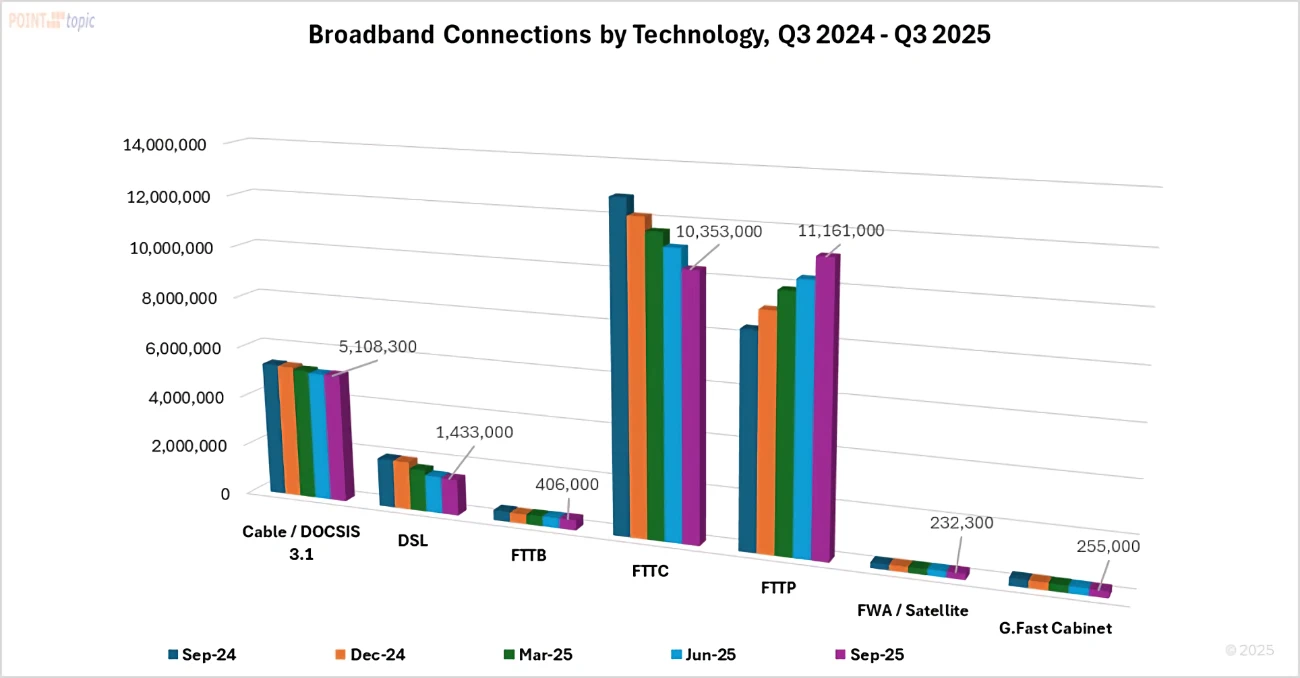
The latest estimated Q3 2025 market statistics from telecoms analyst firm Point Topic have revealed that, for the first time, Fibre-to-the-Premises (FTTP) based UK subscriber broadband ISP connections (11.56 million) have overtaken the previous generation of hybrid Fibre-to-the-Cabinet (FTTC/VDSL2) lines (10.6m).

In terms of the other broadband technologies. Some 5.1 million connections use Virgin Media’s cable / hybrid fibre coax (DOCSIS 3.1) network, which is followed by 1.43 million on pure copper line ADSL (ADSLMax, ADSL2+) technology and 406,000 on Fibre-to-the-Building (FTTB) – predominantly reflecting Hyperoptic’s base. After that, some 255k are connected via a G.fast cabinet (we think it may be even less) and 232k via satellite and fixed wireless networks.

Point-Topic-UK-Broadband-Connections-by-Technology-Q3-2025

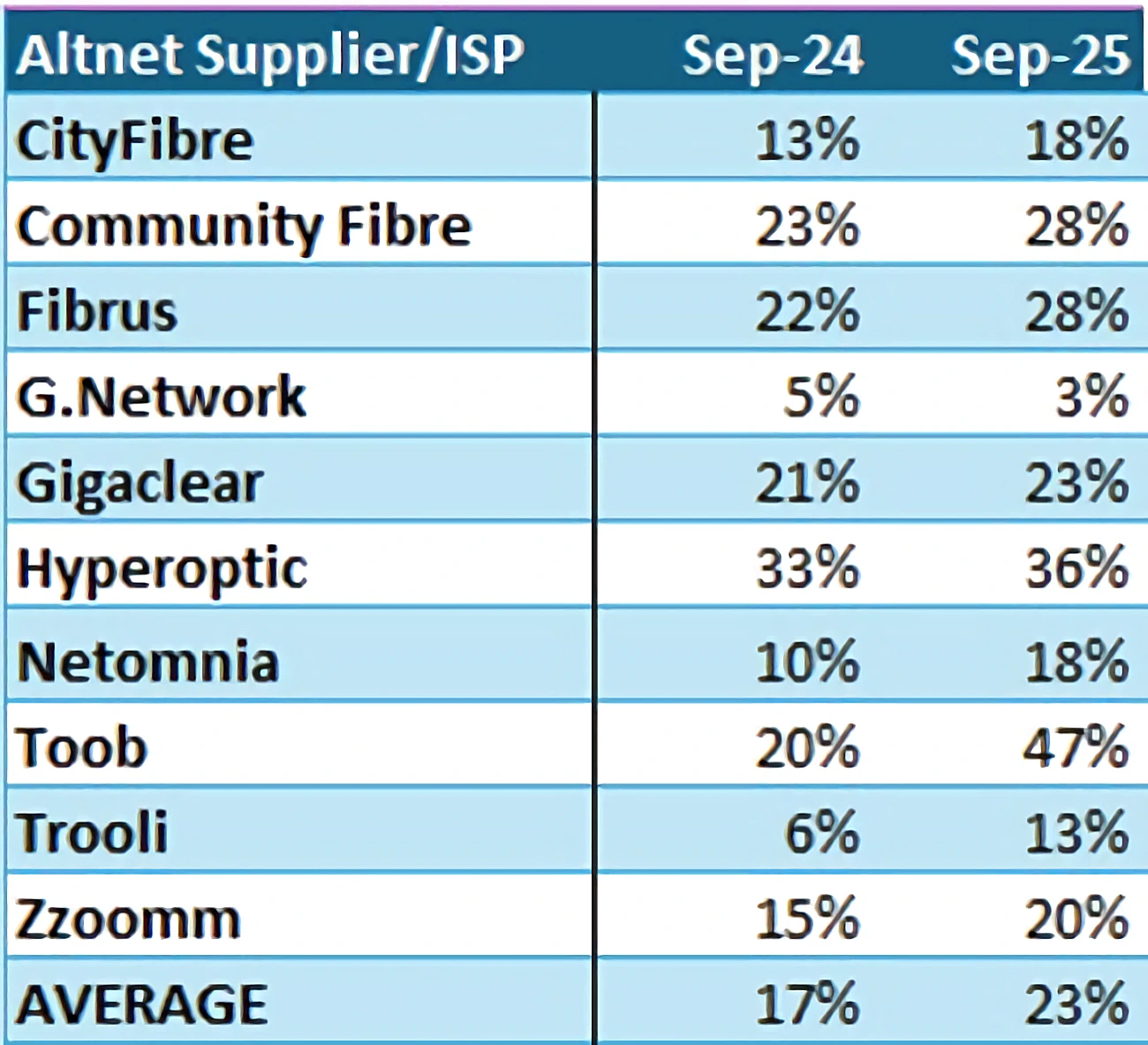
Independent (or alternative network) providers continued to focus on subscriber take-up and saw 193k net additions in Q3 (up from 190k in the previous quarter), with a total consumer broadband FTTB/P subscriber base reaching 3.02 million (up 29% year-on-year). CityFibre alone accounted for 108k additions in Q3 (total base of 730,000), thanks in part to Sky Broadband joining their network.

Year-on-Year Take-up Rates for Selected Altnets (Q3 2024 and Q3 2025)

Altnet-Takeup-by-Selected-Providers-Q3-2025

By comparison, Openreach saw 551k full fibre net additions in Q3, which took their FTTP subscriber base – sold via hundreds of ISPs – to 7.65m (37.7% take-up). But as previously reported, they also lost 242k broadband lines (all technologies) in the quarter to rivals (up from 169k losses in Q2).

The report goes on to summarise a lot of the details we’ve covered before in prior news reports and results announcements, which makes it useful as a general overview of the market.

Q3 2025 UK ISP and network supplier metrics
https://www.point-topic.com/../q3-2025-uk-isp-and-network-supplier-metrics-a-market-overview

Openreach Reveal UK Pilot Pricing for 3.3Gbps FTTP Home Broadband Tier | ISPreview UK

Original article ISPreview UK:Read More

Network operator Openreach (BT) has this afternoon revealed the first pricing for their forthcoming pilot of XGS-PON based Fibre-to-the-Premises (FTTP) broadband ISP lines, which is due to get underway in March 2026. But for now they’re only revealing how much they’ll charge for the 3.3Gbps (3300Mbps) tier.

Just to recap. Openreach’s current full fibre service is largely still based off older Gigabit Passive Optical Network (GPON) technology, which places limitations on how fast they can go before capacity becomes an issue. For example, GPON supports a capacity on each trunk line of up to 2.5Gbps (Gigabits per second) downstream and 1.24Gbps upstream, which needs to be shared between several premises.

NOTE: The operator’s current FTTP network, which is costing £15bn to build, covers around 21 million premises (there are c.32.5m across the UK), but this is due to reach 25 million by December 2026 and then possibly “up to” 30 million by the end of 2030.

As a result, Openreach’s fastest asymmetric consumer broadband product via FTTP currently maxes out at a download speed of 1.8Gbps and uploads of 120Mbps (ISPs usually play it safe and promote this as c.1.6Gbps). However, rural areas covered by their government-funded Project Gigabit (Type C) roll-out contracts can separately access symmetric speeds, albeit only up to 1Gbps, and that’s priced more as a premium business product.

By comparison, the operator’s new XGS-PON technology can potentially handle speeds of up to 10Gbps (the ‘X’ stands for 10, the ‘G’ for Gigabits’ and the ‘S’ for Symmetric speed), which will help them to offer faster broadband speeds and be more competitive with rivals that already have faster tiers using similar upgrades. Consumers might not strictly need such speeds yet, but marketing departments can still use it.

Back in September 2025 ISPreview revealed (here) that Openreach were planning to trial XGS-PON technology in early 2026, which would reach about 40,000 premises in Guildford and push download speeds from ISPs up to a blistering 8.5Gbps (8,500Mbps). The new briefing gives us our first practical taste of that by setting out the pricing for their future 3.3Gbps tier, which will come with upload speeds of either 330Mbps or 3300Mbps (symmetric). This is ONLY for residential premises.

Bandwidth Pilot rental Operative date
Up to 3300/330 Mbit/s £324.00 p.a. 01/03/2026
Up to 3300/3300 Mbit/s £360.00 p.a. 01/03/2026
Connection Pilot charge Operative date
Standard Connection £122.84 01/03/2026
Premium Connection £152.84 01/03/2026
Advanced Connection £297.84 01/03/2026
Standard Connection – XGS Box Swap £0.00 01/03/2026
Proactive FTTP Upgrades Connection Standand £0.00 01/03/2026
Proactive FTTP Upgrades Connection Premium £30.00 01/03/2026
Proactive FTTP Upgrades Connection Advanced £175.00 01/03/2026

At £324 +vat per year (or £27 per month) this looks to be quite competitively priced. But it’s worth remembering that Openreach’s price only reflects the wholesale cost of the line, while retail ISPs still have to add all sorts of extra costs on top before getting to the price you pay (e.g. 20% VAT, network/service features, general costs/support, profit margin etc.).

Consumers in the trial area who already take an FTTP connection from Openreach will of course also need another quick engineer visit in order to upgrade the internal Optical Network Terminal (ONT) to one that supports XGS-PON. We’ve previously revealed details of the new ONTs they’ll be using to support this service (here).

The 8.5Gbps speed mentioned earlier is initially more about testing the capabilities of their new network to handle that performance than launching a commercial product at such speeds (i.e. we suspect it might not be given a price). But the planned future product speeds in their official documentation currently only go up to 3.3Gbps, which to be fair is absolutely fine – it’s still a very impressive performance level.

The classic catch with packages this fast is that most consumers would struggle to harness those top speeds, usually due to Wi-Fi/device limits and any limitations of the online servers you’re connecting with (Why Buying Gigabit Broadband Doesn’t Always Deliver). But if you’re happy to pay for it, why not. The rest of the internet will catch up eventually, and rivals already have faster tiers than 3.3Gbps.

At present it’s too early to identify which ISPs will be launching customer trials using the new 3.3Gbps tier, although EE (BT) were the first to do so when the prior 1.8Gbps tier first emerged. One of the biggest obstacles for other ISPs is that they often have to wait for the next layer of wholesale providers to begin offering circuits at such speeds before they can do the same and this often takes time.

Broadband ISP Zen Internet Expands UK Business Connectivity Products | ISPreview UK

Original article ISPreview UK:Read More

Rochdale-based ISP Zen Internet has today announced that they’ve expanded their Direct Business connectivity portfolio to give UK businesses access to “more full fibre networks than any other ISP“. The main development seems to be the launch of CityFibre’s Business FTTP, Ethernet Flex and Direct Internet Access (DIA) services.

In addition, Zen has also made BT’s SoTAP (Single Order Temporary Access Product) available, which they describe as a “future-proof, all-IP solution for businesses still on ADSL that are not yet in full fibre [FTTP] or FTTC footprints” (we think ‘future-proof’ might be pushing the description it a bit though, as even this should eventually be replaced by fibre).

NOTE: CityFibre’s enterprise-grade Ethernet and FTTP services are now available to more than 260,000 UK businesses through Zen.

As for CityFibre’s Flex and DIA Ethernet services, this includes Ethernet 1000 Flex (offering 200 Mbps committed speeds with burst capacity up to 1Gbps) and 1Gbps DIA Ethernet (a dedicated, uncontended Direct Internet Access service) – both can be quoted by calling Zen’s team directly. But it would be good to see CityFibre going faster than this.

Otherwise, the available speeds on the new CityFibre FTTP for Business products via Zen include 100, 300, 500, 900, 1.8, and 2.5Gbps (symmetric).

Jon Nowell, MD of Zen Business, said:

“Zen Business is building the UK’s most extensive full fibre and leased line network for business. The addition of Full Fibre and Ethernet from CityFibre marks a major step forward in delivering faster speeds and greater value to organisations across the country.

We’re also pleased to unveil BT SoTAP. With the PSTN switch-off fast approaching and ADSL services retiring, we remain committed to helping businesses upgrade to full fibre. In areas where this isn’t yet possible, SoTAP delivers essential continuity as legacy options disappear.”

Andy Wilson, Head of Wholesale at CityFibre, said:

“We’re delighted to be launching our Business Ethernet and FTTP offerings with Zen. This expansion strengthens our shared commitment to delivering choice and value to businesses across the UK. We look forward to supporting Zen to enter new markets and drive growth in 2026.”

Copper thieves see Optus stung by yet another network outage | Total Telecom

Original article Total Telecom:Read More

News

The outage left around 14,000 customers unable to contact emergency services

Optus has suffered yet another network outage, this time impacting around 14,000 customers in southeast Melbourne.

The outage, which took place on Wednesday, was reportedly caused by an “aerial fibre break” caused by thieves stealing copper from from the local underground access chambers.

“We do have that photo evidence and it’s clear that there had been a cut made,” Optus spokesperson Jane McNamara told ABC Radio Melbourne. “We know copper has been removed from the pit and we have contacted police.”

The fibre cut left affected customers without mobile service, including to emergency services, for a number of hours.

“Customers will only be able to call emergency services if they are within coverage of another mobile network or are able to call via WiFi,” warned the company on its website.

Full services have since been restored, with emergency services confirming that they are unaware of any failed emergency calls during the outage

While this outage was not caused by Optus, it nonetheless comes at a sensitive time for the operator. The company has suffered multiple significant network outages this year, the most significant of which, in September, saw 631 people unable to connect to emergency services when needed. Four people are known to have died as a result.

The repeated network outages have saw some politicians calling for a review of Optus’s licence.

“There must be an urgent review of Optus’ licence. They are clearly not capable of providing this essential service and keeping Australians safe,” said Senator Sarah Hanson-Young, the Greens spokesperson for communications and Chair of the Senate Inquiry into the emergency services outage.

So far, the government has not moved to formally review Optus’s licence, but has announced plans to create an independent body, the ‘Triple Zero Custodian’ to oversee Australia’s emergency call services.

Steeper fines are also expected to be enforced.

Keep up to date with all the latest telecoms news with the Total Telecom newsletter

Also in the news
Connected Britain Award winners 2025 announced!
Netomnia announces ‘powerful and ambitious’ rebrand ahead of Connected Britain
VodafoneThree drops Samsung, relies on Nokia and Ericsson for £2bn network upgrade

Broadband ISP Plusnet Launch Black Friday SALE and Reward Cards up to £180 | ISPreview UK

Original article ISPreview UK:Read More

UK ISP Plusnet has kicked off the Black Friday sale across their home broadband packages for new customers, which bundles big discounts on the monthly prices of their Fibre-to-the-Premises (FTTP) and FTTC based packages with Reward Cards (pre-paid Mastercards) that are now worth up to £180.

The internet provider’s home broadband packages are typically data-only plans (no home phone) that include unlimited usage, a new Hub Two wireless router (re-branded BT Smart Hub 2), UK based support, a 24-month minimum contract term, Plusnet’s SafeGuard and Protect internet security features – both powered by Norton – and free activation.

NOTE: Plusnet is powered by Openreach’s full fibre (FTTP) network, which covers around 21 million UK premises but will reach 25m by Dec 2026 and potentially “up to” 30m by 2030.

Take note that, on 31st March each year, the monthly plan price will increase by £4 for broadband. We’ve summarised what this means and the latest deals below, but otherwise Plusnet’s Black Friday deals tend to be some of the best value ones they offer all year. As usual, you’ll need to click the affiliate links in this article to get these discounts.

Plusnet’s Broadband Discounts

Full Fibre 145Mbps (30Mbps upload)
£160 Reward Card
Price: £22.99 per month

Price increases to £26.99pm on 1st April 2026 and £30.99pm on 1st April 2027

Full Fibre 300Mbps (50Mbps)
£160 Reward Card
Price: £24.99

Price increases to £28.99pm on 1st April 2026 and £32.99pm on 1st April 2027

Full Fibre 500Mbps (75Mbps)
£180 Reward Card
Price: £28.99

Price increases to £32.99pm on 1st April 2026 and £36.99pm on 1st April 2027

Full Fibre 900Mbps (115Mbps)
£180 Reward Card
Price: £31.99

Price increases to £35.99pm on 1st April 2026 and £39.99pm on 1st April 2027

The provider also still sells a 75Mbps FTTP and SOGEA (FTTC) based broadband tier that starts at £20.99 and £22.99 per month, respectively, which also includes an £85 Reward Card on the SOGEA option. The SOGEA solution is partly copper based and so tends to suffer from a slightly higher price now.

Chancellor Calls on UK Broadband and Mobile Providers to Play Fair with Price Hikes UPDATE | ISPreview UK

Original article ISPreview UK:Read More

The UK Government’s Chancellor, Rachel Reeves, has today increased the pressure on the country’s main broadband and mobile providers by calling on them to “reinforce” their commitment to “treating customers fairly” by, among other things, confirming that “customers under contract will not face price rises beyond those they signed up for“.

The latest round of pressure has largely emanated from the chorus of displeasure at O2’s (Virgin Media) recent decision to increase their annual mid-contract price hikes beyond the level that customers first agreed when they signed-up (here). Some other providers have also increased the level of mid-contract price rises they apply, but O2 went further by applying this to their existing customers too.

NOTE: The Consumer Price Index (CPI) level of inflation started the year at 3% (Jan 2025) and has since crept up to 3.6%. But last year it was originally forecast to be closer to 2% by now and many telecoms providers will have set their earlier policies based, in part, on that expectation.

In fairness, O2 did allow customers impacted by this to exit their contract penalty free, which Ofcom acknowledged when expressing their own somewhat weak “disappointment” at the change last month (here). But the situation and the ongoing trend of mid-contract price hikes has caused enough consternation to attract much wider levels of criticism than usual.

For example, the Government’s Secretary of State for Science, Innovation and Technology (DSIT), Liz Kendall MP, recently joined the chorus of displeasure by directing Ofcom to “look at in-contract price rises again“ (here) and to “consider the possibility of adopting a similar regime to those such as insurance, where new and existing customers need to be offered the same deal“.

According to a new letter seen by the FT (paywall), Chancellor Rachel Reeves has now decided to weigh in on the issue by penning her own letter, alongside Kendall, to telecoms providers: “We are asking you to reinforce your commitment to treating customers fairly, including by confirming customers under contract will not face price rises beyond those they signed up for,” said the Chancellor.

However, it’s important to consider that this statement can be read in two different ways. On the one hand, it could be seen as the Chancellor making a call for mid-contract price hikes to be banned. But if we consider that the policy of mid-contract price hikes is often one that customers have to accept when they “sign-up“, then she might merely be calling on providers NOT to increase the rate for existing customers at a later date, like O2 did. In the case of the latter, this might actually be seen as a retreat from Liz Kendall’s earlier suggestion to Ofcom.

The letter then goes on to state that the government would be convening a round-table to “discuss further voluntary action to support telecoms customers”, as well as “areas that government can do more to enable the sector to drive investment in the UK’s digital infrastructure”. Sadly, the full letter has not been published and so it’s difficult to judge the detail.

At the same time, it is still important to recognise that network operators often do still have to increase prices due to costs rising in other areas, such as for service provision, regulation, energy and the need to invest in new network upgrades. At the same time, the level of inflation has remained much higher than it was previously forecast to be, which changes the risk and cost assessment that each provider has to make. But many smaller providers are still able to figure all this into fixed price contracts, and so it’s not beyond the bounds of realism for the biggest providers to do the same.

In general, we continue to think it might be better to simply ban the practice of mid-contract price hikes. Using this approach, telecoms providers could still discount the package price across your first contract term and raise prices for new and re-contracting customers, although it might prevent some other types of offers (e.g. first 1-6 months of service free).

We dare say that consumers would find general price reductions for the first term to still be both easier to understand and much easier to advertise, as well as to compare between providers, if mid-contract hikes were simply banned. Convoluted discounts are a headache when it comes to service comparisons.

UPDATE 27th Nov 2025

The full letter can now be found on DSIT’s website (we’ll paste it below). But interestingly, this now includes the following request, which the FT seems to have overlooked: “We would also like you to take proactive steps to move legacy customers onto the pounds and pence approach for price communications with no impact on the timing of planned price increases.”

The above suggestion indicates that the Chancellor may be naive to the fact that a big part of the problem is with how the new “pounds and pence” approach, while more transparent for consumers, also tends to result in customers being hit with bigger bills than the old inflation-linked method (particularly those on the cheapest plans that get hit the hardest).

The Chancellor so mentions giving consumers a “clear and accurate understanding of the quality of service they can expect from their telecoms provider“. Quite how you do that, particularly for some of the more variable mobile and broadband connection technologies (e.g. ADSL, FTTC, 4G / 5G etc.), will be interesting to see.

Dear all,

Telecoms consumer protection

Ensuring continued investment in infrastructure is a central priority for this government. It is also vitally important that consumers are treated fairly, and have confidence in the quality of service they receive. The telecoms sector is fundamental to the success of the UK’s economy and we rely on your commitment to support improved connectivity, provide access to digital services, and enable innovation.

This government has set out a long-term approach to supporting digital infrastructure, underpinned by our 10 Year Infrastructure Strategy. Our ambition is for all populated areas to have access to standalone 5G by 2030, delivered by commercial investment. We also want 99% of premises to have access to a gigabit-capable connection by 2032. We know that this must be a collaborative effort. As such, we are continuing to remove barriers to deployment of both fixed and mobile networks. We are also committed to reviewing the mobile market to ensure that, as the sector evolves, the regulatory framework remains right for investment while delivering high quality of service and fairness for consumers.

The commitments that industry has made through the Digital Inclusion Action Plan, and wider efforts, such as the provision of the lower cost social tariffs are vital in supporting vulnerable and digitally excluded consumers. However, it is clear that more needs to be done to protect all consumers. Ordinary people should feel empowered when engaging with the sector and confident they are getting a good deal.

We are asking you to reinforce your commitment to treating customers fairly, including by confirming customers under contract will not face price rises beyond those that they signed up to. We would also like you to take proactive steps to move legacy customers onto the pounds and pence approach for price communications with no impact on the timing of planned price increases.

We are also asking that you take further steps to ensure that consumers have a clear and accurate understanding of the quality of service they can expect from their telecoms provider in communications with customers, where appropriate.

We will be convening a roundtable to discuss further voluntary action to support telecoms customers, as well as areas that government can do more to enable the sector to drive investment in the UK’s digital infrastructure. Our offices will be in touch with further details, and we look forward to working together on these issues.

Yours sincerely

The Rt Hon Rachel Reeves MP
Chancellor of the Exchequer

The Rt Hon Liz Kendall MP
Secretary of State for Science, Innovation and Technology

In addition, the Chancellor has also written a new letter to Ofcom, which more specifically directs the regulator to publish its “interim review” on the impact of the newest “pounds and pence” approach to consumer pricing by Spring 2026, with a full review due in 2027. Suffice to say that if the regulator does make any changes, then it might take a bit of time to materialise.

Dear Melanie [Ofcom CEO],

Telecoms pricing and transparency

We are writing in light of recent developments in the telecoms market concerning mid-contract price rises, and the important role Ofcom continues to play in protecting consumers in this sector. This builds on correspondence you have already exchanged with the DSIT Secretary of State.

We welcome the action Ofcom took in January to increase transparency around how in-contract price changes are presented to customers entering new contracts and note your recent statement expressing disappointment with O2’s decision to increase prices. We share your concern that these price rises run counter to the spirit of your previous regulatory changes and are particularly disappointing in the context of ongoing cost of living challenges facing many consumers.

As you are aware, inflation remains a key challenge for the government, and we are determined to bear down on it wherever possible. The impact of rising costs on consumers, including in essential services such as telecoms, must be minimised.

The DSIT Secretary of State wrote to you recently requesting an assessment of the impact of the January rule change, as well as consideration of further measures to strengthen consumer protections and transparency in pricing. HM Treasury supports this approach, and we understand that Ofcom is due to publish a report in February outlining trends in switching across telecoms services, as well as data on consumer engagement and confidence in the market.

Building on this work, we would ask that Ofcom produces an interim review of the impact of the January 2025 changes by Spring 2026 with a full review due in 2027.

Separately, we would also ask that Ofcom review the suitability of the current 30-day notice period rule. Specifically, we would welcome Ofcom’s assessment on whether the current rule sufficiently enables consumers to exit their contracts at the point when a price increase takes effect. As we are sure you would agree, it is vital that customers can move to other providers as easily as possible in the face of uncontracted price increases.

This government is keen to play a convening role with industry to underline the importance we attach to these issues. We will be seeking voluntary commitments from industry to protect consumers from unfair pricing practices and would be grateful for Ofcom’s support in the coming weeks regarding this.

Ensuring fairness in the telecoms market is vital to supporting consumers and maintaining trust in the sector. Our officials stand ready to discuss these matters further, we are open to further suggestions you may have to improve consumer outcomes in this sector.

Yours sincerely

The Rt Hon Rachel Reeves MP
Chancellor of the Exchequer

The Rt Hon Liz Kendall MP
Secretary of State for Science, Innovation and Technology

Autumn UK Budget 2025 Brings Little New for Broadband and Mobile UPDATE | ISPreview UK

Original article ISPreview UK:Read More

The Chancellor of the UK Government, Rachel Reeves MP, has today announced her Autumn 2025 Budget and there appears to be no current sign of anything significantly new for broadband and mobile infrastructure (except an update on pushing gigabit broadband into MDUs). In addition, there’s no indication that any of the recent calls for targeted business rates relief on digital infrastructure have been heeded.

Just to recap. The Government currently has two headline investment programmes for improving broadband and mobile – both managed by the Building Digital UK (BDUK) agency. The first is their £1bn industry-led Shared Rural Network (SRN) project, which committed each mobile operator to provide 4G data and voice coverage to 89.2% of the UK’s landmass by 31st January 2027 (this was revised down from 90% in July 2025).

NOTE: Some 87% of UK homes can already access a gigabit broadband network (here) and Ofcom are forecasting a range of 91-97% (homes) by January 2028 (here). Meanwhile, between 89-90% of the UK’s landmass can now access a 4G network from all operators, or 96% from just one operator, and 5G reaches 64-89% of the outside population from all operators (here).

The second is their £5bn Project Gigabit scheme, which aims to make 1000Mbps+ (gigabit) broadband speeds available to c.99% of UK premises by 2032 (revised down from 2030). Back in June 2025 the government confirmed that it would invest £1.9bn into broadband and mobile projects (this comes from existing commitments) until 2029/30 (2025 Spending Review) – largely reflecting the remaining funding from this Project.

Since then, the government has published their 10-Year UK Infrastructure Strategy (10YIS), which among other things confirmed a plan to “bring forward“ a more flexible permitting system (aka – flexi-permits) to boost street works across England and to ease the process of delivering gigabit broadband for leaseholders in multi-dwelling units / large residential buildings (background); albeit with limited detail about how this would be achieved.

Despite the positives, quite a few network operators and organisations have voiced concern over the potentially negative impact from tax rises in today’s budget, which often focus on the threat of rising business rates (here, here, here and here). Coming at a time when network operators are already under pressure from high interest rates, competition and rising build costs, BT (inc. Openreach) and Virgin Media have warned that a hike in business rates could force them to scale-back their network coverage plans.

Suffice to say that all eyes were on today’s autumn 2025 budget to see what sort of changes, if any, the government might make on the telecoms and digital infrastructure front. The bad news is that, at the time of writing, we haven’t seen any particularly big announcements for the sector or indications of a relief from the threat of a business rates hike.

What’s in the 2025 UK Budget?

In an extraordinary development, the now comically named Office for Budget Responsibility (OBR) actually leaked full details of the budget ahead of time by publishing their ‘Economic and fiscal outlook‘ document “too early this morning“. This has since been removed and investigation launched. As a result, we’ve been able to skim that for any developments specifically related to broadband, mobile, telecoms and digital infrastructure, but at the time of writing have come up empty.

However, it’s still possible that the general Budget 2025 Summary document, once published, may contain some non-fiscal details related to telecoms and digital infrastructure that isn’t covered by the OBR and so we’ll update later once that has been published.

In fairness, the government is currently facing a difficult task, due to being extremely strapped for cash (a common issue over the past decade or more). This is largely due to the level of debt and related repayments that have accumulated in recent years.

The flexibility may thus not exist to do everything the industry might want. On the other hand, the government appears to be putting their own digital targets at risk by potentially applying too much tax to the sector and at a time when network operators are already struggling under existing pressures (see above).

UPDATE 1:53pm

The full budget document is now online (linked above), which does include a small update on their plan for helping push gigabit broadband into MDUs (large residential buildings), albeit still quite vague. This is largely in keeping with what was said in their prior infrastructure strategy, but the language is clearer on their approach.

2025 Budget on Gigabit Broadband for MDUs

As set out in the 10-Year Infrastructure Strategy, the government is committed to removing the barriers to gigabit-capable broadband, including for people living in flats. In the next few weeks, the Department for Science, Innovation and Technology will be consulting on measures to create a new right for leaseholders to request a gigabit broadband connection and a duty for freeholders not to unreasonably refuse the request.

The government also said they’d “work with Ofcom to support the availability and adoption of gigabit broadband solutions by business“, albeit without providing any further details.