Ookla Examine Mobile Broadband Upload Speeds and Capacity in the UK | ISPreview UK

Original article ISPreview UK:Read More

Global network benchmarking firm Ookla, which collects data from consumers via their Speedtest.net service (inc. apps), has published a new report that takes a broad look into the impact of mobile (4G, 5G etc.) upload speeds in the age of AI and also reveals how much importance UK operators place upon it (EE, O2, Vodafone and Three UK).

Historically fixed and mobile broadband connections have always tended to prioritise download speeds (i.e. the rate at which data is pulled from the internet to your device), which makes perfect sense because that’s how most of the information we want to access arrives on our devices (loading websites, downloading files, streaming videos etc.).

However, in recent years the importance of upload speeds has steadily risen (i.e. the rate at which you send data from your device to the internet), driven by increasing usage of cloud / remote gaming services, video blogging, video calls, social media and Artificial Intelligence (AI) etc.

Ookla’s new report finds that upload speeds from mobile operators have been rising globally from 2021 to 2025, thanks largely to the release of additional spectrum and a variety of technological advances (both within the network and via end-user devices). But it also claims that operators have not been increasing the percent of network capacity allocated to uplink connections during this period, and some have even been reducing that percentage.

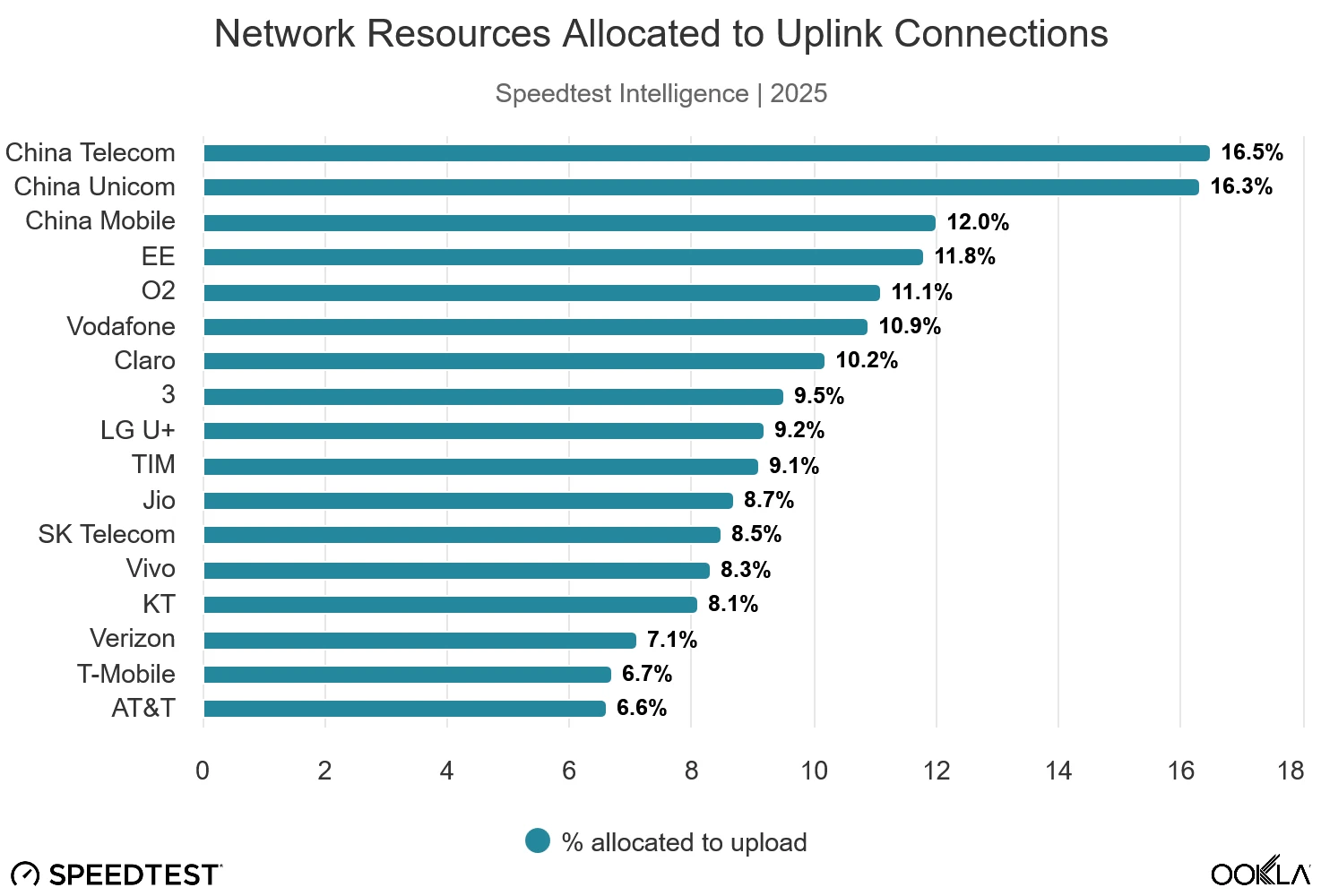
For example, mobile upload speeds for the fastest 10% of UK connections increased by approximately 36% between 2021 and 2025, while mobile download speeds in the UK increased by around 58% between 2021 and 2025. But Ookla states that, out of all the mobile operators analysed, EE (BT), O2 (Virgin Media) and Vodafone in the UK “follow Chinese operators as leaders in network resources allocated to uplink connections“. Not that you’d notice.
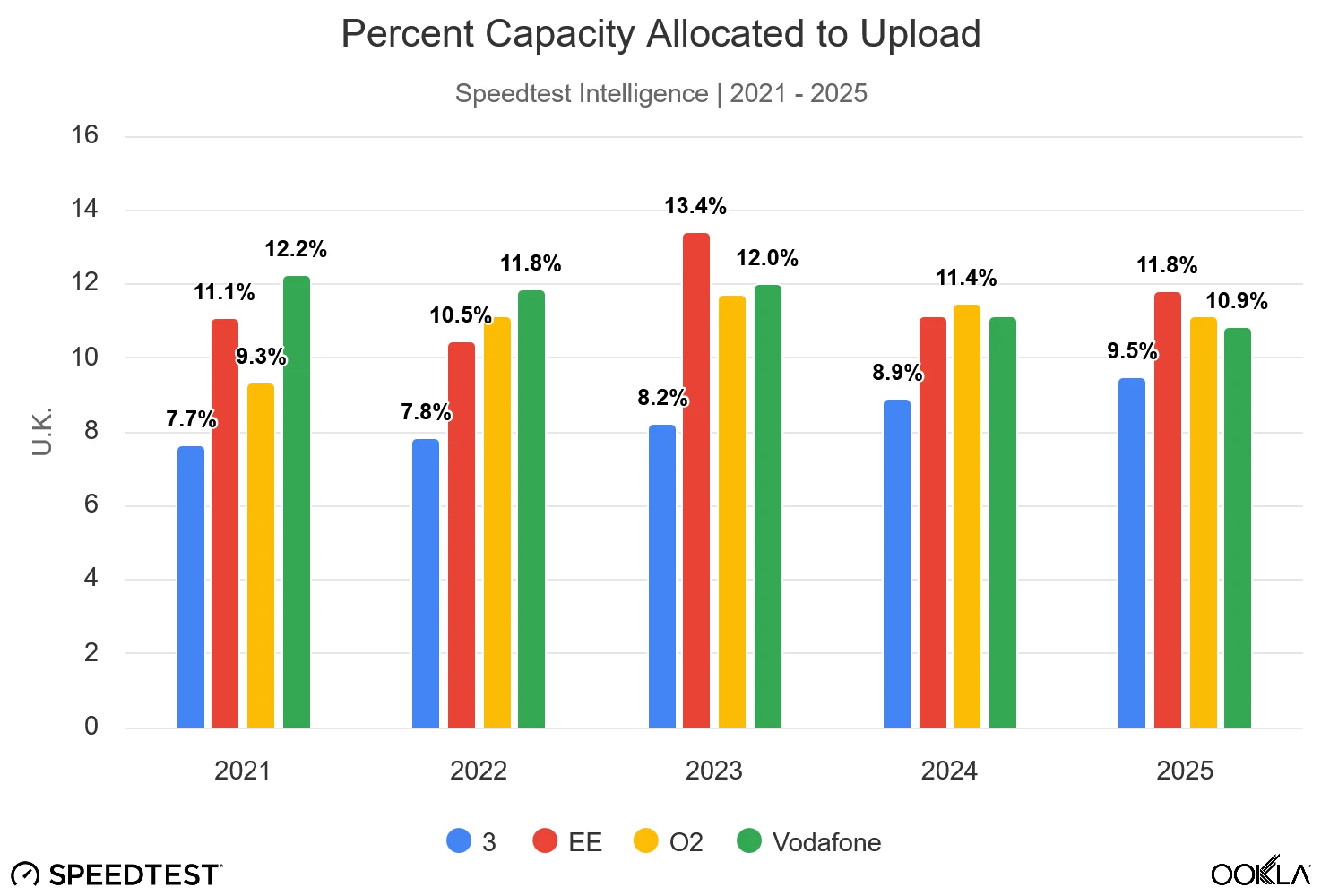
Ookla capacity allocation to uploads by uk mobile operators

Ookla-network-resources-allocated-to-uploads-by-global-operator

Yes, mobile upload speeds have been rising globally, but that’s mainly because 5G enables faster overall connections, both on the uplink and the downlink. In some countries, like Brazil, the percentage of network capacity allocated to upload speeds has been falling. In other countries, like China, the capacity allocated to the uplink has been holding relatively steady. In no country in this study is the percentage of capacity allocated to the uplink rising in a significant way,” said Ookla’s report.

Suffice to say that while upload performance is improving, the proportional importance of download capacity continues to dominate mobile operator investment and network configuration choices. Overall, Ookla’s report doesn’t really say anything new or terribly surprising, but it is a useful additional piece of research to consider.

On the flip side, when we look at fixed broadband connections – where spectrum capacity is not a constraint, the rapid adoption of XGS-PON technology within Fibre-to-the-Premises (FTTP) based broadband lines has resulted in a rise in symmetric speed packages (i.e. downloads run at the same speed as uploads). But of course, that’s more an example of technology change taking precedence over changes in consumer behaviour, since end-users still make much more use of downstream than they do upstream on fixed lines.

Five Alternative UK Broadband Networks Ranked in Sunday Times 100 Tech List | ISPreview UK

Original article ISPreview UK:Read More

The latest 2026 Sunday Times 100 Tech list has been published, which reflects a ranking of Britain’s fastest-growing private technology companies. The good news is that five broadband network operators have managed to make it into the 2026 hardware list, with Netomnia topping the table in 3rd place and CityFibre just edging in at 48th.

The list itself is split into a top 50 for software companies and a top 50 for hardware companies, with altnet operators all being ranked under the hardware list. But it’s worth remembering that being one of Britain’s fastest-growing private technology companies doesn’t always equate to overall success. For example, the last year’s (2025) list only ranked two broadband operators, toob (4th) and G.Network (33rd), but the latter is now in administration (here).

The 2026 ranking manages to include five alternative networks, including toob that remains well ranked (9th) for the second year running. The 100 businesses in the full list are said to have combined revenues of £3.7 billion and plan to create 4,300 “well-paid roles” this year, although there’s no mention of how redundancies might weigh against this (probably because companies tend not to broadcast such things until they happen).

Nick Parbutt, toob CEO and Founder, said:

“It’s an honour to be ranked in The Sunday Times 100 Tech listing for the 2nd year running. This achievement reflects our rapid growth, thriving customer base and is a testament of our dedicated team who work incredibly hard to deliver ultrafast full-fibre connectivity to homes and businesses across England and Scotland.”

2026 Sunday Times 100 Tech List (Hardware)

Rank
Name
Activity
Location
Sales
Growth
Profit
3 Netomnia Fibre broadband provider Tewkesbury £38.7m 352.78% No
9 toob Fibre broadband provider Portsmouth £14.0m 169.89% No
13 Fibrus Fibre broadband provider Belfast £29.5m 116.05% No
18 CommunityFibre Fibre broadband provider London £76.0m 101.93% No
48 CityFibre Fibre broadband provider London £133.5m 27.82% No

Quickline Build UK Full Fibre Broadband to 200,000 Premises and Start New Campaign | ISPreview UK

Original article ISPreview UK:Read More

Alternative rural broadband provider Quickline, which is deploying a new gigabit-capable full fibre (FTTP) and fixed wireless (FWA) network across parts of Yorkshire and Lincolnshire in England (3-Year Rollout Plan), has today revealed that their fibre network now covers 200,000 premises (plus 200k more via wireless) and they’re launching a new brand campaign.

Just to recap. Quickline is currently aiming to extend gigabit-capable broadband to a further 360,000 UK premises across thousands of rural communities (roughly 170k via publicly funded projects and almost 200k from commercial builds) and the provider was previously aiming to end 2025 with a total of 200,000 premises passed. Suffice to say, they seem to have hit their target.

NOTE: Quickline is supported by funding of c.£500m from Northleaf Capital Partners, as well as c.£300m of public subsidy from four Project Gigabit contracts (here, here and here), plus c.£225m in term loans and debt guarantees from the National Wealth Fund and a £25m term loan from NatWest.

The internet provider has now decided to launch a major new regional campaign championing “proper broadband, done right“, which aims to raise awareness of their service and thus boost take-up. The campaign will highlight “what matters most to customers; fair pricing, reliable connectivity, fast speeds and great service“. It also puts a spotlight on Quickline’s commitment to price certainty, at a time when many broadband other ISPs are increasing prices mid-contract.

The multi-channel campaign will run across billboards, bus stops, local press, TV and radio, significantly increasing Quickline’s visibility across the region.

Mark Bowden, Quickline CEO, said:

“We know we’re not one of the big household-name providers, and we don’t take trust for granted. As an independent broadband provider, we have to earn it, by doing exactly what we say we’ll do.

That’s why we’ve launched 2026 with a campaign that clearly sets out who we are, what we deliver and why customers can depend on us. People right across Yorkshire and Lincolnshire will start to see a lot more of Quickline as we continue to build our network and connect more homes and businesses.

This year is about growth, but it’s also about delighting customers and being visible in the communities we serve. That’s how we build long-term relationships and a network people can truly rely on.”

BDUK Updates on Project Gigabit Broadband Contract for Cheshire UK | ISPreview UK

Original article ISPreview UK:Read More

The Government’s Building Digital UK (BDUK) agency recently provided a small but useful update on their stalled £43m (public subsidy) Project Gigabit broadband roll-out contract for Cheshire (Lot 17), which was originally held by Freedom Fibre until they “mutually agreed to terminate” it in March 2025 (here). But Openreach (BT) may now be set to take it on.

Just to recap. The contract for Cheshire (England) was originally valued at £43m (public subsidy) and aimed to extend gigabit-capable broadband connectivity to cover 15,000 premises in hard-to-reach areas, including villages like Kingswood, Allostock, Minshull Vernon and beyond. But this was sent into limbo after the contracted supplier, Freedom Fibre, suddenly pulled out just as the build phase was supposed to start.

NOTE: Project Gigabit aims to help extend gigabit broadband (1000Mbps+) ISP networks to “nationwide” coverage (c.99% of UK premises) by 2032, focusing mostly on the final 10-20% in hard-to-reach areas. Some 89.6% of premises can already access such a network (here), with Ofcom forecasting between 91% and 97% by January 2028 (here).

At the time a spokesperson for BDUK told ISPreview that they were “now moving swiftly to put in place alternative plans with other suppliers to connect premises that were due to be connected. Freedom Fibre has not received any public funding for this contract“. Since then, we’ve been patiently waiting for an update on the plan for Cheshire (Lot 17) and the first clue came in an easily overlooked update to one of the contract’s old documents.

According to a recent update to the old Cheshire Public Review Closure Notice document, BDUK has since put the intervention area through an “alternative procurement under the Type C regional framework as part of call off 8” (details of this contract haven’t yet been published). We initially overlooked this last week because it had been inserted into the middle of some older paragraphs (credits to one of our readers, Peter, for spotting).

Just to give this some context. Openreach currently holds the existing Single Supplier Framework agreement with BDUK (here) – valued at c.£1.2bn, which is focused on Cross-Regional (Type C) procurements (no other suppliers currently tackle Type C). This reflects remote areas where no or no appropriate market interest had previously been expressed before to BDUK, or areas that have been descoped or terminated from a prior procurement. Such areas are often skipped due to being too expensive (difficult) for smaller suppliers to tackle.

A similar thing happened to the Project Gigabit contract for Mid West Shropshire (Lot 25.01) last year, which saw Voneus drop out. Openreach eventually ended up securing the intervention area and merging that into their existing call-off 3 contract (here).

Suffice to say that the mention of Type C and Call Off 8 together would strongly point to Openreach being the preferred bidder, although ISPreview understands that BDUK are still reviewing the bid(s) and nothing has been formally awarded. Openreach declined to comment, and we are awaiting BDUK’s response.

NOTE: Freedom Fibre is backed by investment from InfraBridge (DigitalBridge) and Equitix. The network primarily operates in the Cheshire, Greater Manchester, Staffordshire, Suffolk, Essex and North Shropshire areas of England and North Wales – covering 350,000 premises and being home to 25,000 customers (Jun 2025 data).

Virgin Media O2 UK Outsourcing 700 Roles to Tata CS and Tech Mahindra | ISPreview UK

Original article ISPreview UK:Read More

Sources have informed ISPreview that broadband and mobile operator Virgin Media (O2) has today notified around 700 staff that their roles are to be transferred to the Indian owned Tata Consultancy Services (TCS) and Tech Mahindra. The move is intended to “better deliver for our customers“, although this could still result in some redundancies.

Just to recap. Last month we covered reports that VMO2 were allegedly in the process of reaching a new agreement with TCS, which was speculated to be worth around £750m over 10-years (here). At the time, it was said that the deal could see the telecoms provider outsourcing some of their IT, such as in application management and infrastructure services, to the Indian company.

The network operator has long worked with TCS as part of an enterprise software integration contract, which was announced back in 2023. The UK is currently also said to be TCS’s second-largest market after the USA and they’re in the process of expanding their UK based workforce to create 5,000 new jobs, although the timeframe for this remains unclear, but it now looks set to be supported by today’s development.

Earlier today sources began to inform ISPreview that hundreds of VMO2 staff had been notified that they were to be transferred under TUPE – Transfer of Undertakings (Protection of Employment) – to Tech Mahindra and TCS. The same sources claimed that no offer of voluntary redundancy had been made for those who don’t want to TUPE. VMO2 has since confirmed the transfer and provided the following statement.

A VMO2 spokesperson told ISPreview:

“As part of our ongoing efforts to simplify how we operate, accelerate growth and better deliver for our customers, we are proposing to enhance our tech and service delivery by expanding our strategic partnerships with leading IT firms Tata Consultancy Services and Tech Mahindra, which will see some of our people move to those organisations in the UK.

Through these partnerships, covering areas like project delivery and platform management, we’ll be able to leverage our partners’ expertise and benefit from access to their global networks, innovative ecosystems and the latest digital technologies.

We are having open and honest conversations directly with our unions and employee representative groups on these plans and will continue to support any impacted individuals throughout this process.”

The development comes only a few short days after VMO2 notified around 300 staff in the Fixed Wholesale and Customer Delivery side of their business that they could be facing redundancy in the near future (here), although the operator is hoping to map many of those into other roles.

SK Telecom to fight regulator over record data breach fine | Total Telecom

Original article Total Telecom:Read More

News

The South Korean operator claims the record-breaking fine is excessive and does not consider the company’s proactive response

Last year, SK Telecom (SKT) revealed it had suffered an enormous data breach in 2022, affecting 26.9 million customers. The Personal Information Protection Commission (PIPC) subsequently fined the company 134.8 billion won (around $91 million) for failing to protect customer data.

Now, SKT has said it will appeal the fine, with reports suggesting that the operator deems the fine to be unjustified and disproportionate.

The fine is the largest ever delivered by the PIPC, far exceeding the previous record: a 100 billion won ($68 million) fine imposed jointly on Google and Meta in 2022 for collecting user data for personalised ads without clear consent.

“We are seeking a detailed judicial review of whether the PIPC’s penalty is appropriate,” said SKT in a statement.

The penalty from the PIPC was calculated based on SKT’s mobile revenue, a fact which SKT says differs from previous PIPC rulings. In a 2023 case against SKT’s rival LG Uplus, for example, the resulting fine based on purely on the revenue generated from the specific system that was hacked, resulting in a much smaller penalty (6.8 billion won, or $4.6 million).

The operator also notes that there has been no reported direct or indirect damage to customers as a result of the breach.

This claim, however, has been challenged by the Korea Consumer Agency (KCA), which was approached by 58 of the affected customers seeking dispute mediation last year.

“Considering the joint investigation conducted by the government and the private sector in July and the ruling by the PIPC, it was recognized that the hacking incident caused damage to consumers,” the agency said.

“SK Telecom holds responsibility for compensating individual consumers for the damage,” it added.

In December, the KCA ordered SKT to offer affected customers 100,000 won ($67) in compensation in the form of 50,000 won ($33.5) reduction in monthly subscription fees and 50,000 won in credits usable as cash equivalents.

If the ruling stands and every customer makes use of the offer, SKT’s total estimated payout would be around 2.3 trillion won ($1.5 billion) – greater than the company’s 1.43 trillion won ($970 million) net profit in 2024.

The operator is reviewing the ruling and may yet contest it.

SKT has so far pledged to invest 1.2 trillion won ($783 million) in improving its cybersecurity measures and compensating customers affected by the breach.

Keep up to date with all the latest telecoms news with the Total Telecom newsletter

Also in the news
World Communication Award Winners 2025
Ofcom clears the way for satellite-to-smartphone services
LG Uplus’s AI voice call app glitch leaks user data

The post SK Telecom to fight regulator over record data breach fine appeared first on Total Telecom.

Starlink’s Direct-to-Cell service hits 3m users in Ukraine | Total Telecom

Original article Total Telecom:Read More

a flag on a pole with a city in the background

News

Over 1.2 million SMS messages have been delivered over satellite since the service’s launch last year

Veon-owned Kyivstar says it has registered more than 3 million users for Starlink’s Direct to Cell (D2C) low-earth-orbit satellite service since the commercial launch on 24 November 2025.

The operator reported the service has delivered over 1.2 million SMS messages and that take-up has been strongest in Kyiv, Lviv, Vinnytsia, Khmelnytskyi, and Dnipro. The service also provides “especially vital” support to customers in the southern and eastern regions, where terrestrial infrastructure is frequently damaged or under restoration.

Coverage explicitly excludes occupied areas, border regions, and active combat zones, as part of SpaceX’s efforts to maintain its status as a civilian communications provider.

The service is offered free to all Kyivstar 4G smartphone subscribers as part of their regular plans.

Kyivstar’s figures, released in a company statement, mean roughly 19% of its 15.5 million 4G subscribers have registered for D2C.

“The rapid adoption of Starlink Direct to Cell services by Kyivstar subscribers demonstrates the critical importance of enhancing Ukraine’s resilience and our customers’ appreciation for the availability of satellite-based connectivity,” said Kaan Terzioğlu, VEON Group CEO and Executive Chairman of Kyivstar. “We will continue to lead the way in providing innovative services that Ukraine needs to build its digital future and in meeting the ever-growing demand of our customers for digital connectivity.”

The initial commercial rollout of Starlink’s D2C service is limited to SMS, with voice and video services to be added as part of the constellation’s second generation of satellites, which are currently being launched.

The service is only available on Android devices, with iPhone users with iPhone 13 and later models must wait for a forthcoming software update before they can use the feature, Kyivstar said.

Beyond Kyivstar, Veon is also preparing to launch Starlink’s D2C technology in other markets. Veon’s subsidiary Beeline Kazakhstan, for example, has completed field tests of the service ahead of a planned commercial launch in that market during 2026, pending regulatory approval.

Keep up to date with all the latest telecoms news with the Total Telecom newsletter

Also in the news
World Communication Award Winners 2025
Ofcom clears the way for satellite-to-smartphone services
LG Uplus’s AI voice call app glitch leaks user data

The post Starlink’s Direct-to-Cell service hits 3m users in Ukraine appeared first on Total Telecom.

A case study: LilaConnect’s migration to gaiia in 16 weeks | Total Telecom

Original article Total Telecom:Read More

Case Studies

Growing UK fiber internet provider LilaConnect migrated to gaiia in 16 weeks. Here’s how they made it happen, and how it paid off.

LilaConnect, the retail subsidiary of The Freedom Fibre Group, delivers full-fiber broadband to communities across the northwest of the UK. But, with a strategy of rapid growth across multiple towns and regions, the company needed a modern operations platform that could scale as fast as its network.

After challenges with an internal system that had reached its limits and a failed migration to another platform, LilaConnect turned to gaiia to modernize its operations and create a better customer experience.

Why LilaConnect chose gaiia

LilaConnect required a flexible, API-driven OSS/BSS that could integrate seamlessly with its network operator’s systems and support an efficient, scalable retail ISP experience.

Key considerations included:

  • An API-first architecture for real-time provisioning and activation.
  • A scalable billing and product catalog capable of supporting future growth.
  • Workflow automation to eliminate manual steps and improve speed to serve.
  • A modern, branded checkout and subscriber portal to enhance the customer journey.

After evaluating multiple vendors, LilaConnect chose gaiia for its open, modular architecture, proven delivery timelines, and collaborative implementation model designed for complex integration environments.

“We needed a partner who could move fast, but also give us the structure and flexibility to build the right foundation. gaiia helped us do both.”

—Phil Steed, Head of Platforms, LilaConnect

Delivering business value in 16 weeks

LilaConnect’s implementation focused on enabling a complete customer onboarding flow, connecting every step from availability check to activation. gaiia enabled LilaConnect to launch a branded online checkout that connected LilaConnect’s new website, directly with their network serviceability.

From the first customer order, the new system has significantly reduced manual work across teams, streamlining how new customers are onboarded and how in-life service changes are handled.

“The new checkout and automated workflows have significantly reduced the manual effort required to onboard customers and manage service changes.”

—Tom Ives, Head of Sales Operations, LilaConnect

The “fab 5” workflows

Both gaiia and LilaConnect teams focused on five core workflows that power daily operations: activation, suspension, reactivation, speed change, and service deactivation. Built in gaiia’s Workflow editor, each process is fully automated and configurable, giving LilaConnect control to adapt and scale as they grow.

Key integrations

The go-live included integrations with:

  • LilaConnect’s network provisioning API
  • Stripe and GoCardless (payments)
  • Sonalake PivOTS 
(One Touch Switch)
  • HubSpot, M365, and Twilio (CRM and communications)

The result was a fully automated onboarding and activation process that now runs through a single system, reducing delays, increasing transparency, and improving the experience for both customers and support teams.

Implementation approach: How to accelerate time to market

Beyond the technical success, LilaConnect’s project has become a model for how ISPs can bring services to market faster through clarity, iterative development, and tight scope control.

Here are the key principles that made the difference:

  • Start with the “minimum viable process”
    • Rather than waiting for every edge case, LilaConnect and gaiia focused on the five most critical workflows that represented 90% of customer journeys. This “Fab 5” mindset allowed the team to deliver early business value while deferring non-critical automations to Phase 2.
  • Standardize early
    • From the first migration dry-run, the team enforced standard data models, requiring unique property identifiers (UPRNs) and canonical product structures. This reduced friction during imports, simplified integrations, and made it easier to automate provisioning.
  • Integrate through APIs, not workarounds
    • With Freedom Fibre’s open-access API as the foundation, gaiia connected every major system (billing, network, appointments, and service status) through direct, authenticated API calls. No CSVs, no scripts. This ensured real-time accuracy across systems from day one.
  • Use workflows as the single source of truth
    • Each operational process (activation, modification, or cancellation) was designed as a self-contained, auditable workflow in gaiia. This structure allowed operations and engineering teams to collaborate in the same system without relying on custom code or manual handoffs.
  • Stay aligned with a dedicated cross-functional team
    • Weekly syncs across business, technical, and engineering stakeholders from both LilaConnect and gaiia created continuous feedback loops. Decisions were made fast, blockers were surfaced early, and teams shared the same real-time visibility into progress.

The results

In just 16 weeks, LilaConnect transitioned from a constrained in-house system to a fully integrated, API-driven OSS/BSS environment that connects every part of the customer journey, from online checkout to activation.

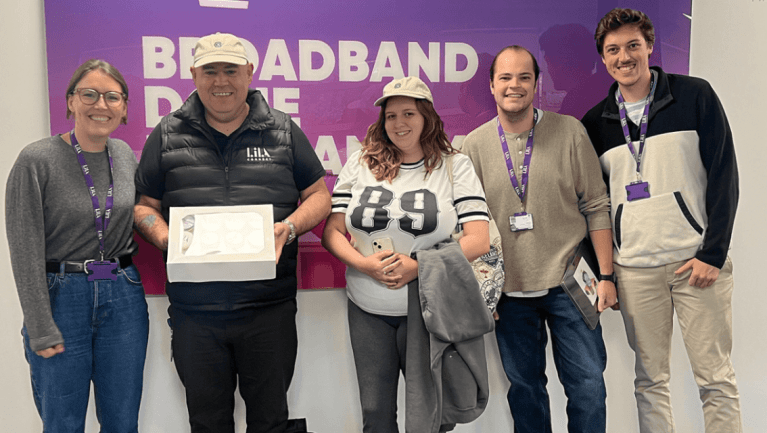
The LilaConnect team

Photo provided courtesy of gaiia

The impact was immediate. The new checkout and automated workflows reduced manual intervention across teams and dramatically improved customer onboarding speed. What once required multiple systems and manual coordination now runs seamlessly within gaiia.

“Our previous fastest sale ever was 19 minutes from checkout to activation. 
On gaiia, we achieved it in 4 minutes.”

—Matt Ogden, Director of Sales & Marketing, LilaConnect

The LilaConnect team now has a single connected platform that:

  • Processes orders and activations in real time through its network provisioning API
  • Automates provisioning, billing, and service changes without manual tickets
  • Provides customers with a smooth, branded digital experience from purchase to installation

With manual tasks replaced by automation, LilaConnect has strengthened operational efficiency and created a scalable model for future growth while improving the subscriber experience at every step.

This content is brought to you by gaiia.

Get news like this in your inbox. Subscribe to the Broadband Communities newsletter!

The post A case study: LilaConnect’s migration to gaiia in 16 weeks appeared first on Total Telecom.

SpeedGeo Study Names Fastest UK Mobile and Broadband ISPs in 2025 | ISPreview UK

Original article ISPreview UK:Read More

The relatively new SpeedGeo project, which stems from a Polish team that compares internet quality based on the broadband speeds of real users, has today published their 2025 results for the United Kingdom. The outcome named Virgin Media as the fastest fixed broadband ISP, while Three UK came top for mobile broadband (4G, 5G etc.).

The study is based on data gathered from real measurements conducted by users of their V-SPEED applications, including via their website, as well as on Android, iOS, Windows and macOS. A total of 109,136 tests were conducted across mobile connections using smartphones or tablets during 2025 (4G, 5G etc.), which increased to 842,397 for their fixed broadband (inc. WiFi connections).

NOTE: Web-based speedtests can be affected by various issues, such as slow Wi-Fi, limitations of the tester itself, local network congestion and package choice (i.e. people may pick a slower / cheaper plan, even with faster gigabit speeds available). The following results are thus only good for observing general market change over time and should not be taken as a reflection of ISP capability.

As with the above note, there are always caveats to consider with speedtest based studies like this, not least because the results for fixed lines tend to be more reflective of take-up than network availability. For example, some fixed ISPs may have a much larger proportion of customers on slower copper-based lines (ADSL or FTTC), which can weigh against those on faster FTTP services with the same provider (i.e. pulling the average down).

Otherwise, the operators in both fixed and mobile categories were all ranked based on average download speed (from highest to lowest), although we do also get the figures for upload speeds and network latency (milliseconds), which are nice to have. Sadly, the main fixed broadband results appear to only focus on major national ISPs and has thus ignored many of the faster but smaller players.

Fastest UK Fixed Broadband Providers for 2025

Provider Download (Mbps) Upload (Mbps) Ping (ms)
Virgin Media 256.5 47.2 23
Vodafone 175.1 83.6 24
BT (EE) 122.5 33.8 21
Sky Broadband 113.6 32.6 16
TalkTalk 94.7 35.1 18

Fastest UK Mobile Broadband Operators for 2025

Provider Download (Mbps) Upload (Mbps) Ping (ms)
Three UK 94.5 14.5 41
EE (BT) 79.7 17.6 36
Vodafone 57.7 12.5 43
O2 48.7 9.7 44

Finally, SpeedGeo has also provided some data on the fastest fixed broadband providers in London, although this does appear to include Three UK into the list (probably due to their 4G/5G based Home Broadband package). But unlike the other tables this one does at least list some smaller networks.

London’s Fastest Fixed Broadband Providers for 2025

Provider Download (Mbps) Upload (Mbps) Ping (ms)
CommunityFibre 287.6 223.7 11
Hyperoptic 259.1 250.5 7
Virgin Media 207.0 46.8 18
Exponential-e 98.5 92.7 9
Vodafone 96.8 38.6 40
G.Network 93.8 85.3 9
Three UK 82.8 12.3 31
BT 60.3 30.3 16
Sky Broadband 60.3 17.4 11
TalkTalk 40.3 11.8 12

Creditors Allegedly Set to Take Control of Rural UK Broadband ISP Gigaclear | ISPreview UK

Original article ISPreview UK:Read More

A major newspaper has claimed that creditors of the indebted Abingdon-based alternative broadband ISP Gigaclear, which has built a full fibre (FTTP) network across 612,000 premises in rural parts of England and is home to c.160,000 customers, are set to take control of the business after an attempt to sell the company failed.

The provider currently still holds an aspiration to extend their network reach to 1 million UK premises. However, like so many other alternative networks (altnets), they’ve recently also had to scale-back their network build and cut jobs, due to the pressures from high interest rates, rising build costs and a highly competitive environment (here and here). Nobody ever said deploying fibre optic cables into rural areas was easy or cheap.

NOTE: Gigaclear is principally owned by Infracapital, together with Equitix and Railpen. The company previously had investment commitments estimated to be worth up to around £1.1bn (here) and in late 2023 secured a £1.5bn debt facility (here). The provider also holds several publicly subsidised Project Gigabit build contracts in Oxfordshire (here) and East Gloucestershire (here).

Suffice to say that funding has recently become somewhat of a hot topic for Gigaclear, particularly after reports emerged in November 2025 that they had begun hunting for a buyer (here). A consortium of the provider’s existing banks then followed that report up, in December 2025, by agreeing to pump “at least£80m of new funding into the company (here), which Gigaclear said meant they were now “fully funded to deliver its plans“.

As Nathan Rundle, CEO of Gigaclear, said last month: “There’s still more work to do to close the digital divide but combined with our achievement of EBITDA positivity earlier this year and strong customer growth, this funding reflects a business that is financially secure, operationally robust and focused on sustainable long-term delivery.”

However, according to a new report in the FT (paywall), the company’s creditors, including the UK taxpayer-backed National Wealth Fund (NWF), as well as banks such as NatWest and Lloyds, are now allegedly “set to take control of heavily indebted broadband provider” after Gigaclear failed to find a buyer for the business. The creditors are also said to have explored options, such as writing down their debt (this could impact taxpayers too, due to the NWF’s involvement via a £240m guarantee on the aforementioned £1.5bn debt facility).

At the time of writing, most of the parties involved have declined to comment on the report, although Equitix are said to have expressed disappointment that “the financial performance of the investment did not meet the targets that Gigaclear set itself”. The expectation is that the company’s creditors will assume control of Gigaclear and then attempt another sale process. None of this is expected to have an impact upon their customers, which will continue to receive the same service, although related cost-cutting can sometimes impact service and support quality in other ways.

The reported move comes shortly after another altnet broadband provider with similarly significant financial challenges, G.Network, was acquired by FitzWalter Capital for an undisclosed sum (here). Barely a week had passed before G.Network then followed that up by filing a Notice of Intention (NoI) to appoint an administrator (here).

As time goes on, we may well see more indebted altnets going down a similar path during 2026, particularly if they fail to find a consolidation partner or financial buyer via more traditional approaches. Quite a few altnets have already spent 2024 and 2025 trying to find such solutions, but only a few have done so and the longer it takes the more painful the outcome could become, especially for investors.