Ofcom Sets Out Current Progress and Future Plans to UK Prime Minister | ISPreview UK

Original article ISPreview UK:Read More

The UK telecoms, media and internet content regulator, Ofcom, has this week written to the Prime Minister (Keir Starmer), Chancellor of the Exchequer (Rachel Reeves) and Secretary of State for Business and Trade (Peter Kyle), among others, to update them on how its work is “contributing to innovation, investment and growth in the UK“.

The new Open Letter is said to cover both Ofcom’s achievements since this time last year and what’s coming over the year ahead, which reflects everything from their approach to fixed broadband, mobile connectivity and online safety, to spectrum sharing, satellite regulation and TV / video streaming etc.

The letter itself doesn’t really say anything that we haven’t covered before through a variety of different articles over the past year, although some people may find the added context that it delivers to be useful, so we’ve published it in full below.

Ofcom said they remain “committed to promoting economic growth and will continue to engage with Government on this matter“. Now, if only they could format their letters with more readily sized paragraphs, to avoid the TL;DR wall of text effect.

Ofcom’s Open Letter to the Government (19th Jan 2026)

Dear Prime Minister, Chancellor,

In January 2025, Ofcom set out our approach to contributing to economic growth across the UK, capturing our longer-term vision for pro-growth regulation, enabled by competition, innovation and investment. A year on, this letter provides an update on the commitments we made then, and sets out what we are doing in 2026 to further enable growth across the UK. It also sets out how we are streamlining and reducing burdens on industry to allow focus on innovation and investment, to support the Government’s commitment to reduce regulatory burdens by 25%. Finally, it sets out how we approach areas where Government and Parliament have consciously established new regulation which is crucial to the safety and security of the UK – such as online safety, security and resilience.

Investment in mobile and broadband infrastructure and connectivity

Driving investment in fibre networks is critical for the reliable, high-speed connectivity that we need to underpin productivity across every sector of the UK economy. In 2021, Ofcom set out a new ten- year framework for economic regulation of fixed networks which was designed to drive significant new investment in fibre broadband, to upgrade the UK’s infrastructure for the future. We consciously chose to drive this by opening up competition to Openreach, to maximise innovation, choice and competitive prices for consumers and businesses. Over the past five years our regulatory approach has enabled billions of pounds of investment in new networks, with full-fibre coverage now available at 78% of UK households, compared to just 6% in 2018. At the same time as rapid coverage improvements, the competition we have generated means full-fibre broadband prices have been falling in real terms, so customers are getting better services for less at a time when the cost of living is so critical for so many households. Analysis in our most recent pricing report shows that, including promotional discounts, the average monthly price available to new residential customers signing up to a standalone full-fibre broadband service fell by 41% in real terms, to £36, in the three years to September 2024. In light of pressures on household budgets, we are working closely with DSIT to ensure that pricing is fair for consumers. In February, we will publish our next report with data on switching, consumers’ confidence in navigating the market and the prices of telecoms services.

2026 marks the midpoint in that ten-year strategy. In line with our commitments in the Government’s Regulatory Action Plan last year, we published a consultation on our approach to the next five-year period in March 2025. We will publish the final statement in March this year, setting the rules until 2031 to provide certainty and stability for investors and underpin the final phase of the UK’s full-fibre build.

People and businesses in the UK expect to be connected where they need, and when they need, which is why we are also prioritising improvements in mobile connectivity. We want consumers to have the tools they need to navigate the market and choose mobile providers based on quality, not just price, encouraging providers to compete on performance and invest in better networks. In March 2025, we committed to overhauling the data consumers can access on mobile coverage and quality by delivering the first phase of our new webchecker, Map Your Mobile. We launched this in June 2025, with new features in November 2025. More than half a million people have used Map Your Mobile so far and further improvements are planned during 2026. We also provided support to the CMA in its review of the Vodafone/Three merger last year, the outcome of which has resulted in the companies making a public commitment to invest £11 billion over an eight-year period, which will significantly improve the performance and capacity of their network. More immediate benefits are being felt by consumers, with the integration delivering faster 4G speeds for 7 million people, as well as a removal of a total of 16,500 sq/km of not-spots in the UK.

Action to deliver further improvements and investment in mobile connectivity requires coordination between government, local authorities and industry as well as the regulator. We will set out later this year our view on what more can be done, and are committed to providing better data and evidence, which will help decision-makers deliver improved outcomes for consumers.

Releasing highly valuable spectrum for innovation and growth

Wireless connectivity requires access to spectrum, which Ofcom manages for the UK. Last year, we made a number of commitments to drive economic growth and innovation by opening up the airwaves to new ways of connecting people and businesses.

First, we committed to consult on enabling satellite direct-to-device (D2D) services. Following consultation, we confirmed in December 2025 that we will authorise the use of most mobile spectrum bands for satellite D2D services. Our decision means the UK will be the first country in Western Europe where mobile operators can team up with satellite companies to allow standard smartphones to receive a signal from space. This will provide connectivity to areas of the country that are not covered by terrestrial mobile networks, bringing social and economic benefits in these areas.

In 2025, we continued our broader work to enable satellite services to support growth and connectivity across the UK, including through authorising satellite broadband providers such as Starlink and Amazon Leo. We have authorised 9 non-geostationary satellite orbit licences so far and take up of these services continues to increase, with over 110,000 active connections in 2025, up from around 87,000 in 2024.

We also committed to and completed the auction of very high frequency mmWave spectrum for use by mobile network operators in October 2025. This will support better connectivity in congested areas such as transport hubs and stadiums.

We are also enabling greater spectrum sharing to extract the maximum benefit for the UK from valuable airwaves:

  • We committed to opening up shared access licensing to high-capacity mmWave spectrum for private networks. Businesses such as the automotive industry and busy ports can access this spectrum through a self-service online tool launched in April
  • We have published our decision to enable Wi-Fi and mobile services to share the 6 GHz band, helping to meet the future demand for data by increasing capacity for everyday use in busy places like train stations as well as for newer technologies like virtual reality and AI. This makes the UK the first country in Europe to commit to these two different technologies sharing this spectrum.

In the coming year, we are focusing on making spectrum available for new services and technologies. This includes a consultation on updating spectrum rules in response to the growing use of drones in Summer 2026, and decisions on expanding spectrum for satellite broadband on planes and ships, and innovative wireless broadband solutions for Wi-Fi, by the end of the year. Finally, we continue to support innovation and trial licences for spectrum with over 730 such licences in 2025.

Supporting the health and commercial future of UK TV and radio

The UK has one of the most successful creative sectors in the world, with our Public Service Broadcasters (PSBs) playing a particularly pivotal role in that ecosystem, and forming an important part of UK culture. The UK’s commercial TV and online video sector recorded revenues of £17.1bn in 2024. To support the thriving creative economy, Ofcom is implementing the Media Act 2024. This updates regulation for the digital and streaming age so that audiences can continue to enjoy the incredible range of programming, journalism and services offered by the UK’s broadcasting and media landscape. Large parts of this work were completed in 2025 as we promised last year. We have modernised PSB licences to reflect PSBs’ use of on-demand players to deliver their public service remits, and removed outdated requirements from commercial radio, while ensuring that audiences continue to benefit from local news provision. This work continues in 2026 – last week we opened a consultation on our proposed new rules for PSB prominence on smart TVs. This will ensure that the BBC, ITV, Channels 4 & 5 and STV & S4C can continue to reach audiences and compete with global players in the modern media environment.

Promoting innovation and agile regulation within and beyond Ofcom’s remit

More generally, technology, including generative AI, is driving huge change across all Ofcom’s sectors. We are investing significantly in understanding, supporting and enabling responsible innovation. This includes doing hands-on and technical AI research, launching sandboxes and technical labs – especially in areas such as spectrum where our regulation involves licensing – and making large data sets available to help train and develop AI models. This involves collaboration with industry and other regulators so we can understand and support new AI use cases. Later this year, we will publish a further update on Ofcom’s strategic approach to AI, following our two previous updates in 2024 and 2025.

Regulators increasingly need to collaborate to respond to new developments in technology and markets. This is why we set up the Digital Regulation Cooperation Forum (DRCF) in 2020 with the CMA, FCA and ICO. In 2025, the DRCF continued its work on regulatory innovation, building on the pilot of the Digital and AI Hub to ease innovators’ engagement with regulators. In March, the DRCF brought together 200 representatives from industry, civil society, academia, government, and regulators to focus on Responsible GenAI. In addition, the DRCF is creating a Digital Library to improve the accessibility of digital regulation and ease of compliance, funded by the Regulatory Innovation Office’s AI Innovation Fund.

Deregulation and streamlining

As well as seeking to promote growth in the rules we set, we also try to ensure that how we regulate doesn’t place unnecessary burdens on industry. We do this in two ways: identifying opportunities to deregulate where rules are no longer needed or are outdated; and actively streamlining our regulatory approach, so that businesses interacting with us face fewer costs and receive a more efficient service. This work contributes to the Government’s commitment to reduce the administrative burden of regulation by 25% over this parliament.

In 2025, we:

  • Reduced the regulatory requirements imposed on Royal Mail, allowing the company to realise annual savings of between £250m and £425m;
  • Abolished a regulator, absorbing the Phone-paid Services Authority’s functions into Ofcom in February We estimate that this will generate an estimated £6.7m of savings to industry over 5 years, or the equivalent of £1.34m each year;
  • Deregulated the commercial radio sector, giving it more flexibility to adapt to changing audience needs, while protecting the provision of local news; and
  • Decided not to carry out a market review or impose further regulation in the Application-to-Person messaging (A2P SMS) market, saving operators and Ofcom substantial administrative costs.

This year, we will continue to actively identify opportunities to deregulate and streamline. Last October, we launched a call for evidence to see where we can deregulate in broadcasting and ensure that unnecessary or outdated regulation is not holding back our TV and radio sectors. This will reduce compliance costs for broadcasters and create space for innovation within a modernised legislative and regulatory framework. We will also deliver further improvements to help streamline our spectrum regulations, which includes consulting on plans to streamline our licensing approach for Aeronautical Ground Stations.

We are working closely with DBT and DSIT on the Government’s commitments in this area. Internally, we are actively exploring how we can use AI to drive efficiency in our operations and streamline our processes.

Implementing the Online Safety Act and driving greater network security

In some areas, Government and Parliament have consciously chosen to increase regulatory responsibilities on certain industries, for good reasons. In our implementation of the Online Safety Act (OSA), the backdrop is twenty years during which social media, gaming, pornography and other companies have rolled out services to adults and children without sufficient, or any, regard to the safety of their users, particularly children. Our task is to drive a huge change in culture as well as a tangible improvement in safety standards, and to do so as quickly as we can. We are under no illusions about the magnitude or the urgency of this task, especially given the rapid acceleration of risk that is being driven by generative AI.

In 2025, large parts of the UK’s online safety regulation came into force for the first time. We published a full report in December 2025 setting out the changes we have already driven across the industry. These include widespread use of age checks at age 18 for the first time which have gone further than in any other jurisdiction, as well as new protections against grooming and child abuse imagery. On 12 January, we opened an enforcement investigation into X, to determine whether it has complied with its duties to protect people in the UK from content that is illegal in the UK. In 2026, you will see further concerted and urgent action from Ofcom to drive change. We work very closely with regulators in other jurisdictions to share best practice, including Australia and the EU.

The OSA inevitably places new regulatory costs on companies because we are asking them to carry out assessments and introduce new systems and processes that they have not previously had to prioritise. The largest and/or riskiest services rightly face the heaviest burdens. Nevertheless, we are committed to making online safety regulation as easy as possible to understand and comply with, particularly for small UK-based companies who want to get it right. In January 2025, we launched the beta version of our dedicated Digital Support Service (DSS), to help businesses understand their regulatory requirements under the OSA. We committed to completing the next phase of work on the DSS by summer 2025 – which we did in May. The DSS includes an online tool for businesses to check if the Act applies, and two interactive digital toolkits which provide a step-by-step guide to the risk assessment and safety duties for illegal content and protecting children. Since going live, our tools have been used thousands of times.

Similarly, our work on the security and resilience of telecoms and the digital infrastructure sector is key to ensuring that UK customers and businesses can rely on the networks that are crucial to their everyday lives. The Government’s Cyber Security and Resilience Bill includes new duties for data centres and enhanced powers for Ofcom. While this will impose new regulatory burdens on businesses, proportionality is always baked into Ofcom’s decision making and will be a key consideration during our implementation of the new rules. Ultimately, secure networks support economic growth and productivity across the UK. They put guardrails in place, preventing costly, and in some cases catastrophic, interruptions to services which underpin the day to day running of our society and economy.

Looking ahead to 2026

Ofcom remains committed to making communications work for everyone, supporting growth and investment to ensure that we deliver for tomorrow’s citizens and consumers, as well as today’s. Our work is guided by our Board’s three-year plan that we published in March 2025, and by our annual Plans of Work, the latest version of which is currently out for public consultation. Taking into account stakeholder feedback, as well as the Government’s finalised Statements of Strategic Priorities, we will confirm our planned work for next year in March 2026.

We look forward to our continued engagement with Government on this vital area of work and would be happy to discuss any of the areas highlighted.

I am copying this letter to the Secretaries of State for Science, Innovation and Technology, Liz Kendall; Business and Trade, Peter Kyle; and Culture, Media and Sport, Lisa Nandy.

Yours sincerely

MELANIE DAWES

Actifai: The built-for-broadband AI you might have missed at Connected Britain 2025 | Total Telecom

Original article Total Telecom:Read More

Contributed Article

Used by over 30 North American ISPs, Actifai is bringing its proven, telecom-specific AI platform to the UK market

by Vasa Babic, Head of EMEA at Actifai

It’s hard to find a technology more discussed yet less consistently monetised than artificial intelligence. For broadband providers, the real challenge isn’t joining the AI conversation, it’s figuring out how AI can actually generate revenue.

At Actifai, that question has been our focus from the start.

Founded in 2019 out of Foundry.ai, an incubator dedicated to applied commercial AI, Actifai began with a simple principle: AI should deliver measurable business value from day one. Our first engagement was with a large North American broadband provider. We saw an opportunity to apply machine learning in one of the most data-rich and transaction-heavy environments: the broadband sales process. By concentrating exclusively on the broadband sector, we developed a depth of industry understanding that makes our technology especially relevant to telecom operators.

When a new customer checks service availability, providers can access significant context: demographics, dwelling type, local competition, and indicators of upgrade propensity. By combining those signals with real-time inputs from sales conversations, Actifai predicts the optimal service package and shapes the offer and message for each customer. Our models draw on proprietary, broadband-specific data. This intelligence is deployed across both phone and digital sales channels, and the results are financial, not theoretical.

That first implementation delivered a tenfold return on investment within months. From there, the business scaled quickly. Today, Actifai supports millions of interactions for over 30 internet service providers, including around a quarter of the 20 largest in North America and, as of Q3 2025, our first UK provider. Generic AI vendors simply cannot match this depth of broadband-specific experience. Our work now extends well beyond new-customer sales. We help providers optimise the entire subscriber lifecycle, from cross-sell and upsell to proactive and reactive retention and, increasingly, support.

From predictive AI to agentic AI

The next phase of our evolution, and the industry’s, is agentic. Earlier generations of machine learning generated insights. AI agents use those insights to take action. Actifai’s agents are rooted in the same foundations that have consistently delivered measurable gains in broadband sales, but now that intelligence reaches service and support. These agents handle complex customer inquiries, make product or billing changes, and initiate actions across existing BSS and OSS systems. In practical terms, they don’t just analyse behaviour, they shape it in real time.

Our approach stays anchored in the business-first ethos that defined our early work: rapid deployment, clear metrics, and straightforward integration. Just as importantly, our technology is engineered to operate directly within telecom BSS and OSS environments. Providers can deploy quickly and realise value without the friction that holds back so many AI initiatives.

AI in the broadband market

As Actifai enters Europe in 2026, we’re stepping into a market that resembles North America at a pivotal stage, a few years earlier. Fibre buildouts are largely complete, competition is tightening, and operators are shifting from expansion to profitability. The core question has changed. Instead of “How do we connect more homes?” providers are asking, “How do we grow and retain revenue and deliver a better customer experience?”

That’s the moment when AI proves its worth.

Connected Britain in September 2025 marked our first formal UK presence. But the story isn’t about arrival. It’s about applicability. We’re introducing commercially mature AI solutions that have already delivered measurable results at scale.

For broadband providers, progress won’t come from chasing the next algorithmic breakthrough. It will come from using AI to address real business problems: lifting take rates, keeping subscribers, and now improving service through intelligent agents.

AI will continue to advance, but profitability remains the true benchmark of innovation. That’s the version of AI we’re bringing to broadband providers.


Learn more about how Actifai can help your broadband business thrive in the era of AI

The post Actifai: The built-for-broadband AI you might have missed at Connected Britain 2025 appeared first on Total Telecom.

Broadband ISP VISPA UK Faces Compulsory Strike-off Action Again | ISPreview UK

Original article ISPreview UK:Read More

Broadband provider VISPA has recently become subject to another “First Gazette notice for compulsory strike-off” – as shown on the Companies House (CH) website, which follows both a significant delay to the publication of their latest accounts (CH’s website states their next accounts were “due by 31 January 2025“) and adoption of CH’s default address.

In recent years the small and previously Manchester-based ISP has tried their hand at building a full fibre (FTTP) broadband network, such as in the town of Marple (here), and they’ve also run their own Fixed Wireless Access (FWA) network around parts of Cheshire. Finally, the provider sells a variety of Openreach based fibre packages, although we’ve not had any fresh news from Vispa for a while now.

According to VISPA Limited’s records on Companies House (06921088), the provider has faced four separate “First Gazette notices for compulsory strike-off” since March 2022, which in the past have been linked to delays in filing their accounts (2022 example). But the delays on those occasions often amounted to only a short period, while VISPA’s “latest” accounts to April 2024 were due to be published almost a year ago on 31st January 2025 and have yet to be published on Companies House.

The current government guidance for striking off a limited company (here) clearly states that this can occur due to a number of reasons, such as if Companies House has “not received annual documents that the company should have sent, like its confirmation statement or accounts” (a period of two months, from the point of notice, is allowed for the issue to be resolved before the company is struck off).

In addition, VISPA’s registered address was changed on 17th October 2025 to a PO Box (PO Box 4385, Cardiff, CF14 8LH). The PO Box given for VISPA is actually the Companies House Default Address, which may be used temporarily when a company’s registered office address lacks proper authorisation. This is viewed as a signal of non-compliance with the rules.

If we’re satisfied a company’s registered office is not appropriate, we’ll change the registered office address to a default address, held at Companies House. If a company’s registered office is moved to the default address, they must provide an appropriate address with evidence of proprietary ownership within 28 days, or we could start the process to strike the company off the register,” says the official guidance (here).

The default PO Box address is currently still present, which is not considered an appropriate address. Some further explanation can be found below.

Government Guidance

2.3 If the company does not change its registered office address from the default address

Companies must have an ‘appropriate address’ as their registered office address at all times.

If the registrar is satisfied a company does not have an appropriate registered office address, they may change it to an address held and maintained at Companies House. This is called a ‘default’ address.

The company can choose to appeal to court against the registrar’s decision.

If the company does not appeal, it has 28 days to deliver a notice changing its registered office address from the default address. The new registered office address must be an appropriate address.

If a company fails to change their registered office within 28 days from being moved to the default address, the registrar may commence steps the strike the company off the register.

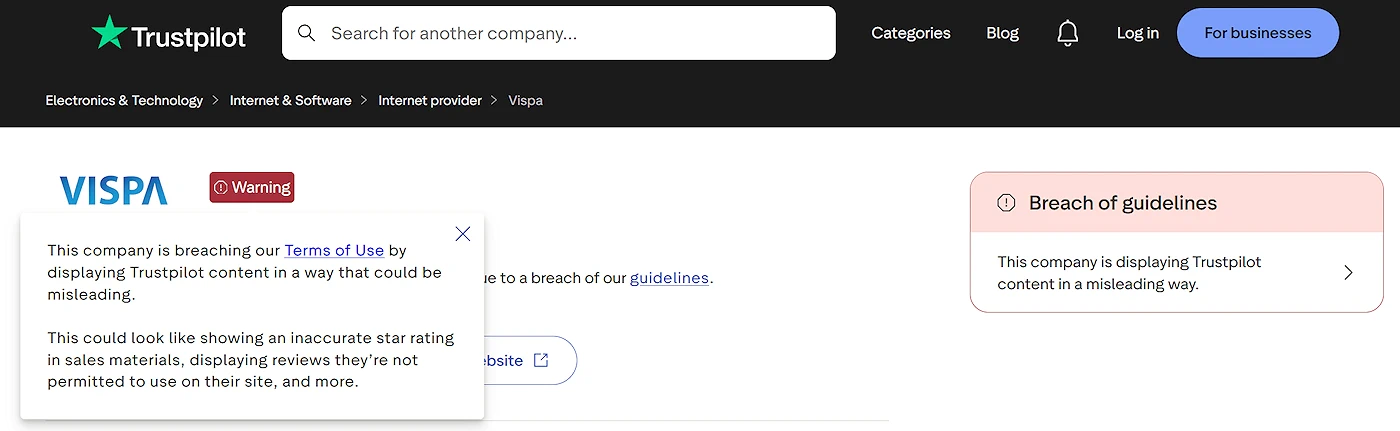
Elsewhere, VISPA’s Trustpilot page shows that all reviews posted over the past year (between the latest one on 30th October 2025 and 7th October 2024) have been negative, with complaints making particular reference to a lack of customer support, connectivity problems and other issues.

Trustpilot itself has also placed “Warning” text in red at the top of VISPA’s review page, which links to the following notice: “This company is breaching our Terms of Use by displaying Trustpilot content in a way that could be misleading. This could look like showing an inaccurate star rating in sales materials, displaying reviews they’re not permitted to use on their site, and more.”

Trustpilot VISPA Screenshot 14th January 2026

ISPreview also discovered an interesting post from somebody claiming to be one of VISPA’s customers on Facebook (here), which included an extract from a message that the ISP had allegedly sent them in November 2025 – after they complained about a lack of support: “Please note that we will shortly be switching your account over to a partner company called Gig“.

We did discover a company called Gig Fibre Ltd, which was incorporated on 16th May 2024 by the same owner as VISPA and, until 20th August 2025, had previously been known as “VISPA GROUP LIMITED“. But we’ve thus far had no luck in extracting a response to any of our emails to VISPA (several attempts have been made to different addresses since early Dec 2025).

The hope is that VISPA will find a way through the current challenges.

MaxCell unveils bold brand refresh to meet global demand for high density fiber infrastructure | Total Telecom

Original article Total Telecom:Read More

Wadsworth, Ohio- MaxCell®, the global leader in flexible fabric innerduct solutions, today announced a comprehensive brand refresh designed to meet the escalating infrastructure demands of the digital age. Featuring a new visual identity, an optimised website, and the tagline “engineered for efficiency and built for flexibility” the update reinforces MaxCell’s position as the premier choice for maximising conduit capacity in Telecom, Data Center, and Utility markets.  

As global connectivity needs surge, network operators are increasingly hindered by the physical limitations of traditional rigid innerduct. MaxCell’s refreshed brand highlights its unique ability to solve these challenges by replacing bulky, wasted space with high-performance fabric solutions that conform to the shape of the cables.


Transforming Network ROI 

The rebranding marks a strategic shift toward performance-driven infrastructure. Compared to traditional rigid HDPE innerduct, MaxCell’s fabric solutions offer a transformative value proposition:

  • Place 300% more cable inside the conduit for growing connectivity demands
  • Installs 2x faster
  • Reduces material and labour costs by 50% or more
  • 81% greener* making it a more sustainable solution (*data collected by Bent Branch Strategies)
  • Seven (7) flexible solutions for any cable deployment scenario or challenge 

A portfolio built for next-gen networks

The refresh also streamlines MaxCell’s comprehensive product suite, making it easier for engineers and contractors to find tailored solutions for specific environments: 

MaxCell Edge: Optimised for the highest performance and lowest friction.

MaxCell Premise: Ideal for indoor (ISP) and data center applications.

MaxWrap: A specialised solution for protecting cables in high-congested areas.

MaxSpace: A breakthrough service for removing innerduct from around live cables without service interruption.

MaxCell delivers significant, unmatched value for network infrastructure projects – enhancing flexibility and scalability for future growth, making it a smart investment for long term success.


About MaxCell 

MaxCell is the world leader in flexible fabric innerduct, providing innovative pathway solutions for the Telecom, Data Center, Government, and Utility industries. Since its inception, MaxCell has helped network owners and contractors maximise conduit space, reduce installation costs, and build scalable networks that are engineered for long-term success.

Media Contact: Senior Marketing Specialist, Elyssa Wenkert, Elyssa.Wenkert@maxcell.us, www.maxcellsolutions.com [maxcellsolutions.com]

The post MaxCell unveils bold brand refresh to meet global demand for high density fiber infrastructure appeared first on Total Telecom.

Liberty Global eying purchase of Three Ireland | Total Telecom

Original article Total Telecom:Read More

blue and black city buildings photography

News

The deal could be valued at up to €1.5 billion, according to analysts

Telecoms giant Liberty Global is in talks to purchase Ireland’s largest mobile operator, Three Ireland, according to a report from The Financial Times.

Formal discussions are already underway with Three Ireland’s owner, Hong Kong’s CK Hutchison, with the deal potentially worth €1.5 billion. However, no formal decision has yet been made.

Three Ireland currently has around 5 million subscribers, representing around 49% of the market, according to telecoms regulator ComReg.

For Liberty Global, the deal would present an opportunity to tie its Irish telecoms businesses together into a single entity.

The company currently operates an Irish mobile virtual network operator (MVNO), Virgin Mobile, which delivers services to around 140,000 customers using Three’s network; it also owns Virgin Media Ireland, which controls around 21.5% of the Irish fixed broadband market.

The acquisition of Three Ireland would allow Liberty to combine these businesses into a single converged entity, offering major cross-selling opportunities and theoretically network synergies.

By contrast, CK Hutchison’s recent focus has been on the potential launch of an initial public offering (IPO) for its global telecom assets, valued at around £20 billion

First reported in March last year, the planned IPO was initially on hiatus until the closure of the £16.5 billion Vodafone–Three merger, but it now appears to be regaining momentum, according to reporting this week. The assets could be listed as early as Q3 this year, according to anonymous sources.

However, this direction is far from certain for Hutchison, which has also been exploring sales of its units in Denmark and Sweden in recent years, as well as a tie-up between its Italian unit WindTre and local rival Iliad.

If any of these deals were to gain significant traction, they could significantly delay any plans for an IPO.

Keep up to date with all the latest telecoms news with the Total Telecom newsletter

Also in the news
World Communication Award Winners 2025
Ofcom clears the way for satellite-to-smartphone services
LG Uplus’s AI voice call app glitch leaks user data

The post Liberty Global eying purchase of Three Ireland appeared first on Total Telecom.

Housing Provider Peabody to Deploy SCCI’s Shared UK Full Fibre Infrastructure | ISPreview UK

Original article ISPreview UK:Read More

The not-for-profit housing association, Peabody, which is responsible for almost 109,000 homes (220,000 residents) across London and the Home Counties of England, has signed a new framework agreement with SCCI Alphatrack (SCCI Group) to deploy their single shared full fibre broadband infrastructure solution (4Fibre) to residents homes.

Instead of installing multiple networks from different network operators, SCCI’s 4Fibre solution builds one open-access network that any broadband supplier can use. The goal is to help minimise disruption for residents, while protecting the structure and safety features of buildings, and reducing environmental impact.

NOTE: SCCI Alphatrack is a specialist in the design, supply, installation and maintenance of Fibre, Media and Fire Life safety systems.

The announcement is a little vague on precisely how much of Peabody’s housing stock is to benefit from this, although we’ve been informed that the main focus seems to be on large high-rise and complex residential buildings. Peabody has over 250 such buildings, mainly in London.

ISPreview has been informed that the first site to benefit from this will be Cumberland Market near Regents Park in Camden, which consists of about 500 units on one estate, including about 120 premises that are being supported by the Building Digital UK (BDUK) agency’s Urban Vouchers (Gigabit Broadband Voucher Scheme). But more will follow.

Elizabeth Connelly, Head of Landscape and Telecoms at Peabody, said:

“This is about making things easier for residents and safer for their homes. We understand the importance of being connected and we want all of our residents to have access to faster, affordable and more reliable broadband.”

A spokesperson for SCCI Alphatrack added:

“The new partnership also supports the national ambition to bring faster broadband to more homes and ensures the homes of Peabody’s residents are ready for the digital demands of the future. It makes it easier to keep accurate building records, supports safer installations, and provides a scalable solution that can grow with demand.”

Eagle-eyed readers may well recall that two alternative broadband operators, G.Network and Netomnia, have previously also signed agreements to build FTTP into Peabody’s homes (here and here). But it’s worth noting that Netomnia haven’t yet expanded their full fibre network into London (i.e. their deal was perhaps more about the Home Counties) and G.Network has just gone into administration, although 4Fibre’s solution was used to help wire a few blocks for G.Network before that happened (about 300 units).

Solutions like the one being delivered by SCCI have potentially become more attractive since delays in the Building Safety Regulator’s (BSR) updated processes for minor works began causing wider problems and pushing up costs, often unpredictably (here).

Only One Telecoms Firm Makes Top 50 UK Companies for Customer Satisfaction | ISPreview UK

Original article ISPreview UK:Read More

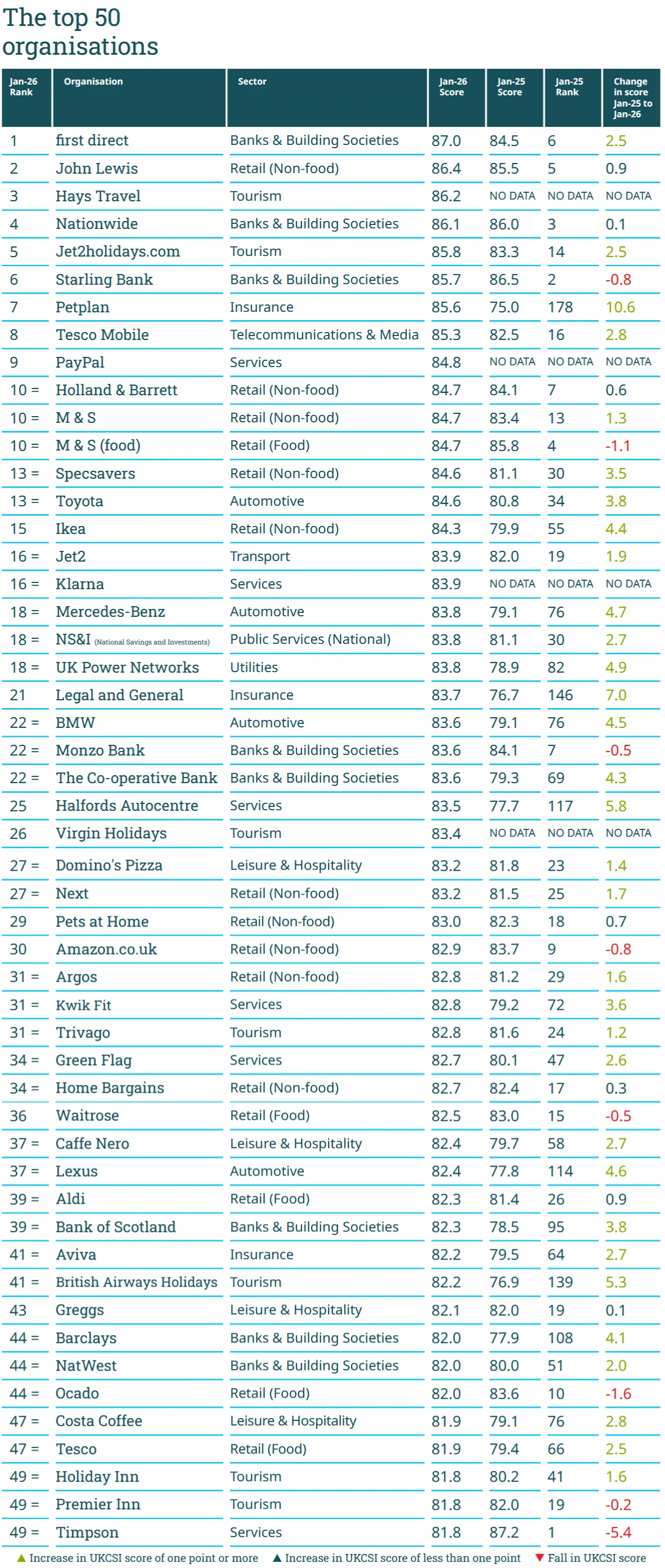
The Institute of Customer Service (ICS) has today published their first biannual UK Customer Satisfaction Index for 2026 (January), which reveals that Tesco Mobile was – for the second consecutive report – the only mobile and broadband (telecoms) provider to make it into their table of the country’s top 50 organisations. But both Virgin Mobile and Three UK were still named among the most improved.

The research typically reflects the results from a large online survey of over 15,000 customers – balanced to be representative of the UK adult population, which asked each of them about their experiences across hundreds of different organisations and market sectors (a total of 59,500 responses were gathered). This was then used to produce a score out of 100 for each organisation.

NOTE: Tesco Mobile’s service is supplied via an MVNO deal with O2 (Virgin Media).

Overall, the “Telecommunications & Media” sector reported another improvement in its general ranking since the last report in July 2025, with average customer satisfaction rising to a score of 76 out of 100 (up from 74.4 in July 2025 and 73.3 in Jan 2025). The number of customers in the same sector who feel the organisation they dealt with cares about them as a customer has also increased to 63.7% (up from 59.5% in Jan 2025).

The good news is that the only telecoms operator to make the top 50 companies table, Tesco Mobile, did improve their ranking from 9th place in July 2025 to 8th place today. The operator’s score also improved from 82.5 to 85.3 over the same time period. Take note that the limited sample size means that some highly rated telecoms providers simply didn’t receive enough feedback to be included into the top table.

Elsewhere, the UKCSI also named two telecoms providers in their top 20 table of the “most improved organisations“, including Virgin Mobile on a score of 76.3 (up from 70 in Jan 2025) and Three UK on a score of 77.3 (up from 71.8 over the same period). The inclusion of Virgin Mobile is a little bit odd as they no longer exist as a standalone brand and most customers were moved on to O2’s plans some 2-3 years ago.

2026-January-Customer-Satisfaction-Survey-UK-Top-50-Companies

United Group B.V. targets growth with €1.5bn refinancing | Total Telecom

Original article Total Telecom:Read More

News

The move will allow the company to save roughly €15 million in annual interest repayments

United Group B.V., the Netherlands-based telecommunications and media operator, has completed a €1.5 billion bond refinancing package, a move it says reflects its strong potential for long-term growth.

The refinancing saw the company issue €1.13 billion of new floating rate notes (FRNs) and €355 million of new PIYC PIK (Pay-if-you-Can, Pay-in-Kind) Notes. This new debt matures in 2031 and 2033, respectively.

The proceeds used from the refinancing will pay off €480 million of existing FRNs due 2029, €650 million of FRNs due 2031, and €351 million of existing PIYC PIK notes due 2029.

As a result, the company expects to save €15 million of annual interest as well as an extension of the Group’s debt maturity profile.

“We are delighted with the outcome of this transaction. It has not just reduced our funding cost, but this was a further vote of confidence from our bond investors and builds on the positive momentum following our strong Q3 results,” said Stan Miller, CEO of United Group. “It reflects our disciplined approach to capital structure management and enhances our financial flexibility, allowing us to continue executing our strategy in our core EU markets, advancing our growth agenda, and creating long-term value for our stakeholders.”

This is the second round of bond refinancing in two months, with the company having reshuffled €400 million of debt in December last year, according to the company’s latest fiancial results.

Alongside debt refinancing, United Group has also been active in simplifying its portfolio in recent years, selling non-core infrastructure and assets to deleverage and focus on core markets.

Last year, the company agreed to sell Serbia Broadband (SBB) to Abu Dhabi-based e& for €825 million. It also sold NetTV Plus, SBB’s direct-to-home services, and sports rights to local rival Telekom Srbija for €652 million.

The operator continues to operate telecoms companies in Bulgaria, Croatia, Slovenia, Montenegro, Bosnia and Herzegovina, Greece, and North Macedonia.

Keep up to date with all the latest telecoms news with the Total Telecom newsletter

Also in the news
World Communication Award Winners 2025
Ofcom clears the way for satellite-to-smartphone services
LG Uplus’s AI voice call app glitch leaks user data

The post United Group B.V. targets growth with €1.5bn refinancing appeared first on Total Telecom.

CityFibre Make Business FTTP Broadband Available to 4.5 Million UK Premises | ISPreview UK

Original article ISPreview UK:Read More

The country’s largest alternative broadband operator, CityFibre, has this morning announced that they’ve “unlocked” their nationwide footprint and made their business Fibre-to-the-Premises (FTTP) services available across 4.5 million premises – offering wholesale business products at data speeds of up to 2.5Gbps (Gigabits per second).

The move comes shortly after CityFibre completed its upgrade from slower GPON to XGS-PON (Symmetric 10Gbps PON) technology, which is how they were recently able to launch a 5.5Gbps speed broadband product at wholesale (here) for residential ISP partners like Sky Broadband to use. But in the meantime, the operator’s business FTTP products have tended to lag behind a bit, although today’s announcement helps to rectify that.

NOTE: CityFibre is owned by Antin Infrastructure Partners, Goldman Sachs, Mubadala Investment Company, Interogo Holding etc. The network is supported by UK ISPs such as Vodafone, TalkTalk, Zen Internet, Sky Broadband and more (local ISP availability does vary). Some 730,000 customers use the network, which as of Oct 2025 covers 4.6 million UK premises (4.3m RFS).

The operator’s new business FTTP services are primarily designed to meet the needs of small businesses, small or home offices (SoHos) and home workers with symmetrical speeds of up to 2.5Gbps, which is useful for data backup, remote collaboration, scalable connectivity, work-ready WiFi for multiple users and more.

CityFibre’s business services also boast of “rapid fix times of less than eight hours and plans to introduce a greater choice of install points, bringing a connection directly to a home office“. The expansion follows CityFibre’s tripling of the availability of its dedicated, enterprise-grade Ethernet services to serve over 260,000 UK businesses, which resulted in over 50% YoY growth in the Ethernet sector for them in 2025.

Andy Nash, Director of Business, Government and Mobile at CityFibre, said:

“Opening up our full FTTP footprint is a game-changer for UK businesses and a great opportunity for our reseller partners. There are hundreds of thousands of small businesses across CityFibre’s network and we’re designing the Multi-Gig, ultra-reliable products they need to innovate and grow.”

Nathan Marke, Chief Strategy Officer at CityFibre partner Giacom, said:

“UK businesses, both large and small, increasingly rely on technology to operate, so reliable, Multi-Gig broadband is key. CityFibre has listened to the market and is making the most of its next generation network to bring greater choice and exceptional products and services to even more businesses across the UK.

Enabling access to the residential as well as business postcodes served by CityFibre’s network, through Giacom’s Cloud Market platform, is great news for our community of 6000 MSPs and expert technology resellers, and means even more SMBs can benefit from high speed, reliable, secure, great value connectivity.”

CityFibre still retains an ambition to extend their network to cover 8 million premises at some point in the future, through a mix of market consolidation and new fibre build. The operator has also recently spoken of their plans for upgrading the network to handle speeds of up to 100Gbps in the not-too-distant future (here).

Virgin Media O2 UK Pledges to Donate 12,000 Smartphones in 2026 | ISPreview UK

Original article ISPreview UK:Read More

Broadband ISP and mobile operator Virgin Media and O2 (VMO2) have today announced that they will once again aim to donate “up to” 12,000 pre-owned Smartphones during 2026 to help people in need get online and reduce e-waste, which mirrors their previous pledge for 2025 that succeeded in donating the same figure.

As usual, VMO2 intend to source these Smartphones from customer returns and its O2 Recycle service, which helps to ensure unwanted devices are given a second life and assists those who might otherwise struggle to afford such a device. Free O2 mobile data (i.e. 25GB with rollover, plus 50 international minutes to 42 countries, unlimited minutes + texts) will also still be available from the Good Things Foundation and VMO2’s National Databank.

NOTE: Since its launch in 2009, O2 Recycle has recycled over 4 million devices and paid out over £356m to consumers (up by £6m from last year). A total of more than 30,000 phones have also been rehomed under previous efforts.

The initiative, supported by Hubbub, will rehome phones through VMO2’s nationwide network of charity partners and community groups (e.g. The Multibank).

Nicola Green, Chief Comms and Corporate Affairs Officer at VMO2, said:

“We know having access to a phone is a lifeline for people experiencing financial hardship.

That’s why Virgin Media O2 is proud to lead the way in providing 12,000 free phones this year to those who need them so they can get online and stay connected to loved ones.

This builds on our comprehensive, industry-leading measures to tackle digital exclusion, whether that’s through our National Databank that provides free O2 mobile data, Community Calling that rehomes phones to those who need them, or our social tariffs for people who receive government support payments.”