GoFibre Quirkily Compares its Rural Broadband Speeds to Major International Cities

Edinburgh-based UK alternative network ISP GoFibre has today published the results of a new study, which reveals how well (download speed) their new full fibre (FTTP) broadband network – present in parts of remote rural Scotland and Northumberland – compares with a selection of major international cities. It’s interesting, if a bit on the random side.

Just to recap, GoFibre is currently busy rolling out their gigabit-capable broadband network across rural parts of Scotland, the Scottish Borders areas and also Northumberland in England. The operator has so far managed to build their network to cover over 120,000 premises (RFS) across 40 “local areas” and today’s focus is on how that compares with a bunch of international cities.

NOTE: GoFibre previously aimed to cover 500,000 premises by around the end of 2025 and is supported by an investment of £164m from Gresham House (here). The operator also holds the Project Gigabit contracts for Teesdale (Lot 4.01) and North Northumberland (Lot 34.01), which are worth £12.64m in state aid.

Citing research from the Ookla’s Speed Test Global Index, as well as a couple of other studies and their own data, the operator has today attempted to “shine a spotlight on the lightning fast speeds” available on their new network by comparing its performance with some of the world’s major cities, which they say are “lagging behind when it comes to broadband speeds“.

However, we should stress that country to country comparisons like this are often rather simplistic and don’t offer a detailed picture of each local market, where different geographies, network maturity, regulation, consumer adoption, underlying infrastructure and levels of investment or competition may have a significant role to play. Not to mention any differences between testing methodologies (e.g. it’s unclear if all the results are using a ‘median’ or ‘mean’ average, but Ookla’s are usually median). Suffice to say it’s a bit of a random study, but if you want to know the results then they’re below. Just take with a pinch of salt.

GoFibre Rural UK Locations vs International Cities – Jan 2025
Scotland/UK Location Actual average download on GoFibre (Mbps) World city Average speed as listed by Global Index (Mbps)
Cupar 363.902 Copenhagen, Denmark 227.14
Falkland 358.206 Frankfurt, Germany 94.73 (Fair Internet Report)
Haddington 370.891 Helsinki, Finland 104.12
Jedburgh 414.375 Jakarta, Indonesia 35.54
Laurencekirk 495.979 Lisbon, Portugal 115
Melrose 431.41 Monaco 154.42
Portlethen 393.53 Paris, France 199.61
North Northumberland 269 New York, United States 270.79
West Fife 421.942 Washington D.C., United States 232 (CNET report)
Ballingry 400.236 Berlin, Germany 86.41

Neil Conaghan, CEO of GoFibre, said:

“While our new campaign is having a bit of fun with some very famous cities, it has a serious message too; it’s about empowering people and places to realise their full potential.

Our rural areas can be better connected even than international capitals, and that’s a great thing for everyone – whether you’re running a business, working from home, studying, getting through your admin or even gaming. It’s time we took advantage of the speeds at our fingertips.

We’re proud to see our cutting-edge technology help smaller towns to outpace some of the world’s leading cities, ensuring that local businesses can compete on a global stage and families can enjoy seamless online experiences.

We encourage anyone not yet signed up to GoFibre to check if you’re eligible – we can’t promise you a cycle and canal network like Copenhagen’s, but our broadband network leaves the Scandis standing!”

RootMetrics Test Names EE as BEST UK Mobile Network for H2 2024

Mobile benchmarking firm RootMetrics (Ookla) has today published their H2 2024 study of UK mobile networks (calls, texts etc.) and mobile broadband performance, which once again sees EE (BT) continuing to win all the award categories, followed by Vodafone and Three UK. But O2 (Virgin Media) found itself at the bottom of the table.

The new study made use of the “latest” 5G Samsung smartphones (model not disclosed) – purchased off the shelf from operator stores – to test both 4G and 5G performance across all four primary operators in 16 of the UK’s most populated metro cities. The team then conducted a total of over 627,000 tests, including at hundreds of different locations (787 of which were indoor) and while driving a total of 23,000 miles during the day and night.

The results shown below have then been split into several categories (network reliability, speed, data, call and text quality etc.) and each is assigned a score out of 100 (higher numbers = better). In terms of the UK-wide results, EE came top in every single category. By comparison, O2 echoed their results in other studies by coming bottom of all the same categories.

Otherwise, most of the mobile network operators saw a small to modest increase in their overall scores this time around, with Vodafone seeing the strongest rise to 85.3 out of 100 (up from 79.1 in the H1 2024 study) – enough to leapfrog over Three UK and take second position. On the flip side, Three UK was the only operator to record a decline in their score to 81.2 (down from 83.2).

Overall Scores for H2 2024 (vs H1 2024)
1. EE – 91.7 (up from 91.5)
2. Vodafone – 85.3 (up sharply from 79.1)
3. Three UK – 81.2 (down from 83.2)
4. O2 – 76.7 (up from 75.3)

Rootmetrics-H2-2024-UK-Mobile-Network-Ranking

In terms of the average (median) UK download speeds on both 4G and 5G networks combined – EE delivered the strongest data speeds of 89.9Mbps (up strongly from 79.8Mbps in the last report), while Vodafone returned 49.9Mbps (up from 42.8Mbps), Three UK came next on 44.9Mbps (up slightly from 44.5Mbps) and, despite being at the bottom, O2 still saw a nice improvement to hit 29Mbps (up from 23.3Mbps).

The study also gave us a look at mobile broadband download speeds for 5G-only connections, which once again found that EE delivered the fastest median average of 231.5Mbps (up from 207.5Mbps), while Three UK came next on 220.1Mbps (up from 210.3Mbps), then Vodafone on 206.6Mbps (up from 184.9Mbps), and finally we have O2 pushing just 82.8Mbps (up from 79.7Mbps).

Rootmetrics-H2-2024-UK-Mobile-5G-Speeds

Finally, RootMetrics gives us a limited look at the current levels of 5G availability (i.e. time spent connected to a 5G service), which found that EE, Three UK, and O2 all topped 61% 5G availability during UK-wide testing, while Vodafone trailed at 48.3%. For perspective, no operator offered 5G availability above 60% a year ago in 2H 2023, reflecting continuous improvements by the operators to expand their 5G services.

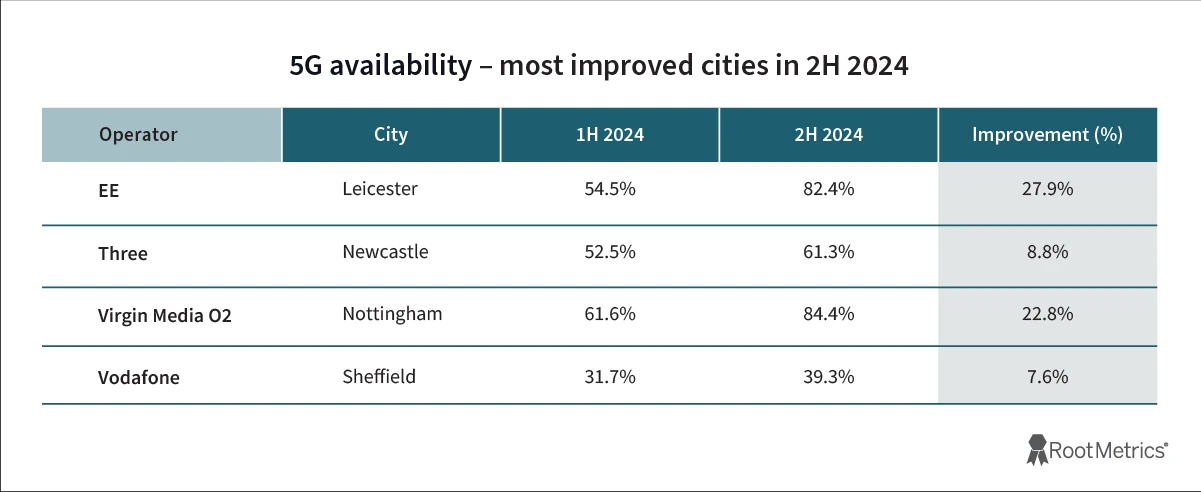
The table below shows where each operator made its biggest increase to 5G availability during testing in major UK cities during the second half of 2024.

Rootmetrics-H2-2024-UK-Mobile-5G-Availability-by-City

The RootMetrics’ report only provides bits and pieces of selected information, while we would have preferred to see a bit more detail (e.g. upload performance and latency, as well as a split by each nation). The data also seems to be dominated by an urban focus, which gives little weighting for poorer performance in rural areas. But that is often the caveat with this type of scientific, albeit very manual, testing – there’s not enough data to give a full UK picture.

RootMetrics UK Mobile Performance Review H2 2024
https://www.ookla.com/../rootmetrics-uk-state-of-mobile-union-2h-2024

Vodafone UK Surge to 1.55 Million Broadband Users as Mobile Falls to 18.3M

Mobile operator and ISP Vodafone UK has today published their Q3 FY25 financial results, which confirms that their fixed line broadband base grew by a new record to total 1.549 million customers (up by 72k in Q3 vs 50k in Q2). But their mobile base fell again to total 18.3m (down by -174k vs -93k in Q2), due entirely to a fall in their prepaid/PAYG base.

In terms of their UK fixed broadband services, the operator reported a huge surge in growth, with a quarterly addition of 72,000 customers (one of their biggest growth spurts ever) – thanks in part to being widely available across both Openreach’s and CityFibre’s national networks. The provider’s full fibre (FTTP) coverage can now reach a combined total of 18.4 million UK households (up from 17.3m last quarter).

Vodafone also attributed part of their “record” quarterly fixed broadband growth to the introduction of Ofcom’s new One Touch Switching (OTS) system in September 2024, which is designed to make it easier for consumers to change broadband and phone provider. But it remains difficult to know precisely how much of the growth was really due to that, and we also had the Black Friday sales period during this quarter.

As for their mobile base, Vodafone actually reported a quarterly rise of 1,000 in Pay Monthly customers (vs a decline of -6k in Q2), but there was yet another sharp decrease of -175,000 in Prepaid / PAYG customers (vs -87k in Q2). Finally, quarterly mobile broadband (data) usage across their UK network increased to 643,984 TeraBytes (up from 617,397 TB last quarter).

NOTE: The Data usage figure above represents the sum of downlink and uplink traffic, all APNs (e.g. web, wap, corporate APNs, MMS), femto traffic (if applicable), inbound roamers and MVNOs – excluding data resulting from voice over LTE traffic.

Margherita Della Valle, Vodafone Group CEO, said:

“Group service revenue growth accelerated to 5.2% in the third quarter. This was driven by a step-up in the UK and strong performance in Türkiye and Africa, whilst Germany is impacted by the TV law change. We are continuing to invest in the turnaround of our German business and we are starting to see improving customer trends, although conditions have become more challenging in the mobile market.

During the quarter, we completed the sale of Italy for €8 billion and received regulatory approval for Vodafone’s merger with Three in the UK. When the UK merger completes in the next few months, we will have fully executed Vodafone’s reshaping for growth. We are on track to grow in line with our full year guidance for this year, which we reiterate today, and are looking forward to a stronger Vodafone in the years ahead.”

The report provided no new updates on Vodafone’s now fully approved merger with Three UK (here), which is expected to take a few more months before it reaches legal completion. Finally, the operator saw their quarterly UK service revenue reach €1,507m (up from €1,462m in the previous quarter). The full report is here (PDF).

Broadband ISP Grain to Rollout its UK Full Fibre Network into Bury

Alternative network operator Grain (Grain Connect) has confirmed that they’re planning to expand their gigabit speed Fibre-to-the-Premises (FTTP) based broadband ISP network into the Greater Manchester (England) town of Bury. The UK network currently covers over 220,000 premises and connects 30,000 customers.

The local rollout in the town, which vaguely aims to reach “thousands of homes”, is getting underway early this very month. After that, the “first customers” are then due to be connected sometime during “Spring 2025“, although it’s unclear how long the build itself will take to reach completion.

NOTE: Grain has previously secured funding of c. £220m (here) via Equitix, Albion Capital, Pinnacle Group and German Landesbank Nord L/B. The operator originally aimed to cover 400,000 UK premises by the end of 2026.

The new expansion into Bury isn’t totally unexpected, as they already have some nearby deployments in parts of Oldham, Bolton, Bradford, and Manchester itself. In terms of competitors, both Virgin Media (inc. nexfibre) and Openreach already have wide coverage of a gigabit-capable broadband network in Bury. In addition, FullFibre Limited also has some coverage, albeit only in the North of the town.

Grain’s full fibre network can now be found in parts of around 60 other UK locations (plus over 150 new build housing developments), which includes a lot of small-to-modest sized patches of various urban cities and towns like Leicester, Liverpool, Accrington, Grimsby, Cleethorpes, Scarborough, Carlisle, Barrow-in-Furness, Hartlepool, Hull, Newport, Sunderland, Blackburn and so forth.

Prices for Grain’s broadband packages start at £17.99 per month for 150Mbps (symmetric speed) and rise to £28.99 for their top 900Mbps+ tier, which includes a 24-month minimum contract term, a pledge of “no in-contract price rises“, no credit checks, free installation and an included wireless router. The ISP is currently offering the first 2-4 months of service for free to new customers (offer length varies between packages).

From the bully pulpit: FCC’s Carr could strongarm allies over new subsea cable regulation

Feature Week

For a man never shy of speaking his mind, returning US President Donald Trump has been remarkably quiet on the topic of submarine cables, an area of increasing geopolitical tension. His new Federal Communications Commission (FCC) chairman, Brendan Carr, on the other hand, will likely have plenty to say as he leads a regulatory shift more than 20 years in the making.

Consolidating regulatory power

The end of 2024 saw the FCC propose the first changes to their submarine cable regulation rules since 2001. These new rules focus primarily on altering the compliance obligations related to International Section 214, which relates to providing telecoms services between the US and other countries.

There are three major changes at the core of this updated framework:

  1. Implementing a three-year reporting requirement: This would include detailed information on ownership, the use of foreign network technology, cybersecurity, etc.
  2. Shorter licence terms: Reducing the licence terms from the current 25-year terms, potentially as brief as 5 years.
  3. Expand the scope of licencing applications: Expanding the reach of regulations to cover more of the subsea cable ecosystem, including cable landing stations, entity zoning, submarine line terminating equipment, and potentially inland data centres and companies leasing capacity from submarine cables.

All of these factors are designed to give the FCC a closer grip on the country’s submarine cable infrastructure, which plays a crucial role in national security.

It should be noted here, however, that submarine cable regulation has not remained stagnant for the past two decades. As cable security and geopolitical tensions between East and West have been evermore thrown into the spotlight, subsea regulation has grown stricter, but this has been governed by the so-called ‘Team Telecom’, rather than the FCC itself.

Team Telecom is a regulatory supergroup made up of the Department of Justice, Federal Bureau of Investigation, Department of Defence, and Department of Homeland Security. All new cable projects are subject to a Team Telecom review and must be given the greenlight before they can receive a licence from the FCC.

This new regulatory shift, then, is more a matter of consolidating powers under the FCC itself alongside stricter licencing terms.

It is also worth noting that this shift has bipartisan support, with the process having begun under the previous Democratic administration.

So, what might these changes mean for the submarine cable industry itself?


Expensive delays

According to Dr Andrew Lipman, partner and head of TMT at law firm Morgan, Lewis & Bockius, the subsea industry’s primary concern is around delays of future projects.

“If these rules are more intrusive and restrictive, they could drive up costs and complicate and delay deployment,” he said. “Delay is a huge concern, particularly in a rising interest rate environment where financing can be heavily impacted.”

When asked if this regulatory shift will see some subsea projects becoming inviable, Lipton said that “only a small handful would be blocked”, but many more could be negatively impacted.

“I don’t think it will largely derail subsea projects, but it will require some surgery and tailoring – and that’s very expensive,” he said.

There is also still a political element at play, with Lipman suggesting the rules will likely be interpreted more proscriptively by the Republican-led Commission.

“It’s very likely that the Republicans and their incoming chairman Brendan Carr will interpret these new rules more conservatively and restrictively than the Democrats,” said Lipman. “National security issues [in the submarine cable industry] have been more bipartisan than many other telecom issues, but I think the Republicans are going to be tougher and stricter than the Democrats would be.”


Impact overseas

This tightening of the screws on the subsea cable industry, particularly how cables interact with US geopolitical rivals like China, could have ramifications far beyond the US itself.

Lipman suggests that Carr will push US allies to adopt a similarly strict regulatory approach. This could potentially lead more projects to cut out troublesome connections to China, instead opting for local intermediaries like Singapore.

“I think this is going to lead to a further separation between the US and its allies in relation to China. “I think Carr will use his bully pulpit as FCC chair to persuade US allies like the UK, Canada, Australia, New Zealand [the ‘Five Eyes’ alliance], as well as India and Japan, to push them to impose comparable and similar requirements,” said Lipman. “Over time, this will lead to more rerouting of data, which will have a significant impact on the industry.”

In addition to impacting routing decisions, these new regulations could also make working with Chinese partners within a consortium less appealing to cable operators.

Carr has notably praised the Clean Networks programme introduced by the first Trump administration, arguing in his Project 2025 chapter that he would like the FCC to create a Clean Standards initiative to further crack down on untrusted technology in US networks.

“The Clean Standards Initiative would address concerns about Chinese involvement, particularly around key technologies,” said Lipman, adding that it will make working with Chinese players more difficult.

The FCC has already revoked the International 214 licences of some Chinese carriers operating in the US, including China Mobile, China Unicom, and China Telecom, and the Commission is considering whether to revoke licences from submarine cables related to these companies, Lipman added.


Regulatory creep into data centres

Perhaps one of the most interesting considerations surrounding these new regulations could be their impact on data centres.

The data centre industry is currently largely unregulated in comparison to the subsea sector. Data centres are not overseen by the FCC or state public utility commissions, nor are they subject to Team Telecom reviews. The only regulatory hurdles these projects really have to face are potential reviews related to foreign ownership by the Committee on Foreign Investment in the United States, where appropriate.

But, with the FCC expanding the scope of their subsea regulations, data centres connected to these systems will likely fall under the new regulatory umbrella.

This, says Lipton, may offer the FCC a backdoor into more directly regulating the data centre industry – a fact that will cause potential headaches for hyperscalers like Google and Meta, who are key players in both sectors. In this AI-era, with billions being spent on new data centres around the world, such regulations would likely be unwelcome.

“The hyperscalers are the 600lbs gorillas in the room,” said Lipman. “This will give the FCC a way to glean more information and have a regulatory hook into the data centre industry.”

Lipman says he expects to see “measured pushback” from the tech giants against any form of regulatory overreach by the FCC.


A step towards a more fragmented global internet?

The FCC’s rule change is expected some time later this year, with rapid action viewed as critical by the Trump administration.

“This is a high priority for the incoming FCC chair and the Trump administration. This is not simply the FCC acting alone, but it’s building on concerns that are shared by the Defense Department, the Department of Commerce, and others,” said Lipton.

Ultimately, it remains to be seen exactly how the proposed changes would be implemented, but it seems inevitable that they would make the process of laying cables beneath the waves more difficult and even more geopolitically sensitive.

How is the new Trump administation going to change the US telecoms market? Join the industry in discussion at Connected America 2025 live in Dallas, Texas

Also in Feature Week:
Trump on telecoms: The story so far
Trump targets TSMC with Taiwan chip tariffs
Telecom policy objectives come into focus in Trump’s first days

Ofcom Grant UK Licence for Amazon’s Project Kuiper Broadband Satellites

Ofcom has today grant Amazon’s Project Kuiper a UK Earth Station Network Licence (ESNL), which will support their effort to launch a global mega-constellation of satellites in Low Earth Orbit (LEO) to deliver affordable ultrafast broadband and mobile (4G, 5G) services. The UK telecoms regulator also made more spectrum available in the 28GHz and 32GHz bands.

Currently, Amazon are still in the progress of developing their service, which means that they’re trailing well behind established rivals like OneWeb (Eutelsat) and Starlink (SpaceX). Nevertheless, Amazon has approval to deploy their own constellation of 3,232 LEO satellites as part of Project Kuiper, which will sit at an altitude of between 590km and 630km. The system can process up to 1Tbps (Terabits per second) of data traffic on each satellite, albeit shared between many users.

NOTE: Project Kuiper’s satellites are now permitted to operate in the Ka-band frequencies between 27.5-27.9405GHz, 28.4545-28.9485GHz, and 29.5-30 GHz.

Each of Amazon’s satellites are fairly small, but like Starlink they make up for that in quantity, and this approach typically delivers lots of data capacity (100-400Mbps broadband speeds), as well as relatively fast latency times (often c.20-40ms) and wide global coverage. But only provided it’s all matched by plenty of Ground Stations and regulatory approvals in supporting countries, which is where Ofcom comes in for the United Kingdom.

The announcement today essentially authorises Kuiper to operate user terminals in the Ka band in the UK and connect it to their satellites, which will be able to serve local homes, businesses and public sector sites.

Ofcom’s Decision in Brief

This decision will enable Kuiper to provide satellite connectivity services such as high speed, low latency broadband to a wide range of customers, and backhaul to businesses, using Ka band frequencies between 27.5-27.9405 GHz, 28.4545-28.9485 GHz, and 29.5-30 GHz.

On coexistence, we consider that the Kuiper NGSO system is capable of coexisting with both existing NGSO licensees and future NGSO systems operating in the Ka band. Kuiper has provided evidence that coordination discussions with other NGSO licensees have commenced, and we encourage all parties to engage in these discussions and progress plans to cooperate ahead of the proposed launch of this service in 2025.

We also consider that Kuiper’s NGSO system is capable of coexisting with other services, including fixed links and geostationary orbit (GSO) satellite systems.

In addition, we assess that granting the licence will not create a material risk to competition, and that the proposed services would benefit UK consumers, customers, and citizens.

We will now proceed to issue Kuiper with an NGSO network licence to operate in Ka band frequencies 27.5-27.9405 GHz, 28.4545-28.9485 GHz, and 29.5-30 GHz, subject to payment of the licence fee.

Amazon have already launched a couple of test satellites (here) and their first production satellites are due to be carried into orbit during early 2025. The first commercial beta testing is thus likely to follow during the latter half of 2025 (later than originally planned, although delays are not uncommon with space projects). But it will then take another 6 years to fully manufacture and launch their planned constellation, which takes us to around 2030.

Project Kuiper has so far secured 83 future launches on rockets from Arianespace, Blue Origin, SpaceX, and United Launch Alliance, and they have options for additional launches with Blue Origin, providing enough capacity to deploy the majority of their satellite constellation. The project has yet to announced what sort of prices and packages consumers can expect from the service, but they’ll probably aim to be competitive with Starlink.

More Spectrum for Fixed Links and Satellite

Semi-separately, Ofcom has also today confirmed that they’re also releasing further radio spectrum in the 27.5-30GHz (28GHz) and 32GHz bands, which are known to be “particularly suitable for ‘fixed links’ and satellite connectivity services“. This not only aids Project Kuiper, but will also bring a capacity boost to other satellite and wireless broadband networks.

The regulator added that they would also decide how to make a further 2 x 112MHz of spectrum (27.9405-28.0525GHz paired with 29.9485-29.0605GHz) available “once we have further evidence on the uptake of spectrum made available through this initial set changes“.

Ofcom have also decided not to introduce a new process to directly authorise satellite gateways in 28GHz frequencies licensed to Spectrum Access licensees at this time. “This is because additional evidence we have received suggests it is reasonable to expect market mechanisms (the leasing of spectrum between parties) to lead to further sharing without our intervention“, said Ofcom, before warning that they may “revisit this again” if evidence shows their approach is not proving effective in enabling gateway access.

Nina Percival, Ofcom’s Director of Spectrum Management, said:

“In line with our mission to support innovation, investment and growth, today’s decisions provide further opportunity for new services delivering better connectivity for people and businesses in the UK – and particularly to those in harder to reach rural communities.”

Government Invests £16m to Help Develop LEO Broadband Satellite Tech

The government has today released a further £16m of public funding from the UK Space Agency’s £160m Connectivity in Low Earth Orbit (C-LEO) programme, which will be used to develop new satellite technologies that can enhance global connectivity by providing “high-speed internet access” (broadband) to remote and underserved areas etc.

The funding is to be split between two innovative projects, starting with Oxfordshire’s EnSilica plc, which will receive £10 million to develop novel silicon chips and software for a user terminal. This will be compatible with UK and European constellations like OneWeb Next Generation (Eutelsat).

NOTE: The C-LEO programme awards funding through two different routes. The projects announced today are grants awarded directly by the UK Space Agency, with further contracts from ESA set to follow in the coming months.

Meanwhile, in Cardiff, Excelerate Technology Ltd will receive £6 million to develop the small and flexible Mobility and Autonomy Market User Terminal (MAMUT), which will allow users to choose the operator and orbit via an app, reducing costs and enhancing global configurability.

Telecoms Minister, Sir Chris Bryant, said:

“The UK has all the cutting edge expertise and technology to spearhead the latest advancements in satellite communications and become a leader in this high-tech industry.

These Government backed projects will not only provide significant advancements in mobile communication, but help to bridge the digital divide, connecting communities in the most hard-to-reach areas.”

Satellite constellations in Low Earth Orbit (LEO) are currently in the process of transforming markets in maritime and aviation connectivity, changing how people communicate as they live and work in some of the remotest places on Earth. The new investment will support that and hopefully provide a boost to the UK’s sizeable space sector in the process.

In 2023, a new record was achieved with the successful launch of more than 2,900 satellites into space. The majority of these satellites are part of commercial constellations, which are expected to expand rapidly. A further 18,000 satellites are likely to be launched between 2021 and 2031, with mega-constellations comprising 75% of this total.

New West of England Digital Office Looks to Boost Broadband Investment

The West of England Combined Authority, which is led by Mayor Dan Norris and represents the local authorities of Bristol, South Gloucestershire, and Bath and North East Somerset (BNES), has today invested £2.5m to deliver a “Digital Office” that it hopes will “unlock” a £1.3bn annual boost to the region’s economy “powered by private investment in better broadband and mobile connectivity“.

What exactly is a Digital Office, you ask? Well, it’s described as being a “groundbreaking initiative” and “one of the very first of its kind in the country” that aims to help ensure benefits for residents across the region, and provide an important service for the telecom industry. So, lots of soundbites, yet we had to dig a little deeper to understand it.

After looking through other documents, the digital office sounds like a central repository for the local authorities to share plans, learnings and identify funding opportunities etc. This will apparently also serve as a “dedicated, single point of entry for the telecom industry” and there’s a pledge to “cut red tape” in order to “speed up infrastructure improvements in the West of England” (i.e. simplify and standardise processes across council boundaries, remove barriers to investment, and provide specialist advice to ensure project efficiency).

The announcement suggests that one of the first efforts by the Digital Office will be to develop a regional “Dig Once” policy to help minimise the short-term disruption of street works. The idea, while good, would probably have been more effective had they started thinking about it around 6 years ago or earlier, at the start of the big fibre roll-out. But better late than never.

Freyja Lockwood, Digital Innovation & Transformation Programme Manager at the West of England Mayoral Combined Authority, said:

“The opening of our new Digital Office is an important further step to attract tens of millions of pounds of further investment into our region, particularly in more rural areas, helping people to work flexibly and stay connected in our modern world.

Better broadband will mean reliable connections for businesses and residents across the region. Streamlining processes now for businesses will make it easier in the future for residents to stream all of the brilliant film and TV that’s made here in the West of England.

The new Digital Office will accelerate the deployment of critical infrastructure in the West of England. By addressing common challenges, we can continue to drive innovation and create optimal conditions for broadband projects to be delivered more quickly.”

The primary focus above seems to be directed toward the challenge of figuring out how to help the 16,000 households in the region that are “still lacking access to superfast connectivity” (they don’t define “superfast“, but it’s usually download speeds of 30Mbps+). The announcement suggests that resolving this could cost between £24 million and £48 million.

Naturally, this is likely to cross a bit with the Government’s £5bn Project Gigabit broadband programme, and the £1bn industry-level Shared Rural Network (SRN) project to boost 4G mobile. But the goal is for the office to be a complementary effort to those.

As part of this the West of England Combined Authority is investing £2.5 million to deliver the Digital Office – including over £500,000 to build capacity within local councils across teams like planning, street works, and economic development. No doubt quite a few network operators would welcome any improvements in planning and permitting at local level, although it remains to be seen precisely what changes will actually come out of this.

Labour to slash rural broadband funding 

white and brown cow on green grass field during daytime

News 

The funding cut could see thousands of rural communities miss out on connectivity coverage upgrades 

The UK government is set to significantly cut funding to the Shared Rural Network (SRN) project, a scheme designed to improve mobile coverage in remote areas of the country, according to a report from The Telegraph. 

The SRN aims to deploy shared 4G infrastructure to some of the UK’s most underserved rural areas. The £1 billion scheme is a partnership between the UK’s four mobile operators (EE, Three, Vodafone, and Virgin Media O2), and is funded by £532 million from the operators themselves and £500 million from the UK government.  

Phase one of the project, which relied heavily on private investment from the operators, sought to improve 4G availability in areas only served by a single mobile operator. This phase was completed last year. 

The second phase of the project, targeting total ‘not-spots’, is just beginning. 

However, it has been understood that the government is set to reduce the number of new mobile masts to be built with support from public funding from 260 to 60.  

A government spokesperson has insisted that the funding cut will have no impact on the government’s connectivity goals, saying instead that less masts are needed than initially anticipated.  

“It is wrong to suggest there will be any let up in our determination to upgrade connectivity for our rural communities,” the spokesperson said. “Mobile network operators have previously said they can deliver the objectives of the Shared Rural Network with far fewer new masts, benefiting communities and reducing the impact on landscapes. We continue to work with operators on the details. The Shared Rural Network has already led to hundreds of mast upgrades and helped bring 4G coverage to over 95% of the UK.” 

The government says that it remains committed to having full mobile coverage across the UK by early 2027. 

The mobile operators, however, fear that this money will simply be “saved” by the government and not reinvested in other connectivity projects, such as railway connectivity projects. The operators will surely argue that they have fulfilled their side of the SRN project and would expect the government to uphold their end of the bargain.

Join the conversation at this year’s Connected North, 23-24 April in Manchester. Get tickets here! 

Also in the news:
EE renews partnership with Home Nations Football Associations and Wembley Stadium
Ooredoo launch GCC’s largest submarine cable connecting seven countries
BT welcomes new Business unit CEO as company’s revenue dips 

Westminster City Council Trials Free Connected London WiFi Service

The Westminster City Council (WCC), supported by the Mayor of London (Sadiq Khan), has worked with wireless technology provider Guglielmo and the Wireless Broadband Alliance (WBA) to launch a free public WiFi network trial with a single sign-on (OpenRoaming) technology. This will be available to anyone living, visiting or working in the city.

At present, it’s already possible to access a free WiFi network across many parts of Westminster, but most of those require people to sign up and log in every time they connect – often via different networks. By comparison, the new ‘Connected London WiFi‘ service only requires users to scan a QR code and follow the instructions to install a profile on your phone or tablet, without inputting any data at all.

NOTE: There are more than 3 million hotspots across the globe with OpenRoaming™ support, according to WBA.

Once someone has installed the profile, the device will automatically connect securely to the OpenRoaming network across Westminster and the globe, which they said will “safeguard privacy as well as saving time and saving money” (note: the WiFi credential is anonymised and is not linked to any personal identifiable information that could be used to track an individuals movements).

The trial itself will initially run for 2-months and be available from 50 locations across the city, including places such as Strand Aldwych, street markets like Berwick Street and Maida Hill Market, and also in libraries and community centres. But in future, there are plans to provide more options than the QR code method of connectivity.

Cllr Geoff Barraclough, Westminster City Council, said:

“Every one of us has struggled to get high-speed mobile connections in central London, especially in busy areas such as Oxford Street and Covent Garden. That’s why so many people rely on using public space WiFi but this can be fiddly and difficult to log in to.

Westminster Council is proud to be the first Council in the UK to launch a single sign-on WiFi network spanning multiple operators. Workers, tourists and Londoners will all benefit from easier connections to faster mobile broadband.

Connected London WiFi offers free, seamless internet connectivity for people moving around the city. With the continued support from the Mayor of London – and potentially other London boroughs – we hope to roll out this WiFi network across the whole of London, and potentially beyond.”

Assuming the trial goes well, then it is said that “efforts will be made to facilitate a London-wide expansion” with other WiFi network providers to roll this out across the capital.