SpaceX Plan Cheap Starlink Community Broadband Sharing Service | ISPreview UK

Original article ISPreview UK:Read More

SpaceX’s Starlink service, which offers ultrafast broadband speeds to the UK and globally via a massive constellation of satellites in Low Earth Orbit (LEO), appears to have leaked out plans for a new “Community” product that could allow multiple subscribers to share access to the service via a single terminal (dish) in return for a cheaper rental.

At present Starlink has around 8,100 satellites in orbit (c.4,300 are v2 / V2 Mini) – mostly at altitudes of c.500-600km – and they’ll add thousands more by the end of 2027. Residential customers in the UK usually pay from £75 a month ($120 in the USA), plus £299 for hardware (currently free for most areas) on the ‘Standard’ unlimited data plan (kit price may vary due to different offers), which promises UK latency times of 28-36ms, downloads of 103-258Mbps and uploads of 15-26Mbps. Cheaper and more restrictive options also exist for roaming users.

NOTE: By the end of 2024 Starlink’s global network had 4.6 million customers (up from 2.3m in 2023) and 87,000 of those were in the UK (up from 42,000 in 2023) – mostly in rural areas. As of July 2025 Starlink has grown to a total of more than 6 million customers.

However, the provider recently updated their website to add a new and somewhat unfinished Starlink Community page, which initially included mention of a “1 Month Pass” with unlimited data that would set you back $60 in the USA (estimated to be about £45 in the UK or £54 if we include 20% VAT).

A related Support page for the new service (now removed), which was initially notified to authorised Starlink resellers and enterprise customers, added that Starlink would be “launching a new affordable way to deliver high-speed internet: one Starlink, multiple subscribers — each with their own Starlink account and seamless experience“.

The idea of a distributed community service is nothing new in the realm of satellite broadband provision (OneWeb has done something similar) and an earlier communication in May 2025, which was issued to Starlink resellers and installers (credits to PC Mag), suggested that owners of the main system might also be able to “earn commission for each subscriber“.

At this stage it’s not known exactly which type of dish Starlink would ship for this or if the main system host would be provided with a superior router / kit to help distribute the wired or WiFi signal over a wider area. Not to mention how capacity would be managed. Each subscriber would still need their own router in order to connect to the shared network.

Such solutions could be handy for serving large residential buildings (MDUs / blocks of flats etc.) or small rural communities. At present the initial launch, which doesn’t yet have a date, seems to only be targetting the USA, although new services usually make their way to the UK too.
Wessex Internet to Expand South Wiltshire Project Gigabit Broadband Rollout | ISPreview UK

Original article ISPreview UK:Read More

The UK Government (DSIT) appears set to expand their £18.8m (state aid) Project Gigabit contract with rural UK ISP Wessex Internet for South Wiltshire (LOT 30). This originally aimed to build their 10Gbps capable FTTP broadband network to cover “around” 14,500 hard-to-reach premises in the area (here), but will now look to reach 21,197 premises.

Project Gigabit’s contracts are not static and their scope, as well as committed levels of public funding, can change over time for a number of different reasons (informed by regular ‘Open Market Reviews’ of existing UK deployment plans). For example, commercial operators may expand or reduce their roll-out plans in the same region, which can reduce or grow the scope for public investment within those same contracted areas.

NOTE: Project Gigabit aims to help extend 1Gbps capable (download) broadband networks to reach “nationwide” UK coverage (c. 99%) by 2032 – the UK is currently at about the 88% coverage mark today (here).

The contracted operator could also find the deployment to be more expensive, or possibly even cheaper, than previously envisaged. Such adjustments may occur due to changes in build costs and interest rates / inflation, as well as any unexpected obstacles to street works or greater efficiencies of build than planned or expected.

Suffice to say, there can be various reasons why the contracted scope of related builds and the level of allocated public funding may change over time, although at ISPreview we generally only pay attention to bigger changes (minor ones happen all the time). In that sense, we recently noticed that the LOT 30 contract with Wessex Internet for South Wiltshire had been expanded.

According to the new notice, the awarded value after modification of LOT 30 is now £24,007,064 (“increased by £5,189,447“), which reflects the fact that the total awarded premises have also increased from the original target of 17,481 to 21,197 premises. Readers may note that the original news only referenced 14,500 premises, but that figure often excludes some allowances for future expansion (e.g. uncertainties around ‘Under Review’ premises that may or may not be built commercially).

The change itself is simply expressed as being due to an “increase in volume of UPRNs from the original contract in accordance with the UK subsidy control regime,” which doesn’t tell us much. But the important thing is that it now looks as if Wessex Internet’s roll-out of a new full fibre network in the remote rural area will be able to reach thousands more premises than originally announced.

However, one thing to be aware of is that changes like this can sometime also impact the expected completion date of a contract, although we don’t yet know if that’s the case here (the original plan suggest completion around 2029). Such contracts are frequently reviewed, so we may see further changes to this and others in the future.

Gigaclear’s East Gloucestershire FTTP Broadband Rollout Contract Shrinks | ISPreview UK

Original article ISPreview UK:Read More

The UK government has posted a Project Gigabit contract modification that shrinks Gigaclear’s £16.6m contract for rural parts of East Gloucestershire (Lot 18), which originally aimed to expand their gigabit-capable broadband network to 4,400 additional premises. But the change shrinks the value of this contract to £10.81m “due to removal of 899 premises” from its scope.

As we’ve said before. Project Gigabit’s contracts are not static and their scope, as well as committed levels of public funding, can change over time for a number of different reasons (informed by regular ‘Open Market Reviews’ of existing UK deployment plans). For example, commercial operators may expand or reduce their roll-out plans in the same region, which can reduce or grow the scope for public investment within those same contracted areas.

NOTE: Project Gigabit aims to help extend 1Gbps capable (download) broadband networks to reach “nationwide” UK coverage (c. 99%) by 2032 – the UK is currently at about the 88% coverage mark today (here).

The contracted operator could also find the deployment to be more expensive, or possibly even cheaper, than previously envisaged. Such adjustments may occur due to changes in build costs and interest rates / inflation, as well as any unexpected obstacles to street works or greater efficiencies of build than planned or expected. Suffice to say, there can be various reasons why the contracted scope of related builds and the level of allocated public funding may change over time.

In this case, the government (DSIT) have merely stated that Gigaclear’s “contracted scope” for LOT 18 has been “reduced in accordance with the UK subsidy control regime“. In practice this means that the “value of the contract has decreased by £5,866,944 from £16,682,000 to £10,815,056 due to removal of 899 premises from the original contracted scope of 4,446 to the new of 3,547.”

The most common reasons for something like this to happen are either because Gigaclear found the removed premises to be too expensive to upgrade or, more likely, commercial deployments of full fibre (FTTP) technology by other operators are now expected to reach the same properties.

The provider, which is home to a customer base of 150,000 (i.e. 25% take-up, with a goal of reaching 29% by the end of this financial year) and has already covered 600,000 premises with their new network (mostly in remote rural parts of England), have recently had to cut some jobs (here and here) after re-focusing their deployment strategy on the Project Gigabit contracts they hold.

NOTE: Gigaclear is principally owned by Infracapital, together with Equitix and Railpen. The company previously had investment commitments estimated to be worth up to around £1.1bn (here) and in late 2023 also secured a £1.5bn debt facility (here). The provider holds several Project Gigabit build contracts in Oxfordshire (here) and East Gloucestershire (here).

Virgin Media O2 Expand UK 3G Mobile Switch Off to Watford | ISPreview UK

Original article ISPreview UK:Read More

Mobile network operator O2 (Virgin Media) has today revealed that customers in the large Hertfordshire (England) town and borough of Watford will be the next UK location to go through their 3G mobile (broadband) switch-off programme on 17th September 2025. This follows completed withdrawals in Durham, Norwich, Telford, Guildford and Torquay.

The process, which is due to reach nationwide completion by the end of 2025, should free up radio spectrum so it can be used to further improve the coverage and mobile broadband speeds of their modern 4G and 5G networks. O2 noted how they had already upgraded masts in the new locations ahead of the switch-off. The switch-off will also reduce the operators’ costs and power consumption.

NOTE: The UK government and all major mobile operators have jointly agreed to phase-out existing 2G and 3G signals by 2033 (here). Meanwhile, O2’s 3G network, which was first launched more than 20 years ago, today carries less than 2% of all network data, but prior to the switch-off also accounted for 11% of their total energy consumption.

The switch-off means that customers in Watford, including those on O2’s virtual / MVNO operators (e.g. Sky Mobile, giffgaff, Tesco Mobile), will require at least a 4G SIM and handset to continue using mobile data. But they are not switching 2G services off yet, which means that affected customers will still be able to use voice calls and send text messages as they currently do, at least for now.

O2 plans to start shifting customers away from 2G during 2025 too, but they and other mobile network operators won’t be able to completely withdraw it for several years (here).

Jeanie York, Virgin Media O2’s CTO, said:

“Switching off our 3G network will enable us to focus our investment on upgrading faster, more reliable and more energy-efficient 4G and 5G networks, giving our customers a better overall experience.

Following on from successful switch-offs in Durham, Norwich, Telford, Guildford and Torquay, we’re now turning our attention to Watford, which will have 3G withdrawn on 17 September. We know that the vast majority of our customers already have a 4G or 5G handset and will not have to take any action, and we’re writing directly to those who will be impacted to provide guidance and support.

While customers without a 4G or 5G device in Watford are particularly urged to take swift action, regardless of where you live in the UK, you will need to upgrade very soon in order to continue using mobile data after 3G is switched off.”

As usual, all of this is being supported by a campaign of communication and engagement with local customers. For example, known vulnerable customers have already been contacted with an offer of a 4G-ready device “free of charge“, while all other customers who do not currently have a 4G handset or SIM are said to have been offered upgrades at a reduced price.

O2 states that their 4G coverage already reaches 99% of the UK’s population, and 5G is available to 77% of the country.

Gov Consults on Fees for New Digital UK Map of Underground Cables | ISPreview UK

Original article ISPreview UK:Read More

The Government has today opened a new consultation on the sharing of information and fees payable by street works firms as part of operating the new National Underground Asset Register (NUAR), which is a digital map of underground UK pipes and cables (broadband, water etc.) that is partly designed to help reduce accidental damage.

The government currently sees huge potential for such maps to help improve the way that national infrastructure is planned, built and managed (e.g. future full fibre broadband and 5G mobile networks). The map could also cut the amount of accidental damage that occurs to existing infrastructure (one estimate suggested this costs up to £2.4bn each year) and boost economic growth by “at least £400m” per year due to increased efficiency, fewer asset strikes and reduced disruptions.

NOTE: The NUAR is focused on England, Wales and Northern Ireland. Scotland has already built a similar system via the Scottish Community Apparatus Data Vault (SCADV).

The NUAR – originally developed alongside Ordnance Survey (OS) and Atkins – is the solution they came up with, which is in the process of going through somewhat of a final public beta phase before full introduction. The service, once “fully operational by the end of 2025“, will pull together information from 600 underground asset owners, covering 3 million kilometres of buried pipes and cables.

As part of that the government are today launching a new consultation that covers the sharing of information with NUAR and the access to this information by those carrying out street works. It also provides some “initial thinking” on the fees payable by street works undertakers for the operation of the NUAR service.

Baroness Jones, UK Technology Minister, said:

“The National Underground Asset Register is a gamechanger for the entire economy, because all of us depend in one way or another on infrastructure that’s underground. We waste time and money dealing with the disruption caused when pipes and cables are damaged, and the Register will help people work smarter, so more of those accidents can be avoided.

For this to all work, it is critical that the information in NUAR is kept accurate and up-to-date. We want to work with industry and asset owners to ensure that happens – and listening to them, through this consultation, is an important step on the road forwards.”

The collection of these fees will not generate a profit for Government, and it is envisaged that no charges will be imposed before there is comprehensive information in the platform. A subsequent consultation will be carried out before this fees structure is introduced, and on current timelines, such fees are apparently “unlikely” to be introduced before 2028.

The UK Internet Service Providers Association (ISPA) has previously warned the government against putting the NUAR on a statutory footing before it’s truly “fit for purpose, proportionate and can fully deliver on expectations“.

NordVPN Names UK as Third Most Targeted Country for Internet Malware | ISPreview UK

Original article ISPreview UK:Read More

The latest Q2 2025 threat protection report from NordVPN, which is a familiar Virtual Private Network (VPN) provider, has revealed that the UK now ranks third in the world for the number of cyberattacks it attracts – having seen a surge of 103 million incidents (up by 7% in Q1) of malware being sent to Brits via emails and texts, malicious sites and infected attachments etc.

First things first, NordVPN has a clear vested interest here as the data gathered for this report – between 1st Jan 2024 and 1st July 2025 – comes from their optional cybersecurity solution (‘Threat Protection Pro’), which is often an incentive to make the situation look as bad as possible to help drive sales. But the data itself does still carry some interest.

The UK follows only the United States (2.91bn total malware incidents) and Canada (1bn) in the global rankings for malware activity. But while the US saw more attacks overall, the UK’s concentration of malware per user remains one of the highest. For example, in the USA there were 1,281 incidents by device per month during Q2, but in the UK this hit 1,473. The UK also attracts much more malware than any other European country.

The main reason for this is that the UK has always been disproportionately big when it comes to its digital economy, including high smartphone use, widespread online banking, and a population that shops, works, and socialises online more than ever.

European Countries Most Affected by Total Malware Incidents (H1)

1. United Kingdom 1.05bn (1,473)
2. Germany 355m (661)
3. France 322.6m (521)
4. Netherlands 322.4m (1,272)
5. Norway 286m (4,044)

NOTE: The figure in brackets represents incidents by device per month.

The data also reveals that Google is the most impersonated brand (32,420 fake web page addresses were associated with it), followed by Yahoo! (17.3k), Telegram (3.75k), Steam (3.74k), Outlook (3.59k) and Amazon (2.25k). Meanwhile, the web domain categories that attract the most malware include video hosting (2.17bn blocked malware incidents), streaming (2.13bn), content delivery (1.89bn), file sharing/storage (1.79bn) and entertainment (1.03bn).

Finally, the most commonly blocked malware during the first half of 2025 was identified as the APC (Advanced Persistent Cyber) virus and its many variants (e.g. APC.AVAHC, /APC and APC.YAV), which often targets system configurations and automated processes to cause disruptions. NordVPN said they blocked 717k “attacks” using this malware, which is significantly more than the next closest malware (the Redcap.ovgfv trojan – 43,298 attacks intercepted).

Broadband ISP TalkTalk Publish UK Accounts to Reveal Surge in Losses | ISPreview UK

Original article ISPreview UK:Read More

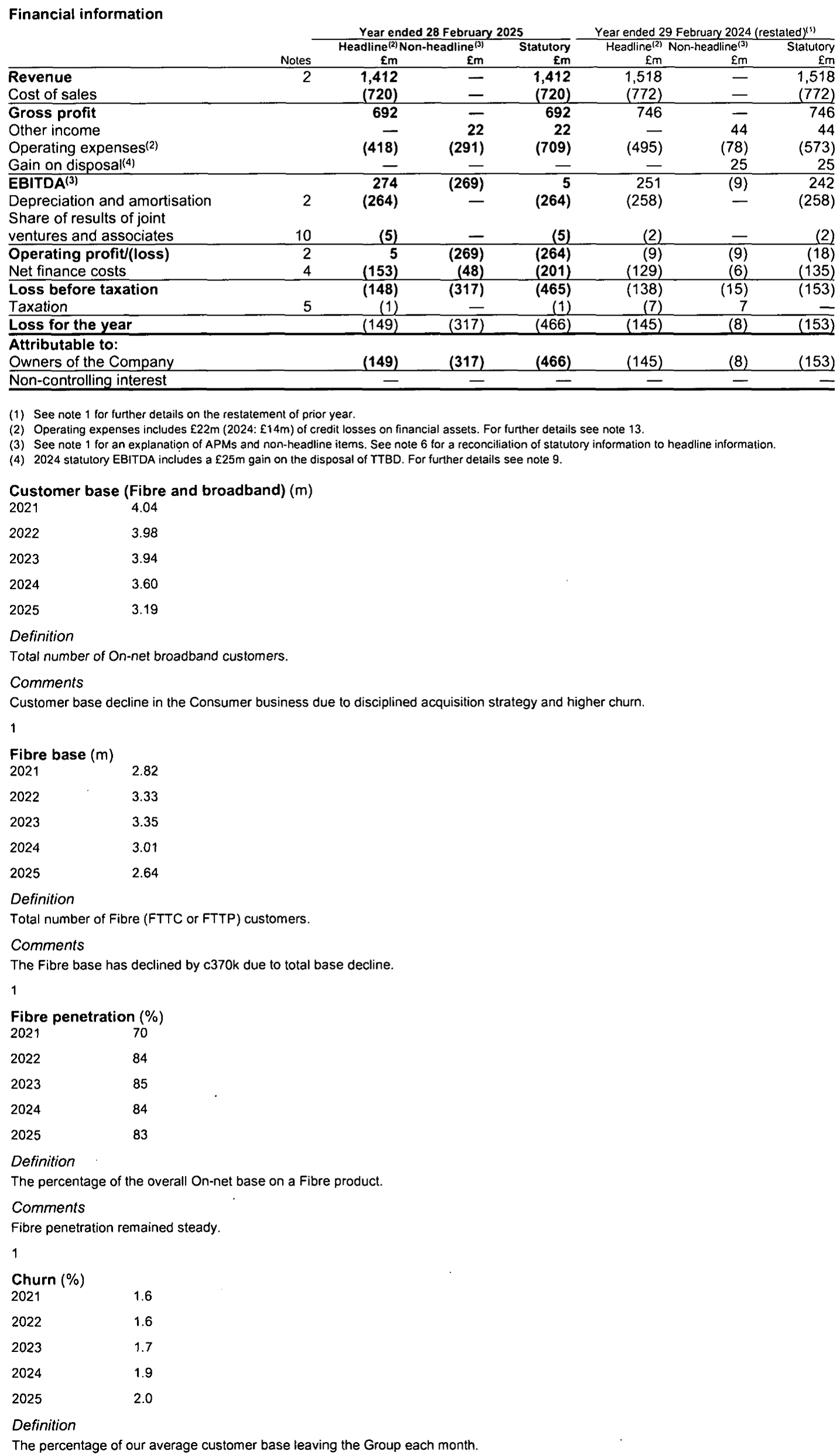
In a perhaps unsurprising development, the TalkTalk Group finally published their annual accounts yesterday and revealed that they made a statutory loss before tax of £465m for the year ended 28th February 2025 (up from £153m last year). The company also lost 420,000 UK broadband customers, leaving them with a group total of 3.2 million.

Quite a few of the figures in the group’s latest report were already in the public domain (here and here), although the full results provide a much more all-encompassing summary of the challenges TalkTalk has been facing. All of this helps to illustrate why the recent £100m funding deal (here), which itself followed last year’s £400m refinancing package – necessary to avoid a default on its debts (here and here), were so crucial.

NOTE: The 3.2 million broadband customers includes 2.3m directly via retail ISP TalkTalk, as well as 0.5m via consumer wholesale and 0.4 via business wholesale. Some 2.6m of that 3.2m total connect via FTTC and FTTP lines and the operator also had 76,000 Ethernet connections (up from 75k).

The group, which has also experienced some job losses (here) and now has 1,570 employees (down from 2,065), is still not out of the woods. The company has thus continued to hunt for a buyer for different parts of their business (here), while also recently migrating another batch of their legacy broadband and phone customers (here) over to the Utility Warehouse (Telecom Plus) and suffering payment disputes with suppliers (here and here).

The results note that monthly churn increased year-on-year to 2% (up from 1.9%), while revenue declined to £1,412m (down from £1,518m) and on-net average revenue per user (ARPU) fell slightly to £25.46 (down from £25.74), mostly due to price rises being offset by the reduction of usage and boosts (add-ons). Gross profit now stands at £692m (down from £746m), although headline operating costs did decrease to £418m (down from £495m).

The overall level of net debt (excluding leases) has now risen from £985m last year to £1,206m this year, or from £1,785m to £1,966m if you include leases. But the proportion of their broadband customer base now on full fibre (FTTP) lines has increased from 15% to 22%.

TalkTalk Statement

“The markets in which our businesses operate have remained fiercely competitive. As a value challenger brand, we have continued to provide a value-based proposition to both wholesale and consumer customers and have remained focused on product reliability and improving customer service.”

TalkTalk-Results-Summary-to-Feb-2025

GIC takes 25% stake in MásOrange and Zegona’s new Spanish FiberCo | Total Telecom

Original article Total Telecom:Read More

red, yellow, and white concrete stairs

News

The joint venture’s fibre-to-the-home (FTTH) network will span 12.2 million premises, making it one of the largest networks in Europe

This week, Singapore sovereign wealth fund GIC has agreed to purchase a 25% stake in MásOrange and Vodafone Spain’s upcoming fibre network joint venture, internally known as ‘Surf’.

Vodafone Spain and MásOrange announced the creation of the joint venture in January. The business, estimated to be worth €8–10 billion, will combine the two companies’ fibre-to-the-home (FTTH) networks, reaching roughly 12.2 million premises across Spain.

The move will create the largest fibre network operator in the country, with more than 4.5 million existing customers.

Assuming the typical regulatory approvals, the deal is expected to close in Q4 this year.

“We look forward to partnering with MasOrange and Vodafone Spain to create Spain’s largest FibreCo,” said Boon Chin Hau, Chief Investment Officer at GIC. “Spain is one of the most advanced European countries in terms of its Fibre to the Home rollout, however, there remains significant fixed broadband penetration growth potential. In addition, the FibreCo has been designed to offer best in class service quality to customers whilst offering robust core infrastructure characteristics to investors.”

The financial details of the deal remain undisclosed, but sources speaking to Bloomberg have previously valued Surf at €6–7 billion, including debt, suggesting the stake is worth €1.5–€1.75 billion.

MásOrange says it will receive at least €3.2 billion from the deal, which it will use to pay down debt, while Vodafone Spain’s new owner, Zegona, will receive €1.4 billion.

That GIC is only taking a 25% stake in the new business is notable. When the creation of Surf was first announced, the plan was for MásOrange to hold a 50% stake and Zegona a 10% stake, with a third-party investor to be found for the final 40%. By May, however, the sale of a stake of this size was looking unlikely, with the company reportedly having only received non-binding offers below the minimum valuation the partners were seeking.

This smaller investment from GIC, therefore, will see the new ownership structure adjusted accordingly, with MásOrange and Zegona’s stakes increased to 58% and 17%, respectively.

Spain is one of the most advanced fibre broadband markets in Europe, with FTTH technology reportedly available to 95.2% of households.

Keep up with all the latest telecoms news with the Total Telecom newsletter

Also in the news:
US judge rules Huawei must face charges of fraud and racketeering
Optus ditches football rights to focus on telecoms
Nokia launches digital twin platform Enscryb to digitalise energy sector

SKT bolsters GPUaaS offering with new ‘Haein’ cluster | Total Telecom

Original article Total Telecom:Read More

Press Release

SK Telecom announced the launch of its new sovereign GPU-as-a-Service (GPUaaS) based on the latest NVIDIA B200 GPUs.

The newly launched GPUaaS features one of Korea’s largest GPU clusters, consisting of over 1,000 NVIDIA B200 GPUs integrated into a single cluster. It delivers state-of-the-art performance in Korea and represents an advancement over the H100-based GPUaaS released in December 2024. It is expected to contribute significantly to nationwide artificial intelligence (AI) infrastructure expansion and the growth of the domestic AI industry.

The cluster is named ‘Haein’ (해인海印), inspired by Haeinsa Temple, which houses the Tripitaka Koreana (a UNESCO World Heritage collection of over 80,000 Buddhist scriptures). The name reflects the intention to establish this cluster as a key part of Korea’s sovereign AI infrastructure.

In particular, Haein has secured a role in the Ministry of Science and ICT’s program for enhancing the foundation of AI computing resource utilization as part of the ‘Proprietary AI Foundation Model’ Project. It will actively contribute to the development of national AI foundation models with global competitiveness.

The ‘AI Foundation Model’ program aims to strengthen Korea’s AI competitiveness on the global stage and advance the national AI ecosystem. Through this program, SK Telecom plans to develop its Gasan AI data center (AIDC) into a core infrastructure hub for the growth of Korea’s AI industry.

SK Telecom has prepared for this sovereign GPUaaS launch with strategic global partnerships, including Penguin Solutions for integrated AIDC solutions and Supermicro for globally sourced AI server procurement.

SK Telecom’s proprietary technologies are leveraged in various ways. By utilizing its in-house virtualization solution, ‘Petasus AI Cloud,’ SK Telecom can instantly partition and reconfigure the GPU cluster according to customer needs, maximizing utilization. In addition, the company provides the ‘AI Cloud Manager,’ an AIOps (AI for IT Operations) platform that efficiently manages the entire AI service lifecycle — from development and training to deployment. This platform, backed by extensive expertise in large-scale model development, enhances user work efficiency and development convenience.

This launch of B200-based GPUaaS marks another tangible milestone following the opening of Lambda’s Korea region in December 2024. SK Telecom will continue expanding its GPUaaS business to provide robust infrastructure support that enables Korea’s AI industry to compete on the global stage.

“Haein’s GPUaaS will serve as a catalyst for enhancing both customer and national AI competitiveness,” said Kim Myoung Gook, Head of the GPUaaS Business Office at SK Telecom. “As an AI infrastructure provider, we are committed to building the nation’s AI superhighway.

Keep up with all the latest telecoms news with the Total Telecom newsletter

Also in the news:
US judge rules Huawei must face charges of fraud and racketeering
Optus ditches football rights to focus on telecoms
Nokia launches digital twin platform Enscryb to digitalise energy sector

Telecoms Industry Leader Steve Leighton Joins Altnets in Landmark Appointment | Total Telecom

Original article Total Telecom:Read More

Industry veteran Steve Leighton, an influential figure in the UK telecoms industry and Chairman of ISPA (Internet Service Providers Association), joins award-winning ISP infrastructure specialists Altnets as Strategic Advisor on 1 August 2025. This appointment comes at a critical juncture as Altnets aims to increase market share, accelerate growth, and redefine how the telecoms sector approaches infrastructure distribution.

More than just a new chapter for Altnets, this appointment is a powerful declaration of the company’s future course and its commitment to assisting the UK’s quickly changing connectivity demands. Under Steve’s counsel, Altnets will enhance its standing as a major force behind full fibre broadband infrastructure delivery, supporting the transformation of the industry.

With 20 years’ experience in the telecommunications sector, plus a stint in government, Steve offers Altnets an unparalleled combination of entrepreneurial skills and policy knowledge. He is best known for his decade of service as CEO of Voneus, where he promoted digital inclusion and rural broadband expansion. As a strategic advisor and entrepreneur, he has also supported several ISPs and tech companies.

Currently serving as Chairman of ISPA, the UK’s trade association for internet service providers, Steve represents more than 200 members, ranging from large corporations to agile small and medium-sized players. He has in-depth knowledge of the commercial and regulatory forces influencing the telecoms sector, thanks to his previous senior government positions, such as Head of Communications Sponsorship at the former Department of Trade and Industry.

Reflecting on his appointment, Steve shares:

“I am absolutely thrilled to be joining the incredible team at Altnets as a Strategic Advisor to the Board. I’ve watched the business grow from both my Voneus seat and more latterly from my seat as the Chairman of ISPA.

“As I enter the most exciting phase of my career, I’m focused on working with businesses that have a clear edge in a competitive market, and Altnets has that. I want to work with driven, like-minded people who share my values, ambition, and positive spirit. The Altnets team ticks every box, and I’m looking forward to helping them realise their big plans while having some fun along the way!”

This couldn’t have come at a more crucial moment for Altnets. Faster, more effective, and better-connected supply chains are critical to achieving the UK’s digital goals. Accelerating the country’s connectivity rollout is an urgent commercial and societal necessity, not just a business priority. Altnets is in a better position than ever to take the lead in unlocking this infrastructure, assisting ISPs, and contributing to the delivery of the high-speed broadband that the UK sorely needs, thanks to Steve’s strategic direction.

This appointment coincides with the formal transition of Olly Shepherd into the role of Managing Director, marking a new phase of leadership for Altnets as the business intensifies its emphasis on development, innovation, and market expansion.

Olly said:

“We are delighted to welcome Steve to Altnets! His appointment represents a significant milestone for us and underscores our position as a leading force across the telecommunications sector.

“Steve’s guidance will be instrumental as we enter our next phase of growth and strengthen industry partnerships. With the ISP landscape evolving rapidly, his expertise gives us real confidence in navigating what’s next and helping to steer our strategic direction.

“This appointment shows our commitment to partnering with top industry experts to deliver outstanding connectivity and lasting value for our customers and stakeholders.”

Steve has been a catalyst behind some of the UK’s most significant infrastructure projects in recent years, driven by his enthusiasm for the telecoms sector and its ability to change lives through connection. Beyond the boundaries of his roles, he has continuously influenced how the sector works together, innovates, and addresses the needs of digitally disadvantaged people.

To find out more about how Altnets is disrupting the telecoms industry, go to https://www.altnets.co.uk/.