VMO2 unveils first of 1,000 Giga Sites to boost 5G | Total Telecom

Original article Total Telecom:Read More

Press Release

The site uses Nokia’s dual-band massive MIMO technology to combine low, mid and high-band spectrum, including new spectrum obtained as part of Virgin Media O2’s deal with Vodafone UK

Virgin Media O2 has today announced the successful switch-on of a first-of-its-kind Giga Site in Paddington, London, utilising newly acquired spectrum and marking a major step forward in delivering faster and more reliable mobile connectivity across the UK.

The new Giga Site combines low, mid and high-band spectrum with Nokia’s new cutting-edge dual-band massive MIMO technology, which uses a large number of antennas to significantly improve 5G network performance by boosting capacity, spectral efficiency, data rates, and coverage. This is the one of the first deployments of its kind on a live European network.

By bringing together different spectrum bands on one mast, the operator can offer strong, reliable signal to a large area. The single site is using a combination of low band spectrum to provide broad coverage, mid band to offer additional capacity, and high band to give customers very fast speeds.

The new site can deliver more than 10Gbps of throughput which is more than the entire O2 UK network carried at the peak of the London 2012 Olympics, and is enough to support 2,000 simultaneous 5Mbps HD video streams.

Following many months of detailed technical planning, the site has been able to make use of newly acquired spectrum from Vodafone UK, with the signal put to use just one minute after it was transferred. Virgin Media O2 will continue to deploy this spectrum over the medium term.

Virgin Media O2 plans to roll out 1,000 of these new Giga Sites nationwide throughout next year to bring a further step change in mobile connectivity for customers on the O2 network who will experience faster speeds and a more reliable connection.

Dr Robert Joyce, Director of Mobile Access Engineering at O2, said: “The switch on of our first Giga Site here in central London is a really important demonstration of how we are investing and innovating to continue improving our mobile network and customer experience. These new sites will deliver faster speeds, greater capacity, and more reliable connections for our customers. As we carry out upgrades and roll out hundreds more Giga Sites across the country, we’ll put our new spectrum to work helping us keep improving mobile connectivity nationwide.”

Mark Atkinson, Head of Radio Access Networks at Nokia commented: “Our partnership with Virgin Media O2 to implement Giga Sites reflects our commitment to helping our customers differentiate with superior performance. This is one of Europe’s first dual-band Massive MIMO deployment combined with our TDD carrier aggregation solution, which showcases how our latest high-performance radios and versatile carrier aggregation solutions allow operators to fully harness the power of their spectrum, enabling the next wave of 5G services.”

These upgrades are part of Virgin Media O2’s Mobile Transformation Plan, which will see the operator invest approximately £700m this year to future-proof its mobile network. The plan is focused on expanding 4G and 5G coverage, a dedicated small cells rollout to boost capacity in dense urban areas, and innovative solutions to address persistent network pain points including along railway lines, at airports, on motorways, and in stadiums and arenas.

Virgin Media O2 recently announced that it had agreed a deal with Vodafone UK to acquire 78.8 MHz of spectrum, bringing the operator’s total spectrum holding to approximately 30% of UK mobile spectrum and materially enhancing the company’s network position.

Keep up to date with all of the latest telecoms news from around the world with the Total Telecom newsletter

Also in the news
Connected Britain Award winners 2025 announced!
Netomnia announces ‘powerful and ambitious’ rebrand ahead of Connected Britain
VodafoneThree drops Samsung, relies on Nokia and Ericsson for £2bn network upgrade

Taiwan rebuffs call to shift 50% of chip production to the US | Total Telecom

Original article Total Telecom:Read More

News

The island nation is the biggest producer of semiconductors in the world and maintaining this dominance is about more than just the economy.

This week, the Taiwanese government has denied that they are considering shifting 50% of their semiconductor manufacturing operations to the US, despite statements made to the contrary by US Commerce Secretary Howard Lutnick earlier this week.

Speaking to NewsNation on Tuesday, Lutnick said that his latest trade talks with Taiwan had included discussions of shifting up to half of the country’s chip production to the US.

“That’s been the conversation we had with Taiwan, that you have to understand it’s vital for you to have us produce 50%,” said Lutnick in an interview with NewsNation.

Taiwan is the world’s largest producer of semiconductors, with Taiwan Semiconductor Manufacturing Company (TSMC) controlling over 68% of global semiconductor foundry revenue at the end of 2024, according to data from TrendForc, Second-place producer, South Korea’s Samsung, accounts for just 8%.

On Wednesday, however, Taiwan’s Vice Premier Cheng Li-chiun rejected the suggestion that the matter had even been discussed.

“Our negotiating team has never made any commitment to a 50-50 split on chips. Rest assured, we did not discuss this issue during this round of talks, nor would we agree to such conditions,” said Cheng, according to Taiwan’s official Central News Agency.

Instead, Cheng said the discussions were focussed on resolving issues surrounding tariffs and the US’s Section 232 investigations, which seek to probe whether imported goods represent a threat to national security.

Taiwan’s exports to the US are currently subject to a 20% tariff, with the island’s government hoping to negotiate this rate’s reduction.

The rapid expansion of the US’s domestic chip production capabilities has been a focus for the government since the start of the decade, when the coronavirus pandemic exposed the fragility of global supply chains. The Biden-era CHIPS and Sciences Act – described by President Trump as a “horrible, horrible thing” – has set aside $39 billion in subsidies for domestic chip production, encouraging major investments from giants like Intel, Micron, and Samsung.

The subsidies even proved enough of a lure to draw interest from TSMC, which announced a $65 billion commitment in 2024 to build three greenfield fabs in Phoenix, Arizona, supported by $6.6 billion in US subsidies. Earlier this year, this investment was scaled up by a further $100 billion.

This investment, however, is seemingly not enough for the US government, which wants far less reliance on overseas production.

Naturally, the elephant in the room during discussions are the major geopolitical factors in play. Taiwan is under constant existential threat from China, and the vital role its semiconductor industry plays in the global tech supply chain is a key reason for its US support. Moving chip production to the US would not only be a technical and economic challenge for Taiwan, but a disintegration of the nation’s so-called ‘Silicon Shield’, removing its largest deterrent against Chinese invasion.

With news published just this week that Russia is reportedly helping China plan an invasion of Taiwan, the country is surely less motivated than ever to hand over its technological crown jewels.

Keep up to date with all of the latest telecoms news from around the world with the Total Telecom newsletter

Also in the news
Connected Britain Award winners 2025 announced!
Netomnia announces ‘powerful and ambitious’ rebrand ahead of Connected Britain
VodafoneThree drops Samsung, relies on Nokia and Ericsson for £2bn network upgrade

Popular Image Sharing Site Imgur.com Blocks Access to UK Visitors UPDATE4 | ISPreview UK

Original article ISPreview UK:Read More

The popular online image sharing website Imgur.com, which was first founded in 2009 and has been widely used to host viral images, short videos and memes that can be linked to from other sites, appears as if it may have responded to a recent Information Commissioner’s Office (ICO) investigation by blocking UK IP (Internet Protocol) addresses.

People on UK internet connections who try to visit the website, or who wish to view imgur.com hosted images via other websites (it’s common practice to upload and share images in this way), are instead being shown a generic error message: “Content not available in your region“. This typically indicates that the website itself has implemented a geo-block against the country.

NOTE: Geographic access restrictions can easily be circumvented via a variety of methods.

The strong suspicion being expressed online is that this could be a response to the new Online Safety Act (OSA) and its requirements for websites to implement “effective age checks“ on visitors (here). The measure is designed to prevent children from encountering online porn and protect them from other harmful content, but it’s also something that has not been universally popular (here).

One of the issues is that Ofcom and the government have been trying to apply this in an extraterritorial fashion to websites based and hosted in other countries. Sites that don’t comply could potentially face fines or be blocked by UK internet providers (broadband and mobile). Suffice to say that some sites have been opting to simply block UK visitors instead of going through the complex and costly hassle of adopting another country’s rules.

However, it now seems more likely that Imgur’s decision is a direct reaction to a recent investigation by the ICO, which we’ll come back to in a moment.

An Ofcom spokesperson told ISPreview:

“Imgur’s decision to restrict access in the UK is a commercial decision taken by the company and not a result of any action taken by Ofcom. It has not stated the reasons for its decision. Other services run by MediaLab remain available in the UK – such as Kik messenger, which has implemented age assurance to comply with the Online Safety Act.”

So far as we can tell, imgur.com does not appear to have issued any prior notice of their intent to adopt such a measure, which will be a breaking change for a lot of online UK content that relied on the image sharing service. However, it may not have helped when, during October last year, imgur.com decided to loosen its restrictions on memes and photos involving adult humour (PC Mag), although they don’t allow nudity / porn.

We should point out that imgur.com has in the past been the subject of several blocks imposed by broadband ISPs too (e.g. here and here), albeit usually by accident due to faulty content filtering. But crucially Imgur.com is currently being investigated by the Information Commissioner’s Office (ICO) for its approach to assessing the age of child users in the UK (here).

The ICO previously said their investigations into Imgur were “considering how the platforms use UK children’s personal information and their use of age assurance measures … Age assurance plays an important role in keeping children, and their personal information, safe online. There are tools or approaches that can help estimate or verify a child’s age, which then allow services to be tailored to their needs or access to be restricted“.

However, the ICO’s investigation is being carried out under data protection law, not the OSA. Admittedly there is crossover between the two regimes when it comes to age assurance (i.e. providers need to comply with both regimes and the two regulators have been co-ordinating on that), but stritcly speaking the ICO’s investigation has nothing to do with the OSA itself.

UPDATE 11:48am

We’ve added a comment from Ofcom above and added some detail on the ICO’s investigation into imgur.com.

UPDATE 12:04pm

The ICO has also issued an update on the aforementioned investigation today (here), which adds some key context. The ICO previously said they had been working closely with Ofcom on this, which has responsibility for enforcing the Online Safety Act, to ensure their efforts are co-ordinated.

Tim Capel, ICO Interim Executive Director – Regulatory Supervision, said:

“We reached our provisional findings on this investigation, and we issued a notice of intent to impose a monetary penalty on MediaLab on 10 September 2025.

Our findings are provisional and the ICO will carefully consider any representations from MediaLab before taking a final decision whether to issue a monetary penalty.

We have been clear that exiting the UK does not allow an organisation to avoid responsibility for any prior infringement of data protection law, and our investigation remains ongoing.

This update has been provided to give clarity on our investigation, and we will not be providing any further detail at this time.

Safeguarding children’s personal information is a key priority for the ICO and our Children’s code strategy outlines our key interventions in this area. Keeping children safe online is the responsibility of the companies offering online services to them and we will continue to hold them to account.”

UPDATE 1:48pm

Imgur.com has updated their help site to include the following statement (this part is still viewable from the UK).

Imgur access in the United Kingdom

UPDATE 4:05pm

The key part of the ICO’s investigation seemed to have focused on how Imgur failed to ask visitors to declare their age when setting up an account. We’ve clarified above that this investigation took place under data protection law and not the OSA.

Broadband ISPs Brsk and YouFibre Launch Black Friday Sale – Make WiFi 7 Standard | ISPreview UK

Original article ISPreview UK:Read More

Sister UK ISPs Brsk and YouFibre (Netomnia) will today launch special Black Friday pricing across their range of broadband packages. On top of that, Brsk also confirmed that their new WiFi 7 routers will, from today (1st Oct 2025), be included as standard for all new customer orders (YouFibre did the same in August – here).

In terms of the early Black Friday discounts, we note that Brsk’s symmetric speed mid-tier 500Mbps package on an 18-month term has now been reduced to £29 per month (down from £30), while 1000Mbps has been cut to £30 per month (down from £35) and the biggest discount of all sees their 2000Mbps tier dropping to just £35 per month (down from £55). All packages include a wireless router and free installation.

NOTE: The Substantial Group (Netomnia) is backed by over £1.6bn of equity and debt from investors Advencap, DigitalBridge, and Soho Square Capital etc. The group aims to cover 3 million UK premises by the end of 2025 (currently on 2.7m) and then 5m by the end of 2027 (inc. 1m customers by 2028). The service is currently available across parts of over 90 cities and towns.

At the same time YouFibre will discount their similar 1Gbps broadband package from £33.99 to £29.99 per month, while their 2Gbps tier is set to drop from £49.99 to just £34.99. YouFibre clarified that this offer will only be available for new customers to take until 1st December 2025.

Finally, Brsk will today introduce their new WiFi 7 routers and make them standard for all new customers. The hardware they’re adopting is expected to mirror the kit used by YouFibre.

New ISP Orbus Broadband Launches and Promises Best WiFi Across UK | ISPreview UK

Original article ISPreview UK:Read More

The United Kingdom’s existing market for internet service providers is already quite an overcrowded place, but today it got a little busier after a new ISP called Orbus Broadband (a trading name of London-based AnyLead Ltd) launched with a promise to deliver “Better Broadband and the Best WiFi Across the UK“.

According to the announcement, Orbus aims to “bring households faster speeds, stronger WiFi coverage, and fairer pricing. At a time when millions of families are struggling with poor service and confusing contracts, Orbus is setting out to offer a simple alternative: full fibre connectivity paired with the latest Eero mesh WiFi system.” Orbus also commits to “avoid the hidden fees and mid-contract price hikes“.

At present the new provider, which includes an Amazon’s mesh WiFi system as standard on their packages, appears to only be offering three packages via Openreach’s national full fibre (FTTP) broadband network. Prices start at £30.99 per month for 150Mbps on a 24-month term and rise to £35.99 for 500Mbps and then £40.99 for 900Mbps.

Shay Ramani, CEO of Orbus Broadband, said:

“We created Orbus to give UK households a better broadband option – one that puts speed, reliability, and fairness first. Our launch is about providing not just fibre connections but also the best WiFi available through our partnership with Eero. Every family should have a service that works across the whole home without confusing pricing or hidden costs.”

The listed Director of AnyLead Ltd is currently Shaileshkumar Ishvarlal Ramani, who is also a director of several other companies, including the Free Price Compare utilities comparison website at the same address.

CityFibre Report 730K UK Broadband Customers as FTTP Covers 4.6M Premises | ISPreview UK

Original article ISPreview UK:Read More

The UK’s largest alternative full fibre (FTTP) broadband ISP network, CityFibre, has today published their latest results and revealed that they now cover 4.6 million premises and have seen record growth in customer connections, with 108,000 customers connected in Q3 2025 (up from 58k in Q2) to total 730,000.

CityFibre has long aspired to reach up to 8 million UK premises – representing c.30% of the UK, but their original target of hitting that by the end of 2025 will be missed. Instead, they’ve more recently been looking to boost coverage via greater consolidation of rival networks (here and here) and coverage expansion under c.£860m worth of Project Gigabit contracts (state aid), while also having to deal with some of the same pressures as many other networks (e.g. high interest rates, rising build costs and competition).

NOTE: The operator is owned by Antin Infrastructure Partners, Goldman Sachs, Mubadala Investment Company, Interogo Holding etc. The network is supported by UK ISPs such as Vodafone, TalkTalk, Zen Internet, Sky Broadband and more (local ISP availability does vary).

Despite those challenges, the operator recently secured a crucial UK funding agreement worth £2.3bn (here) and also saw major ISP Sky Broadband begin to offer services over their network to consumers at speeds of up to 5Gbps (here). The latter seems likely to be what has helped to give CityFibre a record quarter in customer growth.

The operator has today also reported that their Q3 2025 revenue was £43m, (Q3 2024: £34m), with an annualised run rate of £172m, up 26% year-on-year. Adjusted EBITDA was £7.6m in Q3 2025, (Q3 2024: £1.4m) up more than five times year-on-year, and now at an annualised run rate of £30m.

Simon Holden, CEO of CityFibre, said:

“Our rate of customer growth has real momentum, with our ISP partners making the most of CityFibre’s market-leading services and growing across our full fibre network.

We are proving the strength of CityFibre’s wholesale business model as we reach an inflection point, with our recent financing providing the firepower to significantly expand our reach through acquisitions and bring world-class digital infrastructure to people, businesses and communities across the UK.”

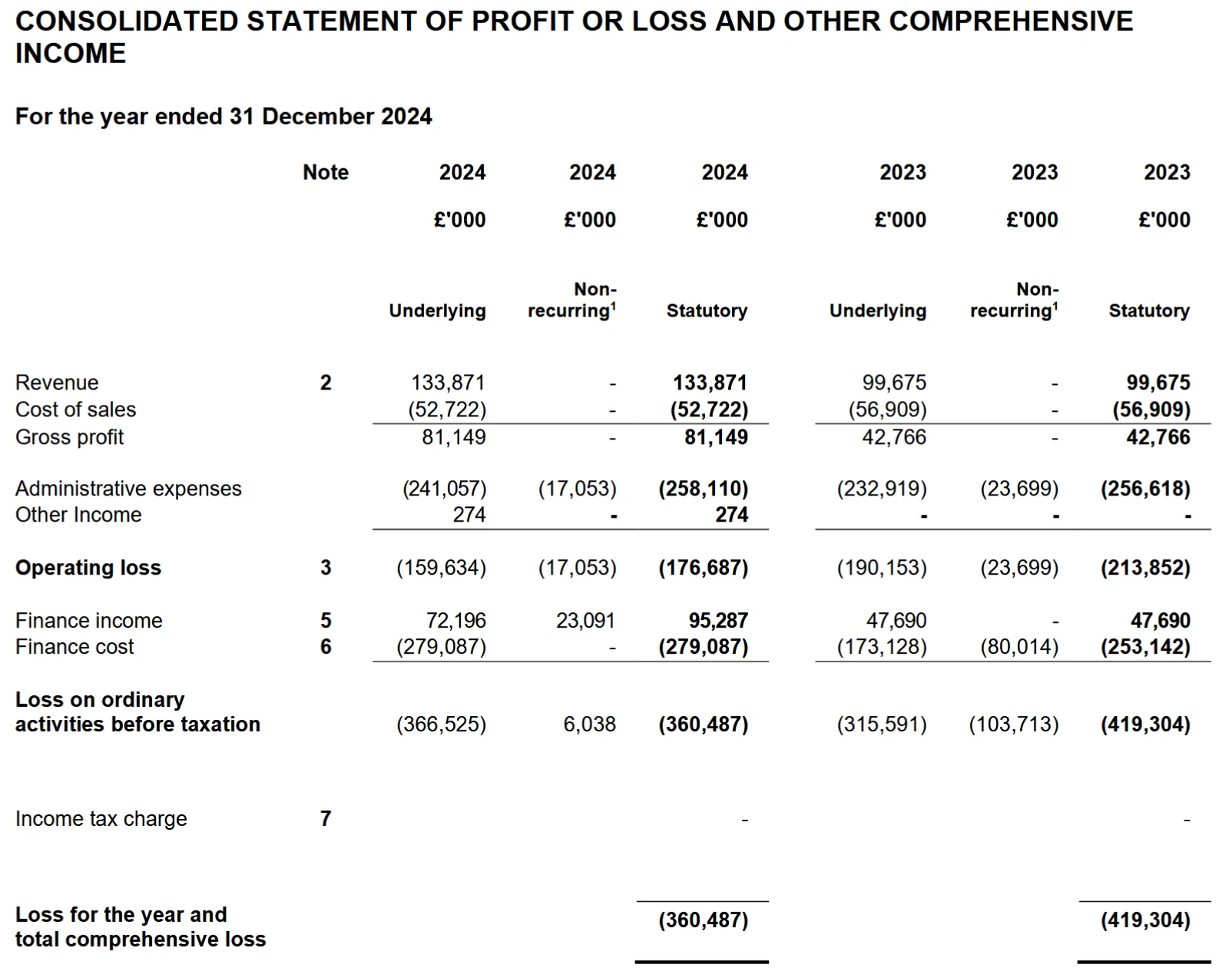
As well as posting a limited and somewhat sanitised summary of their latest quarterly results, CityFibre have today also published their annual group accounts to the end of December 2024 (here). This reveals that total revenue for the year grew to £134m (2023: £100m), while their operating loss fell to £176.6m (2023: £213.8m) and Adjusted EBITDA (earnings before interest, taxes, depreciation, and amortisation) achieved a profit of £6m (2023: £55m loss).

However, underlying net finance costs, comprised of finance income of £72m and finance costs of £279m, did increase by £82m (2023: £125m) driven by increased use of their facility to support capital expenditure, combined with rising interest rates, the impact of which was partially mitigated by hedging arrangements in place.

The company also reported having total assets worth £4.75bn, total liabilities of £4.22bn and the average number of staff employed (including Directors) by the Group ended the year on 1,594 (2023: 1,876).

CityFibre-Consolidated-Statement-of-Profit-and-Loss-for-Dec-2024

Disney+ Internet Video Streaming Service Hikes UK Prices for 2025 | ISPreview UK

Original article ISPreview UK:Read More

Internet video streaming provider Disney+ has followed its usual annual trend by once again hitting new UK customers with a fresh round of price hikes, which are due to all be introduced from on or after 4th November 2025 (or 25th November 2025 if you have an annual plan).

In terms of the actual price changes. The “Standard with Ads” plan has increased by +£1 to £5.99 per month, while “Standard” increases by +£1 to £9.99 (or £89.90 to £99.90 annually) and “Premium” surges by +£2 to reach £14.99 (or £129.90 to £149.90 annually). This represents another annual inflation busting increase that ranges from 11% to 20%, depending upon your plan and whether it’s a monthly or annual payment.

The Extra Member option now also costs £4.99 per month for users of “Standard with Ads” (up from £3.99), and £5.99 for both the “Standard” and “Premium” plans (up from £4.99). Suffice to say that the endless price hikes and ever-increasing fragmentation of streaming TV and movie content continues to get worse, which increasingly risks driving many consumers back to more unlawful pursuits.

Broadband ISP Brillband Launch WiFi 7 Routers as Standard on UK Plans | ISPreview UK

Original article ISPreview UK:Read More

Glasgow-based full fibre broadband ISP Brillband, which was acquired by AllPoints Fibre Networks (APFN) back in October 2024 (here) and sells packages to homes over the same wholesale platform, has today announced that “every new Brillband customer” will receive their next-generation Wi-Fi 7 router as standard. No price hikes needed.

A number of broadband providers have launched WiFi 7 capable routers over the past year, although only a very few have made them the standard choice (e.g. YouFibre). Brillband has today joined this club and they appear to be shipping Amazon’s latest dual-band eero 7 routers to new customers “at no extra cost” (packages start at £38 per month for 900Mbps on a 24-month term).

The base eero 7 model is a dual-band unit that features 2 x 2.5Gbps Ethernet ports, 1 x USB-C port and wireless speeds of up to 1.8Gbps via the 2.4GHz and 5GHz bands (it doesn’t do 6GHz). Unlike other providers, Brillband say they also guarantee no mid-contract price hikes for 24 months.

Duncan Di Biase, CEO and Founder of Brillband, said:

“I founded Brillband to challenge the old way of doing broadband and give people a service that is fair and fast. Launching Wi-Fi 7 with eero 7 as standard for every customer ensures we stay true to our mission whilst delivering a significant upgrade to the service our customers receive.

Our aim is to future-proof our customers’ homes with our 900Mbps speeds delivered via the incredible Aquila network, combined with a WiFi standard that their devices will grow into plus network security without an extra cost.”

O2 UK and Freshwave Expand 4G Small Cells in Perth, Scotland | ISPreview UK

Original article ISPreview UK:Read More

Mobile network operator O2 (Virgin Media) and partner Freshwave have today revealed that they’ve expanded their 4G mobile (mobile broadband) network coverage in the centre of Perth (Scotland). This has been achieved via the deployment of six new 4G outdoor small cells.

Freshwave typically deploys small cell style solutions, which are akin to small shoebox sized mobile (radio) base stations that are designed to deliver limited coverage (usually up to around 100 metres) and thus tend to be more focused on busy areas and specific sites – it’s not uncommon to find these sitting on top of lampposts, CCTV poles or old payphone cubicles (more cost-effective than building new street assets).

The new units in Perth are being deployed under an open access agreement between Perth and Kinross Council (PKC) and Freshwave to access their street assets. The small cells are intended to boost outdoor mobile signal and data capacity for O2’s customers in key public spaces, such as outside Perth Railway Station and on the High Street.

Dr Robert Joyce, Director of Mobile Access Engineering at O2, said:

“We’re proud to be boosting connectivity in Perth as part of our £700m Mobile Transformation Plan. Customers want fast, reliable coverage wherever they go, and by teaming up with local authorities and partners like Freshwave, we’re making that happen.”

Mobile Operator Lebara UK Finally Starts Introducing eSIM Support | ISPreview UK

Original article ISPreview UK:Read More

Mobile operator Lebara, which harnesses Vodafone UK’s mobile virtual network operator (mvno) platform, today finally confirmed to ISPreview that they had begun rolling out eSIM (Electronic SIM) support in a phased manner. But initially this will only be available to new customers joining with an Apple iPhone Air, although support will soon expand.

The eSIM standard is an alternative to physical SIM cards, which works by essentially embedding an electronic SIM into your device (Smartphone) that could – once fully implemented – make it easier and quicker to switch between operators (e.g. not having to wait for a SIM card to arrive), as well as to use additional networks alongside your main mobile plan (e.g. eSIMs for travel when abroad).

In terms of device support, Lebara said that they will be making eSim available for other devices – for both new and existing customers – within this year (starting over the next few weeks as they enhance the service).