Ookla Finds UK Trains Deliver Some of the Slowest Wi-Fi Speeds in Europe | ISPreview UK

Original article ISPreview UK:Read More

Network testing firm Ookla, which collects broadband performance data from consumers via their popular Speedtest.net service, has examined the onboard WiFi performance of train services across Europe (inc. some Asian rail networks) and found that the United Kingdom delivers some of the slowest internet speeds on trains.

Regular readers will already be aware that the quality of onboard WiFi across the UK’s various rail networks and operators can be a bit of a patchwork. The previous government once pledged, in 2017, to make “uninterrupted” WiFi and Mobile (5G) speeds of up to 1Gbps (Gigabits per second) available on all mainline train routes by 2025. But this never materialised, and only a very few rail operators have achieved such an outcome.

The current government recently circled back to this area as part of their Infrastructure Strategy for the next 10 years, which among other things committed £41m to “introduce low-earth-orbit satellite connectivity on all mainline trains, significantly improving both the availability and internet data connection speeds for Wi-Fi connected passengers“. But it’s unclear when this will be delivered.

In the meantime, Ookla’s latest study found a wide gap in the best and worst European train operators for onboard WiFi performance during Q2 2025. Sweden was named the fastest in Europe for Wi-Fi with a 64.58Mbps median average download speed, followed by Switzerland (29.79 Mbps) and Ireland (26.33 Mbps). But at the bottom end of the table came laggards like Spain (1.45Mbps), the UK (1.09Mbps) and the Netherlands (0.41 Mbps).
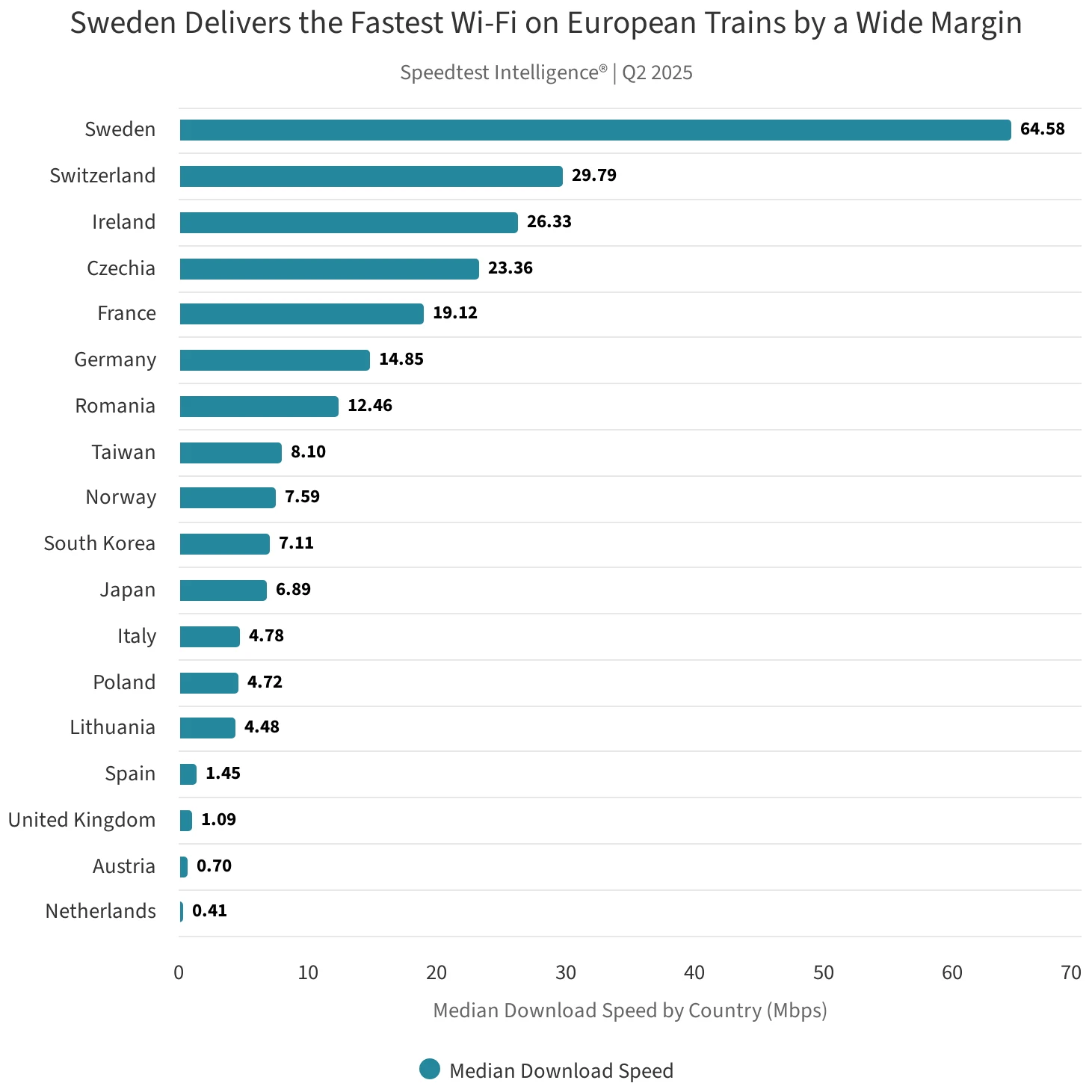
Ookla-Q2-2025-Train-WiFi-Performance-Download-Speed

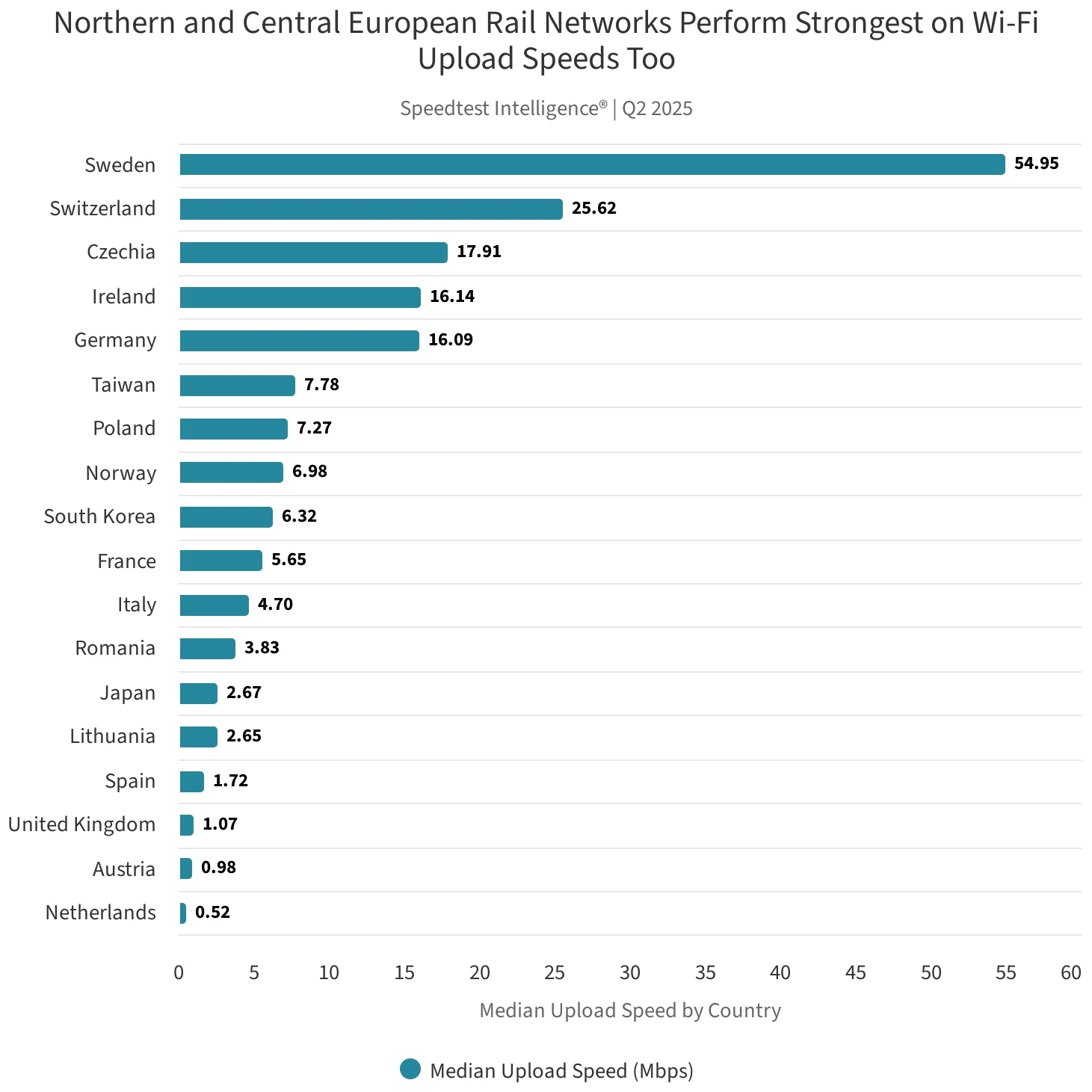
Ookla-Q2-2025-Train-WiFi-Performance-Upload-Speed

Part of the problem in the UK could be that many rail operators are still using older Wi-Fi 4 based connectivity, while 38% of those are on the most congested and slowest 2.4GHz band. On the other hand, some countries that feature a more modern Wi-Fi mix and thus drive greater use of the 5GHz band, like Spain and Italy, clearly still underperform on speed. This is often because their backhaul capacity can’t keep pace due to poor satellite or trackside infrastructure, which is the key factor for onboard performance.

The picture is a bit more varied when we look at latency performance, where the UK places about upper mid-table with an average response time of 49ms (milliseconds). However, given the super slow onboard broadband speeds, having a modestly faster latency isn’t quite so important. Taiwan delivered the fastest latency times of just 13ms, while the slowest came from Poland at 92ms.

Ookla’s full report goes into a lot more detail, including about the materials used in the construction of train carriages and onboard network design, although it’s clear from the report that political leadership and policy makes a big difference in this area. As does the adoption of satellite broadband connectivity from Low Earth Orbit (LEO), which is of course something that the UK government is now pushing (but this won’t help in tunnels).

Ookla’s Onboard Train WiFi Study
https://www.ookla.com/articles/train-wifi-2025

ASA Ban UK ISP Community Fibre’s “Misleading” Best Internet Provider Claims | ISPreview UK

Original article ISPreview UK:Read More

The Advertising Standards Authority (ASA) has banned a website promotion for London-focused broadband ISP CommunityFibre, which occurred after it was found to have misleadingly claimed to be both the “#1 rated internet provider on Trustpilot – with the most 5 star reviews” and “#1 Best ‘Internet Provider’“.

Just for some context. CommunityFibre has so far deployed their 5Gbps speed Fibre-to-the-Premises (FTTP) broadband network to serve 1.342 million homes (inc. 185k businesses within 200 metres of their network), albeit with the vast majority of that being present in London.

However, the ASA found that, when the companies in the same category as CommunityFibre were sorted by “highest number of reviews” on Trustpilot (at the time the promotions were seen – June 2025), two had a higher number of five-star reviews at over 182,000 and 65,000 five-star reviews respectively, compared to CommunityFibre that had over 60,000 five-star reviews.

ASA Ruling Ref: A25-1300873 Community Fibre Ltd

We understood that in order for Community Fibre to appear at the top of the list of ‘Internet providers’ on Trustpilot, the results had to be sorted by “Highest number of reviews” and the filters “4.5+ [stars]” and “London” had to be applied. This had the effect of filtering out a large number of Community Fibre’s competitors.

Whilst there were approximately 400 companies in the Trustpilot category “Internet provider”, when these filters were applied only 20 companies appeared. Moreover, when these filters were applied, although Community Fibre appeared at the top of the list of internet providers, another company which appeared beneath them in the list held a higher star rating.

Because the ads gave the impression that Community Fibre was the highest rated internet provider on Trustpilot when we understood that was not the case, we concluded the ads were misleading.

On that point, the ads breached CAP Code (Edition 12) rules 3.1 and 3.3 (Misleading advertising) and 3.7 (Substantiation).

As usual, the ASA banned the promotions in their current form and told CommunityFibre to “ensure they did not state or imply that they held the number one ranking, or had the most 5-star reviews, on third-party review websites if that was not the case“.

UK’s MNOs line up for mmWave spectrum – but can they use it effectively? | Total Telecom

Original article Total Telecom:Read More

a tower with a cell phone on top of it

News

Ofcom has confirmed that all three of the UK’s mobile operators – EE (BT), Virgin Media O2 (VMO2), and VodafoneThree – have been given the greenlight to participate in the upcoming auction

This week, UK telecoms regulator Ofcom has approved all three of the UK’s mobile operators to participate in the upcoming auction for spectrum in the 26GHz (25.1-27.5GHz) and 40GHz (40.5-43.5GHz) bands.

In total, 5.4 GHz of the spectrum will be available in 200MHz lots, with 68 licences available covering ‘high density’ areas across the country. For areas outside the remit of these licences, the UK’s Shared Access licensing framework will apply, meaning operators can attain permission to use the spectrum on a first-come, first-served basis.

The spectrum, often known as mmWave spectrum, has qualities that make it both appealing and challenging for the operators. On the one hand, it can support multi-gigabit-per-second peak data rates, with massive capacity and low latency. This makes it ideal for supporting large numbers of users simultaneously in dense environments like stadiums and city centres, as well as providing a ‘fibre-like’ broadband experience for Fixed Wireless Access (FWA) users.

On the other hand, the spectrum has a much shorter range than the mid-band (generally 1GHz–6 GHz) spectrum typically used for 5G, hence more base stations are required to support an equivalent area, driving up deployment costs. It also has poor signal penetration, meaning it can be blocked by common obstacles, including walls, windows, and even the human body itself.

As a result of its limitations and inherent expense, mmWave deployments worldwide so far have been patchy.

At the dawn of 5G, the US quickly emerged as the poster child for mmWave, spending billions of dollars on relevant spectrum licences, with Verizon even targeting nationwide coverage. The reality, however, was underwhelming. While the spectrum has found some success in targeted urban environments and for FWA, deployment at scale has proven difficult, with the spectrum’s value sliding in response.

Indeed, this deployment challenge is being felt around the world. Even in South Korea – one of the most advanced mobile markets in the world – the country’s three national mobile operators were forced to surrender their mmWave licences to the regulator, having failed to meet minimum deployment targets.

This raises the question of how the UK mobile operators plan to use mmWave spectrum effectively – and how much they will be willing to pay for it.

Ofcom’s auction has reserve prices set at £2 million for lots in the 26GHz band and £1 million for those in the 40GHz bands. Given the relatively large amount of spectrum available and the expensive rollout of 5G Standalone the operators are already undertaking, it seems unlikely that they will be willing to shell out huge sums of money for mmWave.

While no official date for the auction has been given, it has long been planned for this month, with Ofcom saying that it will take place “soon”.

Keep up to date with all of the latest telecoms news from around the world with the Total Telecom newsletter

Also in the news
Connected Britain Award winners 2025 announced!
Netomnia announces ‘powerful and ambitious’ rebrand ahead of Connected Britain
VodafoneThree drops Samsung, relies on Nokia and Ericsson for £2bn network upgrade

Ex-PayPal CEO takes the reins at Verizon | Total Telecom

Original article Total Telecom:Read More

News

Existing CEO Hans Vestberg, who served as CEO since 2018, will be vacating the role with immediate effect

This week, Verizon has announced the appointment of Daniel Schulman, former CEO of PayPal, as company CEO.

The move sees existing CEO Hans Vestberg leave the role immediately, but remain in the company as a special advisor until October 4, 2026, helping to oversee the integration of Frontier Communications.

Schulman is no stranger to the company, having served on the company’s Board for seven years.

“I believe in Verizon and its future, and I am honored to be chosen to serve as CEO,” said Schulman in a company press release. “Verizon is at a critical juncture. We have a clear opportunity to redefine our trajectory, by growing our market share across all segments of the market, while delivering meaningful growth in our key financial metrics. We are going to maximize our value propositions, reduce our cost to serve, and optimize our capital allocation to delight our customers, and deliver sustainable long-term growth for our shareholders.”

In a message to employees on his first day, Schulman, who had previously worked for both AT&T and Virgin Mobile USA, said the appointment felt “like coming home” after 25 years in the telecoms industry.

“Today, we stand at an important moment—we are going to move quickly and boldly to win in both mobility and broadband. I fully intend for us to regain our leadership by growing share across all segments of the market, by consistently delighting our customers. At the same time, we must drive financial results that exceed current market expectations. We must also deliver for our shareholders,” he said.

“The biggest competitive advantage we have is our team. Every day, we have to focus on what truly matters to our customers. We want them to trust us, love us and stay with us,” he added.

Th final sentence is particularly poignant; earlier this year, Verizon revealed it had lost around 300,000 postpaid customers to its rivals in Q1 2025, a fact it largely attributes to the price hikes it implemented in January.

Verizon is not the only US telecoms giant undergoing a major leadership change before the end of the year. Last month, T-Mobile announced that its Chief Operating Officer, Srini Gopalan, will take over the company reins from current CEO Mike Sievert in November.

Keep up to date with all of the latest telecoms news from around the world with the Total Telecom newsletter

Also in the news
Connected Britain Award winners 2025 announced!
Netomnia announces ‘powerful and ambitious’ rebrand ahead of Connected Britain
VodafoneThree drops Samsung, relies on Nokia and Ericsson for £2bn network upgrade

Wessex Internet Builds Rural Broadband to 50k UK Premises as Revenues Rise | ISPreview UK

Original article ISPreview UK:Read More

Rural-focused broadband ISP and alternative network builder Wessex Internet, which is deploying a mix of full fibre (FTTP) and fixed wireless networks across Southern England, has today published their annual accounts to the end of 2024 and highlighted both their “best-in-class” take-up of over 30% and a 20.5% rise in revenues to £5.76m (2023: £4.78m).

The provider, which also holds several state aid backed Project Gigabit build contracts (valued at £72m to deliver full fibre across over 53,000 properties by 2029), currently covers 50,000 premises (Oct 2025) across parts of Dorset, Hampshire, Wiltshire and Somerset (inc. 14,000 customers – Aug 2025). Existing deployment plans aim to expand this to 137,000 premises (here).

NOTE: Wessex Internet is backed by abrdn and in late 2023 secured £35m of extra funding (here), then £50m from the NWF in June 2025 (here). The provider’s Project Gigabit contracts include – North Dorset (Lot 14.01 – 7,100 premises, £6m state aid), New Forest (Lot 27.01 – 10,500 premises, £14m), South Wiltshire (Lot 30 – 14,500 premises, £18.8m), Dorset and South Somerset (Lot 14 – 21,400 premises, £33.5m).

Overall, the provider’s latest accounts could be said to be healthier or more stable than those of quite a few other altnets we’ve seen recently, and they also make a point of highlighting how they’re “up to date on all delivery milestones that fell during 2024 and to the date of these financial statements“.

Wessex Internet also describes itself as being “fully funded until 2029” and states that “take-up of our network is best-in-class; exceeding 30% overall and 50% in our most established networks“. We’ve summarised some of their key figures below, although it should be noted that the comparison figures for 2023 actually reflect a 15-month period to the end of December 2023.

Key Figures from Wessex Internet’s Results (Dec 2024)

➤ Revenues increased 20.5% to £5.76m (2023: £4.78m)

➤ Operating loss increased to £7.84m (2023: £5.43m)

➤ Total Homes Passed is listed as 50,000 premises

➤ Total Homes Connected increased by 50% during the year

➤ Gross profit remained fairly stable at £3.62m (2023: £3.68m)

➤ Total fixed assets worth £64.84m (2023: £39.49m)

➤ Net liabilities of -£22.27m (2023: -£10.12m)

➤ Average monthly number of employees (inc. Directors) for the year ended 2024 on 307 (includes a 180 strong construction team), which is up from 213

➤ Network investment increased by £24.7m in the year (2023: £22.6m)

The company currently has a £68m debt facility with no capital repayments under 2029. Some £28.4m of this has already been drawn, leaving £39.6m available.

Broadband and Mobile Considered as Part of UK Home Buying and Selling Reform | ISPreview UK

Original article ISPreview UK:Read More

The UK government has begun consulting on new proposals aimed at speeding up the process of home buying and selling, while also improving the material information that Estate Agents are required to provide for every transaction. The availability of broadband, as well as mobile signal and coverage, are some of the data points proposed for inclusion in future guidance.

As above, the main focus of the government’s reform in this area (here) is on finding a way to speed up the process of buying and selling UK homes, which currently takes an average of 120 days to complete and around 1 in 3 transactions fail. As part of this, they’re also consulting on new guidance to help estate agents meet their legal obligations and improve the “material information” they provide (here).

NOTE: The consultation on material information for property listings is open for feedback until 29th December 2025. Feedback from members of the public is also being sought.

At present quite a few estate agents already include some details, albeit often quite limited, on the broadband capabilities of the homes they list for sale. Similarly, many online property comparison websites also list such details, even if some estate agents don’t always go that far.

However, this detail rarely extends to include mobile signals and coverage, while alternative broadband networks can sometimes be overlooked due to limited research (i.e. there’s still a tendency to focus on only the biggest ISPs and networks).

Government Statement (Ministry of Housing)

​The home buying and selling process is long, complicated and frustrating for both consumers and property professionals. A key reason for these inefficiencies is that both consumers and professionals often struggle to access the right information at the right time. Significant problems which might affect a buyer’s decision only emerge after their offer has been accepted.

​​We recognise that obtaining, interpreting and publishing material information can be challenging in the context of property sales. We therefore intend to produce new guidance that indicates what is likely to be considered material information, helps professionals meet their legal responsibilities and results in a better quality service for consumers.

As part of this the government have also published a list to show the categories that “we think may be considered material information“, based on previous guidance and engagement with industry stakeholders. The list mentions broadband and mobile connectivity.

Proposed Material Information for Property Sales

  • price
  • council tax and domestic rates
  • tenure, including time remaining on lease (if applicable)
  • ground rent or service charges (if applicable)
  • electricity supply
  • water supply
  • sewerage
  • heating type
  • broadband
  • mobile signal and coverage
  • property type (for example, terraced, detached)
  • number and types of room
  • parking
  • accessibility and adaptations
  • rights and easements
  • flood risk
  • property construction (for example, standard, thatched roof, prefabricated)
  • issues with property (for example, damp, subsidence, asbestos, Japanese knotweed)
  • building safety defects, including fire and structural risk modifications
  • restrictions (for example, listed property, conservation area, restrictions on usage)
  • coastal erosion
  • planning permission
  • coalfield or mining area
  • any other category

Naturally, the issue of including digital connectivity is not always an easy one to resolve, particularly in areas where copper lines with variable broadband speeds are still a factor or locations where the availability of smaller broadband networks may not always be apparent; especially if estate agents only look at data from commercial comparison sites, which often excludes the presence of smaller networks.

Extending this to include mobile connectivity can be an even bigger challenge, not least due to variability of that environment (e.g. local spectrum band assignments and cell sites do change and vary between operators) and the fact that you need to consider the importance of indoor vs outdoor reception. But Ofcom’s new Mobile Coverage Map might be able to provide a limited non-commercial basis for achieving this, even if it’s far from perfect.

Suffice to say it will be interesting to see what approach the government ends up taking, but we won’t learn that until later in 2026.

Ofcom Confirm Bidders for the UK 5G Mobile Auction of 26GHz and 40GHz | ISPreview UK

Original article ISPreview UK:Read More

The UK telecoms regulator, Ofcom, has today confirmed that the final bidders due to take part in their auction of the 26GHz and 40GHz millimetre wave (mmW) bands for faster 5G data (mobile broadband) services will include BT (EE), Telefonica UK (O2 / Virgin Media) and Vodafone (VodafoneThree). No surprises this time around.

The major mobile network providers currently already have access to several 5G capable bands between 700MHz and 3.8GHz. Such frequencies reflect the same sort of low and mid-band radio spectrum that mobile operators have been using since the advent of the first 3G and 4G networks.

NOTE: The regulator aims to make 5.4GHz of spectrum frequency available across both the 26GHz and 40GHz bands.

The move to auction off 26GHz (25.1-27.5GHz) and 40GHz (40.5-43.5GHz) will complement those existing bands by providing lots of additional spectrum frequency, which means more data capacity for extremely fast speeds (e.g. multi-Gigabit). But such signals tend to be very weak and can’t cover a wider area without a much denser / more expensive network, which in practice means they’ll primarily be used for serving busy urban areas (shopping malls, airports etc. – “High Density Areas“) and fixed wireless broadband (FWA) links.

Ofcom plans to make this spectrum available in a clock auction (200MHz lots) with 15-year licences across 68 “high-density” areas (i.e. cities and select transport hubs). Interestingly, the UK is one of the first countries in Europe to award spectrum in the 40GHz band for mobile, although the 26GHz award is much more in keeping with the EU’s existing approach and many operators can already access it.

The first bidding or principal stage is currently still expected to take place this month (an exact start date will be confirmed soon), although we won’t learn the final outcome until a little bit later. Ofcom’s reserve prices for this spectrum also appear to be modest when compared with other European auctions (£2m per 26GHz lot and £1m per 40GHz lot).

As usual, winning the auction is only part of the challenge. Network operators will then need to update and adapt their networks to support the new bands, and not all UK devices (Smartphones etc.) are currently able to harness them; this is particularly true of the 40GHz band.

Boldyn Networks Boost London’s 5G Mobile Cover via 200 Small Cells | ISPreview UK

Original article ISPreview UK:Read More

Digital infrastructure firm Boldyn Networks has this morning announced that they’ve so far deployed over 200 5G capable small cells across busy parts of London, which can be harnessed by all the major mobile network operators (i.e. Vodafone / Three UK, O2 and EE) to boost their coverage, local capacity and mobile broadband performance.

Small cells are shoebox sized mobile (radio) base stations, which are designed to deliver limited coverage (usually up to around 100+ metres) and thus tend to be more focused on busy areas, specific sites or even indoor locations – it’s not uncommon to find these sitting on top of lampposts, CCTV poles or old payphone cubicles (i.e. more cost-effective than building new street assets or trying to secure wayleaves to access buildings etc.).

NOTE: Boldyn Networks has supply agreements with various fibre broadband providers, such as G.Network (here), which help to connect some of their small cells.

The ongoing deployment is part of a “broader initiative to enhance mobile connectivity in high-footfall urban areas through scalable, shared infrastructure, supporting London’s smart city ambitions“, said Boldyn Networks. It also supports the London Mayor’s manifesto to improve digital connectivity in London.

The new cells have thus been installed across some of the capital’s busiest areas, such as King’s Cross, Waterloo, London Bridge, Old Street, The Shard and Hyde Park Corner. Most of these have also been deployed at quite a rapid pace, with the operator often targeting a 3-month order-to-activation timeline.

The rollout is partly underpinned by Boldyn’s existing 20-year exclusive concession agreement with Transport for London (TfL), which includes work to build a new fibre network through the re-use of existing TfL ducts etc. This gives them access to more than 80,000 fibre-connected street assets, including on lighting columns, 2,000km of ducts and 400km of underground fibre, without the need for new planning permissions.

Brendan O’Reilly, CEO of UK & Ireland at Boldyn Networks, said:

“By overcoming traditional barriers such as planning delays and high deployment costs, we’ve unlocked a new model for rapid, sustainable connectivity. Through our partnership with TfL, we are delivering high-performance connectivity in high-footfall areas while preserving the city’s aesthetics and minimising disruption. Our small cell strategy is accelerating MNOs 5G rollout today across London and laying the foundations for the smarter, more connected capital of tomorrow.”

What’s not so clear from today’s announcement is the question of how many more small cells are likely to be deployed by Boldyn in London over the next few years, although some of this work is perhaps more demand-led and so tricky to predict.

Rural UK Broadband Altnet Quickline Sees Revenues Grow to £3.9m | ISPreview UK

Original article ISPreview UK:Read More

Alternative network ISP Quickline, which is rolling out a new gigabit-capable Fibre-to-the-Premises (FTTP) and wireless (FWA) broadband network across rural parts of Yorkshire and Lincolnshire in England (3-Year Rollout Plan), has published their accounts to the end of 2024 and revealed revenues grew to £3.9m (2023: £3m). But they had an operating loss of £33.1m (2023: £28.8m).

Just to recap. Quickline’s network rollout is currently aiming to extend gigabit-capable broadband to a further 360,000 UK premises across thousands of rural communities (roughly 170k via publicly funded projects and almost 200k from commercial builds) and the provider hopes to end 2025 with a total of 200,000 premises passed.

NOTE: Quickline is supported by funding of c.£500m from Northleaf Capital Partners, as well as c.£300m of public subsidy from four Project Gigabit contracts (here, here and here), plus c.£225m in term loans and debt guarantees from the UKIB (National Wealth Fund) and a £25m term loan from NatWest.

Sadly, the latest results don’t provide any updated totals for current premises passed or customers, but we do learn that the company now has total assets worth £156m (2023: £86m) and total liabilities of -£97.7m (2023: -£136m). This gives them positive net liabilities of £58.6m (2023: -£49.7m).

The average number of people employed by the company (inc. Directors) during the year reached a total of 334 (2023: 251). Quickline also received some other operating incoming from public funding, including £297k (2023: £0) from government grants, £1.235m from broadband contracts via the Building Delivery UK agency (2023: £686k) and £1.942m from the gigabit broadband voucher scheme (2023: £700k).

Finally, it’s worth pointing out that Quickline’s ultimate parent company is QCL Topco Limited, although they’re currently a few days overdue on their own accounts.

Virgin Media O2 UK Claims 1.8 Million over-65s Have Fallen for Online Scams | ISPreview UK

Original article ISPreview UK:Read More

Broadband and mobile giant Virgin Media and O2 has this morning published new research, which claims to reveal that more than 1.8 million people over the age of 65 have been scammed online in the past year, with the average victim losing £831. In response, they’re launching a free Scam Schools programme with sessions “across the UK” to help Brits get safer online.

According to a new Censuswide survey of 3,004 UK respondents (1,004 of which were aged 65+), which was commissioned by VMO2, some 55% of respondents fear their older relatives could lose their life savings to fraudsters and 39% are not confident that they could spot a scam. Unsurprisingly, some 73% believe vulnerable older people are being deliberately targeted by scammers.

Latest Scam Messages in Circulation Today

VMO2 highlights some of the latest scam messages currently being identified through their network.

  • Criminals posing as banks or HMRC 
  • BARCLAYS BANK: A suspected fraudulent attempt for 199.99 has been made. If this was not you, respond N. 
  • ThinkMoney: Transfer of 329.99 to HMRC ROAD TAX on hold. We would need to verify this activity. If it was not you, call us on X
  • Bogus winter fuel or pension support offers 
  • DWP official reminder: 
    According to DWP (Department for Work and Pensions) records, you have not submitted an application for the 2024-2025 Winter Heating Allowance, or the application information submitted previously is incorrect. To ensure that you can receive the ¬£300 allowance, please complete the application before July 3, 2025. 
    If you fail to submit an application before the deadline, you will lose your eligibility for this allowance. Please act now and complete the application through the following link:  
  • Fake investment and pension schemes 
  • Hope you’re well. If facing difficulties, I hope this helps. and I sincerely invite you to join our Stock Wealth group.  
    WHATSAPP LINK REMOVED 
  • This smart investing system can make you 8-15% monthly returns. 
    Sign-up how: LINK REMOVED
  • Parcel delivery scams  
  • EVRI: Nobody answered when our driver attempted to deliver your parcel. Please Visit X to schedule a redelivery. 
  • Impersonation scams where criminals pose as children or grandchildren 
  • Hi dad save my new number x 

Such fears have even driven 29% of respondents to tell loved ones to stay offline to avoid being tricked, while 60% have taken on online tasks for their family members, such as managing banking or financial services (22%), paying household bills (21%), and booking medical appointments (20%). 

On the flip side, the data shows that 40% say the fear of being scammed prevents older relatives and friends living life to the fullest, while 45% agree it stops them enjoying simple things online (shopping, banking, or staying in touch with family) and 42% say they feel guilty they can’t do more to keep their older relatives safe online. 

When asked about the scams they fear could most easily trick older people, respondents pointed to familiar – and increasingly sophisticated – tactics, including:  

  • Criminals posing as banks or HMRC (80%) 
  • Phishing texts and emails carrying unsafe links (79%) 
  • Fraudsters posing as tech support (76%) 
  • Parcel delivery scams (76%) 
  • Bogus winter fuel or pension support offers (74%) 
  • Fake investment and pension schemes (73%) 
  • Social media competition or giveaway scams (68%) 
  • Impersonation scams where criminals pose as children or grandchildren (65%) 
  • Romance scams (59%) 

The network operator has today responded to this by teaming up with the Good Things Foundation to launch a series of free “scam schools” across the UK, which are designed to help Brits swerve the scammers and get online safely.

Murray Mackenzie, Director of Fraud Prevention at VMO2, said:

“Scammers are becoming ever more convincing and anyone can fall victim. From fake investment opportunities to messages claiming to be from trusted banks or delivery companies, fraudsters are always changing their tactics. Worryingly, it’s often-older people who are most at risk.

At Virgin Media O2, we’re committed to keeping people safe online by blocking millions of fraudulent texts before they reach our customers, and by helping communities build the skills and confidence they need to spot and avoid scams. Scam School is the latest example of how we’re stepping up to protect people from fraud – because everybody deserves to feel safe online and to use the internet to make the most of every day.”

Unfortunately, there are only a few of these scam school events occurring, and seemingly only in England. People can find out more, and sign-up to existing, or new sessions, here.  

Scam School Dates and Locations

Smartlytes – Birmingham – 21st October 2025

Ladywell Unit – Lewisham – 22nd October 2025

Formby Library – Liverpool – 22nd October 2025

Whitley Community Development Association – Reading – 29th October 2025

FareShare Midlands – Birmingham – 28th October 2025

Delamere School – Manchester – 17th November 2025