Major Amazon Web Services Outage Disrupting Global Internet Services UPDATE3 | ISPreview UK

Original article ISPreview UK:Read More

Connectivity to many popular internet services and systems across the world, such as Alexa, Snapchat, Fortnite, Signal, Perplexity, Slack, HMRC, Roblox, Ring and many more (payment providers, VoIP services etc.), are being disrupted this morning after cloud-platform Amazon Web Services (AWS) appeared to suffer a major global outage.

According to Ookla’s Downdetector service, the disruption appears to have started just after 7:44am, although in the past few minutes the situation has started to improve. AWS currently says that its engineers have applied “initial mitigations” and “are observing early signs of recovery” for at least some affected services.

Meanwhile, Cloudflare’s data shows a clear drop in AS14618, associated with AWS’s US-East-1 region (Ashburn, Virginia) — one of AWS’s largest and busiest data centre regions — starting around 8am UK time. Traffic fell by as much as 68% at 9am UK time.
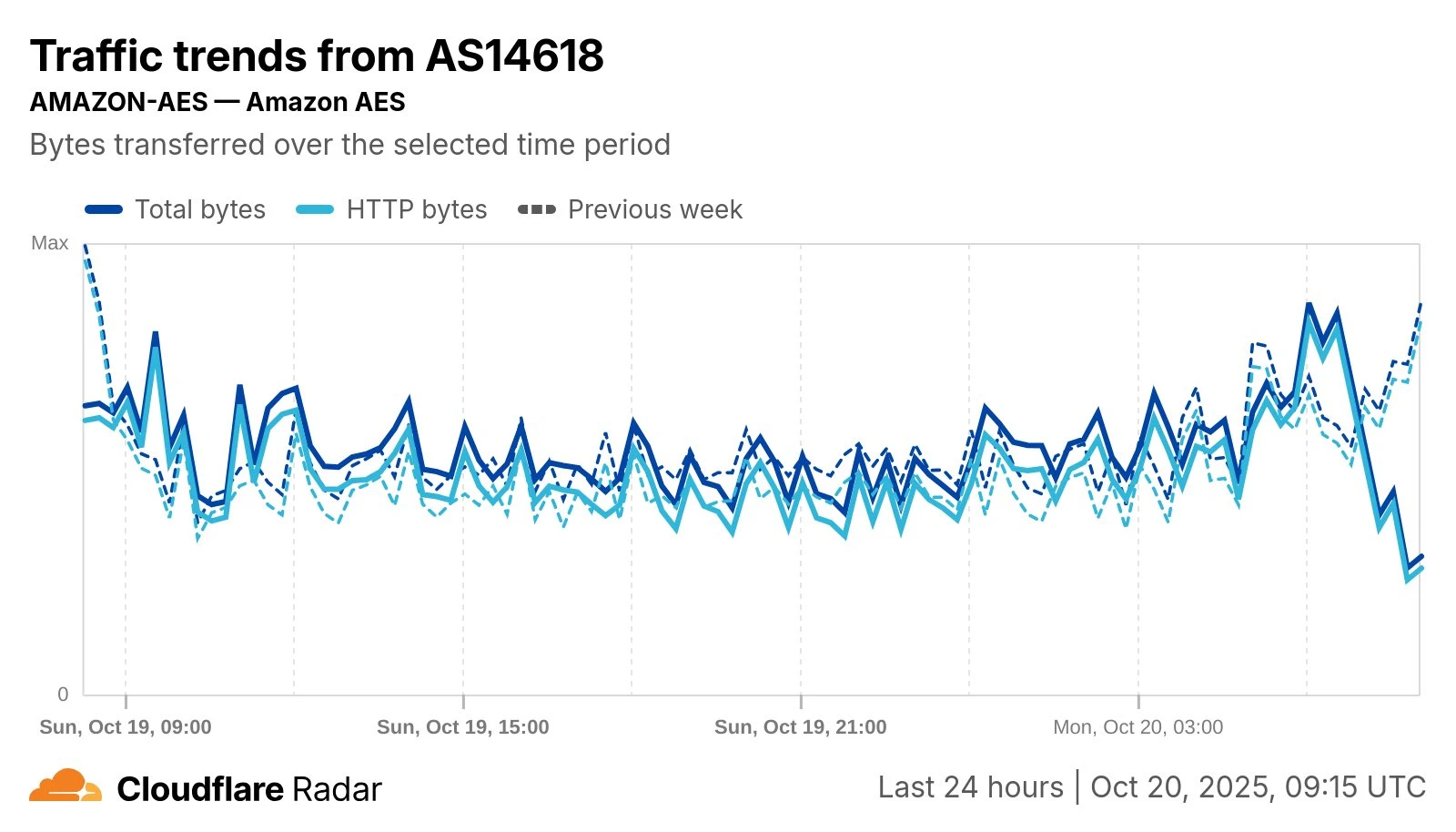
Cloudflare-Radar-AWS-Outage-on-20th-Oct-2025

Some of the services impacted include Amazon itself (partial), Amazon Alexa, Amazon Music, Amazon Prime Video, Amazon Web Services, Ancestry, Asana, Atlassian, Bank of Scotland, Blink Security, BT, Canva, Clash Of Clans, Clash Royale, Coinbase, Dead By Daylight, Duolingo, EE, Epic Games Store, Eventbrite, Flickr, Fortnite, Halifax, Hay Day, HMRC, IMDB, Jira, Life360, Lloyds Bank, My Fitness Pal, Peloton, Perplexity AI, Playstation Network, Pokemon Go, Ring, Roblox, Rocket League, Signal, Sky, Slack, Smartsheet, Snapchat, Square, Tidal, Whatsapp, Wordle, Xero, Zoom and more.

UPDATE 10:46am

AWS are now reporting signs of recovery. “We are seeing significant signs of recovery. Most requests should now be succeeding. We continue to work through a backlog of queued requests. We will continue to provide additional information,” said the company.

Summary of AWS Service Status Updates

Increased Error Rates and Latencies
 
Oct 20 2:27 AM PDT We are seeing significant signs of recovery. Most requests should now be succeeding. We continue to work through a backlog of queued requests. We will continue to provide additional information.
 
Oct 20 2:22 AM PDT We have applied initial mitigations and we are observing early signs of recovery for some impacted AWS Services. During this time, requests may continue to fail as we work toward full resolution. We recommend customers retry failed requests. While requests begin succeeding, there may be additional latency and some services will have a backlog of work to work through, which may take additional time to fully process. We will continue to provide updates as we have more information to share, or by 3:15 AM.
 
Oct 20 2:01 AM PDT We have identified a potential root cause for error rates for the DynamoDB APIs in the US-EAST-1 Region. Based on our investigation, the issue appears to be related to DNS resolution of the DynamoDB API endpoint in US-EAST-1. We are working on multiple parallel paths to accelerate recovery. This issue also affects other AWS Services in the US-EAST-1 Region. Global services or features that rely on US-EAST-1 endpoints such as IAM updates and DynamoDB Global tables may also be experiencing issues. During this time, customers may be unable to create or update Support Cases. We recommend customers continue to retry any failed requests. We will continue to provide updates as we have more information to share, or by 2:45 AM.
 
Oct 20 1:26 AM PDT We can confirm significant error rates for requests made to the DynamoDB endpoint in the US-EAST-1 Region. This issue also affects other AWS Services in the US-EAST-1 Region as well. During this time, customers may be unable to create or update Support Cases. Engineers were immediately engaged and are actively working on both mitigating the issue, and fully understanding the root cause. We will continue to provide updates as we have more information to share, or by 2:00 AM.
 
Oct 20 12:51 AM PDT We can confirm increased error rates and latencies for multiple AWS Services in the US-EAST-1 Region. This issue may also be affecting Case Creation through the AWS Support Center or the Support API. We are actively engaged and working to both mitigate the issue and understand root cause. We will provide an update in 45 minutes, or sooner if we have additional information to share.
 
Oct 20 12:11 AM PDT We are investigating increased error rates and latencies for multiple AWS services in the US-EAST-1 Region. We will provide another update in the next 30-45 minutes.

UPDATE 11:34am

Despite AWS slowly getting back to normal, people are still reporting problems with various linked services, such as Ring. It may take time for everything to fully return. A number of broadband ISPs, such as YouFibre, appear to have support (phone, chat etc.) systems that depend upon AWS and have been disrupted. Sky Broadband are also reporting phone problems, although it’s unclear if they’re AWS related.

Altnet Broadband ISP Gigabit IQ to Crowdfund for Fresh UK Investment | ISPreview UK

Original article ISPreview UK:Read More

Internet access and online security provider Gigabit IQ (formerly Grayshott Gigabit) has begun inviting selected people to invest in their company via crowdfunding, which they rightly warn is a “high risk investment” and one where those who make a commitment are “unlikely to be protected if something goes wrong“.

The idea of crowdfunding in this way is rather unusual for a broadband provider and isn’t likely to scale as well as shares or direct investment agreements (e.g. private equity, debt, bank loans, public subsidy etc.). But for a smaller provider, it could still have some benefits, provided you’re willing to accept the risks.

According to an email sent out by Gigabit IQ, which was seen by Thinkbroadband, the scheme is currently in the “pre-launch” phase. Due to this, we don’t yet know much about how the crowdfunding campaign will operate, what it will seek to raise, its eligibility rules or how the funding will then be used (i.e. will it go toward FTTP network expansion, development of their wholesale internet security products or be used more generally?).

Gigabit IQ’s Email Invite

Don’t invest unless you’re prepared to lose all the money you invest. This is a high risk investment and you are unlikely to be protected if something goes wrong

Hi, we’re crowdfunding! What began as a community project in Grayshott is now expanding across the UK. As one of the people who supported us early, we’d love you to join our national journey by offering you the exciting opportunity to share in the exclusive pre-launch to join Gigabit IQ’s first investment round before our crowdfunding campaign goes public.

At Gigabit IQ, we’re not just another broadband company. We are redefining the ISP space by combining full-fibre gigabit speeds, award-winning managed Wi-Fi, and AI-driven online safety tools to protect families, schools, and businesses. 

Here’s why now is the right time to get involved:

1. Proven traction: We’ve doubled our customers in the past year and achieved 3x revenue growth in 3 years. 
2. Massive addressable market: With access to 1.5 million homes across the UK, we can serve over 500 towns and villages.
3. Award-winning innovation Winner: Best UK Rural ISP and Best OTT Service.
4. Shortlisted: 5x nominations at the ISPA 2025 Awards.
5. Industry leadership in online safety: We’re working with Internet Matters 
6. Community-first model: We actively support schools and PTAs, and we’re launching

Overall, it’s an interesting idea, although much will depend upon the detail and what they’re actually planning to do. All of this is very important because Gigabit IQ isn’t a large, familiar brand like some of the market’s other players. People who commit their money to this will want to know precisely what it’s going to support and what targets will be set to ensure some accountability on the delivery side.

Crossed BT Wires Led to Three Innocent UK People Being Accused of Child Abuse | ISPreview UK

Original article ISPreview UK:Read More

A recently published judgement by the UK’s Investigatory Powers Tribunal (IPT) has revealed the disturbing case of how a simple mistake by one of BT’s (Openreach) broadband engineers led to three people, who shared the same house, having their lives turned upside down after they were wrongly accused of child sex offences.

The Open Judgement (PDF) details the case in all its excruciating detail (credits to The Register for an excellent summary). In short, the Dyfed Powys Police ultimately traced an Internet Protocol (IP) address, with BT’s help, that had been identified as being involved with the downloading and sharing of indecent images of children to the address of the three individuals.

Two search warrants were then executed at the home address of the first Claimant, on 4th August 2016 and 24th January 2017. The second and third Claimants were both present at the premises when the first warrant was executed; the premises were unoccupied when the second search took place. Electronic devices belonging to each of the Claimants were then seized.

During the course of all this, the three individuals faced a serious impact upon their lives, with family members, social services and places of work all being informed about the child protection investigation. As you can imagine, this caused all sorts of problems with employment, family splits and the stress of it alone must have been horrific.

The case itself actually ended up being closed on 15th September 2016 after officers found no solid evidence of any wrongdoing, and all three were told they were no longer persons of interest. But curiously, the police continued to be notified of child abuse content being shared by IP addresses that resolved to the same address. BT was then asked to investigate the problem.

Extract from the Judgement

Enquiries made of BT on 27 January 2017 were responded to on the following day. Following a network test involving the temporary break and restoration of service at both addresses, BT identified that a pair of crossed connections in the local network had caused a high likelihood that the IP addresses had been misattributed as between ‘Address X’ and the home address of the first Claimant.

BT explained that approximately eight years previously, two wires within a street cabinet servicing both addresses had been inadvertently crossed. In consequence, the authentication result for the IP address relating to ‘Address X’ had been incorrectly attributed to the first Claimant’s address.

Once traced, the correct individual was finally identified as living within a very close proximity to the home of the first Claimant. A search warrant was then executed at ‘Address X’ and the occupant was arrested on suspicion of possession of child abuse content, which was later found on their devices. The arrested individual made partial admissions and was subsequently convicted of related offences.

The trio who had been wrongfully accused later raised a case over the matter by arguing that their Article 8 rights (i.e. the right to a private family life) under the Regulation of Investigatory Powers Act were infringed. The claim largely seems to have hinged on the idea that the police’s RIPA requests for communications data from BT were unlawful because they could have made other lines of inquiry before issuing them.

Sadly, despite nobody denying that the trio had been through a horrific ordeal and suffered “far-reaching consequences“, the tribunal ultimately dismissed their arguments and ruled in favour of the police. The judgement found that the RIPA requests were lawful and that the main fault rested with BT, which was initially criticised for failing to offer a “meaningful response” during an internal review of the case that occurred on 19th January 2017 (although as above, BT eventually did respond in a more effective way).

The case certainly raises plenty of questions about how the police and telecoms operators conduct themselves in such cases, as well as the potential for the data they use to be unreliable.

ISP Virgin Media UK Discount 1130Mbps Home Broadband to £29.99 with Netflix | ISPreview UK

Original article ISPreview UK:Read More

New customers looking to join Virgin Media (O2) should note that the ISP has just introduced some bigger discounts across some of their home broadband and bundle packages. For example, Virgin’s 1130Mbps (1Gbps) package is now just £29.99 per month on a 24-month minimum term (price increases to £33.99 from April 2026 and £37.99 from April 2027).

The provider’s home broadband plans, which include a wireless router and free setup, generally start at £23.99 per month for their 132Mbps service (rising to £27.99 from April 2026), then £25.99 for 362Mbps (rising to £29.99 from April 2026), £27.99 for 500Mbps (rising to £31.99 from April 2026) and £29.99 for 1130Mbps (rising to £33.99 from April 2026). A 2Gbps tier also exists in nexfibre areas, which is priced at £56.99 (rising to £60.99 from April 2026); people in nextfibre areas can also access symmetric speeds, if they so wish.

NOTE: Virgin Media’s packages adopt mid-contract price hikes that are applied each April (rental prices rise by £4). The operator’s network is currently available to 18.53 million UK premises.

The new prices are expected to be available to order until 5th November 2025. But just remember that Virgin Media’s packages also apply sharp price increases once you reach the end of your contract, which are currently listed in the small print as £48 for the 132Mbps tier, £66 for 362Mbps, £72 for 500Mbps, £78 for 1Gbps and £90 for 2Gbps. This is why, if you intend to stick with Virgin at the end of your term, it’s critical to renegotiate.

Virgin Media’s fastest 500Mbps, 1Gbps and 2Gbps tiers also now come with Netflix bundled at no extra cost (i.e. the Standard with Ads plan).

Full Fibre Broadband ISP 4th Utility Sees UK Turnover and Take-up Surge | ISPreview UK

Original article ISPreview UK:Read More

Network operator and broadband ISP 4th Utility, which have been quietly deploying their gigabit speed Fibre-to-the-Premises (FTTP) service to UK homes (SDU) and large residential buildings (MDU), this week published their annual accounts for the year ended 31st March 2025 and reported a “doubling of monthly subscriptions sold through the year“.

The provider, which back in 2022 spoke of holding an ambitious plan to deploy their full fibre “service [to] another 250,000 homes over the next five years” (i.e. roughly 300,000 by 2027), did not provide an update on their progress toward this in their latest results (i.e. no customer or homes passed totals). But we assume they’ve probably been impacted by the same sort of wider economic pressures as everybody else (i.e. rising build costs, high interest rates and competition).

However, the results did reveal that their turnover more than doubled to £4.74m in the year (2024: £1.94m), which also contributed to the negative EBITDA (earnings before interest, taxes, depreciation, and amortisation) reducing to £5m. The company also made £2.8m of capital expenditure, which was invested into their infrastructure and systems to support further growth.

The overall loss for the financial year came in lower than the prior year at -£12.7m (2024: -£15.3m), but they also had total assets less current liabilities of £31.6m (2024: £37.7m) and total equity of -£1.6m (2024: £11m). Finally, the average monthly number of people (including Directors) employed by the company during the year was 40, which is down from 58 in the prior year.

Derbyshire County Council Commits £900k to Plug Rural Broadband Gaps | ISPreview UK

Original article ISPreview UK:Read More

The Derbyshire County Council (DCC) in England has agreed to invest £900,000 to support the launch of two grant programmes, which will aim to improve broadband connectivity in at least some of the communities – predominantly rural ones – that are currently still expected to miss out on access to faster connections.

At present UK ISP Connect Fibre holds the main £33m (public subsidy) Project Gigabit contract for Derbyshire (LOT 3), which will see them expanding their Fibre-to-the-Premises (FTTP) broadband network to serve an additional 17,000+ premises in hard-to-reach rural areas (i.e. communities such as Eckington, Hulland Ward, Shirley and many more).

In addition, a second £10.7m Project Gigabit contract for the Peak District was also held by network operator FullFibre Limited (Fibre Heroes), which would have covered 4,400 premises (including some in Derbyshire). Unfortunately, FullFibre Ltd pulled out of that contract back in May 2025 (here), but even if both contracts had reached completion, then Derbyshire will still be left with a gap to fill.

According to the DCC, around 32,000 premises (homes and businesses) across the county still receive broadband speeds of less than 100Mbps in areas with no prospect of commercial providers rolling out full fibre within the next 3 years. Of these, around 3,000 premises are still receiving very slow speeds of less than 10Mbps (the level of the Universal Service Obligation).

The county council’s cabinet have thus approved the use of £900k in funding “from our Digital Derbyshire reserves” to set up 2 grant programmes to boost broadband speeds in premises with some of the poorest performing internet connections.

Summary of the New Grant Schemes

The ‘Gigabit Fibre Connectivity Grant’ will provide a full fibre network to clusters of ‘hard to reach’ premises which are close to one another.

And the ‘Interim Connectivity Grant’ will focus on providing short-term solutions, such as satellite or mobile broadband, to properties which:

  • are in remote areas where delivery of a fixed full fibre network is too expensive and there is no commercial roll-out planned
  • currently use outdated copper-only lines which are only capable of a maximum of 24Mbps.

The council added that they would be continuing to “push” the East Midlands Combined County Authority (EMCCA) to “prepare proposals for its digital programme and identify appropriate funding to help improve broadband speeds in more homes and businesses in Derbyshire in the future“.

Carol Wood, DCC Cabinet Member for Net Zero and Environment, said:

“Decent broadband is essential to every-day life and something many of us take for granted. But we know that having a reliable internet connection is a postcode lottery with many businesses and residents in rural areas still losing out.

By launching these two grant programmes, we can help improve broadband speeds for lots of local people and help prevent rural communities from falling behind in the digital divide.”

The catch in all this is that, in the grander scheme of building full fibre broadband networks, the allocation of £900,000 is just a drop in the ocean. The funding is roughly enough to hook up a couple of small villages or around 300-600 premises – assuming a rural focus. The expansion to include alternative methods of connectivity via the “interim” grant is welcome, although we don’t yet have any details on precisely how that will be structured.

We should point out that the government’s Gigabit Broadband Voucher Scheme (vouchers worth up to £4,500 per property) is currently also available to poorly served remote rural premises in Derbyshire, which is being supported by the following suppliers: Dragon Wifi, E-volve Solutions, GigaPeak, Openreach and WeFibre. The DCC might thus do well to combine their focus with that of the GBVS.

Shetland Expecting Fix for Broken Subsea Fibre Cable to Occur Next Weekend | ISPreview UK

Original article ISPreview UK:Read More

Homes and businesses on Shetland, which is a remote UK subarctic archipelago that resides north of the Scottish mainland, could see the full restoration of local broadband services by around next weekend. Connectivity was disrupted earlier this month after Storm Amy caused damage to the main SHEFA-2 (Faroese Telecom) subsea fibre optic cable (here).

The SHEFA-2 cable reaches Shetland via two landing sites, including one stretch that goes north west up to the Faroe Islands and another that runs south to connect Orkney and the Scottish Mainland. The damage, which came only a few short months after a fishing vessel struck the same cable (here and here), is understood to have occurred around 1.5km off the coast of Orkney on a “section that has previously experienced problems caused by natural forces (tides/current).

NOTE: Storm Amy struck northern Scotland on 3rd October 2025 and caused a lot of disruption.

Such breaks typically take several weeks to fully repair, which is partly due to the time it takes to arrange a cable repair ship to be dispatched, as well as uncertainty around the scale of damage, the need for surveys and weather. The last break was repaired within a couple of weeks, but this one was expected to take a little longer because the damage is in shallow water – close to shore – and requires a new landing at Ayre of Cara (Orkney).

The good news, according to Shetland Telecom, is that Alcatel Submarine Networks (ASN), which has been contracted to conduct the work, has now completed their surveys and confirmed the schedule for the repair. Repair ship Cable Vigilance, which s currently still docked in Calais (France), will depart late for the islands on Monday 20th October.

Preparations involving local (Orkney) workboats are then planned for Tuesday 21st, with Cable Vigilance due to arrive in Orkney on Thursday 23rd to begin cable recovery and jointing operations. The new shore-end section is planned to be landed on Saturday 25th, with full restoration anticipated later the same day. So, some good news for customers of Sky Broadband, Vodafone, TalkTalk and a few other network providers.

The catch is that this timetable remains subject to weather conditions, and any bad weather could still delay the effort.

EXA Infrastructure adds €1.3bn to M&A war chest | Total Telecom

Original article Total Telecom:Read More

green plant on brown round coins

Press Release

Backed by major lenders, EXA Infrastructure has raised new facilities to support network expansion and M&A ambitions

EXA Infrastructure, the largest dedicated digital infrastructure platform connecting Europe and North America, has refinanced its existing facilities and raised new financing in total over €1.3bn to support continued growth ambitions and network expansion plans.

The new facility, structured over seven years, will allow EXA Infrastructure to capitalise on significant market opportunities and expand its network footprint in line with scaling customer ambitions.

Jim Fagan, CEO, EXA Infrastructure, said: “This move gives us an unrivalled ability to continue investing in our network, at a time when our customers need growing amounts of capacity across more routes, to handle an evolving set of applications and demands. Our recent investments have already shown our strategic focus, and with this refinancing, EXA Infrastructure is firmly positioned to lead in network and digital infrastructure throughout Europe and across the Atlantic.”

EXA Infrastructure announced the signing of binding agreements to acquire Aqua Comms in January, followed by strategic network deployment announcements throughout 2025, including the largest fibre backbone deployment in Central Europe and the first new subsea cable in the North Sea in 25 years.

Lenders for this refinancing process include MUFG Bank Ltd., DNB, Banco Santander, Landesbank Baden-Wuerttemberg, Lloyds BankNORD/LBGoldman Sachs International BankNatWestKookmin Bank London Branch, Woori Bank London BranchNIBC Bank, funds managed by Allianz Global Investors, and funds managed by Edmond de Rothschild Asset Management.

Rothschild & Co is acting as debt advisors to EXA Infrastructure in connection with the refinancing, and Latham and Watkins LLP is acting as the company’s legal advisor. Simpson Thacher and Bartlett LLP is acting as the legal advisor to the lenders in connection with the transaction.

“We’re proud to have the support of such high-calibre lenders and institutions who understand not only our business   but also the wider digital infrastructure landscape,” said Kate Hennessy, CFO at EXA Infrastructure. “Such strong demand for the facility underscores market confidence in our strategy and reaffirms our desire to pursue our next stage of growth with conviction.”

Keep up to date with all of the latest telecoms news from around the world with the Total Telecom newsletter

Also in the news
Connected Britain Award winners 2025 announced!
Netomnia announces ‘powerful and ambitious’ rebrand ahead of Connected Britain
VodafoneThree drops Samsung, relies on Nokia and Ericsson for £2bn network upgrade

From telco to techno: Why operators must embrace orchestration to stay relevant | Total Telecom

Original article Total Telecom:Read More

Viewpoint Article

Enterprises today are pushing for simplicity, no multiple portals, fragmented services or complex user experiences. What they want is mobility that works as seamlessly as the cloud: unified, scalable, and fully integrated into their IT environment.

Yet too often, telecom operators are still perceived as “just connectivity providers.” Unless this perception changes, others will fill the role enterprises truly need — the role of the tech orchestrator.

The Gap to Close

Recent GSMA Intelligence research shows that enterprises will spend 10% of their revenues on digital transformation during 2025-2030. The appetite is enormous, but the challenges are equally large: the cost of implementation and the difficulty of integrating new technologies with legacy systems.

Enterprises are asking for something far beyond “connectivity plus”: they want simplicity, orchestration, and outcomes.

Telecom Operators are in the best position to integrate mobile connectivity directly into enterprise IT ecosystems. Unlike third-party intermediaries, operators manage both the network and the service orchestration layers, ensuring a direct, secure, and cost-efficient connection between the customer’s IT systems and their mobile environment. This end-to-end integration eliminates costly middleware and manual processes, while providing real-time visibility, automated order management, and simplified governance.

The opportunity (and challenge) ahead

But the shift from telco to techno is not a marketing exercise — it represents a fundamental transformation in how operators deliver value. The focus must move from selling connectivity to enabling measurable business outcomes.

  • Employee productivity. Mobility is now about empowering every worker — from the office to the field — to be securely connected and efficient.
  • Transparency and cost control. Enterprises want a clear, centralised view of their mobility spend and usage.
  • AI readiness. Without orchestrated, standardised data, enterprises cannot leverage AI for predictive provisioning or real-time optimisation.

Across the industry, enterprise leaders consistently share the same message: make it easier, faster, and smarter. That is the opportunity operators must seize.

Collaboration as the Differentiator

No single operator can meet these expectations alone. Multinational enterprises demand scale, consistency, and trust across borders — and achieving this requires collaboration.

This is where alliances like FreeMove play a pivotal role. By working together, operators can provide:

  • Consistency: a unified, orchestrated experience across multiple countries.
  • Speed: faster time to market through shared expertise and resources.
  • Customer-centric outcomes: harmonised solutions tailored to each enterprise’s digital maturity.

At the recent Mobile World Live Unwrapped series, experts from the FreeMove Alliance — including Usman Javaid (Orange Business), Urs Lehner (Swisscom), and Stefan Grosse Onnebrink (Deutsche Telekom) — discussed this transformation in depth. Their shared conclusion was clear: collaboration is not a “nice-to-have”; it is the only way to deliver enterprise mobility at scale.

The FreeMove Automation Solution exemplifies this approach. Whether a customer is just beginning their digital journey or ready for full ITSM integration, the solution adapts to their needs. It reduces tools, lowers manual workload, improves transparency, and lays the foundation for an AI-driven future.

The road ahead

The choice for telcos is stark.
They can remain commodity providers of connectivity — or evolve into techno-orchestrators that simplify complexity, co-create with customers, and deliver tangible outcomes.

The future of enterprise mobility will not be defined by who owns the network, but by who can orchestrate ecosystems that deliver simplicity, trust, and measurable value.

Through initiatives like the FreeMove Automation Solution (FAS), operators enable seamless API-based integration into ITSM and procurement systems (including ServiceNow and Punch-Out interfaces), allowing enterprises to manage their global mobile fleet as part of their broader digital infrastructure.

In a context where enterprises will dedicate nearly 10% of revenues to digital transformation by 2030, operators stand out as trusted partners who can bridge the gap between connectivity and IT transformation—simplifying integration, enhancing security, and reducing total cost of ownership across multinational operations

The transformation from telco to techno is already underway, and collaboration will define its success.

To explore these ideas further, watch the full Mobile World Live Unwrapped session featuring Usman Javaid (Orange Business), Urs Lehner (Swisscom), Stefan Grosse Onnebrink (Deutsche Telekom), and Selma Avdagic Tisljar (FreeMove Alliance): https://www.mobileworldlive.com/mwl-unwrapped-webinar-beyond-borders-connecting-enterprises-globally-with-automation-collaboration/


How Netceed avoids disruptions in a complex global supply chain | Total Telecom

Original article Total Telecom:Read More

Interview

Netceed offers customers supply chain resilience in a complex world. Here’s how they do it, according to their director of telecom sales

Enhancing supply chain resilience has become a key part of Netceed’s operations, which advertises offering a full range of services to support networks from end to end, including supply chain solutions.

Speaking recently at Connected Britian, Steve Doddington, the director of telecom sales for Netceed, says Netceed has made a strategic choice not to have a single reliance on one vendor across the geographies where they operate.

“We have, across those geographies, multiple vendors and multiple warehouse locations,” Doddington said. “Through those multiple vendors that we have, we’re able to source products and derisk the supply chain.”

As a result, Doddington said Netceed can offer their customers supply chain resilience in a complex world.

Doddington also said Netceed can leverage the stock that they have across multiple locations, all while localizing inventory to support their customers, including in the UK.

Managing the supply chain effectively through forecasting and inventory management is also a strong suit of Netceed’s, according to Doddington.

All the while, Doddington said Netceed is also positioning themselves for the future my examining how the company can be more proactive with services offered, via intelligent data.

“We’re working on it,” he said. “We’re looking across all our Netceed entities at our IT capability and we’re trying to come up with a platform of data analytics that will actually allow us to do that proactive work.”

At the end of the day, Doddington said Netceed’s goal is to remove the operational burden from their customers.

“Let them concentrate on what they do best, and what they do best is they install networks, they hook up customers,” he said. “Why would you want to invest in your own logistics infrastructure when a company like ourselves has that infrastructure, that experience, that capability in house.”

Check out our full interview below!

Keep up to date with all of the latest telecoms news from around the world with the Total Telecom newsletter

Also in the news
Connected Britain Award winners 2025 announced!
Netomnia announces ‘powerful and ambitious’ rebrand ahead of Connected Britain
VodafoneThree drops Samsung, relies on Nokia and Ericsson for £2bn network upgrade