Netomnia Expand FTTP Broadband Coverage in Oldham to 35,000 Premises | ISPreview UK

Original article ISPreview UK:Read More

Alternative network operator Netomnia (Substantial Group), which has deployed their own full fibre broadband (FTTP) network to cover 3 million UK premises RFS (inc. 460,000 customers), have announced that their long-running roll-out across the large town of Oldham (Greater Manchester) has now reached 35,000 premises (RFS).

The original deployment was first announced all the way back in June 2022 (here), which at the time proposed to invest £21m to cover 71,000 premises across Oldham with the help of civil engineering contractor O’Connor Utilities. Today’s update confirms that they’ve so far invested just under half of the original commitment (£10m) and thus still have a long way to do.

NOTE: The Substantial Group is backed by over £1.6bn of equity and debt from investors Advencap, DigitalBridge, and Soho Square Capital etc. Netomnia sells to consumers via retail ISP brands like YouFibre and Brsk (they also sell business-only packages via some third-party retail brands, such as Aquiss etc.).

The work forms part of Netomnia’s goal of reaching 5 million premises by the end of 2027 (inc. 1m customers by 2028), although their future plans for Oldham now seem likely to be impacted by the proposed consolidation deal with nexfibre’s parents (here); assuming it gets the green light from the competition authority. Both nexfibre and Virgin Media already have significant coverage of the same town.

Jamie Goate, National Head of Fibre Network Operations at Netomnia, said:

“Delivering over 35,000 premises serviceable in Oldham is a significant milestone and reflects the scale and pace of our build programme. Oldham’s rollout is part of our wider mission to help communities across the country access the most powerful Internet.”

Virgin Media O2 Warn Customers to Watch Out for Fake 5G SIM Upgrade Emails | ISPreview UK

Original article ISPreview UK:Read More

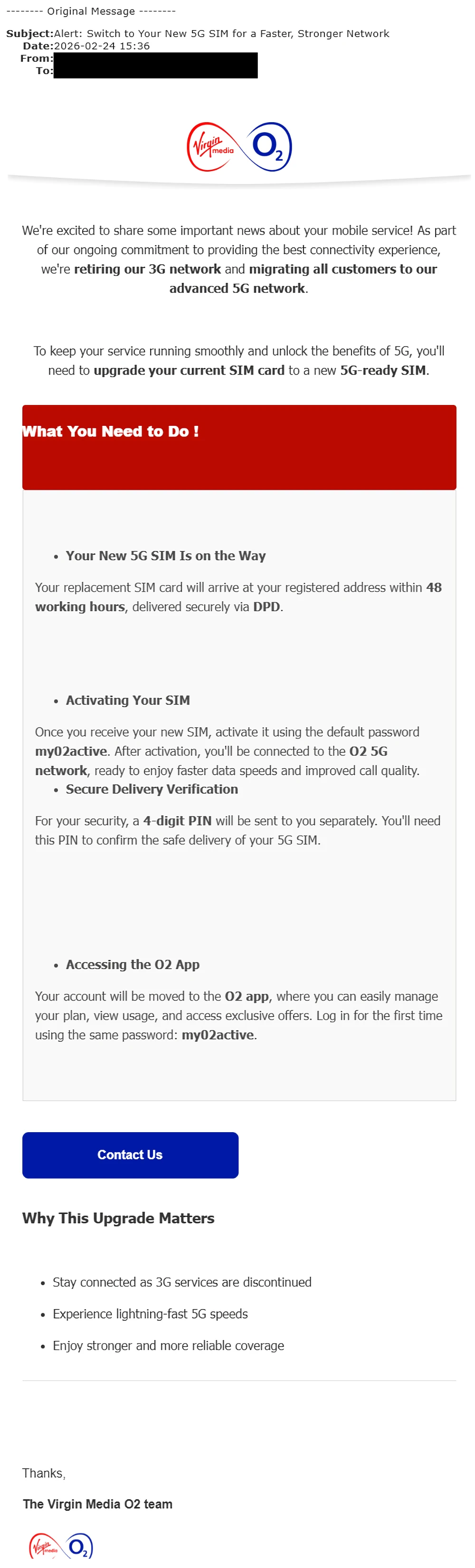
Customers of broadband and mobile giant VMO2 (Virgin Media and O2) have been warned to keep an eye out for a new round of phishing emails, which use the retirement of O2’s 3G network as an excuse to falsely invite subscribers to “upgrade your current SIM card to a new 5G-ready SIM“.

Please note that these emails were NOT sent by Virgin Media O2 and should NOT be responded to. Do not click on any links or reply to these messages. Instead, we recommend deleting them immediately. If you’d like to report the email, you can forward it to our dedicated phishing inbox at phishing@virginmediao2.co.uk,” said an official statement from VMO2.

The authentic looking email is typically designed to steal your sensitive personal and financial data, or to possibly assist in hijacking your computer system by encouraging the installation of malicious software. Sadly, such emails are a common threat to all telecoms providers, which are frequently having to deal with authentic looking SCAM emails, letters, calls and texts from fraudsters.

We should point out that O2 has now effectively already completed their switch-off of the old legacy 3G mobile network, which is another red flag for authenticity.

VMO2-5G-SIM-SCAM-Email

Virgin Media O2 Satellite Service Goes Live with 4G Mobile from Space | ISPreview UK

Original article ISPreview UK:Read More

The United Kingdom will today become one of the first countries in Europe to go live on Starlink’s latest Direct to Cell (DtC) and satellite based 4G mobile data (broadband) connectivity, as mobile operator O2 (Virgin Media) switches-on its new O2 Satellite service for customers. Better yet, it’ll only set most customers back an extra £3.

At present around 650 of Starlink’s (SpaceX) c.9,800 satellites in Low Earth Orbit (LEO) support DtC (aka – Direct to Device) technology, which technically enables them to deliver global coverage of a fairly basic 4G mobile roaming service and supply it directly to unmodified Smartphones on the ground. The goal in the UK, at least for now, is to make it possible for customers of O2’s service to stay connected in even some of the remotest areas, where mobile signals either fail to reach (“not spots“) or are less reliable.

NOTE: Starlink plans to launch its first GEN2 (second generation) DtC satellites in late 2027, which will also aim to deliver 5G connectivity and peak data speeds of 150Mbps per user (here).

The new service, once applied, effectively boosts O2’s UK landmass mobile coverage from 89% to 95%, delivering a coverage uplift equivalent to an area around two thirds the size of Wales. The service is designed to complement O2’s existing mobile network, and customers will connect automatically when traditional cellular coverage is unavailable.

Speaking of which, O2 Satellite will also continue to keep customers connected in the rare event of a local (terrestrial) cellular network outage too, which gives the network operator significantly more resilience. But at launch there will be some limitations, which means it can currently only support text messaging and limited data connectivity across specific apps like WhatsApp, Messenger, Google Maps and more.

O2 Satellite Compatible Apps at Launch:

  • AccuWeather
  • AllTrails
  • BBC Weather
  • Facebook Messenger
  • Google Find Hub
  • Google Maps
  • Google Messages
  • Google Personal Safety
  • Samsung Weather
  • WhatsApp
  • X
  • Yahoo Mail

Otherwise, the service, which is available as a £3-per-month bolt-on and will be included at no extra cost for all ‘Ultimate Plan’ customers in the “near future“, is initially also only available to customers with the latest Samsung smartphones (inc. Samsung Galaxy S25, S25+, S25 Ultra and S25 Edge). Support for other devices, manufacturers and apps will be introduced “soon“.

Lutz Schüler, CEO of VMO2, said:

“This is a defining moment for UK mobile connectivity and a statement of our intent to keep innovating and ensure our customers can stay connected no matter where they are. By launching O2 Satellite, we’ve become the first operator in Europe to launch a space-based mobile data service that, overnight, has brought new mobile coverage to an area around two thirds the size of Wales for the first time.

We already have the UK’s largest 5G+ footprint and we’re not standing still, investing heavily this year in our mobile network to give O2 customers a brilliant, reliable service that they can depend on.”

Baroness Lloyd, Minister for the Digital Economy, said:

“This is a major achievement for the UK and demonstrates leadership in next-generation connectivity. Being the first in Europe to launch direct-to-device satellite data services puts the UK firmly at the forefront of mobile innovation. O2 Satellite is a boost for growth and connectivity and a strong signal of the UK’s leadership in the global digital economy.”

Stephanie Bednarek, VP of Starlink Commercial Sales, said:

“Delivering Starlink Direct to Cell in partnership with Virgin Media O2 underscores the importance of keeping people connected no matter where they are. For the first time, millions of people across the UK will have access to data, voice and video through apps, and messaging in remote areas where terrestrial coverage isn’t available.”

The development won’t come as much of a surprise because VMO2 had already said the new service would launch during “early 2026“. In addition, a number of ISPreview’s readers had also spotted (here) that it was live this week on the MCC (Mobile Country Code) of 234 (UK) and MNC (Mobile Network Code) of 02.

The service is currently harnessing only part of the B3 band (1800MHz) and so should be able to work indoors too, albeit with some limitations due to the significant signal attenuation that occurs when passing through walls etc. Overall this sounds like an incredibly useful and seemingly quite affordable add-on, which will be of particular interest to those who travel a lot around the UK (business or otherwise) or live in poorly served areas.

However, O2 Satellite is not the only DtD service gearing up for launch in the UK this year, with Vodafone (VodafoneThree) working alongside AST SpaceMobile to launch a similar product (here). Suffice to say that it will be interesting to see how the two services compare once both fully live, particularly in terms of price and performance. At £3 extra per month O2 has set quite an affordably cheap bar for Vodafone to beat.

On the flip side, it’s clear that at launch O2’s new service will be significantly hobbled by its limited device support, but hopefully they’ll improve that at pace in order to help fully realise the potential for this sort of service.

Finally, for those wondering why the service doesn’t deliver more than 95% coverage, that’s due to two reasons. Firstly, the service is currently limited in areas close to international borders due to regulation, and secondly, the service currently only works up to the 58th parallel North (about Inverness), due to the current orbit of satellites limiting coverage in the most northern latitudes. But this is expected to improve with time (Starlink’s main non-DtC broadband network already extends beyond this).

Nexfibre Publish Q4 2025 UK Full Fibre Broadband Build Update – 2.6M Premises | ISPreview UK

Original article ISPreview UK:Read More

Network operator nexfibre, which shares some parentage with its UK ISP partners Virgin Media (O2) and giffgaff, has just published their latest quarterly Q4 2025 build update and confirmed that their new 10Gbps capable Fibre-to-the-Premises (FTTP) broadband network now covers 2.6 million UK premises. But future expansion looks set to come from consolidation.

Just to recap. Back in 2022 Telefónica, Liberty Global and InfraVia Capital Partners setup nexfibre as a new £4.5bn joint venture (here), which aimed to deploy an open access (wholesale) full fibre network to reach “up to” 7m UK homes (starting with 5m by 2026) in areas NOT served by Virgin Media’s own network of 16m+ premises. The funding reflects £3.3bn of fully underwritten financing and up to £1.4bn in equity commitments.

NOTE: Virgin Media and giffgaff are currently the only big retail providers on nexfibre’s network.

However, as existing readers will already know, nexfibre’s roll-out plan suffered a significant blow last year after Telefonica launched a Strategic Review of their global business (here and here). The decision has since resulted in nexfibre scaling back their planned roll-out, which in practical terms means there isn’t currently a solid build plan for going beyond the current level of coverage. But as the recent deal to acquire Netomnia’s network shows, the focus now seems to be on expanding coverage through consolidation (here).

The latest Q4 2025 build update from nexfibre reflects the aforementioned change and confirms that their full fibre network has now reached 2.6 million premises as ready for service (up from 2.44m in Q3). But as is clear from their latest roll-out update and map, there’s currently no significant new fibre build planned for 2026 (this may change once the deal with Netomnia is done and they can plan for future deployments).

Rajiv Datta, CEO of nexfibre, said:

“With our network now extending to c. 2.6 million premises, we’re proud to be among the UK’s leading alternative fibre providers.

As we look ahead, I’m delighted that our shareholders InfraVia, Liberty Global and Telefónica have announced an agreement to acquire Netomnia, with more than 3 million fibre premises and 460,000 customers.

The combination of nexfibre, Netomnia and more than 2 million Virgin Media O2 premises, which will be upgraded by nexfibre, will create a scaled, financially secure challenger to BT Openreach, with a full fibre footprint of around 8 million premises by the end of 2027.

When combined with the growing fibre footprint of Virgin Media O2, our two networks will collectively reach 20 million premises, giving ISPs a highly attractive wholesale alternative, and enabling faster access to fibre for millions of homes and businesses across the UK.

I look forward to working with the Netomnia team over the coming months.”

MedUX Study Finds UK 4G and 5G Mobile Connections Lagging Behind Europe | ISPreview UK

Original article ISPreview UK:Read More

Network benchmarking firm MedUX has this morning published the results from a new pan-European study that examined the real-world Quality of Experience (QoE) of mobile connectivity (4G, 5G etc.) across the continent, which unfortunately finds that Great Britain (GB) is lagging near the bottom of most tables.

The new report – ‘Unveiling #1 QoE Countries in Europe‘ – is based on crowdsourced data gathered from over 180 million performance tests and 39 billion radio samples in over 33 European countries. But it’s worth remembering that there can be caveats with this sort of data, although such caveats are shared by all of those countries involved.

For example, mobile data performance remains tricky to pin down because end-users are always moving through different areas (indoor, outdoor etc.), using different devices with different capabilities and the surrounding environment is ever changeable (weather, trees, buildings etc.). Not to mention any differences in backhaul capacity at different cell sites or differing spectrum use between operators and masts etc.

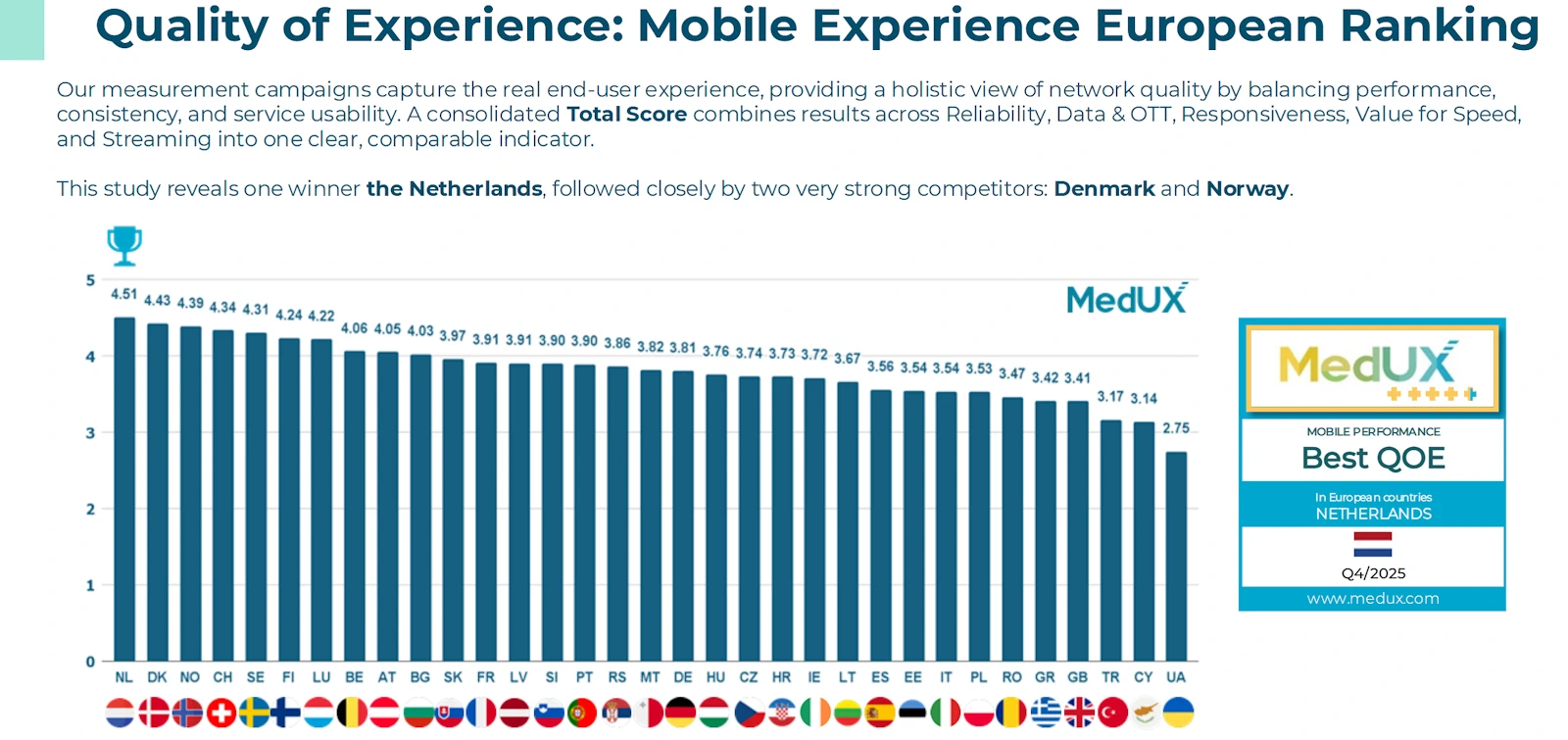
The research reveals that the Netherlands leads the region for overall QoE, a measure of user satisfaction, scoring 4.51 out of 5. Denmark and Norway follow closely behind as strong competitors, with Switzerland completing the top tier of European mobile network performance.

Sadly, Great Britain continues to lag behind most of the other countries and tends to appear within the bottom quarter of all the scoring categories. For example, we place fourth from the bottom in MedUX’s overall QoE table, scoring just 3.41, which compares poorly with the Netherlands in top place with 4.51.

MedUX-Mobile-QoE-Scores-by-Country-2026

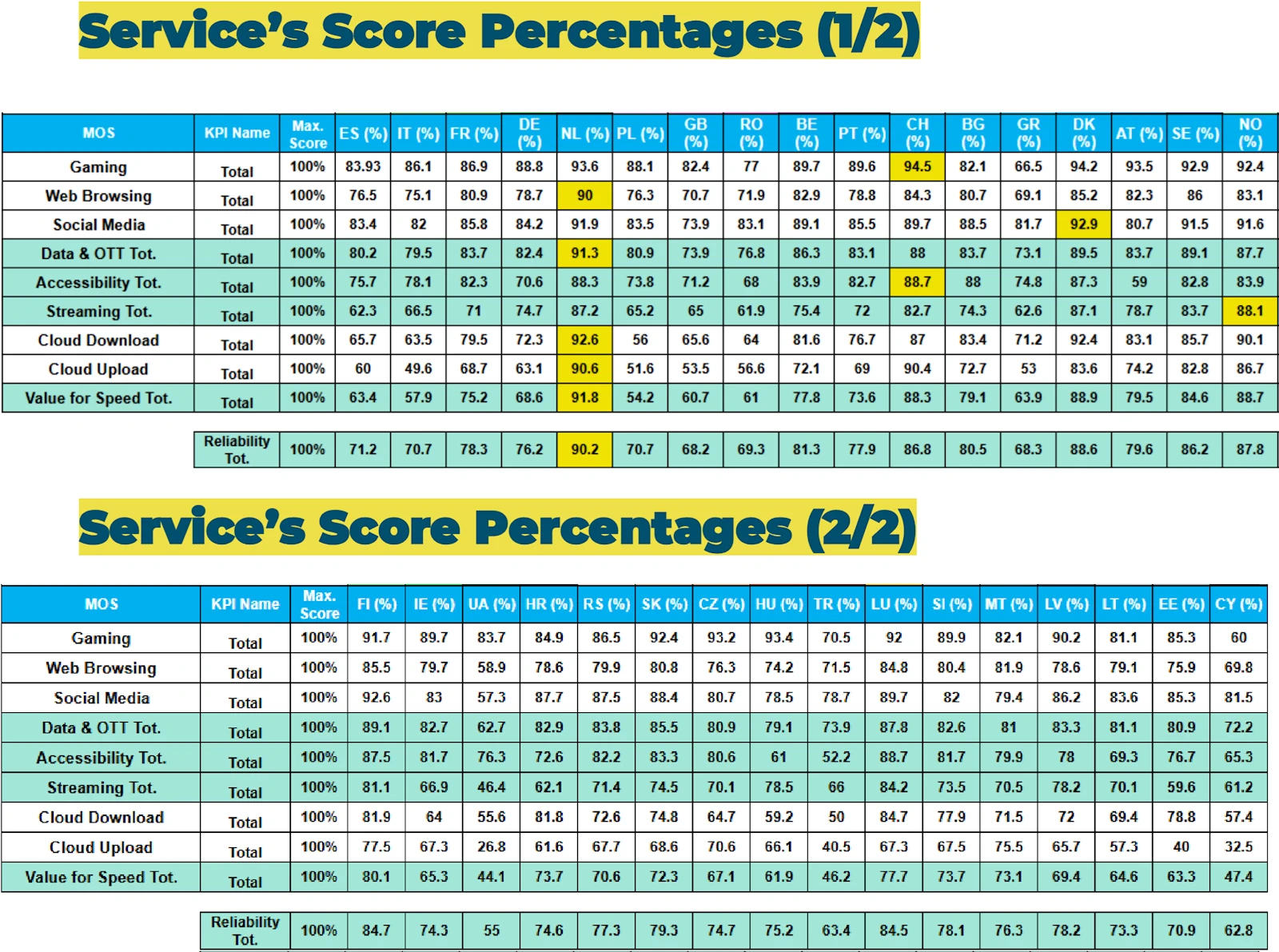
You can get a better idea of where Great Britain places by looking at the total reliability (% out of 100) scores for each of the main performance categories by country.

MedUX-Mobile-QoE-Scores-by-Country-and-Category-2026

The UK’s poor situation tends to reflect a combination of issues, such as the previous government’s U-turn to ban Huawei, which caused a significant and costly delay to network deployments – particularly 5G. Mobile operators have also faced restrictions when it comes to upgrading existing masts to 5G and deploying new ones, although recent rule changes may soon start to improve the planning process a bit.

Speaking of the government, both the past and present governments have had a tendency to set some rather easy coverage targets for the latest services, which is because they mostly end up relying on commercial investment to do the job.

For example, the current government retains an ambition “for all populated areas” to have access to the latest 5G Standalone (5G+) based mobile broadband technology by 2030, although this sort of language is potentially open to interpretation and not as effective as a clear geographic target for coverage.

Ofcom recently reported (here) that 5GSA (5G+) networks are now available to 83% of areas outside of premises in the UK, falling to 47%-65% when looking at it as a range across different mobile operators. On top of that, the regulator itself could have also been faster to release more 5G friendly radio spectrum in order to boost capacity and coverage (e.g. we only just got around to releasing the 26GHz and 40GHz bands a few months ago).

At the end of the day, we’ve clearly got some work to do in order to improve mobile network coverage and performance.

Orange and Samsung expand Open RAN and vRAN partnership | Total Telecom

Original article Total Telecom:Read More

gray radio tower under the cloudy sky during daytime

Press Release

Following successful pilots during recent years, the companies advance to the next stage for expanding vRAN and Open RAN deployments in 2026

Samsung Electronics and Orange Group, one of Europe’s leading telecommunications operators, today announced an expanded partnership, entering the next phase of their virtualized RAN (vRAN) and Open RAN projects in Europe. Building on successful pilots completed since 2023, the companies have agreed to extend the number of vRAN and Open RAN sites in 2026.

With the seamless integration of Samsung’s vRAN and Open RAN solutions in previous projects, the operator’s live network delivered enhanced Quality of Service (QoS) and an improved end-user experience, showing performance maturity and operational effectiveness comparable to or better than those of traditional RAN solutions.

Samsung and Orange have been working together to ensure that vRAN and Open RAN are viable solutions in building sustainable networks. This open and flexible architecture not only enhances network resilience but also fosters innovation by enabling the operator to leverage optimal solutions.

In this next phase, the companies are further advancing their vRAN and Open RAN collaboration by integrating the latest processors into Orange’s networks. This includes Samsung’s AI-powered vRAN with Intel Xeon 6 system-on-a-chip (SoC), which runs on a single commercial off-the-shelf (COTS) server from Dell with a cloud platform from Wind River.

This upgraded solution with enhanced computing power enables a powerful, single server to meet high-capacity configuration requirements from Orange, resulting in a smaller footprint, improved performance, reduced power consumption and simplified operations. This also helps the operator to handle intensive workloads and AI applications on a single server by flexibly managing network resources and applying unused computing capacity to run AI and edge applications on its existing network.

“Moving forward to the next chapter of our collaboration with Orange demonstrates how Samsung’s software-driven, open solutions are a proven, robust foundation that offer reliable network performance and services to operators and customers alike,” said Angelo Jeongho Park, Executive Vice President and Head of Global Sales & Marketing, Networks Business at Samsung Electronics. “We’re committed to advancing virtualized and open platforms as beacons of innovation that can harness AI to meet the high demands of future networks.”

“From our first call for the pilot project to our current phase in the field, Samsung’s virtualized RAN and Open RAN have proved significant performance achievements in Orange’s networks,” said Laurent Leboucher, Orange Group CTO. “With new deployments planned ahead, we look forward to further accelerating the transformation of Orange’s networks to be AI-ready.”

This strategic collaboration underscores the continued commitment of both companies to driving innovation based on an open architecture, delivering cutting-edge solutions and AI capabilities into the network.

Samsung Networks has pioneered the successful delivery of 5G end-to-end solutions, including chipsets, radios and cores. Through ongoing research and development, Samsung is driving the industry to advance 5G networks and paving the way for 6G and beyond with its market-leading product portfolio, from purpose-built RAN, vRAN, Open RAN, AI-RAN and core to private network solutions and AI-powered automation tools and applications. The company currently provides innovative network solutions to mobile operators that deliver boundless connectivity to hundreds of millions of users worldwide.

Keep up to date with all the latest telecoms news with the Total Telecom newsletter

Also in the news
World Communication Award Winners 2025
Ofcom clears the way for satellite-to-smartphone services
LG Uplus’s AI voice call app glitch leaks user data

The post Orange and Samsung expand Open RAN and vRAN partnership appeared first on Total Telecom.

5G Standalone, slicing, and the path to network monetisaton | Total Telecom

Original article Total Telecom:Read More

Interview

5G Standalone (SA) is poised to transform mobile networks in the UK, offering capabilities far beyond existing 5G deployments, according to Blessing Makumbe, Ericsson’s Head of Cloud Software and Services in North Europe

Speaking to Total Telcom at Ericsson’s Remixing 5G event, Makumbe explained that 5G SA’s rapidly increasing availability in the UK meant customers will soon experience the differentiated mobile experience sorely missing from 5G non-standalone.

“We’re at a point now where the value of 5G SA is no longer being questioned,” said Makumbe, noting that the device ecosystem is also now “fully ready” for widespread usage.

The UK’s mobile operators have set ambitious coverage goals for the coming decade, with EE is targeting 99% population coverage by 2030, Virgin Media O2 wants the technology available “in all populated areas” during the same period, and VodafoneThree is targeting 99.95% by 2034. This means that soon customers across the country will begin to notice not only a significant uptick in speed and reliability, but also the launch of new services, particularly those around guaranteed connectivity quality.

“The main driver will be customer experience. You want something that will be guaranteed wherever you are, whatever you’re doing,” explained Makumbe. “What we’re seeing through our Consumer Lab research is that users are willing to pay for these differentiated services.”

Network slicing – perhaps the poster child of 5G SA’s new capabilities – underpins many of these services. Currently, slicing has most prominently found use in the context of large-scale private networks, with the likes of VodafoneThree using them to create unique slices for media, broadcasting, and point-of-sale devices at a single sporting event. With broader availability of 5G SA, these slices could soon be something impacting individual consumers.

“What I’d like to see as a vision for the next few years is moving away from these specific slices for big events, and instead they become something we see on a day-to-day basis,” said Makumbe. “The big headline in the next three years will be the number of slices that each operator has. We’re talking about 20 to 30 slices – even more than that!’

Naturally, this improved service quality, reliability, and flexibility also has major advantages for enterprise customers too. For Makumbe, part of the challenge here is to understand each company’s unique requirements and collaborating on new ways to leverage the 5G network.

“Once you go to a port, for example, you begin to realise that there is a lot more that you can do in that space. It’s not just connectivity to enter and exit the port, it’s asset tracking, its surveillance, and its creating a lot of valuable data too,” he said.

From consumer experience to enterprise innovation, 5G SA has enormous potential to catalyse the UK’s economic growth. Whether operators successfully capitalise on this opportunity will soon become clear.


Meet Ericsson at MWC

Visit the Ericsson pavilion in Hall 2 and take a journey through a living, breathing city district — exploring live demonstrations and our latest thinking on AI, autonomous networks, 6G, network APIs, and next-generation mission-critical solutions. Join our open-access sessions and panel discussions, where industry leaders will come together to exchange ideas and shape what’s next.

Explore our full conference agenda and plan your visit

The post 5G Standalone, slicing, and the path to network monetisaton appeared first on Total Telecom.

Virgin Media O2 Business Completes Dark Fibre Network in Swansea | ISPreview UK

Original article ISPreview UK:Read More

Broadband ISP Virgin Media O2 Business (VMO2) has completed the Dark Fibre Network East project as part of the Swansea Bay City Region project (Digital Infrastructure Programme), which is said to have delivered a new secure fibre optic network linking 36 public-sector sites (e.g. council offices, NHS, doctors, schools etc.) through 46 connections in Llanelli, Swansea and Neath Port Talbot.

The deployment contract was officially announced for VMO2 Business back in September 2024 and originally due to complete by December 2025, reflecting a total investment of £1,354,698 under the Swansea Bay City Deal. Suffice to say that it only took slightly longer than planned to reach formal completion.

Just some of the “partners” connected through the project include the Welsh Ambulance Service University Trust, Swansea Bay University Health Board, Hywel Dda University Health Board, Carmarthenshire County Council, Swansea Council, Neath Port Talbot Council, the University of Wales Trinity Saint David, and Swansea University.

All of those should now benefit from faster and more secure connectivity, including cloud systems and new ways of working. The network also improves resilience, helping critical services stay connected and continue operating during disruptions.

Martin McFadyen, Director of Public Sector at VMO2 Business, said:

“This project has been a fantastic success and will strengthen public-sector services for years to come. We’re proud to have been the delivery partner and look forward to continuing our strong working relationships across the Swansea Bay City Region.”

As part of the social value commitments under this contract, “ultrafast broadband” is also supposed to be provided free of charge for 5 years at a total of 16 community organisations. In the past we’ve seen how similar anchor tenancy models can also result in such networks being opened up for use by commercial network expansions too, although this would require additional private investment.

Bright Edge Networks Launch New UK Wholesale Telecoms Platform – Beacon | ISPreview UK

Original article ISPreview UK:Read More

Telecoms and networking provider Bright Edge Networks has today announced the launch of a new UK wholesale telecoms platform, which has been designed to enable Managed Service Providers (MSP) and resellers to self-serve a variety of broadband and hosted VoIP solutions “with full margin control“.

Partners of the new service will be able to self-serve a wide suite of wholesale services including Fibre-to-the-Premises (FTTP), SoGEA (FTTC), leased lines and hosted Voice-over-IP (VoIP) – backed by Bright Edge’s carrier relationships and operational support. Pricing is said to have been set at the “wholesale level, allowing resellers to define their own margins, while Bright Edge retains contractual responsibility with underlying carriers“.

Built with automation and reseller flexibility firmly in mind, some of Beacon’s other key features for resellers include real time postcode availability checks, automated ECC and pricing data, integrated number porting, semi-automated provisioning and consolidated billing. Support requests are also handled directly by Bright Edge, allowing partners to stay focused on sales and customer relationships.

Chris Byrd, CTO of Bright Edge Networks, said:

“Beacon has been built from the ground up with resellers in mind. We wanted a platform that removes friction from selling connectivity and voice, while still offering the robustness and performance businesses expect. From real time availability to streamlined provisioning and billing, Beacon gives partners the tools they need to operate efficiently and scale with confidence.”

Giffgaff Confirms 2026 Price Lock for UK Full Fibre Broadband Plans | ISPreview UK

Original article ISPreview UK:Read More

Mobile and internet provider giffgaff has today confirmed that they’ve introduced a “price lock” on their monthly rolling full fibre broadband plans, which means that new and existing customers of the fixed like service “can rest assured that there won’t be any price hikes for their monthly rolling plan in 2026“.

Members of the new service – powered by nexfibre’s new Fibre-to-the-Premises (FTTP) network (covering 2.6 million premises) – will also continue to retain the flexibility to change packages if your circumstances change (e.g. if you need to increase the speed for a month or two). In addition, users of giffgaff’s mobile service since before 1st Jan 2026 can also still take advantage of three months free broadband if you sign up by 12th April 2026.

NOTE: In the future giffgaff should also become available in non-nexfibre areas, such as those served by Virgin Media’s own separate XGS-PON / FTTP network. But it’s unclear when that will occur. Virgin are slowly upgrading their old coax areas to support XGS-PON (originally due to complete by 2028).

Lest we forget that giffgaff’s broadband packages also include free setup, despite including a wireless router in the package. Otherwise, packages currently start at £29 per month for a 200Mbps service on a 30-day term and rise to £35 for their top 900Mbps plan.