Ofcom UK Propose New Rules to Tackle Mobile Messaging Scams | ISPreview UK

Original article ISPreview UK:Read More

Ofcom has today announced a “comprehensive package of planned measures” that are designed to improve protection for mobile phone users against messaging scams. According to the regulator, some 50% of UK mobile users said they received a suspicious message between Nov 2024 and Feb 2025 via text or iMessage, but it’s hoped today’s changes may reduce that figure.

Most of the United Kingdom’s major broadband, phone and mobile network operators have already implemented various technical measures to tackle things like Nuisance Calls, Scam Calls and Scam Texts (e.g. mobile operators block an estimated 600 million+ messages each year). But these aren’t always 100% effective, and there are still plenty of operators and device manufacturers that could do more.

NOTE: An estimated 100 million suspicious messages were reported to UK mobile operators through the 7726 service in the year to April 2025.

In particular, scammers often use mobile messaging services to reach victims at a mass scale and manipulate them into making payments or sharing sensitive information (e.g. pretending to be government services or parcel delivery firms – business messaging scams).

Sometimes they may even impersonate a friend or family member texting from a different number, often asking for money in a fabricated emergency situation (i.e. person-to-person messaging scams). This criminal activity causes significant financial and emotional harm to UK people and businesses and damages their confidence in vital communications services.
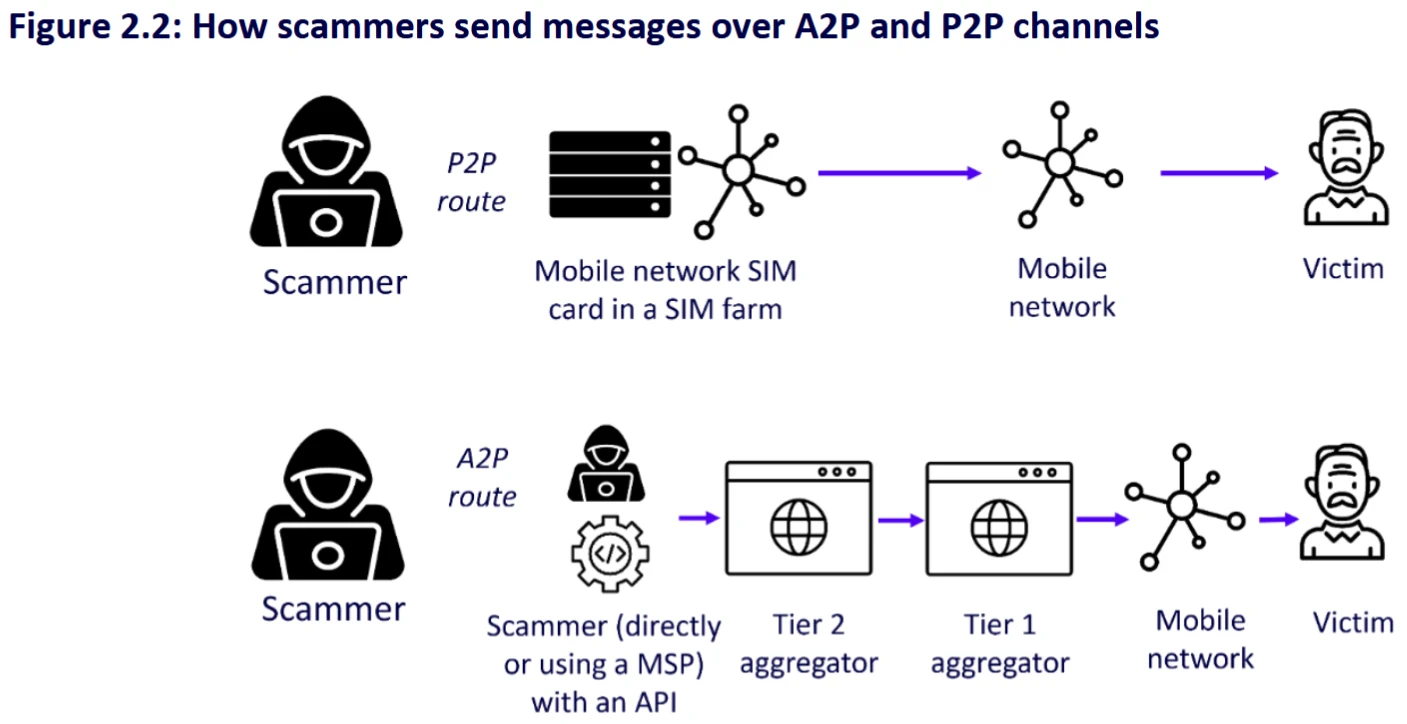
Ofcom-How-Messaging-Scams-Work

The Proposed Rules for Tackling Messaging Scams

Person to Person (P2P) Messaging

In order to tackle person-to-person messaging scams, Ofcom are proposing that mobile providers must: 

  • set volume limits for pay-as-you-go SIM cards. This will make it harder for scammers to message large numbers of potential victims at once; 
  • block numbers used by scammers. Providers must use scam reports from customers and third parties – such as law enforcement – about phone numbers and web links that are being used to perpetrate scams. They must then prevent scammers from sending messages from these numbers;  
  • block scam messages in transit. Providers must identify and block scam messages being carried on their networks by detecting malicious sender IDs, weblinks, and phone numbers.  

Business Messaging

To disrupt business messaging scams, the regulator is proposing that mobile operators and ‘aggregators’ that transmit businesses’ mobile messages must: 

  • conduct upfront and ongoing due diligence checks. Effective “Know Your Customer” checks must be carried out on new business message senders to prevent criminals from sending mass texts. Similarly, “Know Your Traffic” checks should be completed, including reviewing account activity and promptly investigating reports of fraud; 
  • prevent use of fake sender names (known as Alphanumeric Sender IDs). Providers must corroborate business message senders’ Sender IDs, which show who a business mobile message came from, against information they’ve gathered about the business (to check, for example, that a business that purports to be hairdresser is not sending parcel delivery messages – indicating a scammer). They must also maintain a policy on protected sender ID lists and generic sender IDs (such as ‘customer service’); 
  • apply incident management processes. Where scam activity is identified, root out criminals who are using business messaging services and hold companies to account where they have not conducted appropriate checks; and 
  • block scam messages in transit. Providers must act on scam reports from users and third parties to detect and block malicious weblinks and phone numbers. 

The measures are designed to “further disrupt scammers, raise the bar across the mobile industry and address current gaps in protection for consumers and businesses“. But some of the proposals, like the idea of putting volume limits on PAYG SIMs, could impact legitimate consumers too if not carefully considered. This is especially relevant given how most PAYG plans are more like normal Pay Monthly services today, albeit often on shorter 30-day terms (i.e. the definition between what is Pay Monthly and PAYG has become somewhat confused).

However, we understand that the volume limits would focus more on how many messages get sent via a SIM over a specific period of time, which we presume would be set to try and separate automated activity from human usage. Most, but not all, mobile operators in the UK already set such limits (varies between 100 per hour to tens of thousands a month), but even when adopted their application and enforcement can vary a lot (e.g. sometimes further texts are blocked, while in other cases accounts get sent for manual review). Ofcom seems to be seeking to standardise a more effective approach.

Ofcom are also proposing new rules for all mobile operators and aggregators to ensure the requirements are effective and to minimise the risk that providers block legitimate messages. These include: a right to challenge where numbers or messages are blocked; and requirements relating to reviewing policies, training staff, record keeping, compliance with data protection legislation and the continued transmission of legitimate messages.

Amy Jordan, Ofcom’s Strategy Delivery Director, said:

“Messaging scams can have a devastating impact on their victims. Our plans will ensure that mobile firms consistently apply proven measures to thwart these crimes. That means locking scammers out of networks and blocking hundreds of millions more scams from getting through to people and businesses each year.”

Ofcom’s related consultation on all this is now open for responses until by 5pm on 28th January 2026 and, after that, they aim to publish their final decision sometime during summer 2026.
Ofcom Grant Starlink an E Band Capacity Boost for UK Satellite Broadband | ISPreview UK

Original article ISPreview UK:Read More

The telecoms regulator, Ofcom, has today granted “temporary authorisation” for SpaceX’s Starlink service to harness the E band (71-76GHz and 81-86GHz) frequencies for their mega constellation of compact ultrafast broadband satellites in Low Earth Orbit (LEO). The move will boost their backhaul data capacity at three gateway earth station sites.

The service currently has almost 8,800 satellites in orbit (c.5,200 are v2 / V2 Mini) – mostly at altitudes of c.500-600km – and they’ll add thousands more by the end of 2027. Residential customers in the UK usually pay from £75 a month, plus £299 for hardware (currently free for most areas) on the ‘Standard’ unlimited data plan (kit price may vary due to different offers), which promises UK latency times of 26-33ms, downloads of 116-277Mbps and uploads of 17-32Mbps. Cheaper and more restrictive options also exist for roaming users.

NOTE: By the end of 2024 Starlink’s global network had 4.6 million customers (up from 2.3m in 2023) and 87,000 of those were in the UK (up from 42,000 in 2023) – mostly in rural areas. As of July 2025 Starlink has grown to a total of more than 6 million customers.

However, the operator’s growing network is known to have been dealing with some “capacity constraints on its UK operations“, which is why they recently requested (here) to use the E band spectrum at three of their existing gateway sites in Morn Hill (Hampshire), Wherstead (Suffolk) and Woodwalton (Cambridgeshire). But the E band has NOT previously been available in the UK for long term use by gateways, and Ofcom are still in the process of developing a policy to change that, hence the “temporary” approach to today’s change.

At present the E band is used by Fixed Services in the UK, while the adjacent band 86 – 92GHz is similarly allocated to, amongst other services, the Earth Exploration Satellite Service (EESS – passive) on a primary basis. The licences for those aren’t due to expire until 31st December 2028 and thus today’s decision will allow Starlink to harness the bands, albeit with some technical restrictions to support coexistence with existing services, a few years before the regulator introduces a more permeant change.

Ofcom Statement

“Granting these temporary authorisations does not prejudge the outcome of our future consultation process on proposals for longer-term access to E band for satellite gateways and does not provide any assurance that Starlink will be able to access this spectrum at these sites, or on these terms, beyond the end date of the temporary licences.”

Despite the above statement, Ofcom has indicated that their goal with the E band is to make it available to satellite gateways on a more permeant basis in the future, so it’s likely that Starlink will continue to benefit from this access even after 2028. The move should “alleviate capacity constraints on [Starlink’s] UK operations, thereby improving the quality of internet services to its [broadband] customers,” added Ofcom.

The regulator separately still intends to make the Q/V bands (37.5–43.5GHz, 47.2–50.2GHz and 50.4–52.4GHz) available for satellite gateways in the future and they’re already consulting on that (here).

Otherwise, Starlink has previously outlined several benefits of obtaining access to E band for its UK gateways, including:

• Promoting competition, benefitting consumers and businesses without raising coexistence concerns;

• Improving latency and service quality;

• Providing redundancy for fibre-based broadband connections;

• Potentially reducing customer costs, by offering a more affordable way to increase capacity than deploying additional Ka-band gateways.

EE UK Offers Free Calls and Data for Jamaica as Hurricane Melissa Hits | ISPreview UK

Original article ISPreview UK:Read More

Mobile network operator EE (BT) has notified customers in Jamaica (Caribbean) that, due to the likely devastating impact of Hurricane Melissa (Category 5) today, they’re promising to credit back charges for mobile calls, texts and data (mobile broadband) used in Jamaica, as well as mobile and landline calls from the UK to Jamaica.

The time-limited offer isn’t live yet, and will instead run between 29th October (tomorrow) and 31st October (inclusive). “Please be aware that mobile signal in the area might be affected by damage to local networks and equipment,” said EE, before adding that their “thoughts are with everyone affected by Hurricane Melissa.”

NOTE: Melissa’s maximum sustained winds of 185mph are currently tied for second-highest ever in the Atlantic, sitting just 5mph shy of the record 190mph set by Hurricane Allen in 1980. In terms of surface pressure, Hurricane Melissa (892mb) is tied for third all-time.

We wouldn’t be surprised if Vodafone (VodafoneThree) and O2 also made a similar gesture in the near future, as that tends to be the way these things go. Credits to Zoom Earth for the screenshot showing Hurricane Melissa’s latest position and winds over the island.

Starlink Threatens to Brick Dormant UK Broadband Kit if Users Don’t Update | ISPreview UK

Original article ISPreview UK:Read More

A lot of people use SpaceX’s LEO satellite-based Starlink ultrafast broadband service as a backup or for occasional roaming, which means that outside of those times their terminal kit (dish and router) will be left dormant (i.e. the service is paused or cancelled but can be reactivated). If you’re one of those, you need to reconnect it ASAP to avoid it being bricked.

The warning comes after Starlink began sending out emails titled “Plug In Starlink For Critical Update“, which is then said to reflect an “important update [that] … is part of ongoing improvements for security, performance, and reliability“. But the kicker is that if you don’t perform the software update “before17th November 2025 your “Starlink will no longer function“. Hard luck if you miss this!

NOTE: By the end of 2024 Starlink’s global network had 4.6 million customers (up from 2.3m in 2023) and 87,000 of those were in the UK (up from 42,000 in 2023) – mostly in rural areas. As of July 2025 Starlink has grown to a total of more than 6 million customers.

Crucially, Starlink says you “do not need an active service line to complete this update” and “will not be charged” for it, thus anybody worrying about having to pay to reactivate their service just to get the update need not fear. All you have to do is power the kit on and connect it, then the update should be applied automatically.

According to the related FAQ Page, only “select customers” who receive the email or in-app notification need to do this, which we suspect may be filtered to focus on those whose kit has not been connected to a live service for a while. But the software version history may suggest that your kit doesn’t need to have been inactive for a super long period of time before all of this becomes necessary.

How do I check if the software update has happened in the app?

  1. Go to the Advanced Button
  2. Click on Software Version on Starlink
  3. Check for the year 2025. in the software prefix

Software Versions

Software version 2024.05.0 is the key cutoff for sideloading capability.

Before 2024.05.0: Kits on these older versions cannot sideload and must plug in and point at the sky to receive the required update by November 17 2025 or else they will be permanently inoperable.

Between 2024.05.0 and 2024.12.26: Kits on these versions can sideload the update through the app. Customers must do this before November 17, or else their Starlink will be unable to access the internet until the update is performed.

After 2024.12.26: These versions do not require action at this time.

Note: Around September 27, 2024, software version naming changed from week numbers to dates. As a result, some versions labeled higher than “2024.12” (e.g. 2024.13, 2024.14, etc.) were actually released before version 2024.12.26. This can make version order appear confusing, but 2024.12.26 remains the true cutoff for current software.

The detail on software versions above indicates that it isn’t just older hardware being targeted, which could be a problem for some Starlink resellers that have a lot of stock sitting around. As above, all sorts of situations can arise that might make it difficult for people to get back to their Starlink kit and connect it in time for the deadline, which gives owners a shockingly short period of notice.

Quite why Starlink is giving such relatively short notice of a major breaking change like this is unclear, and they’ve provided precious little detail on what the update actually changes. In the meantime, some of those people who have been hurriedly re-connecting their old kit are finding that updates sometimes fail to be applied, which could add another layer to the unfolding drama. It will be interesting to see how things unfold after 17th Nov.

On a completely different topic, the Starlink team has also enabled their Direct to Cell (DTC) mobile service in Jamaica for all Liberty Caribbean customers. “Emergency services, families and businesses with a compatible LTE smartphone can now stay connected through apps and send and receive text messages (SMS) through our satellites even if terrestrial networks are impacted“, which will remain free until the end of November.

Starlink currently has almost 8,800 satellites in orbit (c.5,200 are v2 / V2 Mini) – mostly at altitudes of c.500-600km – and rising. Residential customers in the UK usually pay from £75 a month, plus £299 for hardware (currently free for most areas) on the ‘Standard’ unlimited data plan (kit price may vary due to different offers), which promises UK latency times of 26-33ms, downloads of 116-277Mbps and uploads of 17-32Mbps. Cheaper and more restrictive options also exist for roaming users.

SignalTracker Compares UK 5G Performance with India, Greece, Spain and Finland | ISPreview UK

Original article ISPreview UK:Read More

A new study from SignalTracker, which runs a popular Android mobile app (not iOS) for monitoring and testing mobile network performance, has compared the 5G mobile (mobile broadband) performance (speeds, coverage etc.) in India against the UK, Greece, Spain and Finland.

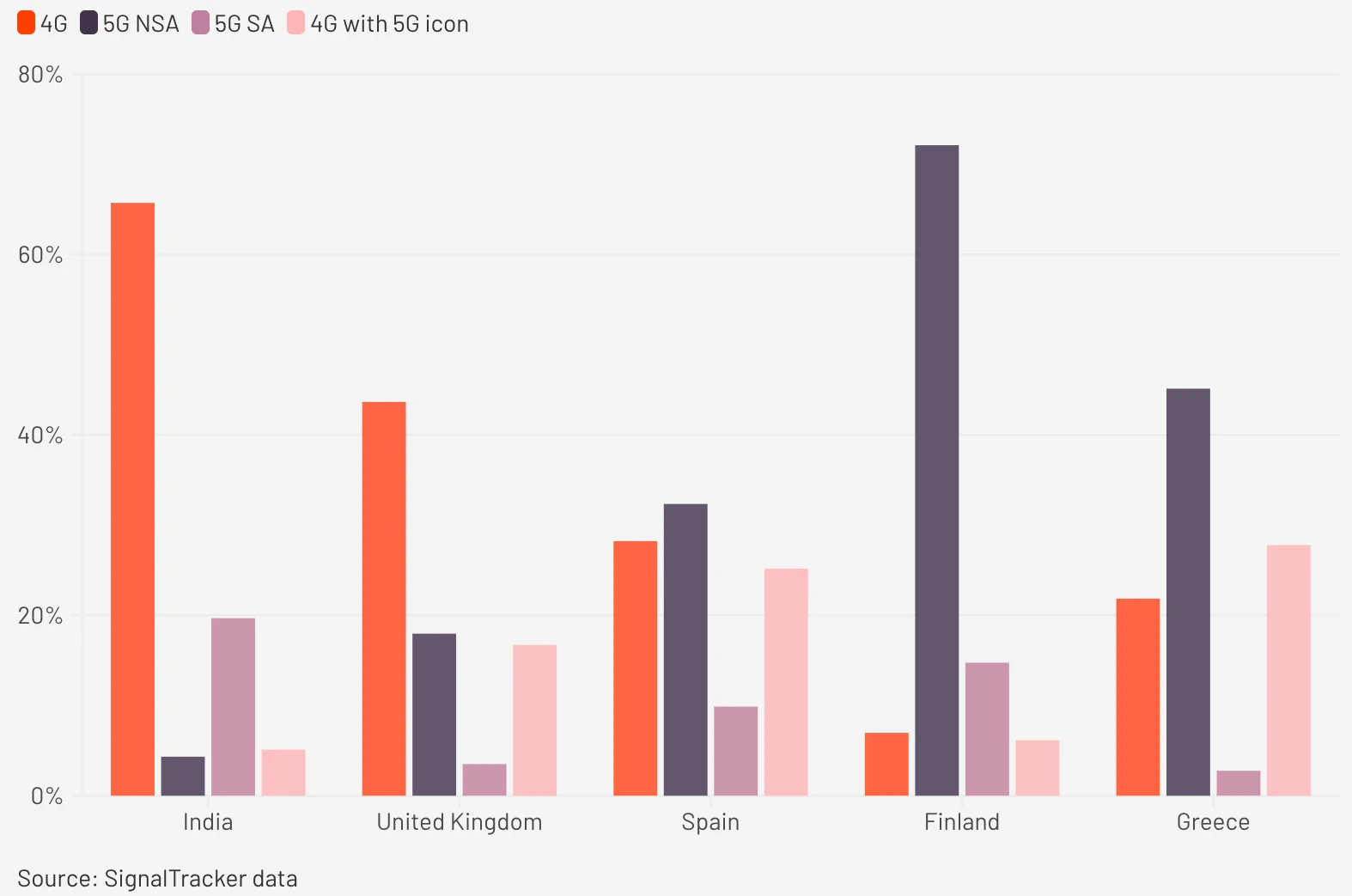
The results reveal that India has a higher proportion of 5G Standalone (5GSA) connectivity than the European countries in their sample (20% of its tests), with the UK (4% of its tests) and Greece having some of the weakest coverage. The UK (c.17%), Greece and Spain also had the highest proportion of users with so-called “fake 5G” (i.e. where Smartphones display a 5G icon, but your connection is actually using a 4G base station), while India and Finland had the lowest (c.5-6%).

NOTE: Early deployments of 5G were largely Non-Standalone (NSA), which meant they were partly reliant upon older and slower 4G infrastructure. But SA networks are pure end-to-end 5G that can deliver ultra-low latency times, greater energy efficiency, better mobile broadband speeds (particularly uploads), network slicing, improved support for Internet of Things (IoT) devices, increased reliability and more.

Proportion (%) of Users by Mobile Connection Type

SignalTracker-5G-Users-in-UK-India-Greece-Spain-and-Finland

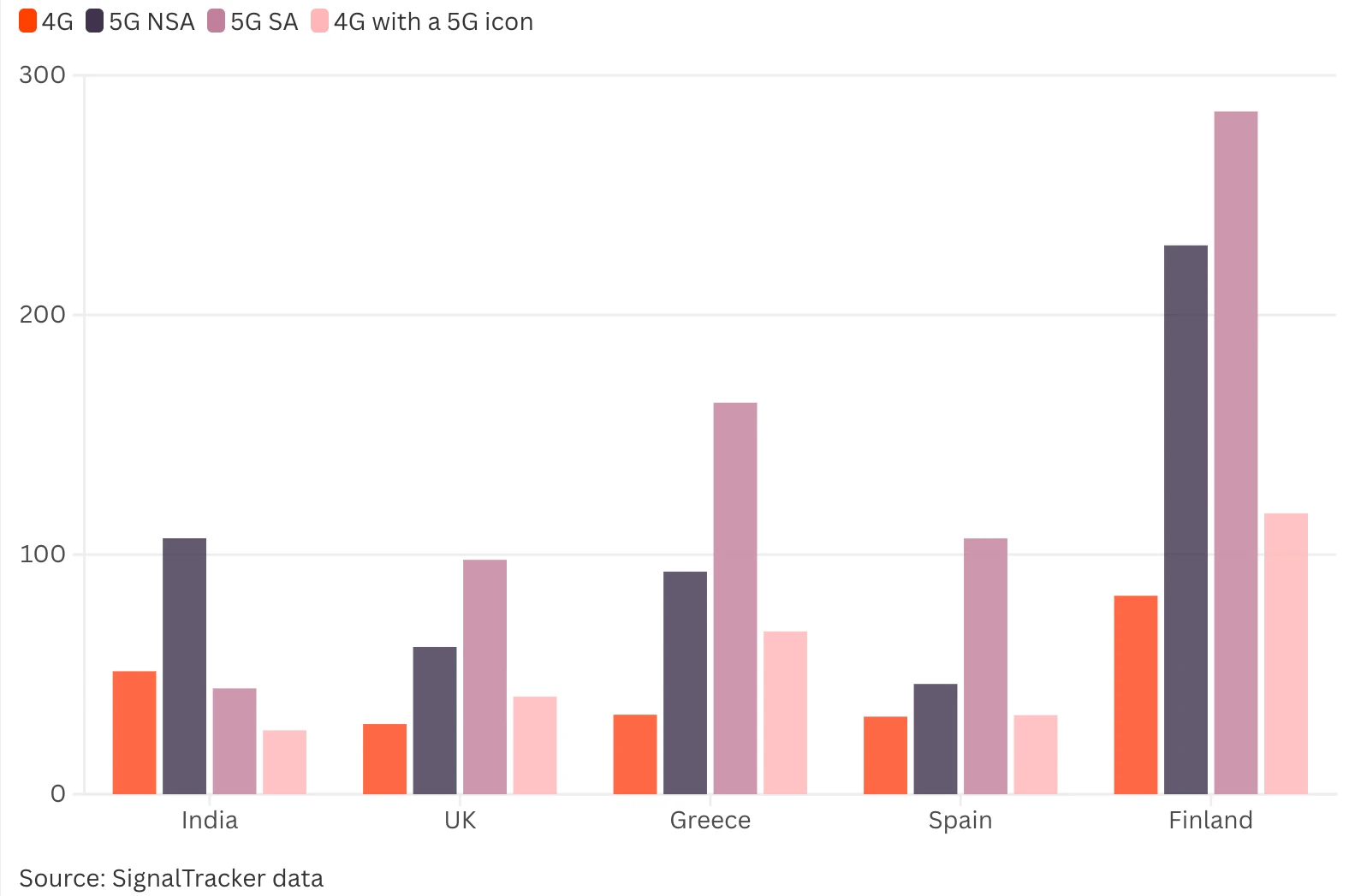
In terms of average mobile broadband download speeds, 5G NSA users in Finland topped the table with 229Mbps (Megabits per second) and in fact they were ahead of every other country in all of the various different mobile technology types. By comparison, the UK seemed to be closer to the c.60Mbps level for 5G NSA connections, although 5G SA links did touch the c.100Mbps line.

Average Download Speeds by Mobile Connection Type

SignalTracker-5G-Download-Speeds-in-UK-India-Greece-Spain-and-Finland

The new report is fairly limited in the data it provides and the number of countries involved, thus we can’t really gleam too much from the limited testing, except to say that the UK’s major mobile networks (EE, Vodafone / Three UK and O2) continue to underdeliver when compared against other countries (something we’ve seen in other studies too).

Improvements are on the way, with all of the major mobile operators now making big investments in 5GSA connectivity, although it may still take a few years for that to fully manifest and by then we’ll be starting to talk about the arrival of future 6G networks.

Ofcom temporarily grants Starlink more spectrum in the UK | Total Telecom

Original article Total Telecom:Read More

News

The decision will give Starlink’s satellites a much-needed boost in backhaul capacity

This week, Ofcom has announced it has granted permission for SpaceX’s Starlink satellite constellation to use the E band (71–76GHz and 81–86GHz) spectrum to increase the backhaul capacity.

The spectrum will be used to transmit data to and from three of the company’s ground stations in Morn Hill (Hampshire), Wherstead (Suffolk), and Woodwalton (Cambridgeshire).

Starlink wrote to Ofcom in December 2024 to request the spectrum, saying it was facing “capacity constraints in the UK due to increased demand”.

It argued that accessing the spectrum would provide improved latency and service quality, allowing it to compete in the market more effectively, as well as providing increased redundancy for existing fibre broadband networks. Starlink also said that it would potentially reduce costs for customers, by allowing it to serve customers more effectively without needing to build more expensive gateways.

Starlink had 87,000 UK customers, comprising both residential and enterprise users, at the end of 2024.

The E band spectrum is currently used in the UK for fixed services (i.e., wireless links typically used for backhaul), but this is up for debate. The licences currently expire at the end of 2028, with Ofcom indicating that temporary licences could be made permanent after this date, depending on the results of the relevant consultation.

For now, however, Ofcom is keen to stress that the future of this spectrum is far from certain.

“Granting these temporary authorisations does not prejudge the outcome of our future consultation process on proposals for longer-term access to E band for satellite gateways and does not provide any assurance that Starlink will be able to access this spectrum at these sites, or on these terms, beyond the end date of the temporary licences,” Ofcom said in a statement.

Keep up to date with all of the latest telecoms news from around the world with the Total Telecom newsletter

Also in the news
Connected Britain Award winners 2025 announced!
Netomnia announces ‘powerful and ambitious’ rebrand ahead of Connected Britain
VodafoneThree drops Samsung, relies on Nokia and Ericsson for £2bn network upgrade

MTN Launches StarEdge Horizon: a New Layer 2-based Solution for Private and Faster LEO Satellite Connectivity | Total Telecom

Original article Total Telecom:Read More

FORT LAUDERDALE. October 27, 2025 — MTN, the leading global provider of best-in-class satellite and wireless solutions, announced the launch of a cutting-edge solution for Low Earth Orbit (LEO) satellite connectivity: StarEdge Horizon, a service that provides a Layer 2 network architecture over SpaceX-Starlink for enterprises. StarEdge Horizon delivers more consistent performance by routing long-haul traffic off the public internet. This avoids the extra latency typically introduced by using standard VPNs and tunneling, especially when centralizing security at MTN’s servers or the customer’s cloud or data center.

StarEdge Horizon is a fundamental shift in how LEO is deployed for enterprise users,” said Emmanuel Cotrel, CEO at MTN. “We are moving beyond basic internet access to deliver a true Layer 2 private network solution. This is about providing corporate security, guaranteed high-speed, with a simplified network and seamless integration for redundancy. This ensures that mission-critical operations in every remote corner of the globe are always connected with fiber-level secure connectivity.

Layer 2 is a method that allows two points to communicate as if they were on the same local network, simplifying data management. With StarEdge Horizon, this protocol provides many benefits to companies such as:

  • Redefining Security and Simplified Wide Area Network (WAN) Integration: As companies have made security a top priority, StarEdge Horizon is engineered to improve cybersecurity while unifying remote corporate networks. With a true private network architecture, StarEdge Horizon’s private path lets remote sites connect into the corporate WAN through MTN’s points of presence. Internet access is centralized at MTN’s servers or the customer’s data center under one policy, improving visibility and reducing operational complexity and cost.
  • Mission-Critical Performance and Continuity: The system also enables advanced Network Segmentation and Quality of Service (QoS) prioritization. In moments of network saturation, this capability guarantees that mission-critical data, such as control systems or security feeds, is prioritized over general internet traffic, maintaining operational continuity. In addition, StarEdge Horizon system seamlessly integrates with OneWeb, LTE, or traditional VSAT solutions, providing automatic redundancy.
  • Direct Cloud Peering and Static IP: In addition, Horizon provides private connectivity options to major clouds (AWS, Azure, Google Cloud) where available, reducing exposure to the open internet for cloud-bound traffic. It also delivers true static IP addressing and subnet allocation, giving each remote site or device a secure and consistent network identity. This enables centralized monitoring, policy enforcement, and access control capabilities that are essential for enterprise security, remote management, and application allow-listing.

StarEdge Horizon is rolling out with enterprise customers across land-based sectors including energy, construction, and logistics, among others. MTN plans broader availability for the maritime sector in Q1 2026.

###

About MTN

MTN is a world-class network operator that connects global operations with the speed, security, and trust required. Our multi-network architecture delivers resilient, fully managed connectivity for critical systems and remote teams across the maritime, energy, government, and enterprise sectors.

Headquartered in Florida with offices across Europe, the Middle East, and South America, MTN enables rapid deployments and white-glove service anywhere. The company has pioneered the delivery of converged connectivity solutions on a global scale by partnering with major wireless carriers and satellite communications providers that integrate 5G/LTE and high-throughput satellite (HTS) networks, as well as cutting-edge Low Earth Orbit (LEO) constellations such as Starlink and OneWeb.

For more information, please visit www.fmcglobalsat.com or www.mtnsat.com

Media contact

Fernando Arreaza Vargas, Director of Media Relations and Corporate Communications

Fernando.vargas@mtnsat.com | +1.305.343.8279

Grain Start Building UK Full Fibre Broadband Network in Gainsborough | ISPreview UK

Original article ISPreview UK:Read More

Carlisle-based alternative broadband network and UK ISP Grain, which recently secured a £225m funding boost to continue their expansion (here), has revealed that they’ve now begun to expand their Fibre-to-the-Premises (FTTP) lines across the Lincolnshire (England) market town of Gainsborough; home to over 20,000 people.

The town represents a reasonable choice for Grain since, at present, their main gigabit-capable broadband competitors at infrastructure level in the area would be the incumbents of Openreach and Virgin Media (inc. nexfibre); both of which have strong coverage. In addition, OFNL (inc. Fibrenest) has a small deployment via some new build homes and Giggle Fibre (Harmony Networks) also seem to be present, but you still can’t order the latter.

NOTE: Grain has so far secured funding deals worth somewhere around £500m via Equitix, Albion Capital, Pinnacle Group, German Landesbank Nord L/B, HPS Investment Partners, LLC etc.

As for Grain, the announcement doesn’t reveal anything much about their deployment plan for the area, although we can clearly see plenty of related roadworks around the left side of the town, which will probably be converted into a live service within the next few months. The rollout is part of their wider expansion across the East Midlands, with towns like Leicester, Loughborough and Nottingham already partly covered.

The operator’s FTTP broadband network across the UK is currently home to over 43,000 customers and covers 270,000 UK premises (aiming to reach 600,000 in the future).

Richard Cameron, CEO at Grain Broadband, said:

“We’re excited to offer Gainsborough residents an internet service that can keep up with their digital lives. We’re not just delivering faster internet – we’re also helping customers save money every single month. Whether you’re working from home, streaming your favourite shows, or gaming online, Grain is here to keep you connected.”

Customers can expect to pay from £17.99 per month on a 24-month term for symmetric speeds of 150Mbps (including a router and free installation), which rises to £27.99 for their 1000Mbps tier. Some of these packages are also currently running a half-price promotion that lasts for between 3 and 12 months – varying by package.

BT Group Explore Launch of Budget UK Mobile Brand to Complement EE | ISPreview UK

Original article ISPreview UK:Read More

Telecoms and broadband giant BT is reportedly exploring the possibility of launching a new low-cost mobile service brand to complement their premium EE service. Such a move would seek to replicate Three UK’s approach with sub-brand Smarty or Vodafone’s approach with VOXI, albeit with some of BT’s own unique twists.

The network operator has occasionally hinted at this idea before, although until now they’ve often seemed to be too focused on other projects to really develop it into something serious. But according to the FT‘s (paywall) sources, the telecoms giant is now alleged to be actively exploring a number of different options for launching a budget mobile brand.

One such option could involve creating an entirely new brand, in much the same way as Three UK and Vodafone already did above (not forgetting that O2 also did this with giffgaff) – starting from scratch. The other option could involve BT moving to acquire an existing Mobile Virtual Network Operator (MVNO) and then changing it to suit their purposes.

The move, if confirmed, could be seen as a response to how competitive the UK’s mobile market has become in recent years. Virtual operators seem to have been springing up all over the place, while pure eSIM providers (usually focused more on travel / roaming solutions) have recently added yet another new dynamic to the market.

Virgin Media O2 CEO Joins BT in Raising Concern Over UK Biz Rates Hike | ISPreview UK

Original article ISPreview UK:Read More

The CEO of broadband and mobile giant Virgin Media and O2 (VMO2), Lutz Schüler, has today warned the UK government against reforming business rates in a way that would impose a “hefty hike” on telecoms providers because, he says, it would act as a “disincentive to invest that will be a real kick in the cabinets” to the industry. At a time when they’re already under pressure.

Not unlike the BT Group, VMO2 (inc. nexfibre) are currently in the middle of a major infrastructure programme, which reflects their ongoing roll-out of 5G based mobile broadband technology and the upgrade, as well as expansion, of their existing fixed broadband network to adopt the latest 10Gbps capable XGS-PON full fibre (FTTP) infrastructure.

However, as well as being under pressure from the existing business rates regime and rising costs (i.e. build costs, high interest rates, competition etc.), VMO2 has also had to contend with some disruption to their plans from partner Telefonica’s decision to conduct a Strategic Review of their heavily indebted business (here and here).

Suffice to say that the last thing VMO2 want to see right now is the government reforming business rates in a way that would significantly raise the tax burden of deploying new fibre and mobile infrastructure. The Chief Financial Officer (CFO) of BT Group, Simon Lowth, recently made similar points via a more in-depth blog post (here); this followed earlier remarks from the group CEO, Allison Kirkby (here).

Lutz Schüler, VMO2 CEO, said (Telegraph):

“A hefty hike in business rates is a direct network tax and a disincentive to invest that will be a real kick in the cabinets to the telecoms industry at a time when business costs in the UK are already eye-watering. We urge the Treasury to rethink its business rates proposals and ensure critical infrastructure investment remains proportionately incentivised and supported in line with the Government’s growth mission.”

A spokesman for HM Treasury said:

“We’re making business rates fairer by introducing permanently lower rates for retail, hospitality and leisure from April, funded by a higher rate on less than 1pc of the most valuable business properties. We’ve also capped corporation tax at 25pc, the lowest in the G7, secured major trade deals with the US, EU and India, and seen interest rates cut five times since the election to help businesses across Britain.”

However, despite the concerns, the Government currently seems set to continue with their changes. The move puts them in the somewhat confusing situation of trying to both encourage investment in new digital infrastructure – sometimes with public money (Project Gigabit, SRN etc.) – while, at the same time, running the risk of discouraging it via higher taxation.

In an ideal world the network operators would probably prefer it if the government excluded digital infrastructure from their changes or introduced another targeted relief from business rates, but there’s currently no sign of that happening.