O2 UK Reach Grim Milestone as Mobile Network Blocks 1 Billion Scam Texts | ISPreview UK

Original article ISPreview UK:Read More

Mobile operator O2 (Virgin Media) has today revealed that over 1 billion scam text messages have been blocked by their network and prevented from reaching customers. The provider is now calling on the government to ensure that their forthcoming Fraud Strategy helps to tackle this by empowering law enforcement with the tools and resources needed to crackdown on the problem.

Like other broadband and mobile providers, VMO2 already uses various types of threat detection and filtering technologies to prevent malicious messages and calls from being delivered on its network (e.g. their free AI scam call detection system is flagging 50 million suspicious calls every month). It also analyses reports from customers – those who share suspicious messages for free via 7726 – to monitor trends and improve scam detection.

However, while network operators are putting in place new technologies and methods to better tackle the problem, there remains a weak spot when it comes to enforcement (tricky as a lot of the criminals often reside overseas). This is perhaps underlined by the fact that there were fewer than 4,000 prosecutions in 2024 and, as a result, VMO2 argues that “fraudsters can continue to commit crime without consequence because police forces are not given enough power and resources to counter professional gangs“.

The network operator is now calling for “urgent action from government” to make fraud a strategic priority, such as by creating a dedicated, centralised national policing agency to handle all fraud investigations. This would replace the current fragmented system, whereby the 43 individual police forces are currently responsible for most investigations.

Murray Mackenzie, Director of Fraud Prevention at Virgin Media and O2, said:

“That we’ve had to intervene to block 1 billion scam texts shows the scale of the organised crime gangs we’re up against.

Scammers are relentlessly targeting Brits and, despite the investments we’re making to stay one step ahead, sadly fraud is the biggest crime in the UK.

We must send a clear message that fraud is not a crime without consequence. Government must use its forthcoming Fraud Strategy to empower law enforcement by giving them the tools and resources needed to show fraud doesn’t pay and bring these criminals to justice.”

VMO2 appears to support the idea of creating a Crime Prevention Agency charged with taking the “national and international action” necessary to prevent fraud and cybercrime, which was separately proposed via a recent report from the Police Foundation. The same report also called for a new National Anti-Fraud Data centre to be established with private companies legally required to share relevant data, as well as a new national strategy to recruit and upskill investigators.

The remarks largely echo the same position that VMO2 took almost exactly one year ago today (here).

Virgin Media O2 Integrate Neutral Host Small Cell into Live UK 5G SA Network | ISPreview UK

Original article ISPreview UK:Read More

O2 (Virgin Media) has partnered with IONX Networks to become one of the first mobile operators in the UK to successfully integrate a neutral host Small Cell into their live 5G Standalone (SA) core network, which supports the ongoing expansion of their new ultrafast mobile broadband service (currently available to more than 70% of the population).

Just to recap. 5GSA networks are pure end-to-end 5G connections that can deliver ultra-low latency times, greater energy efficiency, better speeds (particularly uploads), network slicing, improved support for IoT devices, increased reliability and more. Unlike older Non-Standalone (NSA) 5G networks, they don’t have any legacy 4G in the mix to slow them down.

Meanwhile, Small Cells are mini shoebox sized mobile (radio) base stations, which are designed to deliver limited coverage (usually up to around 100 metres) and thus tend to be more focused on busy urban areas and specific sites – it’s not uncommon to find these sitting on top of lampposts, CCTV poles or even inside buildings to boost mobile coverage.

Sadly, today’s announcement from IONX Networks doesn’t tell us anything about where their Neutral Host (i.e. a network that mobile operators or other communications providers can then buy access to via wholesale) based Small Cell has been deployed within O2’s national network. But the fact it’s a Neutral Host setup means that rival operators may also be able to harness it, once a deal is done.

Rob Joyce, Director of Mobile Access Engineering at VMO2, said:

“At Virgin Media O2, we have the largest 5GSA of any operator and are focused on bringing it to more locations through our £700m Mobile Transformation Plan. This neutral host approach supports our mission to densify 5G in a scalable, cost-effective way — bringing the power of 5GSA to more people.”

The new deployment is said to follow the UK’s wider Joint Operator Technical Specifications (JOTS) framework, while also adopting a unified, software-defined architecture supporting both MORAN (Multi-Operator RAN) and MOCN (Multi-Operator Core Network) features.

October 2025 Progress Update on BT 10Mbps UK Broadband USO | ISPreview UK

Original article ISPreview UK:Read More

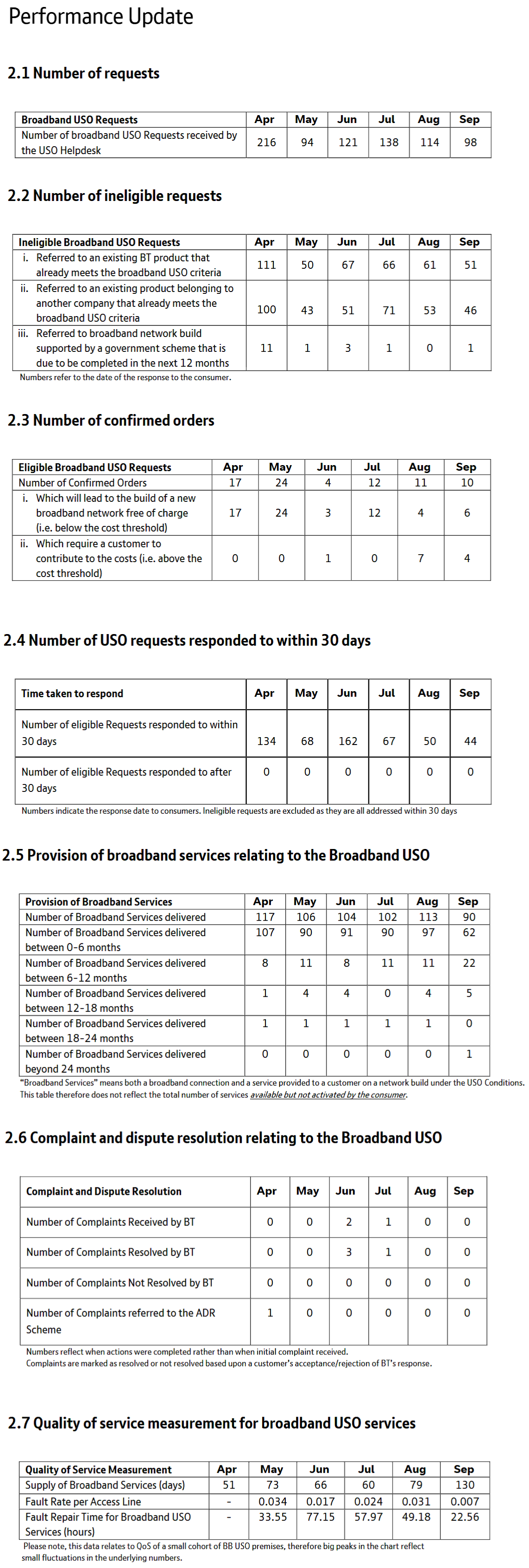
ISP BT has published the biannual (October 2025) progress update on their delivery of Ofcom’s somewhat unpopular 10Mbps Universal Service Obligation (USO) for broadband. The provider has so far helped to build a USO connection to over 8,553 premises (up from 8,411 in April 2025), with 186 further builds in-progress (down from 349).

The USO is a legally-binding and industry-funded obligation that falls on BT across the UK and KCOM in Hull. In short, people living in areas where they can’t yet receive a 10Mbps or faster download speed, and aren’t expected to be covered by such a network in the next 12-months, can request a service capable of 10Mbps+ (1Mbps+ upload) from the aforementioned internet providers.

NOTE: For many of those extremely remote areas, the cost of a USO connection will be significantly in excess of the industry £3,400 contribution (end-users have the option to pay excess costs or decline the USO solution).

A cost sharing model also applies here, which means that the providers will “calculate the total excess cost of the build and divide that between the eligible premises. If that amount is below £5,000 per premises (on top of the £3,400), we’ll automatically split the costs“. But some areas can still end up costing hundreds of thousands of pounds, even up to £1-2m, and would thus find the USO route to be unviable (here and here).

Ofcom states that 48,000 UK premises (0.2%) currently fall into the USO gap (i.e. those outside of suitable fixed line, fixed wireless or 4G mobile coverage) or c.370,000 premises if you exclude wireless solutions. But the regulator predicts the current 48k figure could fall to 19k by January 2028, mostly as a result of upgrades delivered via ongoing publicly funded schemes (gigabit vouchers, project gigabit contracts etc.).

Just to be clear about this. Many of those who pursue the USO option via BT say they were offered 4G (mobile broadband) connections via EE instead, but those actually considered to have been delivered under the USO itself usually get Fibre-to-the-Premises (FTTP). Commercial builds of the latter have also helped to shrink the USO gap (tackling the first c.80%+ of the country).

The gap will continue to shrink as both commercial and subsidised builds (e.g. the Gov’s £5bn Project Gigabit programme) expand. The government are also still exploring how best to reach those who live in “Very Hard to Reach” areas with even faster speeds – roughly equating to the same sort of area as the USO is focused upon – and at the same time they’re due to review the USO itself (here), which could lead to changes. But this work seems to have been delayed by last year’s change in government.

BT’s October 2025 Broadband USO Report

The latest statistics continue to show that the USO delivery is a slow process (e.g. in Oct 2023 there were 185 builds in progress, then 265 in April 2024, 215 in Oct 2024, 349 in Apr 2025 and now 186). We suspect this may be a combination of factors, such as a lack of consumer familiarity with the USO (apply for it here), new services like Starlink becoming available, the shrinking area of USO eligibility and the fact that the policy may be running into the limitations of economically viable deliverability.

BT-Broadband-USO-Progress-October-2025

Falkland Islands Government Grants Licence for Starlink Satellite Broadband | ISPreview UK

Original article ISPreview UK:Read More

The Falkland Islands Government (FIG) has, after plenty of confusion and debate earlier in the year (here and here), finally granted a VSAT Broadband Connectivity Licence to SpaceX’s Starlink service. The move allows homes and businesses on the remote islands, which are a British Overseas Territory, to take an ultrafast internet service via Starlink’s satellite network.

Just to recap. The islands, which reside around 500km off the South American coast and are home to 3,700 people, have long suffered from poor internet connectivity and that’s partly due to the political fallout from the 1982 Falklands War. Until now, locals have had little option but to connect via an extremely slow and expensive satellite data link from the dominant provider, Sure (Sure Falklands Islands).

NOTE: The fastest broadband package on Sure’s website is PRO XL, which will give you downloads of 10Mbps and a 364.65 GB (GigaByte) data allowance for £467 per month! Unlimited data packages also exist, but you’d still be paying £229 – £320 per month.

Locals have long been campaigning for the FIG to work with SpaceX in order to approve the use of its Starlink based broadband service, which reflects a mega constellation of satellites in Low Earth Orbit (LEO). The change, if approved, would enable access to a significantly faster and more flexible service for less money. But first they’d have to find a solution for Sure’s exclusive licence and the hefty annual VSAT fees (£5,400) that could be levied against those seeking to officially take Starlink’s service (some were already using it in an unofficial and unsupported capacity, which was previously illegal).

The first real positive development came in June 2025, after the FIG bowed to pressure from residents and revised the VSAT policy and fee level (£180 per year – bringing it within the realm of consumer affordability). But the Communications Regulator still needed to go through the usual motions and negotiate a solution to Sure South Atlantic’s exclusive telecommunications licence. Only after that could Starlink officially launch its service and determine pricing for the Falklands.

According to the Open Falklands blog, the FIG and Sure reached an agreement last week to allow Sure to continue to discharge its universal service obligations under its exclusive telecommunications licence, alongside the more permissive VSAT licensing scheme approved by Executive Council in June this year. The deal also paves the way for the re-opening of personal VSAT licence applications with the new policy and fee level in place.

The commercial agreement, which also avoids the FIG having to fight Sure’s judicial review proceedings, involves the government paying money to Sure to compensate for the loss of broadband revenues it can demonstrate it was making before the introduction of widespread Starlink usage. The threat of new competition has thus also had another welcome impact:

Extract from the Open Falklands blog

Although the detailed workings of the scheme are commercially confidential, Executive Council determined it was right to inform the public of the potential sums involved, as this is taxpayer money. Over the remainder of the exclusive licence period, Sure will be eligible to claim up to £6.167m. However, the actual amount claimed will be dependent on Sure evidencing losses against a pre-Starlink baseline. As such, the more people retain or take up Sure broadband packages, the less will be claimed.

Alongside this new agreement Sure will launch two unlimited residential broadband packages priced at £50 and £115 a month, exclusive of line rental, for unlimited use. The different prices reflect the two different speeds of the packages [up to 5Mbps and 15Mbps respectively], which will be available from 1st December 2025 and will replace all existing broadband packages for new customers. Existing customers on packages sized ‘medium’ and above will be able to retain their existing arrangements if they wish.

Existing extra small and small broadband packages will be phased out by 31st January 2026, with customers on these packages being given a two-month transitional period from the 1 December 2025 to move to a Sure unlimited package or to VSAT services with a licence. There will be some other changes on the same timetable, such as adjustments to monthly line rental and an amendment to broadband hotspot use for unlimited package holders, which will be communicated by Sure.

The new Sure packages can already be seen on their website (here), which also summarises a number of other changes to pricing. The packages are much more competitive and attractive than what came before (the merits of a competitive market at work), although the speeds of 5Mbps and 15Mbps remain pretty poor by modern standards and latency times on Sure’s older satellite network will be much slower than Starlink’s constellation in Low Earth Orbit (LEO).

The big question now is what sort of packages and prices will Starlink come out with now that they’ve finally been granted a VSAT licence and can officially serve residents at an affordable level. The provider is expected to reveal that information very soon (possibly within the next few days). But the service will likely be more expensive and probably a bit slower than their packages in the UK.

Starlink currently has almost 8,800 satellites in orbit (c.5,200 are v2 / V2 Mini) – mostly at altitudes of c.500-600km – and rising. Residential customers in the UK usually pay from £75 a month, plus £299 for hardware (currently free for most areas) on the ‘Standard’ unlimited data plan (kit price may vary due to different offers), which promises UK latency times of 26-33ms, downloads of 116-277Mbps and uploads of 17-32Mbps. Cheaper and more restrictive options also exist for roaming users.

Rural UK Broadband Altnet Gigaclear Hunts Buyer to Tackle £1bn Debt | ISPreview UK

Original article ISPreview UK:Read More

A new report has claimed that Abingdon-based broadband ISP Gigaclear, which has built a full fibre (FTTP) network across 612,000 premises in rural parts of England and is home to c.160,000 customers, have begun the process of hunting for a buyer as one of the preferred options for tackling their £1bn debt mountain.

The provider, which back in 2010 took on the huge challenge of trying to expand FTTP across rural areas using a commercial approach, currently holds an aspiration to extend their network coverage to 1 million premises. But like so many other network operators they’ve more recently had to scale-back their build and cut jobs, due to the pressures from high interest rates, rising build costs and a highly competitive environment (here and here).

NOTE: Gigaclear is principally owned by Infracapital, together with Equitix and Railpen. The company previously had investment commitments estimated to be worth up to around £1.1bn (here) and in late 2023 secured a £1.5bn debt facility (here). The provider holds several Project Gigabit build contracts in Oxfordshire (here) and East Gloucestershire (here).

Gigaclear’s main focus today is on delivering their publicly subsidised Project Gigabit contracts (i.e. “ultra rural areas“) for the government, while also trying to boost customer take-up through a stronger focus on commercialisation of the network they’ve already built. But at the same time they’ve still got a huge debt pile to tackle and efforts to raise fresh investment have yet to bear much fruit.

Suffice to say that there was nothing particularly surprising about the FT‘s (paywall) latest report, which claims that the provider has launched a sale process and this week started sending out “teaser documents” to potential buyers. Failing that, Gigaclear may have to consider writing down its debt (painful for creditors like NatWest, Lloyds and the National Wealth Fund), a debt-for-equity swap or seek a further cash injection from investors.

One thing to keep in mind here is that, despite Gigaclear only having covered 612,000 premises, the operator’s strong rural focus means that their physical network size is actually, geographically speaking, quite large and most of that exists outside of busy urban areas. But New Street Research is said to have estimated that Gigaclear could fetch between £500m and £700m.

The hope is that the provider will be able to avoid a restructuring process that results in them doing the first major write-down of debt in the alternative network (altnet) sector, which could fire the starting pistol on similar outcomes elsewhere.

A spokesperson for Gigaclear said:

“Our existing stakeholders remain supportive of the business, and we continue to work constructively with them to explore a range of options that support the long-term success of Gigaclear and deliver the best outcome for all parties.”

However, potential candidates for a consolidation agreement, such as CityFibre, may well still seek a reduction in the altnet’s debt levels before doing a deal. Meanwhile, Gigaclear insists they’re continuing to deliver “strong operational performance” and are “delivering on all key financial metrics”.

On the surface, CityFibre’s urban focus should be a good complement for Gigaclear’s more rural centric network, but there are some other potential caveats to consider. The rural provider’s network infrastructure might well require some expensive upgrades to match CityFibre’s latest XGS-PON network, and Gigaclear’s standard pricing (after discounts) tends to be much more expensive than CityFibre’s equivalent plans.

None of this should overlook the fact that Gigaclear has still managed to deliver an impressive full fibre network in some of the country’s most challenging rural areas. So, whatever the future holds, this will continue to exist and has had a hugely positive impact on many of the communities served.

Broadband ISP Aquiss Prep 2025 UK Black Friday Discounts – 6 Months Half Price | ISPreview UK

Original article ISPreview UK:Read More

Shropshire-based independent broadband ISP Aquiss has this morning unveiled its planned Black Friday discounts early by offering new customers six months of half-price service on their Openreach (FTTP + FTTC/SOGEA) and CityFibre (FTTP) based packages, which will be available to order between 1st and 30th November 2025.

All packages include unlimited usage, a 12-month minimum contract term, a pledge of no annual mid-contract price rises, a static IPv4 address and static IPv6 addresses (/56). But new customers will be expected to supply their own broadband router.

Aquiss has always been about empowering our customers with straightforward, high-performance broadband that just works,” said Martin Pitt, MD of Aquiss. “With Black Friday sales ramping up and families streaming more than ever, we’re thrilled to launch this deal early. It’s our way of giving back to the communities we serve, making full fibre more accessible so everyone can stay connected without breaking the bank.”

Mobile Operator Spusu Launches New SIM Only Plans for UK Customers | ISPreview UK

Original article ISPreview UK:Read More

The SIM-Only mobile provider spusu, which holds a virtual operator (MVNO) agreement via BTWholesale to harness EE’s national 4G and 5G network, has today announced the launch of several new mobile plans. But unfortunately their “unlimited data” plan seems to have vanished and it’s unclear when it will return.

As usual, all of their mobile plans include unlimited UK calls and texts, 500 minutes to EU numbers from the UK, and 500 roaming minutes and 500 roaming texts for use abroad. Most plans also include between 6GB (GigaBytes) and up to 15GB of EU roaming data for mobile broadband connectivity while travelling.

In terms of the new plans, spusu 10 gives customers 10GB of data for £6.90 per month, while spusu 20 doubles that to 20GB for just £7.90. Both come with 6GB and 8GB of EU roaming data respectively, useful for holidaying or working abroad. After that spusu 30 dishes out 30GB for £9.90, and spusu 80 offers a hefty 80GB for just £12.90, complete with up to 15GB of EU roaming data.

The new plans are intended to complement those that already exist, such as spusu 5GB for just £4.90 and spusu 100GB for £14.90. But the operator also appears to have recently removed their “unlimited data” package from the website at some point around August 2025, and it’s unclear whether or when that may return (we’ve asked).

Christian Banhans, UK MD of spusu, said:

“We want people to stop overpaying for their mobile plans. With spusu, you get fair prices, generous roaming and no nasty surprises. Even our biggest plan, spusu 100, gives customers 100GB for under £15 per month so that those who have big data appetites can stay connected on a budget.”

Vodafone and Three UK to Cut Jobs from Network Development Division | ISPreview UK

Original article ISPreview UK:Read More

Mobile operator VodafoneThree (Vodafone and Three UK) has reportedly begun informing some staff members that they face redundancy in the future, due to their roles being outsourced to India under new contracts with network suppliers Ericsson and Nokia. On top of that, the Transfer of Undertakings (Protection of Employment) – or TUPE – rules will not apply.

Just to recap. Ericsson and Nokia were recently appointed as key partners to support the delivery of the newly merged network (here). But according to The Register, employees in the operator’s UK Network Development division have allegedly since been warned that planning and optimisation jobs would soon be transferred overseas, which meant that permanent staff were now “at risk of redundancy.”

In our current context, the activity transferring to Ericsson and Nokia will be based in India, therefore TUPE does not apply,” said a related FAQ page on the employment change, seen by The Register. “Whilst Ericsson and Nokia both have services and employees in European locations, including the UK, the roles impacted will be offshored to India.”

In fairness, the merger was always expected to result in some redundancies, which often happens when two companies come together (i.e. reducing duplication of roles and making the combined business more efficient). Except in this case the recent Ericsson and Nokia announcement had in fact boasted of creating as many as 13,000 jobs in engineering and construction, although it did state that 74% of these roles would be outside of London and the South East, albeit with no mention of India.

Extract from the Ericsson and Nokia Announcement

VodafoneThree’s fully funded and regulated plan to build the network at pace will bring jobs to every region of the UK, creating as many as 13,000 jobs in the engineering, construction and maintenance of telecom towers, fibre optics and base stations over the entire eight year build period.

The majority (74%) of roles created will be outside of London and the South East, bringing employment opportunities to people in towns and communities across the four nations. This reinforces VodafoneThree’s commitment to supporting national growth through digital transformation, while equipping today’s and tomorrow’s talent with the skills they need for the future.

At present, it’s not yet known exactly how many workers and contractors will lose their jobs over this, although some insiders are said to have estimated that at least 80 roles could be impacted. We have asked the mobile operator to comment and await their response.

Openreach Cuts UK Price of 1.2Gbps and 1.8Gbps FTTP Broadband Tiers | ISPreview UK

Original article ISPreview UK:Read More

Network operator Openreach (BT) has today informed ISPs about a “realignment of prices” on their top two fastest Fibre-to-the-Premises (FTTP) broadband tiers – 1.2Gbps and 1.8Gbps (both 120Mbps upstream), which in practice appears to mark a further price reduction. Rivals will perhaps remark that we’ve seen quite a few special offers from the incumbent of late.

The changes apply to internet service providers that have joined the network operator’s Equinox contract, which is the name of their sometimes divisive volume focused discount scheme that also provided pricing certainty over a 10-year period (here and here).

NOTE: Openreach’s new full fibre (FTTP) network currently covers almost 21 million UK premises (with take-up of c.38%) and aims to reach 25m by December 2026, before potentially rising “up to” 30m by 2030. The deployment is currently costing the BT Group c.£15bn.

According to the latest briefing, as of 1st February 2026, the Equinox prices in the Openreach price list will be changed as follows (Openreach is giving 90 days notice of this, as required by Ofcom):

1. GEA-FTTP 1200Mbit/s / 120Mbit/s from £23.28 per month to £22.24 per month +vat

2. GEA-FTTP 1800Mbit/s / 120Mbit/s from £30.59 per month to £23.28 per month +vat

Price changes will be effective from 1 February 2026 until 30 September 2031 (inclusive), which is the end of the Equinox contract period. Prices will be subject to annual increases of CPI – 1.25% or 0%, whichever is highest. There are no changes to any other Equinox terms,” added the briefing.

As usual, it’s important to point out that these are wholesale prices, and they thus do not directly reflect the prices consumers pay at retail for the same service, which is because ISPs still have to add all sorts of extra network features, 20% VAT, the need for a profit margin and more before it becomes the product you purchase.

The move will no doubt be welcomed by most ISPs that use Openreach’s broadband network, as well as consumers who might have been eyeing an upgrade to one of the top tiers (assuming providers do choose to pass any related reductions on to their customers, which seems likely); particularly 1.8Gbps, as the change for 1.2Gbps is fairly small.

Meanwhile, we suspect that some rival networks might well lobby Ofcom against approving the measure, perhaps viewing it as another competitive threat to their existence. But thus far Ofcom has been fairly happy to approve such promotions, and we suspect this one will be much the same.

US govt pushing to ban TP-Link over national security fears | Total Telecom

Original article Total Telecom:Read More

News

U.S. federal agencies are reportedly considering a significant restriction on TP-Link, a company that produces widely used home internet routers, amid escalating concerns over national security linked to China.

The U.S. Commerce Department, alongside the Departments of Justice, Homeland Security, and Defense, has proposed banning future sales of TP-Link Systems’ devices, a company whose routers reportedly comprise more than a third of the American home router market. The proposal reflects deepening anxieties about the potential for Chinese influence over technology critical to the nation’s cybersecurity infrastructure.

TP-Link Systems, headquartered in California and recently spun out from its former Chinese parent company TP-Link Technologies, faces scrutiny for lingering connections with China. Despite the corporate split completed last year, officials remain wary of the company’s ties to Beijing, fearing that such links could expose American consumers’ data to security risks.

In May, several Republican lawmakers, including Senate Intelligence Committee Chair Tom Cotton, advocated for a ban on TP-Link routers. Their concerns have been fueled by investigations revealing that Chinese state-sponsored hackers exploited TP-Link routers in cyberattacks targeting U.S. critical infrastructure, most notably 2024’s Salt Typhoon attacks.

TP-Link has rebuffed these claims, noting that many device brands were compromised in the attacks and that no evidence was presented that the company is connected to China.

The Commerce Department has not yet implemented the proposed ban and may still opt against it. TP-Link Systems contends that it is a U.S.-based firm that poses no threat to consumers. A company spokesperson told The Independent that no official actions or confirmations regarding the ban have been made and that any regulatory concerns can be addressed through practical measures such as onshoring development and enhancing cybersecurity transparency.

The current scrutiny of TP-Link occurs in the broader context of intensifying tensions between the U.S. and China, particularly over technology and trade disputes. This move parallels actions taken against other Chinese technology firms like TikTok, where U.S. regulators have similarly cited national security as a basis for restricting Chinese influence on American digital infrastructure.

In addition to national security concerns, TP-Link Systems is facing a criminal antitrust investigation by the U.S. Department of Justice. The investigation focuses on the company’s pricing strategies, specifically allegations of predatory pricing. The case suggests that TP-Link may be deliberately selling products at a loss in order to monopolise the market, before increasing prices at a later time.

TP-Link currently controls about 65% of the U.S. home networking market. As such, the potential ban on TP-Link devices would represent one of the largest consumer technology prohibitions in recent U.S. history.

Also in the news
Connected Britain Award winners 2025 announced!
Netomnia announces ‘powerful and ambitious’ rebrand ahead of Connected Britain
VodafoneThree drops Samsung, relies on Nokia and Ericsson for £2bn network upgrade