BT and EE to Sell Starlink as UK Rural Broadband Solution to Customers | ISPreview UK

Original article ISPreview UK:Read More

Telecoms giant BT (EE) has this morning announced a “landmark agreement” to make Starlink’s mega constellation of ultrafast broadband satellites in Low Earth Orbit (LEO) available to their consumer broadband customers in “rural and remote areas“, where traditional fixed-line infrastructure is “economically unviable or geographically challenging” to build.

The announcement doesn’t provide a lot of information on how this will be deployed, but it does state that Starlink is “quick to deploy and capable of delivering download speeds of up to 280 Mbps“. The collaboration is also curiously described as being a “first in the UK and one of the first globally“, although we’re not currently sure what makes this a “first” – Starlink is already used by other providers, sometimes they just resell the service and other times it’s adopted as backhaul for an existing network.

The new service is currently expected to be available to customers in the “latter half of 2026” and we assume BT / EE must be planning to do something a bit different from merely reselling the same product that consumers can already buy, today, directly from Starlink itself. The move comes shortly after O2 announced that they’d also be harnessing Starlink, albeit to connect their roaming mobile users via Direct to Cell (here).

Allison Kirkby, CEO of BT Group, said:

“As we create a better BT for all of us, no one is doing more to connect the UK than we are. This landmark agreement with Starlink is a giant leap for rural connectivity – allowing us to get fast and reliable in-home connectivity to our customers in some of the UK’s most rural and isolated areas and to bridge the digital divide better than ever.”

Chad Gibbs, VP of Business Operations at SpaceX, said:

“On behalf of Starlink, we’re excited to team up with BT Group and bring high-speed internet to more people across the UK. Their local presence will help us reach those communities which have historically faced challenges with reliable connectivity. Starlink is committed to its mission to connect the unconnected while maintaining focus on delivering overall quality of service.”

Starlink currently has almost 8,900 satellites in orbit (c.5,300 are v2 / V2 Mini) – mostly at altitudes of c.500-600km – and rising. Residential customers in the UK usually pay from £75 a month, plus £299 for hardware (currently free for most areas) on the ‘Standard’ unlimited data plan (kit price may vary due to different offers), which promises UK latency times of 26-33ms, downloads of 116-277Mbps and uploads of 17-32Mbps. Cheaper and more restrictive options also exist for roaming users.

NOTE: By the end of 2024 Starlink’s global network had 4.6 million customers (up from 2.3m in 2023) and 87,000 of those were in the UK (up from 42,000 in 2023) – mostly in rural areas. As of July 2025 Starlink has grown to a total of more than 6 million customers.

BT See Openreach UK Broadband Lines Fall by 242k as FTTP Covers 20.3M Premises | ISPreview UK

Original article ISPreview UK:Read More

The BT Group has today published their H1 FY26 biannual results to Sept 2025, which reveals that Openreach’s full fibre (FTTP) network added 2.2 million premises to their UK coverage to total 20.3m (level with H2 FY25 growth); including 5.5m in rural areas. But broadband line losses to rivals jumped to 242k in the last quarter (up from 169k in Q1 2025).

The group’s consumer divisions – including BT, EE and Plusnet – reported being home to a total of 8,210 million broadband connections (up slightly from 8.198m in H2 FY25), which included 3.677m FTTP customers (up from 3.202m). BT’s business division similarly had a total of 576k retail broadband lines (down from 595k) and 144k of those were FTTP lines. BT Wholesale also supplied a total of 688k broadband lines to other ISPs (down from 697k) and 131k of those were FTTP (up from 93k).

NOTE: Openreach is investing £15bn to cover 25 million UK premises by Dec 2026 (inc. 6.2m in rural or semi-rural areas). But the ambition also exists to reach up to 30m by 2030.

In terms of consumer mobile connections, EE reported total mobile customers of 13.924m (up from 13.863m), including 11.199m using 5G (up from 10.806m). BT also reported that their fixed broadband consumers gobbled an average of 444GB (GigaBytes) of data per month (down from 446.1GB), which falls to 18.2GB for EE’s post-paid mobile users (up from 17GB).

Elsewhere, some 59.1% of BT’s fixed consumer base take a “superfast broadband” product (down from 62.9% in H1) and 37.1% have adopted one of their “ultrafast” products (up from 32.6%), which these days largely reflects FTTP cannibalising customers from slower FTTC and ADSL lines. ISPreview also noted that 25.9% of BT’s customers are now taking both mobile and broadband (converged), which is up from 24.6%.

Finally, BT confirmed that EE’s 5G Standalone (mobile broadband) network had so far been rolled out across 50 major UK towns and cities, covering over 66% of the population (up from 40%). The provider aims to reach 99% by the end of 2030.

Financial Highlights – BT’s Half-Yearly Change
* BT Group revenue = £9,806m (down from £10,232m in H2 FY25)
* BT Group total reported net debt = £20,853 (increased from £19,816m)
* BT Group profit after tax = £651m (up from £299m)

Openreach’s Network

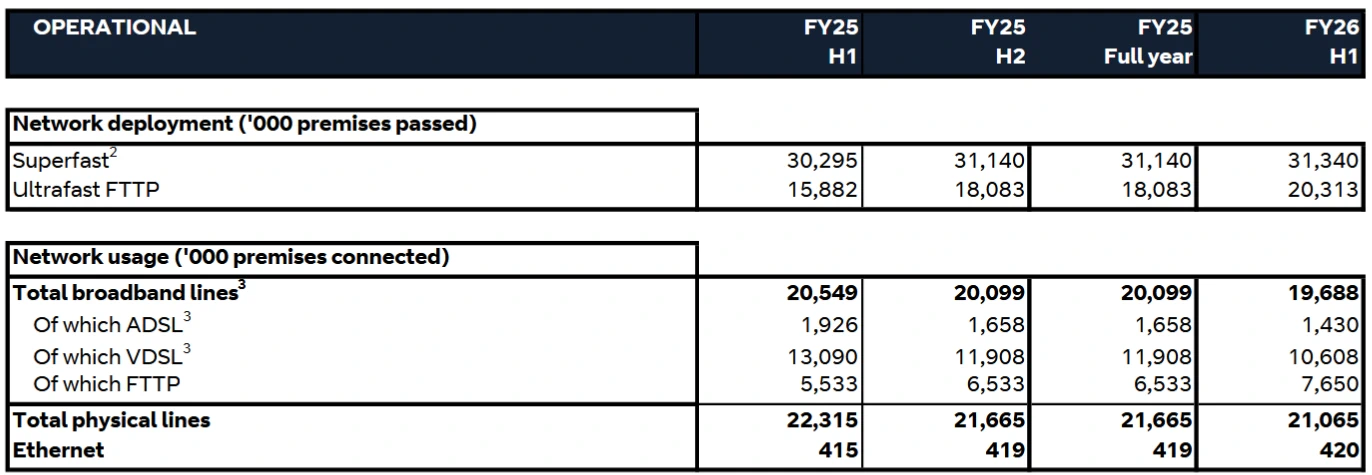
The table below offers a breakdown of fixed line network coverage and take-up by technology on Openreach’s UK network, which covers the totals for all ISPs that take their products combined (e.g. BT, Sky Broadband, TalkTalk, Zen Internet, Vodafone etc.).

Openreach-FY26-H1-network-coverage-and-takeup

The rollout of their FTTP lines continues to grow, with 2.23 million premises being added to their network coverage in H1 FY26 and that’s level with 2.2m in the previous half. As for take-up, some 7.65 million FTTP broadband connections have been made on Openreach’s network (up by 1.11m), which equates to a take-up of 37.66% (up from 36.13%). This is a healthy figure for the incumbent.

However, rival networks have managed to peel plenty of consumers away from the industry giant’s older network (mostly from the areas where OR has yet to build FTTP), with Openreach reporting that total broadband lines fell from 20.09m to 19.68m in the last half year (down by -411k vs -450k in the previous half). The latest bleed in customer lines may well have been given a boost by Sky Broadband’s launch of CityFibre based packages (here).

Allison Kirkby, CEO of BT Group, said:

“BT is delivering on its strategy in competitive markets. We’re building the UK’s digital backbone, connecting the country like no one else and accelerating our transformation. Openreach full fibre broadband now reaches more than 20 million homes and businesses and our award-winning EE network is live with 5G+ coverage for 66% of the population.

Since the start of the year, we’ve driven customer growth across Consumer broadband, mobile and TV and we’re stabilising our UK-focused Business division. Outside the UK, we’ve completed strategic exits and we’re reshaping our International unit. BT’s transformation is delivering ahead of plan, as our UK focus and radical simplification and modernisation are helping to offset declines from our International and legacy businesses and higher labour-related costs since the start of this tax year.

We remain on track to deliver our financial outlook for this year, our cash flow inflection to c.£2.0bn in FY27 and c.£3.0bn by the end of the decade, and we’re announcing an increased interim dividend to 2.45 pence per share.”

Take note that BT now only publishes detailed results biannually for H1 and H2 (financial quarters), thus they release very little data for the other two intervening quarters and that similarly means we will only be able to do two detailed reports – like the one above – twice every year.

Just a quick reminder. BT introduced a new metric in 2023, which predicted that their total labour force would shrink from 130,000 to between 75,000 and 90,000 by 2030 (inc. subcontractors). The operator also predicted that Openreach’s FTTP coverage would grow to between 25-30 million premises and deliver take-up of between 40-55% by that same date. The latest report includes a quick progress update on this.

BT Group’s Progress Against Strategic Metrics:

• FTTP premises passed increased by 2.2m to over 20m; target of 25-30m.

• Openreach take-up increased to 38% and retail take-up increased by 0.6m to 4.0m; targets of 40-55% and 6.5-8.5m respectively.

• 5G UK population coverage increased to 89% and 5G retail connections increased by 0.7m to 13.9m; targets of 99% and 13.0m-14.5m respectively.

• 5G+ population coverage increased to 66%; target of 99%.

• Total labour resource decreased by 5k to 111k; target of 75-90k.

• Group Net Promoter Score increased to 30.5, up 5.2pts year-on-year; target of 30-35.

UK telecom industry unites to combat scam calls with new fraud charter | Total Telecom

Original article Total Telecom:Read More

Scam spelled with scrabbles on a wooden table

News

UK telcos have taken a significant step towards tackling the persistent issue of scam calls by committing to a new Telecommunications Fraud Charter. This initiative unites major mobile service providers, including BT/EE, Virgin Media O2, VodafoneThree, Tesco Mobile, TalkTalk, and Sky, with Comms Council UK (CCUK), in a concerted effort to clamp down on fraud and better protect victims.

The charter, announced ahead of the UK Government’s forthcoming Fraud Strategy, embodies a series of targeted anti-fraud measures designed to disrupt scam call operations and offer faster support to those affected.

According to recent data, 96% of mobile users decide whether to answer a call based on the displayed number, with 75% unlikely to respond to unknown international numbers. As a result, scammers from outside the country are increasingly posing as calling from within the UK.

As a result, today’s signatories are have committing to rolling out advanced call tracing technology across their networks, in order to locate and block scam calls. The Charter supports the development of a Traceback system, enabling operators to pinpoint the origin of suspicious or fraudulent calls in real time across networks. This initiative is part of a broader push for inter-sector collaboration, encouraging data sharing between telecommunications, banking, and technology industries.

Public awareness campaigns and improved victim support mechanisms are also key components of the plan. The CCUK has committed to developing best-practice guidance aimed at commercial customers, enhancing how service providers detect, respond to, and communicate fraud-related threats.

In addition, the Charter provides greater scope for data sharing with law enforcement, providing them with the necessary intelligence to track down scammers more effectively. Victims of fraud will benefit from quicker response times, with support fast-tracked to within two weeks.

“This initiative brings together government and industry to deliver change for consumers and businesses.The overall message around collaborative data sharing, advanced technology solutions, and unified public messaging will help disrupt fraudulent activity at scale,” said Tracey Wright, Chair of Comms Council UK.

“Spoofed calls allow scammers to deceive the public with fake identities and false promises. This government is committed to tackling fraud. In a major upgrade of our mobile network, call spoofing will be eliminated within a year – stripping away the tools scammers use to cheat people out of their hard-earned cash. We’re stepping up our defences to protect victims and make sure the UK is the hardest place in the world for scammers to operate,” added Lord Hanson, the UK’s Minister for Fraud.

This industry initiative aligns with various regulatory updates from Ofcom over recent years. Just last week, Ofcom announced new measures designed to block, limit and disrupt mobile scammers.

Also in the news
Connected Britain Award winners 2025 announced!
Netomnia announces ‘powerful and ambitious’ rebrand ahead of Connected Britain
VodafoneThree drops Samsung, relies on Nokia and Ericsson for £2bn network upgrade

When the land grab ends: F&W Networks talks long-term efficiency and growth | Total Telecom

Original article Total Telecom:Read More

Interview

With the fibre ‘land grabbing’ largely complete, altnets are doubling down on efficiency

At Connected Britain this year, there was much talk of the inevitability of alnet consolidation and the shift in focus away from network deployment towards customer uptake.

Speaking at the event, F&W Networks chairman Carlos Bock described the initial altnet boom as ‘almost a land grabbing exercise’, suggesting that they could have worked harder to connect customers as they went.

“I think we [as an industry] could have done better to try to correlate our rollouts with the connection of subscribers,” said Bock. “This alternative […] would maybe have been more efficient, but also more fragmented. I’m not sure it would have put us in a better position than we are today.”

Now, in need of proven returns, the industry is focussed much more heavily on efficiency, both in their continued build out and ongoing operations.

“It’s about optimising every single aspect of the delivery chain for capital efficiency and the operational chain for operational efficiency,” said Bock. “Both concepts are key; the first so you can build a large network and the second so you can become profitable more quickly.”

For F&W Networks, this capital efficiency has left them in a strong position for continued growth in a rapidly constricting market.

“We have a clear path to cash flow break even in 2026 and we’re starting talks with investors to expand and complete our existing footprint. The opportunity is still there,” concluded Bock.

Check out the full interview here!

Also in the news
Connected Britain Award winners 2025 announced!
Netomnia announces ‘powerful and ambitious’ rebrand ahead of Connected Britain
VodafoneThree drops Samsung, relies on Nokia and Ericsson for £2bn network upgrade

Rural Broadband ISP Voneus Secure UK Funding to 2030 as More Job Cuts Loom | ISPreview UK

Original article ISPreview UK:Read More

Alternative UK broadband network Voneus has today officially confirmed what we touched on last month (here), which reveals that they’ve strengthened their position for “long-term growth” with a business reorganisation and have secured funding through to 2030 (i.e. renegotiation of an existing £70m debt facility). But more job cuts are set to follow.

Just to recap. Voneus, not unlike many other altnets, has been struggling a bit recently with redundancies and a slowdown in their network build (here). This came after the operator also found itself having to withdraw (here) from their publicly funded Project Gigabit broadband build contract for Mid West Shropshire (Lot 25.01), which has since been picked up by Openreach (here).

NOTE: Voneus previously received investments from Macquarie Capital, the Israel Infrastructure Fund (IIF) and Tiger Infrastructure Partners (principal shareholder of Rural Broadband Solutions) etc. The operator originally aspired to cover 370,000 UK homes via their gigabit-capable networks, but they’ve so far done 100,000 (18th Feb 2025).

The company’s most recent accounts, which cover the year to 31st March 2024, revealed that their turnover had increased by 34% to £4.417m, while gross profit shrank by -17% to £768.6k and total employees grew from 156 to 238. But Voneus’ loss before tax has also more than doubled to £36.65m (up from £14.83m), although their net assets have grown to be worth £93.43m (up from £23.32m).

However, the latest announcement confirms our earlier report of a revised funding deal (including some unspecified new funding from existing investors), which will see them through to 2030 and reveals that their mixed wireless (FWA) and full fibre (FTTP) broadband network is now home to 26,000 customers.

The provider further states that they’ve also implemented “several key operational improvements“, including the creation of a new cross-functional commercial team that more closely aligns its marketing and sales activities. In addition, they’ve set up a hybrid tech support hub that handles all support levels for wireless as well as tech support for fibre, allowing for more efficiencies.

As part of its strategic review, Voneus added that they will now “undertake a business reorganisation to ensure operational efficiency and future scalability“. This process is expected to include the “outsourcing of some business functions” and may result in a “limited number of redundancies“. The company will now begin individual consultation with those roles potentially at risk.

A spokesperson for Voneus said:

“Voneus has made excellent progress in connecting rural Britain, achieving some of the highest penetration rates in the sector. These changes are about building on that success ensuring we remain agile, efficient, and positioned for long-term growth. While any potential redundancies are deeply regrettable, this reorganisation is necessary to secure our continued investment in people, technology, and the rural communities and customers we serve.”

Otherwise, the company plans to continue its organic growth strategy, whilst also continuing to “actively explore” mergers and acquisition opportunities.

R100 Gigabit Broadband Rollout Reaches 93,800 Premises in Scotland | ISPreview UK

Original article ISPreview UK:Read More

The Scottish Government (SG) recently revealed that 93,800 premises have now benefitted from their £697m Reaching 100% (R100) project with Openreach (up from 83,419 in July 2025), which is rolling out full fibre (FTTP) broadband to remote rural areas. But the full roll-out is still not expected to complete until early 2028.

The R100 scheme currently aims to cover another 113,000 premises – split across three contracts – in areas that lack access to “superfast broadband” (30Mbps+) by March 2028. The most challenging LOT 1 (North Scotland and the Highlands) area is expected to cover around 61,000 premises by 2027/28, while LOT 2 (Central Scotland) was due to reach 32,000 by 2023/24 and LOT 3 (South Scotland) targeted 22,000 by 2024/25.

R100 Funding: SG (£591m), BT (£53m) and Building Digital UK (£52m). The responsibility for broadband in Scotland is reserved to Westminster, but that doesn’t stop local and devolved authorities from making their own investments.

Just for some wider context. At the end of June 2025 some 81.89% of premises in Scotland could access a gigabit-capable (1Gbps download) broadband ISP network and this fell to 70.20% when only looking at FTTP technology (here). Ofcom predicts that Scotland’s full fibre (FTTP) coverage will reach somewhere between 81-93% by January 2028, rising to 87-94% for gigabit-capable broadband (FTTP + Hybrid Fibre Coax / cable).

The latest update appears to confirm that the deployments for LOT 2 and LOT 3 have technically now exceeded their delivery targets, which largely leaves the most challenging LOT 1 build left to reach completion. But it should be noted that these figures also include some additional build (overspill), which catches the extra premises that Openreach picks up while working within the same areas on the R100 build (we don’t know how big this is for each area).

Broadband connections delivered by contract area (31st Oct 2025)
Contract area Total premises for delivery in the R100 contracts R100 contract premises delivered R100 SBVS (voucher) premises delivered
Central 30,286 31,020 1,649
North 60,764 30,328 3,510
South 21,889 26,648 645
Total 112,939 87,996 5,804

The R100 deployment remains ongoing, but we should point out that Openreach (BT) and GoFibre have separately also recently secured several public subsidised Project Gigabit broadband roll-out contracts for Scotland (here, here and here), which will extend FTTP to an additional 139,000 premises in remote rural areas (focusing on the bits that R100 fails to reach) via a subsidy total of around £288m.

Broadband ISP TalkTalk Issue Trading Update and Explores New Ownership Structures | ISPreview UK

Original article ISPreview UK:Read More

The TalkTalk Group has today published a very brief trading update for the half year ended 31st August 2025, which largely only highlights the positives (unlike their annual accounts) and claims to have “delivered a solid first-half performance“. The group is currently aiming to tackle its debts by targeting £146m in total savings by FY28.

The group, which recently launched a major brand refresh and advertising push for its consumer broadband ISP business (here), is currently still doing everything it can to cut costs and to tackle their underlying debt problem; including the possible disposal (sale) of its remaining businesses (here) and more job cuts (here).

All of this follows last year’s £400m refinancing package, which avoided the immediate risk of a default on its debts (here, here), and the recent £120m funding deal (here). Sadly, the latest results for H1 FY26 fail to add much detail to the current overall picture of the business, but it does highlight a few of the recent positives.

TalkTalk’s H1 FY26 Trading Update

H1 Financial Highlights

  • Cash EBITDA (pre-IFRS) £74m (H1 FY25: £72m), an improvement of £2m year-on-year, with lower SAC and opex offsetting reduced base and lower IP sales.
  • Cost transformation on track, with the Group targeting £146m in total savings by FY28, supported by efficiencies, IT simplification, and the retirement of legacy copper infrastructure. 
  • The Group’s cash discipline has been maintained, supported by proceeds from £44m of non-core asset disposals and £74m of new funding following recent funding round.

H1 Operational Highlights

  • TalkTalk’s consumer business delivered a brand refresh, initiated the rollout of TalkTalk U (a differentiated Wi-Fi product that uses smart data to deliver coverage around the home at speeds that flex to customers’ needs) and continued the migration of customers to the Kraken customer platform.
  • PXC increased its FTTP AltNet penetration to 24%, rolled out new VoIP and Ethernet over FTTP products, and achieved further cost and automation gains, with over 95% of next-generation broadband orders now fully automated.

Having created the TalkTalk consumer and PXC businesses from the former consolidated group structure 18 months ago, the group now say they expect to “commence a more formal process to explore new ownership structures for the separated businesses” and confirms that it has appointed PJT to advise on “strategic options for both businesses” (this largely links back to all that ongoing talk of a sale).

James Smith, CEO of TalkTalk Group, said:

“Over the past six months, we’ve made huge progress in continuing to transform and simplify the group. Our consumer business has returned to its challenger roots, with the launch of TalkTalk U and our partnership with Kraken to deliver best in class customer service. At the same time, PXC is leading the way in next-generation connectivity, expanding its AltNet footprint and rolling out next-generation business-grade products.

Despite considerable pricing competition across all our markets, we’ve continued to deliver by staying disciplined, driving efficiency, and focusing relentlessly on value. We remain on track to achieve our full-year financial guidance.”

Major UK Phone Providers Agree to Crackdown on Scam Calls and Fraud | ISPreview UK

Original article ISPreview UK:Read More

A new landmark Telecommunications Charter has today been agreed between several of the UK’s leading broadband, mobile and phone providers, which commits BT (EE), Virgin Media (O2), VodafoneThree, Tesco Mobile, TalkTalk, Sky (Sky Broadband) and the Comms Council UK to a “crack down on scam calls and fraud“. A sub-charter also exists for B2B phone services.

Just to recap. Most of the United Kingdom’s major telecoms providers have already implemented various technical measures to tackle Nuisance Calls and Scam Calls. But these aren’t always 100% effective, and not all operators have introduced the same level of protections. Suffice to say, there’s still plenty of scope for improvement, and Ofcom are forever pushing new changes to boost national defences against such fraud (here, here and here).

NOTE: Scam calls come in all sorts of different shapes and sizes, from people claiming that your computer has been infected with viruses, to those pretending to represent your bank, insurance company, HMRC or even using AI to clone the voice of a family member etc. The goal in all these cases is to extract personal and financial details for abuse.

The new Telecommunications Charter – due to be signed at the BT Tower in London today – seeks to support those efforts, not least by committing the signatories to actively engage with the development of a UK Traceback Solution (i.e. allowing providers and the police to trace the origin of suspicious or fraudulent calls across interconnected networks).

In addition, they’ve also agreed to put more effort into improving related consumer awareness and enhancing the protection and support given to victims of fraud (i.e. help times will be slashed to two weeks). The group has further agreed to designing scalable, collaborative data-sharing models between the telecoms, banking, and tech sectors to support a more co-ordinated approach with the police, which will help to track the scammers down and stop them.

The top mobile networks have further committed to block foreign call centres from impersonating banks within the next year, which follows on from some of Ofcom’s recent work. Data shows that 96% of mobile users decide whether to answer a call based on the number displayed on their screen, with three-quarters unlikely to pick up if it’s from an unknown international number.

All of this is intended to help support the government’s upcoming Fraud Strategy, which will broadly aim to unite industry, disrupt criminal networks and better protect the public. O2 have separately been pushing the government to create a dedicated, centralised national policing agency to handle all fraud investigations (here), although it remains to be seen if that will materialise.

Minister for Fraud, Lord Hanson, said:

“Spoofed calls allow scammers to deceive the public with fake identities and false promises. This government is committed to tackling fraud.

In a major upgrade of our mobile network, call spoofing will be eliminated within a year – stripping away the tools scammers use to cheat people out of their hard-earned cash.

We’re stepping up our defences to protect victims and make sure the UK is the hardest place in the world for scammers to operate.”

The announcement goes on to mention that “AI will also be deployed to identify and block suspicious calls and texts“, although most of the major mobile and phone operators are already using such tools to tackle the problem – some for several years. So we assume they mean that the use of such tools will now be expanded upon and spread to more providers.

Finally, the Comms Council UK (CCUK), which represents the UK’s VoIP sector, will work to “create practical guidance for members” to help prevent and tackle fraud. This reflects the aforementioned B2B voice and telephony sub-charter, where CCUK will help business customers by developing business victim support principles and best practice guidance to raise standards in identifying and responding to fraud.

We’ll finish with the usual barrage of industry comments:

Claire Gillies, CEO at BT’s Consumer Division, said:

“Protecting BT, EE and Plusnet customers from scams and fraud is an imperative for us. To be the network customers can trust we have developed cutting-edge, AI-driven solutions to keep everyone safe. We’re proud that in 2025, we’re blocking 3 million scams a day across our network and continuing to innovate at pace to protect our customers from the growing threat of fraud. This second fraud charter is an important and timely intervention for the telecoms industry. It’s vital that we collaborate as an industry to protect the nation from this growing crime.”

Rachel Andrews, Fraud Director at VodafoneThree, said:

Vodafone and Three block millions of scam texts and fraudulent calls for their customers every day. The second Telecommunications Fraud Charter will take this even further, strengthening how we work across the industry and with government to stay one step ahead of criminals. By combining data, collaboration and innovation, we can keep people and businesses safe and build the trusted, secure digital networks the UK depends on every day.”

Murray Mackenzie, VMO2’s Director of Fraud Prevention, said:

“Fraud has a devasting impact on its victims and costs the telecoms industry many millions of pounds each year. We’re committed to preventing fraud and to date, we’ve blocked more than 1 billion scam texts from reaching our customers and are using AI to flag 50 million scam calls every month.

No industry alone can completely prevent fraud but by working across sectors we can stop scams, disrupt organised gangs and help people protect themselves. We’re playing our part and urge government to match our resolve in the forthcoming Fraud Strategy by providing law enforcement with the resources needed to bring fraudsters to justice.”

Tracey Wright, Chair of Comms Council UK, added:

“The launch of the second Telecommunications Fraud Charter marks a significant step forward in the fight against fraud in our sector. We are proud to support this initiative, which brings together government and industry to deliver real, lasting change for consumers and businesses alike. As part of the Charter, we commit to continue to release best practice guidance to our membership that will raise standards and reduce opportunities for fraudulent behaviour using voice and telephony. The Charter’s overall message around collaborative data sharing, advanced technology solutions, and unified public messaging will strengthen our collective defences and help disrupt fraudulent activity at scale.

Through my work with Comms Council UK, I have seen first-hand the positive impact of sector-wide collaboration and intelligence sharing. By aligning our efforts through this Charter, whether through joint initiatives on fraud detection or stronger customer protections, we are building a safer, more trusted communications environment for everyone. The Charter sets a clear path for the telecoms sector to lead by example, and we look forward to working alongside our partners to deliver on its commitments and create a future where fraudsters find it harder to succeed.”

INCA Continues Work to Standardise Wholesale Full Fibre Among UK Altnets | ISPreview UK

Original article ISPreview UK:Read More

The Independent Networks Co-operative Association (INCA), which represents many of the UK’s alternative broadband networks, has today provided a progress update on their work to standardise wholesale access (‘Wholesale Standards Initiative‘) and make it easier for retail ISPs to purchase services from such operators.

The initiative, which first launched a year ago (here), helped to establish clear commercial and technical frameworks for wholesale access. The work has now evolved into a cross-industry effort, involving some of the leading wholesale networks, retail ISPs, aggregators and solution providers.

At its core, the initiative has been working to provide all industry players with a “simple, common baseline of language and understanding” that can be used in framework contracts and supported by a detailed set of Application Programming Interfaces (APIs).

The latest development in this effort is that supporting members are now working to create a Common Care Framework. This is said to be designed to ensure services are supported by consistent processes, as well as a smooth, predictable, and reliable service experience being available regardless of the underlying network provider. An initial set of draft technical APIs have already been produced to support these principles.

Max Fernando, Chair of the Wholesale Standards Initiative, said:

“The initiative has made significant progress in just a year and is well placed to boost the marketplace by enabling ISPs, aggregators and Altnets to interconnect on a common platform. This in turn helps to facilitate integration across the industry and add value and enhance the quality of service that the sector can offer to residents and businesses.

The Altnet market is rapidly shifting from a focus on building networks to serving end users — and with it, wholesale standards need to evolve to ensure that the full potential of UK’s fibre footprint is unlocked. Previously, retail ISPs have pointed out the costs and complexity associated with needing to onboard new networks – the initiative aims to tackle these issues head on.”

The goal of all this seems to be to align the UK’s fibre market with similar models in Spain and Sweden, where independent standards have helped to drive efficiency and support aggregators. The success of the UK’s initiative has already attracted some of the UK’s leading aggregators, including AllPointsFibre Networks, Zen Internet, PXC and ITS Technology. It’s also supported by a growing ecosystem of solutions providers, including Sonalake, Fibre Cafe, NetAdmin and CWP, who plan to embed the standards into their UK market solutions.

Zoom to open UK data centre as part of AI-focused expansion | Total Telecom

Original article Total Telecom:Read More

News

Zoom has announced plans to open a UK data centre in early 2026, aiming to meet local data residency requirements and broaden its appeal to regulated sectors including the public sector, healthcare and financial services.

The facility, which Zoom says will host services such as Meetings, Webinars, Rooms, Team Chat, Phone, Notes, Docs and its AI assistant, is intended to give UK organisations greater choice over where their data is stored and processed. The company plans UK‑only meeting zones and telephony gateways with local dial‑in numbers at launch. Additional services such as Zoom Contact Center and integrations to support PCI compliance are expected to follow.

Details of the new facility, including investment and location, have not been announced.

“Launching a UK data center is a significant milestone in Zoom’s journey to provide secure, compliant, and high‑performance services for all of our customers. By investing in local infrastructure, we are ensuring that organisations across the UK, from financial services to government, can confidently embrace the future of AI‑first collaboration,” said Louise Newbury‑Smith, Head of UK & Ireland at Zoom.

The move reflects Zoom’s evolution from a video‑conferencing provider to what it describes as an “AI‑first collaboration suite”, a platform encompassing telephony, workspace booking, document tools and automation alongside meetings and chat.

The planned UK data centre will join a network of regional facilities that Zoom already operates in Germany, the Netherlands and Saudi Arabia. By building this new facility in the UK, Zoom is aiming to preempt sovereignty and compliance concerns that can be a barrier for highly regulated organisations considering cloud services.

The planned investment by Zoom adds to a growing trend of cloud and collaboration providers establishing UK data centres to address data sovereignty and regulatory compliance — a priority heightened by post‑Brexit data arrangements and sectoral rules for healthcare and finance. For the UK market, such local infrastructure can lower barriers to adoption among risk‑sensitive organisations, while also signalling continued vendor confidence in Britain as a strategic tech hub.

The investment follows other recent UK activity from Zoom, including the opening of an “Experience Centre” in London in June 2024, which the company said has hosted more than 5,500 guests.

Also in the news
Connected Britain Award winners 2025 announced!
Netomnia announces ‘powerful and ambitious’ rebrand ahead of Connected Britain
VodafoneThree drops Samsung, relies on Nokia and Ericsson for £2bn network upgrade