Broadband ISP Virgin Media UK Adds Identity Protection to Security Add-on | ISPreview UK

Original article ISPreview UK:Read More

Internet, TV and phone provider Virgin Media (O2) and security partner F-Secure have today announced that they’ve now begun offering customers of their optional (paid) ‘Advanced Security’ add-on service an additional “Identity Protection” feature, which is designed to help prevent identity theft.

Just to recap. All Virgin Media customers currently receive their Essential Security software as standard to help fight phishing scams, viruses and to provide other protections. Customers can optionally add Advanced Security, for three months free via a trial, or pay £3.50 monthly or £35 annually, which offers additional on-the-go protection both in and out of the home – for an unlimited number of devices.

Unfortunately, the press release doesn’t actually say how the new Identity Protection feature actually works, so we’ve had to query that with Virgin Media and will update again later. Otherwise, the Advanced Security service includes the following core features:

Advanced Security Features

➤ Remote device disruption: Helps to protect devices from being remotely accessed and controlled.

➤ Banking and shopping protection: Stops untrusted network connections while buying or banking online.

➤ Virus removal: Detects, scans and removes viruses alongside other malware on customers’ devices.

➤ On-the-go protection: Provides constant 24/7 security on the go, regardless of a customer’s mobile network provider, and even if they are offline or connected to a different broadband connection.

➤ Devices protection: Available on an unlimited number of devices for total protection everywhere.

➤ Generate and store strong passwords: Get instant alerts and advice if your personal data has been exposed in a data breach.

➤ Scam protection: Get notified of untrusted online stores and block SMS scams automatically with the latest AI technologies.

The provider claims that, over the past year, their Advanced Security service has prevented 131.5 million unsafe or harmful websites from being accessed, as well as stopping some 346,204 viruses, malware, and spyware threats and blocking 4.1 million banking and shopping sessions from being intercepted, enabling safer online transactions (this is PC only data as F-Secure cannot pull data from Apple/Android phones).

Poverty Alliance Warn Vulnerable Users at Risk from UK 2G and 3G Mobile Switch Off | ISPreview UK

Original article ISPreview UK:Read More

A new report from the Digital Poverty Alliance (DPA) has warned that the ongoing switch-off by mobile operators Vodafone / Three UK, EE and O2 of legacy 3G and 2G networks “exposes a deep fault line in digital inclusion,” which they say could risk disconnecting vulnerable users (e.g. those with telecare systems and safety devices) from essential communication and support.

Most of the major mobile network operators have already switched off their 3G mobile (mobile broadband) services, with O2 due to complete their own process this year. The change frees up radio spectrum so that it can be used to further improve the network coverage and data speeds of more modern 4G and 5G networks, as well as future 6G services. The switch-off also reduces the operators’ costs and power consumption.

NOTE: The UK government and all major mobile operators have jointly agreed to phase-out existing 2G and 3G signals by 2033 (here).

Broadly speaking, most of the 3G switch-off process appears to have been fairly uneventful, although that isn’t too surprising because 3G was always a bit more data-focused than 2G and struggled its way into the market. The technology thus ended up being rapidly superseded once 4G arrived. Not to mention that mobile operators did provide a fair amount of support during the switch-off process.

The next step will be to switch-off the ancient 2G network, which will be a slower process because it remains necessary for various devices (e.g. Energy Smart Meters / IoT) and as a fallback in areas of poor 4G and 5G signals. O2 has already started this process, although they won’t completely switch it off for several more years. EE then aims to switch it off from May 2029 and VodafoneThree plans to achieve the same outcome during 2030 (Three UK doesn’t have a 2G network).

However, the DPA’s latest policy brief – 2G/3G Switch-Off: Readiness and Risk – examines what this shift means for households already facing digital poverty and warns that, without targeted support, the phase-out “could sever a digital lifeline” – cutting people off from family, healthcare, and emergency systems that depend on older connectivity.

The report does note that some providers, such as O2, are “taking positive steps“, like offering free 4G-ready handsets to customers at risk of losing service. “But isolated good practice cannot replace coordinated national action,” said the brief.

Elizabeth Anderson, CEO of the Digital Poverty Alliance, said:

“As the UK moves toward retiring its 2G and 3G networks, we cannot allow progress to come at the cost of connection. The people most at risk are often those least able to upgrade – older adults, those on low incomes, and individuals who depend on telecare for safety. Unless action is taken now, the switch-off could disconnect exactly those who rely on these systems the most.”

In response, the DPA has published a series of recommendations for the UK government, regulators, and industry to ensure the transition is “inclusive and equitable” through practical measures.

DPA Recommendations

• Providers should supply upgraded telecare devices, including installation, at no additional cost.

• Free replacement and installation of security alarms that currently rely on 2G or 3G networks.

• Providers should offer affordable upgrade paths or price-match older 3G contracts for customers in digital poverty.

• Government and industry must coordinate offline awareness campaigns to reach those without digital access.

• Digital inclusion and vulnerability training should be mandatory for frontline provider staff.

• Free, community-based digital skills training should accompany any device upgrade schemes.

The report seems to suggest that mobile operators should be the ones to supply and install “upgraded telecare devices” for free, which is obviously not their field and is more the responsibility of the telecare industry – one that has often failed to ensure the hardware they supply works properly with modern networks. A similar issue existed with the legacy phone (PSTN) switch-off and telecare providers have since stepped up their involvement to help solve that alongside network operators.

Clearly the 2G switch-off process is going to require a lot more handholding than it did with 3G, which isn’t surprising given the wider context of its use. This is exactly why mobile operators are working to a much more gradual and graceful retirement of 2G than we saw with 3G.

TalkTalk UK Broadband Group Appoints New Chief Financial Officer | ISPreview UK

Original article ISPreview UK:Read More

The debt troubled TalkTalk Group, which at this point has been through a demerger of its businesses, several funding deals (here, here and here), job cuts and is currently said to be considering the possible disposal (sale) of its remaining businesses (here), has today announced the appointment of Henry Davies as its new Chief Financial Officer (CFO). Not an easy job, we suspect.

Henry is said to bring extensive experience in leading business transformation and growth. He most recently served for almost ten years as CFO of Circle Health Group, where he led the business through multiple successful refinancing efforts, significant balance sheet restructuring, and an “award-winning cultural and financial transformation“. Previous roles include Group CFO at Mecom Group and Group Financial Controller at DS Smith.

NOTE: TalkTalk is currently home to 3.19 million broadband customers (down 420k from last year), including 2.3m directly via retail ISP TalkTalk, plus 0.5m via consumer wholesale and 0.4 via business wholesale. Some 2.64m of the total were FTTC/P lines. The operator also has 76,000 Ethernet connections.

Suffice to say that getting a good CFO is vitally important for TalkTalk and, so far as we can tell, they seem to have picked the right sort of individual, given what they’ve been going through for the past few years. The company’s previous CFO, James Smith, was promoted to the position of Group CEO in September 2024.

James Smith, TalkTalk Group CEO, said:

“On behalf of the TalkTalk Group board, I’m delighted to welcome Henry to the business. He has a wealth of experience that will benefit the Group as we move into the important next phase of our strategic development.

I’d also like to express my thanks to Brian Lochead, who joined us as interim CFO last year to support the business through our post-refinancing transition, and wish him success in his next endeavours.”

INCA Calls for Clarity from Openreach on Which UK Homes Won’t Get Full Fibre | ISPreview UK

Original article ISPreview UK:Read More

The Independent Networks Co-operative Association (INCA), which represents many of the UK’s alternative broadband networks, has today called on incumbent network operator Openreach (BT) to clarify which homes it’s likely to sacrifice if they carry out their threat to scale-back the deployment of full fibre (FTTP) broadband. The altnets will then know where to target.

The issue centres on last week’s comments from Openreach’s CEO, Clive Selley, who warned both the Government and Ofcom (here) that he was “going to hold fire” on seeking approval for the final phase of the operator’s plan to expand full fibre gigabit broadband beyond their current 25 million premises target for December 2026 (i.e. the goal to expand FTTP up to 30 million premises by 2030); at least until the regulatory and tax environment showed themselves to be favourable.

Selley’s warning was clearly issued with a view to the threat from both rising business rates and Ofcom’s forthcoming market review (i.e. the desire for softer regulation given today’s more competitive environment). However, any reduction in their deployment would naturally hit rural areas the hardest, since those are often the last to benefit from such upgrades.

The CEO of INCA, Paddy Paddison, has now followed Gigaclear’s earlier remarks (here) by calling upon Openreach to be transparent about which homes it claims it cannot invest in so that altnets can carry the can and bring forward their own business cases without fear of overbuild; something that their investors would very much welcome.

Paddy Paddison, Chief Executive of INCA, said:

“Openreach’s problem isn’t regulation – it’s competition. Nearly a million customers a year are choosing Altnets over the tired old network operator because they offer better products, better value, and better service. That’s what a functioning market looks like.

Investors are backing Altnets because they see innovation and delivery, not dependency on regulatory favours. The danger is that Ofcom confuses BT’s investment interests with the UK’s investment interests. The success of the broadband rollout depends on maintaining competition, not cushioning the incumbent.

Openreach’s threats to reduce investment say more about its struggle to compete than about the regulatory framework itself. The best way to serve consumers and investors alike is to protect the diversity of networks that are already driving real progress.

If Openreach cannot compete on a fair playing field for all, the regulator should not be forced to help them out. Last time Openreach refused to invest, it opened the door to Altnet investment, a move that has since delivered more than 16 million full-fibre homes across the UK.”

The response is a useful way for altnets to remind people – as well as the incumbent itself – that this isn’t a completely Openreach dominated market any more and if the incumbent steps back, then they could step in. On the other hand, there are currently only a few altnets with a strong rural focus and many of those have recently had to scale-back their own build plans and cut jobs, due to the pressures from high interest rates, rising build costs and a highly competitive environment (here and here).

Suffice to say that it’s currently unclear how many altnets would have the drive, funding and scale needed to completely fill any big holes that may be left by an Openreach retreat. At the same time, it remains unclear whether Openreach will actually scale-back their infrastructure deployment plans or are merely applying pressure to help focus minds in their desired direction of travel.

INCA added that they would also be writing to both the Government and Ofcom to set out their concerns and to seek assurances that the UK’s regulatory framework will continue to promote investment, competition, and consumer choice.

Gigaclear Call for Openreach Changes to Bring Gigabit Broadband to UK Rural Areas | ISPreview UK

Original article ISPreview UK:Read More

Abingdon-based alternative broadband ISP Gigaclear, which has built a full fibre (FTTP) network across 612,000 premises in rural parts of England (inc. 160,000 customers), has responded to Openreach’s recent threat to scale-back their own fibre roll-out (here) by calling for “fair regulation between the incumbent and altnets to level the playing field“.

Just to recap. Last week saw Openreach’s CEO, Clive Selley, warn both the Government and Ofcom that he was “going to hold fire” on seeking approval for the final phase of the operator’s plan to go beyond their current 25 million premises target for December 2026 (i.e. the goal to expand FTTP up to 30 million premises by 2030); at least until the regulatory and tax environment showed themselves to be favourable.

NOTE: Gigaclear is principally owned by Infracapital, together with Equitix and Railpen. The company previously had investment commitments estimated to be worth up to around £1.1bn (here) and in late 2023 secured a £1.5bn debt facility (here). The provider holds several Project Gigabit build contracts in Oxfordshire (here) and East Gloucestershire (here).

At this stage, it’s not known whether Openreach will actually scale-back their infrastructure deployment plans. But Selley’s warning was clearly issued with a view to the threat from both rising business rates and Ofcom’s forthcoming market review (i.e. the desire for softer regulation given today’s more competitive environment). However, any reduction in their deployment would naturally hit rural areas the hardest, since those are often the last to benefit from such upgrades.

The CEO of rival provider Gigaclear, Nathan Rundle, has now hit back and warned that the digital divide between rural and urban areas was now at risk of widening “significantly without greater collaboration across the industry“.

Gigaclear CEO, Nathan Rundle, said:

“We have already made substantial headway in bringing full-fibre connectivity to rural homes and businesses that otherwise would have been forgotten – but the job is not done and we will continue to champion the need for greater collaboration and a level playing field that will help ensure the regulatory environment remains attractive for investors. This is how we will connect these hard-to-reach rural homes and businesses and support the Government in reaching their 2032 target of achieving nationwide gigabit coverage for 99% of properties.”

Gigaclear has been providing ultrafast full fibre broadband to the hardest to reach rural areas for the last 15 years, with over 600,000 homes and businesses able to access our network and serving over 160,000 customers. This includes many Building Digital UK communities in hard to reach areas, some of which are currently in progress, in Oxfordshire and Gloucestershire. What these underserved rural communities need now is constructive collaboration between the regulator, the incumbent and altnets.”

The caveat is that some of what they’re seeking naturally reflects Gigaclear’s own vested interests. The provider is calling upon Ofcom and Openreach to use mechanisms enabled by the Communications Act 2003 (Sections 93A & 93B) to bring about “meaningful digital transformation in rural areas … by enabling altnets to collaborate with incumbents, rather than being sidelined, the rollout can be accelerated, and duplication minimised“.

As highlighted in their Telecoms Access Review (TAR) 2026-2031 consultation response, Gigaclear again urges the regulator and industry to level the playing field and focus on:

  • Recognition of altnet coverage in determining when copper switch-off (stop-sell) can be triggered for incumbents, ensuring we assess full-fibre progress collectively, not just by one provider.
  • Prioritisation of the hardest-to-reach rural geographies (Area 3), with a co-ordinated framework where Openreach agrees not to over-build in those zones for a defined period, giving altnets the chance to serve customers without duplication. This is important as many rural areas cannot support multiple competing FTTP networks. Without a clear regulatory framework the investment case is damaged and inconsistent statements from the incumbent only add to this. 
  • PIA Pricing – Gigaclear stand ready to work with the Government, the Regulator and the Incumbent on this area. Gigaclear highlight that whilst altnets can make use of existing infrastructure through Openreach’s PIA products, evidence suggests that PIA users make a disproportionately large contribution towards covering the cost of Openreach’s passive infrastructure. We would encourage all stakeholders to support the case for a more level playing field – one that would promote collaboration and lead to a sustainable relationship between the incumbent and altnet providers.

Breaking news.. more to follow..

Openreach Faces Protest in Lincoln Over Rollout of 40 Broadband Poles | ISPreview UK

Original article ISPreview UK:Read More

The Street Works and Permitting Manager at Lincolnshire County Council (LCC) in England, Ashley Behan, has asked network access provider Openreach (BT) to “pause” the roll-out of 40 new telecoms poles – needed to expand the coverage of their full fibre (FTTP) broadband network – until they can explain how they’re going to respond to local complaints and engage with the community.

The use of poles to run overhead cables (telecoms, electricity etc.) is a common practice across the UK, where millions have been used over the decades. This is because poles are quick and cost-effective to build (several times cheaper than trenching), can be deployed in areas where there may be no space or access agreement to safely put new underground cables, are less disruptive (avoiding the noise, access restrictions and damage to pavements of trenching) and can be built under Permitted Development (PD) rights; often with only minimal prior notice.

NOTE: The BT Group are investing £15bn to cover 25 million UK premises with FTTP by December 2026 (inc. 6.2m in rural or semi-rural areas). But the ambition also exists to reach up to 30m by 2030, provided the regulatory and tax environment is favourable.

However, many people dislike poles – usually due to their negative visual impact and the lack of prior consultation before deployment, which in some cases has occasionally even erupted into disruptive protests. The latter is most likely to occur in areas that haven’t previously had poles before (i.e. past cables were underground), as well as areas of outstanding natural beauty or where several gigabit broadband networks may already exist.

As the Independent Councillor for the City of Lincoln Council, Biff Bean, said of Openreach’s new deployment in the Birchwood and Hartsholme areas (BBC News): “[Poles are] antiquated, old-fashioned 1950s-style technology. We don’t want our communities covered in them, especially when the option’s there to bury the cables. Openreach have got to take residents’ objections into account, not railroad them through.”

The current Labour-led government, much like the previous Conservative-led one, recently responded to this by calling on broadband operators to “end the deployment of unnecessary telegraph poles” (here), to “share existing infrastructure when installing broadband cables as the default approach” and they also pledged to foster a “revised” code of practice.

Following the code

At issue in Lincoln seems to be the question of whether or not Openreach are following the industry’s new Best Practice Guidance on Poles, which was published earlier this year. The new guidance outlines “mandatory obligations and best practice recommendations“, including notification requirements, height restrictions and regulations for natural and protected areas, making these easier to understand for everybody.

The new guidance also recommended that providers engage much more closely with communities prior to deployment and to consider the visual impact of their fibre roll-out. But Ashley Behan indicates that Openreach have not yet explained “how they’re going to engage with the community as part of the best practice guide that they’re signed up to” and should thus “pause” their deployment until they can do so.

A spokesperson for Openreach said:

“We’re listening to concerns raised locally and have already arranged meetings with the MP and council to explain our plans in more detail and hear feedback directly.

Our engineers always aim to use existing infrastructure wherever possible to minimise disruption, and we keep new poles to a minimum. However, in some areas, they’re the only way to connect everyone – especially where underground options aren’t viable.

There is strict guidance in place, and we always follow the correct processes whenever we need to put a new pole in place.”

Just to be clear. Openreach aren’t breaking any hard rules with their approach (it is not a solid requirement to consult the community prior to build), but they are perhaps at risk of damaging the credibility of the industry’s new guidance by not following its recommendations as closely as they perhaps could. Failing to do so risks reopening a can of worms and thus leading to stricter measures from the government.

The council’s Ashley Behan went on to explain how the local authority would thus like Openreach to engage in “extra community engagement, letter dropping, speaking to community leaders so that the community understand what’s going to be taking place in their streets“.

The government are currently assessing the impact of the aforementioned guidance before deciding whether further action may be required. But it should be noted that many operators have since had to scale-back their fibre deployments due to wider economic and competitive pressures (i.e. there are now fewer complaints being raised), which is the main reason why we aren’t seeing as many complaints this year as last.

Naturally, network operators have a difficult balancing act to perform, which is one that both needs to respect the government’s wishes (inc. local communities), while at the same time trying not to damage the wider roll-out and their already strained cost models. Not forgetting that consumers and businesses with access to more than one gigabit broadband network will often directly benefit from greater choice and lower prices.

ISP KCOM Start Black Friday SALE on UK Broadband Packages | ISPreview UK

Original article ISPreview UK:Read More

Macquarie-backed network operator KCOM, which has already deployed their own full fibre (FTTP) network across 305,000 premises in parts of East Yorkshire (primarily Hull) and Lincolnshire in England, has finally kicked off their big Black Friday sale and slashed the monthly rental on their broadband packages for new customers.

Customers will now pay from just £21.99 per month on a 24-month term for symmetric speeds of 100Mbps (£37.99 thereafter) and this rises to £29.99 for their top 900Mbps (500Mbps upload) package (£51.99 thereafter). But take note that customers in the Hull part of their network will pay around £3 to £4 per month more than those in their more recent network expansion areas (depending on package choice).

NOTE: KCOM’s monthly prices will increase by between £2 to £3 in March each year due to their mid-contract pricing policy.

The packages typically include an eero 6+ router from Amazon (two of them for a mesh network on 900Mbps), unlimited data usage, static IP address and a free installation. KCOM’s Black Friday discounts are expected to remain available to take until 13th January 2026.

Nexfibre Publish Q3 2025 UK Full Fibre Broadband Build Update – 2.44M Premises | ISPreview UK

Original article ISPreview UK:Read More

Network operator nexfibre, which shares some parentage with ISP partners Virgin Media (O2) and giffgaff, has published their latest quarterly Q3 2025 build update and confirmed that their new 10Gbps capable Fibre-to-the-Premises (FTTP) broadband network now covers 2.44 million UK premises. But future deployments beyond 2025 remain uncertain.

Just to recap. Back in 2022 Telefónica, Liberty Global and InfraVia Capital Partners setup nexfibre as a new £4.5bn joint venture (here), which aimed to deploy an open access (wholesale) full fibre network to reach “up to” 7m UK homes (starting with 5m by 2026) in areas NOT served by Virgin Media’s own network of 16m+ premises. The funding reflects £3.3bn of fully underwritten financing and up to £1.4bn in equity commitments.

NOTE: Virgin Media and giffgaff are currently the only big retail providers on nexfibre’s network.

However, as existing readers will already know, nexfibre’s roll-out plan recently suffered a significant blow after Telefonica launched a Strategic Review of their global business (here and here). The decision has since resulted in nexfibre scaling back their planned roll-out – now aiming to reach just 2.5m premises in 2025 (down from c.3m).

The latest Q3 2025 build update from nexfibre continues to reflect this change and confirms that their full fibre network has now reached 2.44 million premises as ready for service (up from 2.3m in Q2). In addition, this week’s publication of Telefónica’s Strategic Plan for the future (here) suggests that we may soon get a better idea of what approach nexfibre will be taking for 2026 and beyond.

Rajiv Datta, CEO of nexfibre, said:

“nexfibre continues to make strides in expanding full-fibre broadband to communities across the UK that have historically been underserved. With our network now reaching over 2.4 million premises, we’re proud to be one of the largest alternative fibre providers in the country.

Our optimised rollout strategy is progressing as planned, powered by the dedication and agility of our exceptional team and trusted partners. Together, we’re building a technologically-advanced, XGS-PON-only network designed to meet the needs of future generations.

With the backing of committed investors and robust financial support, we remain focused on developing a wholesale fibre platform that will be instrumental in driving market consolidation and unlocking the full potential of the UK’s digital infrastructure.”

Sky UK in Talks to Acquire ITV’s Media and Entertainment Divisions | ISPreview UK

Original article ISPreview UK:Read More

Broadband and media giant Sky UK (Comcast) is reportedly engaged in “preliminary” talks over the possible £1.6bn acquisition of ITV’s broadcasting business, specifically the company’s Media and Entertainment divisions, which include both their free-to-air TV channels and the ITV X video streaming service.

The traditional TV broadcasting business is currently coming under immense pressure from both a rise in the use of video streaming services (Netflix, Prime [Amazon], YouTube, Disney+ etc.) and the future switch-off of terrestrial TV services – expected to occur during the 2030s (licences that support DTTV are due to expire in 2034) – in favour of streaming TV channels over broadband.

Suffice to say that consolidation and innovation may help to balance against that, while such a sale would also see the pair controlling over 70% of the UK’s TV advertising market (although ITV did just forecast that its ad revenues would be 9% lower in the last quarter of 2025). According to the BBC News, such a situation might normally raise a few regulatory red flags, but the rise in competition from streaming services does tend to change that dynamic (it might now be viewed as more of a rescue deal).

However, the deal would not include ITV Studios, which creates a number of “popular” TV shows (Love Island, One Piece, Alan Bates vs The Post Office etc.). The news also follows shortly after Liberty Global sold off half its 10% stake in ITV, which could turn out to have been premature (i.e. if a deal is done, their stake might have ended up being worth more).

Ofcom Predict 97 Percent of UK Covered by Gigabit Broadband in Jan 2028 | ISPreview UK

Original article ISPreview UK:Read More

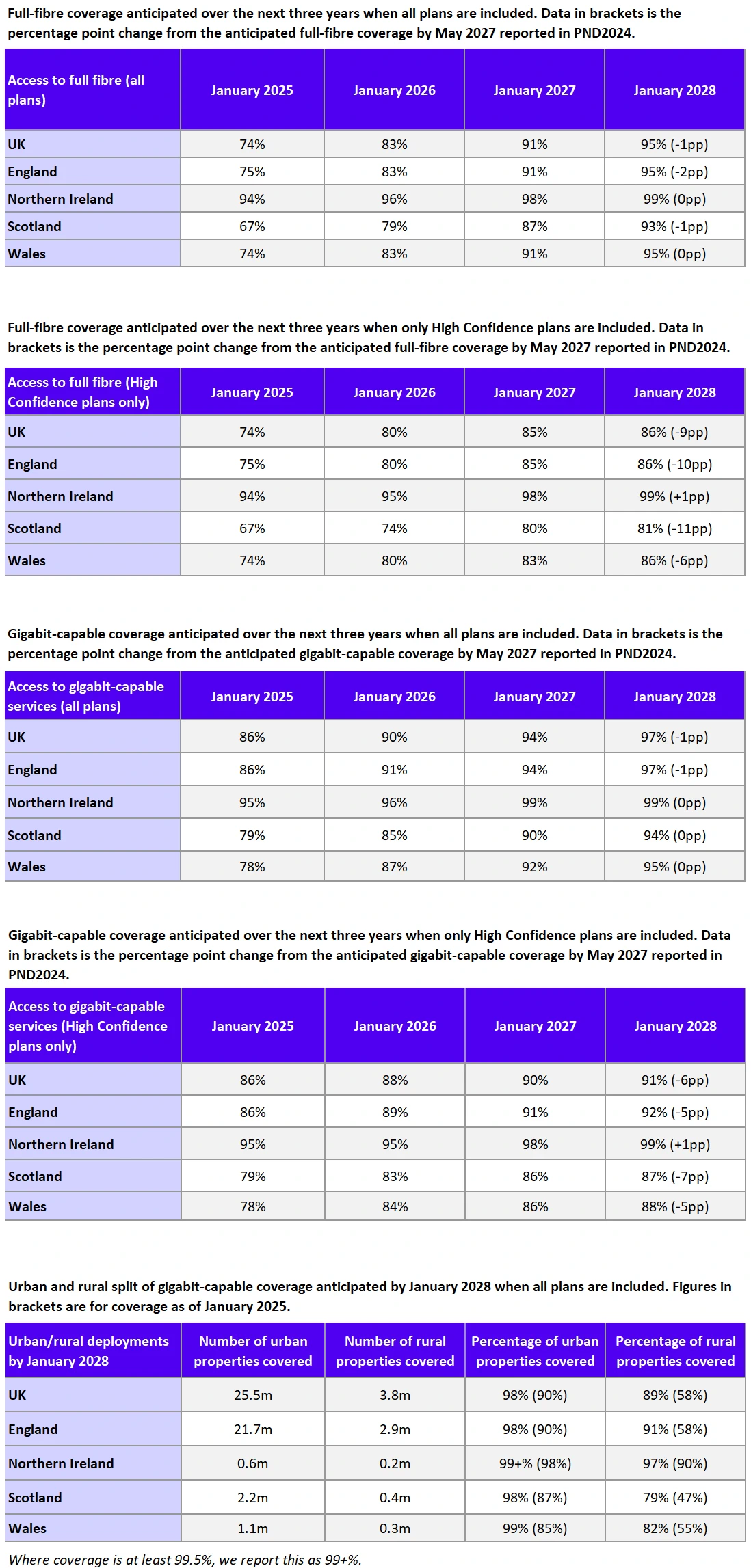
Somehow, we overlooked that the telecoms regulator had published the fourth edition of their forecast for Planned Network Deployments, which has revised down its expectations of future coverage after UK broadband operators did the same. The report now predicts that full fibre (FTTP) lines will reach 86-95% of homes by January 2028 – rising to 91-97% for gigabit-capable networks (i.e. FTTP and Cable).

According to the regulator’s latest data to January 2025 (here), some 74% (23.68 million) of UK homes are currently within reach of a Fibre-to-the-Premises (FTTP) network (up from 62% in Jan 2024) and this rises to 86% for gigabit-capable networks (up from 80%). The latter is being driven by both FTTP from multiple operators and Virgin Media’s older DOCSIS 3.1 powered cable network (there’s a lot of overbuild between these in urban areas).

NOTE: Broadband coverage via full fibre stood at just 3% of the UK back in 2017.

The new report goes further and, based on the stated deployment plans of network operators as of January 2025 (looking up to 3 years in advance), attempts to predict how much coverage will be achieved by January 2028. These plans include those that are privately funded as well as any plans that are supported through public funds/intervention.

The vast majority of this FTTP and gigabit-capable broadband coverage tends to come from commercial builds – mostly in urban areas, although rural areas will also see substantial network upgrades. The UK Government’s £5bn Project Gigabit programme is specifically focused on the final 10-20% of hardest to reach premises (i.e. aiming to extend gigabit coverage to around 99% “nationwide” by 2032).

However, we must apologise because Ofcom actually published this update in May 2025, but for some reason it was never mentioned in their email updates to us. In that sense, this news update is intended as somewhat of a catch-up piece and also helps to give context for the Government’s recent decision to push back their Project Gigabit delivery target from 2030 to 2032 (here).

As Ofcom itself explains: “Operators have revised their build plans downwards from last year, both in scope and confidence of achieving,” which we suspect can be taken as a reflection of the many news reports we’ve written over the past 2-3 years about individual network operators slowing their builds; often due to a combination of factors (i.e. rising build costs, high interest rates and strong competition in areas of overbuild).

What’s the revised projection for 2028?

If all of the planned deployments are realised, Ofcom’s report forecasts that gigabit-capable networks in urban areas could increase from 23.4 million (90%) as of January 2025 to 25.5 million (98%) by January 2028, and from 2.5 million (58%) to 3.8 million (89%) in rural areas. This picture will of course vary across regions and local authorities.

The following forecast splits the figures down across England, Wales, Scotland and Northern Ireland. Ofcom typically gives two figures for each technology type, which reflects the range between their most optimistic build forecast and the more pessimistic, albeit highest confidence, one. This is why the January 2028 expectations for UK gigabit coverage range from 91% (high confidence) to 97% (most optimistic). The reality may thus sit somewhere in-between.

The regulator also estimates that 79% of UK homes will have access to two or more gigabit-capable networks by the end of 2027.

Ofcom-UK-Broadband-Coverage-Forecast-for-January-2028