Questions as UK Study Claims Xmas Trees May Slow “internet speed” by 88 Percent | ISPreview UK

Original article ISPreview UK:Read More

A new piece of “research” from Broadband Genie has claimed that Christmas trees can slow your “internet speed” via WiFi by up to 88%. This is said to be due to how the tree’s “pine needles, branches, fairy lights, tinsel, and baubles can absorb and deflect your router’s Wi-Fi signals“, causing it to “slow and reduce its range” throughout the home. But it’s not always that simple.

I was shocked to discover just how much of a difference it can make. I first noticed when I couldn’t receive signal in some parts of our home and my video calls for work became jittery. Our house isn’t massive, so there is nowhere else for the tree to go. I’ve moved it away as much as I can from the router, and it has since made it a bit better. I just wish I knew this before we decorated it!,” said Sophie from Cambridge.

NOTE: See our Top Tips for Boosting Your Home Wi-Fi Wireless Network guide for more advice.

According to the press release, Sophie previously experienced download and upload speeds of 193Mbps and 26Mbps, respectively, prior to putting up the Christmas tree. But these fell to 134Mbps (-31%) and 3Mbps (-88%), respectively, after the tree had been erected in her living room.

However, we have to question this study because it appears as if the test was only based on a single user’s experience, as opposed to using multiple users in different environments with different scenarios and establishing proper baselines to produce a more scientifically credible output. The press release also fails to identify precisely where the router was located in relation to the tree, which is important.

Can Xmas Trees Slow Internet Connectivity?

The key point above about Christmas Trees being able to disrupt WiFi is indeed correct, although how much it impacts your home does depend upon a lot of different factors, such as precisely what you’ve put on the tree, what materials it’s made from, the radio bands being used (2.4GHz, 5GHz and 6GHz) in your network/devices and the location of your router / tree etc.

For example, if the main router is in another room and the Christmas tree is near to an end corner window, then it’s less likely to have a dramatic impact on overall performance. In this case, it sounds like the router and tree were initially placed very close together in the same room, which would of course be very counterproductive to signal propagation and performance around the home (concealing routers behind things can weaken their reach).

It’s also well-known that some older style blinking Christmas Tree Lights (blown glass bulbs with a carbon or tungsten filament) could cause a bit of interference for those with copper line broadband services (e.g. ADSL and FTTC/VDSL/SOGEA), which if you’re not careful might even impact your connection stability. But this tends to be less of an issue with modern LED lights, and keeping the tree well away from your modem/router will help.

Before going to press we conducted our own very anecdotal test, although in this case our router was positioned upstairs on the landing (central to the house) and the Christmas tree sat downstairs in the living room. Overall, we noticed no appreciable decline in WiFi performance vs baseline to any devices, but then we have none connected near to the tree itself.

As above, if you do suffer a performance detriment on your WiFi, then it may be time to consider a wireless mesh solution or perhaps even running a wired link around the home. Powerline adapters (e.g. the TP-Link TL-PA7017P KIT for £44) are also an option, although these have their own set of caveats.

We’d of course be interested to hear about any other before vs after (tree deployment) results from other visitors in the comments.

Openreach Reveal Annual 2025 UK Broadband and Ethernet Price Rises for ISPs | ISPreview UK

Original article ISPreview UK:Read More

Network access provider Openreach (BT) has today started to unveil their usual round of annual price increases (and some decreases) for 2025 across their wholesale broadband and Ethernet products for UK ISPs, which touches on everything from full fibre (FTTP) to hybrid fibre (SOGEA), SOTAP and unbundled lines (LLU), among other products.

Ofcom currently allows (example) Openreach to increase prices across their various products, usually by the CPI level of inflation (currently 3.6%), although this may differ between products due to various factors (discounts etc.) and there could also be some decreases. But increases mean that ISPs on the same network will need to pay more for the services they sell, which often ends up being passed on to consumers at the retail level.

NOTE: All the price changes being announced this week will be introduced from 1st April 2026.

The price changes are far too numerous to easily summarise as they occur across masses of different products and services, but you can find more details by following the links on their Pricing Page and Briefings Page. At the time of writing, Openreach haven’t yet confirmed all of their changes for 2025 (Cablelinks and Ethernet to follow) – it sometimes takes them a few days to release all the changes (today’s mostly relate to older copper line services and construction charges).

However, some prices are going down. For example, the cost of fitting an ISP supplied UPS will see a price reduction from £13.50 to £6 +vat for both FTTP and SOGEA broadband products. On the flip side, various Excess Construction Charges (ECC) are going up in price for those who need extra engineering work.

This round of annual price changes will be the last to take place under Ofcom’s current regulator regime for Openreach. Future changes will depend upon the outcome of their 5-yearly Telecoms Access Review 2026 (TAR) during early 2026.

Indian government U-turns on mandatory mobile security app | Total Telecom

Original article Total Telecom:Read More

flag hanging on pole

News

Onlookers fear the app could pose a significant threat to user privacy

Back in January, the Indian government launched its cybersecurity app Sanchar Saathi, aiming to tackle the growing challenge of mobile security and fraud.

Now, the government has scrapped an order that would have seen this app pre-installed on every mobile device sold in India.

On Monday, the government announced a new order that would give smartphone makers 90 days to ensure all devices have the Sanchar Saathi app embedded at the point of sale. For mobile phones already in shops but not yet sold, the government wants software updates to install the app within three months.

Now, after significant push back from cybersecurity experts and device manufacturers like Apple and Samsung, the government says it will no longer require pre-installation.

The Sanchar Saathi app – which means ‘communication partner’ in Hindi – is used to track lost or stolen phones and identify fraudulent mobile usage.

According to India’s Minister of Communications Jyotiraditya Scindia, the app has already delivered “strong citizen benefits” since its launch in January. These include 26 lakh (2.6 million) mobile phones traced and 7.23 lakh (723,000) successfully returned to their owners; 40.96 lakh (4.09 million) fraudulent mobile connections identified and disconnected based on citizen reports; and 6.2 lakh (620,000) fraud-linked IMEIs (International Mobile Equipment Identities) blocked to curb misuse.

To achieve this, however, the app reportedly requires permission to access phone calls, messages, call and message logs, photos, files, and the phone’s camera. These functionalities “cannot be disabled or restricted”, according to the order.

As such, watchdogs fear that the app represents a major threat to personal privacy and could ultimately be used by the government to monitor many different types of user activity, from the use of banned applications to VPNs.

“The problems deepen when we look at the scope and safeguards. The order invokes ‘telecom cyber security’ as a catch-all justification, but it does not define the functional perimeter of the app,” explained Apar Gupta, founder director of the Internet Freedom Foundation, to The Telegraph Online.

He added that there was a significant risk of ‘function creep’, where solutions evolve far beyond the scope of their original intent.

In response to this criticism, Scindia clarified earlier this week that users would be able to delete the pre-installed Sanchar Saathi app.

“There is no snooping and no call monitoring. If you want #SancharSaathiApp, keep it. The choice to activate, keep, or delete the app rests entirely with the user,” he said in a post on X (Twitter).

This reassurance, however, has seemingly done little to stem the criticism facing the government.

Most significantly, reports suggest that both Apple and Samsung were resistant to the order, with Apple telling Reuters it would not comply and “would convey its concerns to Delhi”.

Government apps being preinstalled on consumer devices is far from the norm; the only major markets where this is routinely practiced are China and Russia.

Keep up to date with all the latest telecoms news with the Total Telecom newsletter

Also in the news
Connected Britain Award winners 2025 announced!
Netomnia announces ‘powerful and ambitious’ rebrand ahead of Connected Britain
VodafoneThree drops Samsung, relies on Nokia and Ericsson for £2bn network upgrade

New Survey Claims to Show Demand for Satellite Connected Smartphones | ISPreview UK

Original article ISPreview UK:Read More

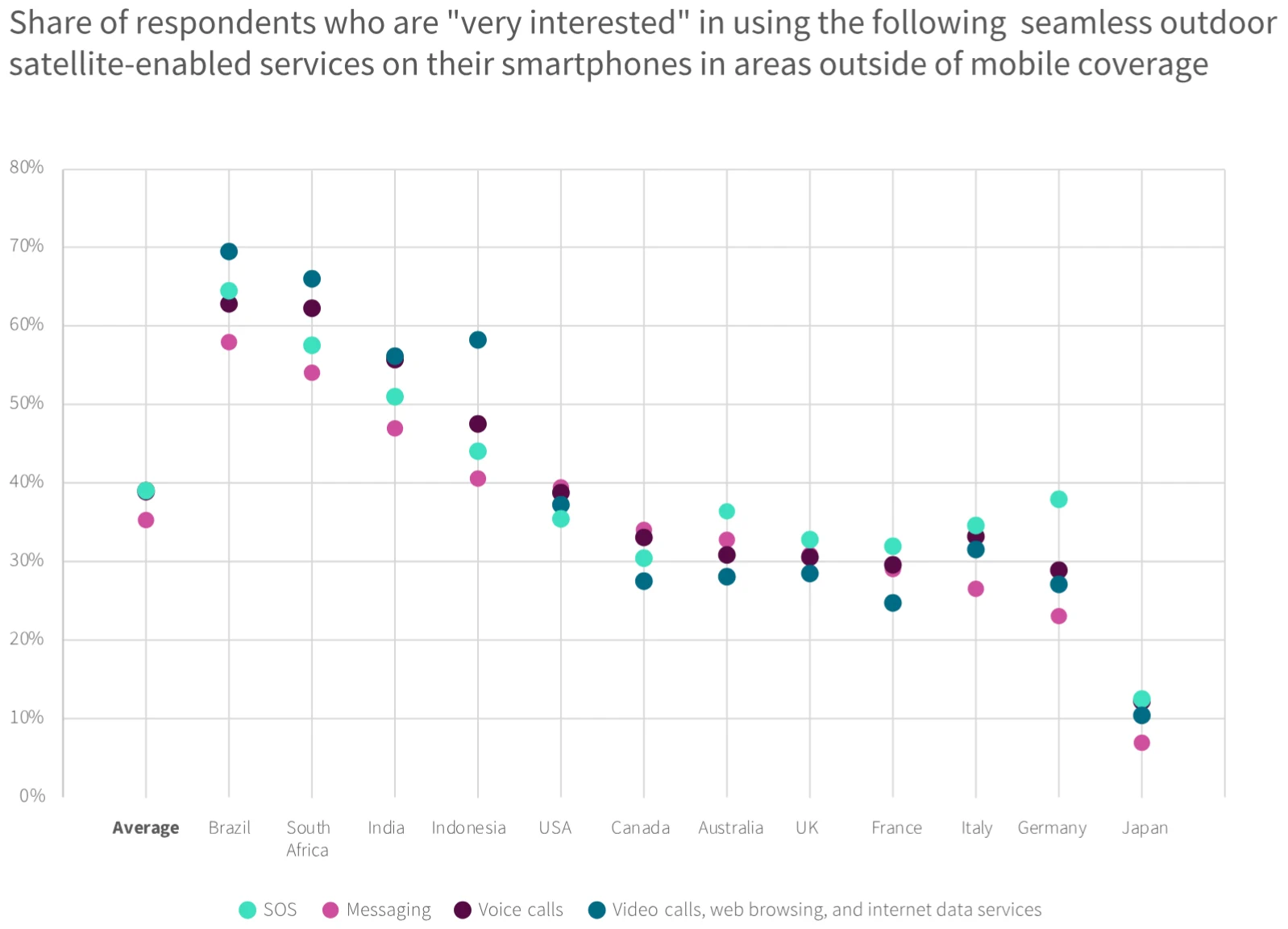
A new survey from Viasat and the GSMA (Global System for Mobile Communications Association), which questioned 12,390 mobile phone users across twelve markets (including the UK), claims to have revealed the “booming consumer demand” for Direct-to-Device (D2D) satellite services (mobile calls, texts and internet data).

Several satellite-based broadband operators are currently developing services that can directly connect to unmodified consumer Smartphones via regular mobile spectrum bands. Some examples of this include Starlink (Direct to Cell), AST SpaceMobile and Viasat (i.e. they have a vested interest in the survey). In fact, some phones, like the latest iPhone series from Apple and Samsung, already have a basic communication system that can work via satellite (e.g. for emergencies).

NOTE: The Survey involved over 1,000 people in each market – from May to June 2025, covering Australia, Brazil, Canada, France, Germany, India, Indonesia, Italy, Japan, South Africa, the United Kingdom (UK), and the United States of America (USA).

Suffice to say that Viasat and GSMA Intelligence were keen to know how much interest there might be in such services. In order to do this, they surveyed 12,390 mobile phone users about their existing terrestrial coverage, their awareness and interest in satellite-based services, and their willingness to pay for these services and to switch mobile network providers to access these services.

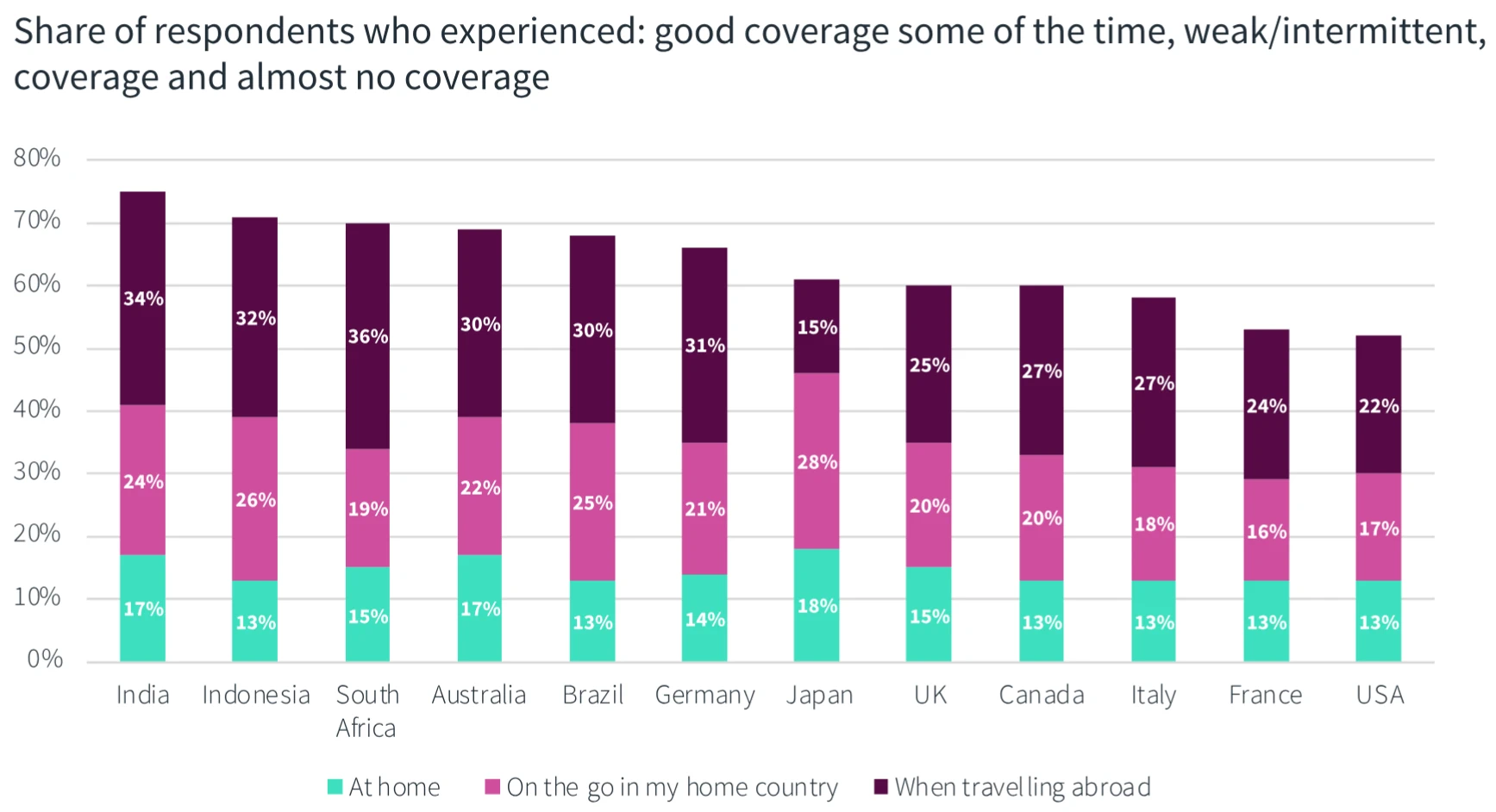
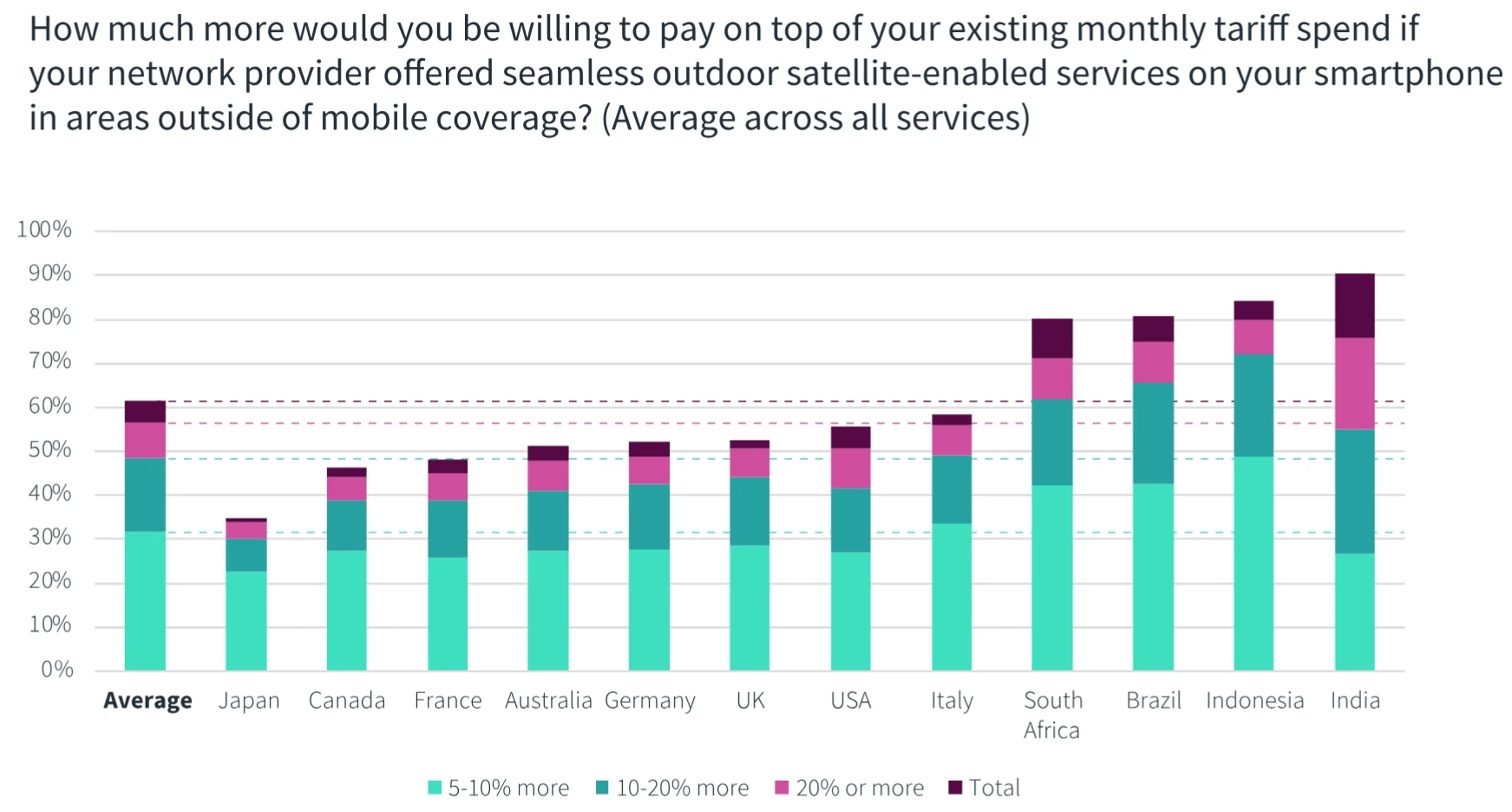
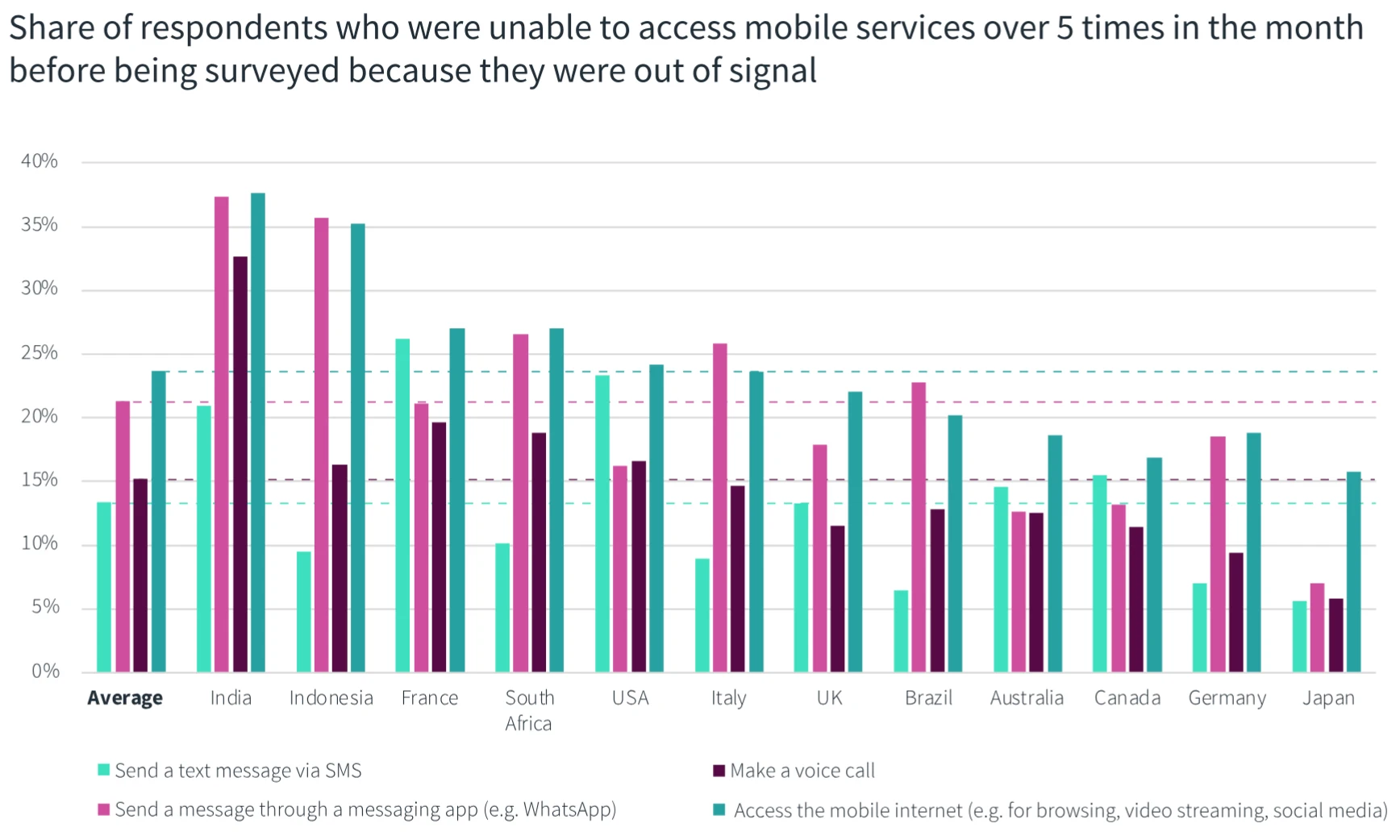
The survey found that, on average, more than a third of consumers report losing access to basic mobile cellular services at least twice a month. Perhaps as a result, 60% of consumers are willing to pay extra for satellite services, while 47% of global phone users stated they would switch to a different operator if they didn’t get cell coverage in traditional dead spots.

Consumers are apparently also ready to pay an additional 5-7% on their monthly phone bill for D2D satellite features, and even more in developing regions like India (9%). But awareness varies – with 74% of consumers aware of satellite features in India compared with only 25% in Japan, creating a ‘marketing gap’ which telcos must navigate to capitalise on demand.

Tim Hatt, Head of Research & Consulting, GSMA Intelligence, said:

“Six in ten say they’re willing to pay extra for D2D services, and nearly half would switch provider to get them, a decisive signal of demand and a clear revenue runway for operators. With satellite services aligned to 3GPP standards and moving from trials to commercial reality, the race is on to deliver D2D at scale, first messaging and voice, then data – so operators can differentiate on reach, resilience and customer trust.”

GSMA-and-Viasat-Survey-Mobile-Problems

GSMA-and-Viasat-Survey-Mobile-Coverage-Quality

GSMA-and-Viasat-Survey-Demand-for-Satellite-Mobile

GSMA-and-Viasat-Survey-Demand-for-Satellite-Mobile-Prices

Rural UK Broadband Altnet Gigaclear Secures £80m Funding from Banks | ISPreview UK

Original article ISPreview UK:Read More

Abingdon-based broadband ISP Gigaclear, which has built a full fibre (FTTP) network across 612,000 premises in rural parts of England and is home to c.160,000 customers, has today announced that they’ve secured “at least” £80m in new funding from its consortium of existing banks. The provider now claims to be “fully funded to deliver its plans“.

The provider, which is this month celebrating its 15th birthday after taking on the huge challenge of trying to expand FTTP across rural areas via a commercial build, currently still holds an aspiration to extend their network reach to 1 million UK premises. But like so many other operators they’ve recently also had to scale-back their build and cut jobs, due to the pressures from high interest rates, rising build costs and a highly competitive environment (here and here).

NOTE: Gigaclear is principally owned by Infracapital, together with Equitix and Railpen. The company previously had investment commitments estimated to be worth up to around £1.1bn (here) and in late 2023 secured a £1.5bn debt facility (here). The provider holds several Project Gigabit build contracts in Oxfordshire (here) and East Gloucestershire (here).

Suffice to say that funding has recently become somewhat of a hot topic for Gigaclear, which was in the news last month over reports that they had begun hunting for a buyer (here). But in the meantime it appears as if the provider’s existing banks have agreed to pump “at least£80m of new funding into the company, although exact details of the deal were not included in the announcement.

Gigaclear’s main focus today is now on delivering their publicly subsidised Project Gigabit contracts (i.e. “ultra rural areas“) for the government, while also trying to boost customer take-up through a stronger focus on commercialisation of the network they’ve already built. But at the same time they’ve still got a £1bn debt pile to manage.

Nathan Rundle, CEO of Gigaclear, said:

“For 15 years, Gigaclear has been committed to one clear mission: ensuring rural communities are no longer left behind. From our earliest builds to our rapidly expanding customer base, every milestone has been driven by that goal. As we look ahead, this new funding gives us a robust platform to continue expanding our network and deliver unparalleled connectivity to even more rural homes and businesses as well as further supporting the evolution of the business to achieve becoming cash flow positive.

There’s still more work to do to close the digital divide but combined with our achievement of EBITDA positivity earlier this year and strong customer growth, this funding reflects a business that is financially secure, operationally robust and focused on sustainable long-term delivery.”

In 2025, the company says they expanded their network via Project Gigabit, connecting more than 30,000 new premises – putting them on track to achieve a 28% penetration rate. Looking ahead, Gigaclear now says they will continue expanding their “customer base, investing in operational innovation and enhancing the customer experience through technologies such as AI-powered installation tools“.

Openreach Join New NUAR Digital UK Map of Underground Cables and Pipes | ISPreview UK

Original article ISPreview UK:Read More

The UK’s largest broadband network operator, Openreach (BT), has officially joined the new Government-backed National Underground Asset Register (NUAR), which is often described as being a “secure” digital map of underground UK pipes and cables (broadband, water etc.) that is partly designed to help reduce accidental damage.

Just to recap. The government currently sees huge potential for NUAR’s mapping to help improve the way that national infrastructure is planned, built and managed (e.g. future full fibre and 5G/6G mobile networks). Previous claims suggested that the map could help to cut the amount of accidental damage that occurs to existing infrastructure (estimated by some studies to cost up to £2.4bn each year) and boost economic growth by “at least £400m” per year due to increased efficiency, fewer asset strikes and reduced disruptions.

NOTE: The NUAR is focused on England, Wales and Northern Ireland. Scotland has already built a similar system via the Scottish Community Apparatus Data Vault (SCADV).

The NUAR – operated by Ordnance Survey (OS) – is the solution they came up with, which is in the process of going through somewhat of a final public beta phase before full introduction. The service, once “fully operational by the end of 2025“, will pull together information from 600 underground asset owners, covering 3 million kilometres of buried pipes and cables.

However, the effectiveness of the NUAR means little without full backing from major infrastructure builders, which is why Openreach’s move to join the scheme is today being heralded as “a giant step forward“. Openreach is adding location data including ducts, conduits, poles, spans, cabinets, and chambers, for over 550,000 kilometres of its network to the NUAR platform. The injection of new data means NUAR now covers over 80% of known assets underneath the ground.

In total NUAR now holds detailed information from underground asset owners for an estimated 3.25 million kilometres of pipes, across electricity, gas, water, pipeline operators and telecoms. As work continues with asset owners to capture more data, the platform is said to be “edging closer to achieving full coverage for the subterranean network below“.

Trevor Linney, Openreach’s Networks Director, said:

“As the UKs largest telecommunications infrastructure provider, we are pleased to have started our NUAR journey. Safety is our number one priority, and today Openreach provides information to other providers needing to dig near our infrastructure.

NUAR has the potential to provide the ‘one stop shop’ for users to view everyone infrastructure in a consolidated and unified way, helping keep everyone safe and preventing damage and disruption.”

Carsten Roensdorf, OS’s NUAR Product Manager, said:

“Openreach coming on board is a giant step forward towards getting full coverage in the NUAR platform, further assisting the safe digging process by providing access to a comprehensive set of underground asset data.

Openreach has a very wide coverage and will add value to most of the searches carried out in NUAR.”

The move is significant for both existing users and also for those rival networks and companies that have yet to sign-up, since it makes the map much more useful and attractive. “For those asset owners not yet on board with NUAR, they are missing out on accessing underground asset data from all main electricity and gas networks, together with comprehensive telecom data including Openreach’s network, all in one simple interface at the click of a button,” added Carsten.

The NUAR says it gives excavators better access to data and enables safer and more efficient installation, maintenance, operation and repair of buried infrastructure. It also claims to increase industry co-ordination, because NUAR is a centralised platform that shares a standardised view of underground asset data on the map. And it increases operational efficiency through instant access to data, reducing multiple requests for information that previously took on average six days to obtain.

However, the UK Internet Service Providers Association (ISPA) has previously warned the government against putting the NUAR on a statutory footing before it’s truly “fit for purpose, proportionate and can fully deliver on expectations“. But with the addition of Openreach, it’s now much closer to being ready for prime time.

Slice Mobile Introduces Network-Wide UK Data Gifting During December | ISPreview UK

Original article ISPreview UK:Read More

Virtual mobile operator (mvno) Slice Mobile, which harnesses EE’s national UK 4G and 5G (mobile broadband) network, has this week attempted to set itself apart from the rising crowd of eSIM focused providers by rolling out network-wide data gifting throughout December (i.e. you can optionally share your data allowance with any other users on the network).

In short, provided both people are on Slice Mobile, they can share each other’s data. Gifting itself takes place in 1GB (GigaByte) increments, with the ability to share up to 10GB of data each month. “No need to all be tied to the one master account, all you have to do is use the same network and have their number,” said Slice Mobile.

Data gifting is currently occurring as part of a phased roll-out, which means that all network users – including those new to Slice Mobile – will be able to data gift from Mid-December ahead of the data intensive festive break.

Rosie Snell, Community Manager for Slice Mobile, said:

“Network-wide data gifting opens the door to network-wide generosity. One month you might send 3GB to your mum and next month you might send 5GB onto your bestie. Running out of data may seem like a first world problem – but for some having data is imperative. It could be the difference between being able to make it home safely, video call family or send an email to land the perfect job.”

Slice currently offers four eSIM mobile plans – Mini (20GB/£10), Middy (60GB/£15), Biggie (200GB/£20) and Bigger Biggie (Unlimited/£30) plan. All plans include a 30-day monthly rolling contract, unlimited calls and texts, inclusive EU roaming, 5G as standard and a 7-day free trial. But take note that their unlimited data plan does impose a Fair Usage Policy (“after 450GB your speeds may slow down a little“).

Take note that Slice Mobile is related to Lycamobile UK because Lycamobile’s parent company, Paraspara, owns Slice Mobile.

Redundancies Expected as UK Broadband ISP Hyperoptic Adjust Strategy | ISPreview UK

Original article ISPreview UK:Read More

City-focused broadband ISP Hyperoptic, which claims to have already deployed their full fibre (FTTP/B) network to cover 1.9 million UK homes passed, has informed ISPreview that they’re making some “modest adjustments to our teams working on multi-unit residential buildings” and as a result there may be a few redundancies. Less than 5% of employees are said to be affected.

The operator, which is home to 400,000 active subscribers (9th Jun 2025) and at the start of this year suffered a round of redundancies (here), is currently still going through a strategic shift that has seen their own network build switch to focus more on commercialisation. At the same time, they’re also working to harness Openreach’s growing national FTTP network in order to reach other parts of the UK (here), which will go live during early 2026.

NOTE: KKR acquired a majority (75%) equity stake in Hyperoptic during 2019 (here) and the operator, which in 2024 was home to around 1,700 employees, has a committed debt and loan facility of c.£1.25bn.

The main development today is that it looks like a further 5% of the provider’s employees may be at risk of redundancy just before Christmas, which we estimate may impact around 70 jobs and seems to reflect their evolving build strategy toward multi-unit residential properties (MDUs). This largely reflects the fact that their own fibre build (on-net) is due to reach completion once it hits the c.2 million homes passed mark.

From early 2026, “new activity will be guided by customer demand, helping us focus our investment where it can make the most meaningful difference,” said a spokesperson for the operator. In short, they’re continuing to switch their focus from network build to commercialisation of what already exists. But there’s also a little bit more to it than that.

A Spokesperson for Hyperoptic told ISPreview:

“As Hyperoptic matures, and with most of our planned build now complete, we are evolving our multi-unit residential build strategy. From early 2026, new activity will be guided by customer demand, helping us focus our investment where it can make the most meaningful difference.

In addition, we recognise the importance of the Building Safety Regulations and are fully committed to meeting all compliance requirements. These regulations have introduced new processes for connecting buildings over seven storeys or 18 metres, and we are in constructive discussions with the Ministry of Housing, Communities & Local Government to ensure we have the clarity needed to continue delivering safe, compliant connections for residents.

With these developments, we are proposing modest adjustments to our teams working on multi-unit residential buildings, with fewer than five per cent of employees affected.

Hyperoptic continues to evolve and expand its network, progressing strongly with new-build developments and strengthening coverage in existing areas. We remain focused on delivering our strategic goals for 2026 and continuing our growth trajectory, both on our own network and through the launch of services on the Openreach network.

Our ambition remains unchanged: to exceed 2 million homes passed and surpass the 500,000-customer milestone.”

The company’s most recent accounts (here), which covered the period to the end of 2024, show they generated maiden adjusted earnings of £2.7m in 2024 (vs a loss of £4.7m in 2023) and gross profit rose 20% to £87m. The operator’s statutory pre-tax losses for the year stood at £144m, albeit roughly similar to 2023. Revenues also grew by 22% to £114m and their customer base jumped 20%, while EBITDAi increased significantly to £24m.

Rocket Mobile Launch New UK Mobile Network “built for football fans” | ISPreview UK

Original article ISPreview UK:Read More

A new virtual mobile operator (mvno) has launched today called Rocket Mobile, which claims to have been “built exclusively for football fans” and will harness 4G and 5G (mobile broadband) connectivity from VodafoneThree’s (Vodafone and Three UK) growing national UK network infrastructure.

Customers of the eSIM focused service can expect to pay £16 per month for unlimited data, calls and text messages on a no-contract plan. The service also includes 20GB of EU data roaming and 1GB for the rest of the world. In addition, subscribers will apparently benefit from “exclusive football games, content, and live events” as part of their GFN (Global Fan Network) partnership.

Football fans never get an easy ride – everyone knows the costs of tickets, merch, and just supporting the teams they love,” said Brett Lotriet Best of Rocket Mobile. “It’s time for a fan revolution in mobile. Rocket Mobile is here to give fans everything they need at a price they can actually afford. For £16 a month, they get all their data, calls, and texts, with a fair price that’s locked in – a small way to support the community that is the lifelblood of the game.”

The price point makes this service similar to iD Mobile and a few others, although they offer 30GB of EU roaming data in 50 destinations but lack the GFN partnership. But whether the latter is enough to make you adopt an unfamiliar new eSIM provider is another matter. “Rocket Mobile isn’t just another mobile provider,” added Best. “It’s a platform for fans to connect, create, and celebrate the sport they love, without being priced out of the game.”

Cellnex UK Deploys Small Cells to Tackle Mobile Notspots in Harrow | ISPreview UK

Original article ISPreview UK:Read More

Wireless infrastructure firm Cellnex UK has today announced that they’ve partnered with the Harrow Council in London to deploy Small Cell technology across the Borough’s street furniture, which will target 4G and 5G mobile (mobile broadband) connectivity “blackspots” around high streets and transport hubs.

Small Cells are typically akin to shoebox sized mobile (radio) base stations that are designed to deliver limited coverage (usually up to around 100 metres) and thus tend to be more focused on busy urban areas and specific sites – it’s not uncommon to find these sitting on top of lampposts, CCTV poles or old payphone cubicles (i.e. more cost-effective than building new street assets).

Cellnex UK has already adopted a similar approach with the Hounslow and Swansea councils, thus their expansion into Harrow suggests that this is delivering some positive results. As with the prior deployments, the Small Cells are designed to be open access, so any mobile operator can make use of them at wholesale once built.

Councillor Norman Stevenson said:

“Reliable 4G and 5G is no longer a luxury but a necessity. We know it can be frustrating trying to use data or connect to mobile signal in busy areas. That’s why we’re putting residents and businesses first by bringing better connectivity to help people carry out their day-to-day activities while on the go.

This partnership helps to deliver Harrow’s Digital Infrastructure Strategy which aims to support the rollout of both advanced mobile networks and full-fibre broadband to drive economic growth and digital inclusion as well as attract private investment.”

Camilla Vauiter, Cellnex UK Commercial Director, said:

“We are increasingly looking for ways to creatively improve the reliability of mobile coverage throughout the UK. By working collaboratively with local authorities, like Harrow, we want to unlock the available public assets around us that can accelerate the deployment of connectivity solutions where they are needed most. Connectivity is more than just infrastructure; it’s ensuring everyone can participate fully in today’s digital society. This partnership with Harrow will help build that foundation.”

Sadly, the announcement doesn’t clarify how many of these Small Cells will be deployed across Harrow as part of this agreement or precisely where they’ll be installed. In addition, it’s unclear which mobile operators have already signed-up to adopt the new infrastructure, although we assume they wouldn’t be doing it without first having recorded some interest.