South Yorkshire Celebrates Hitting 95 Percent Gigabit Broadband Coverage | ISPreview UK

Original article ISPreview UK:Read More

The South Yorkshire Digital Infrastructure Team, which primarily works under the South Yorkshire Mayoral Combined Authority (SYMCA) to accelerate the rollout of fixed gigabit broadband (1000Mbps+) and 5G mobile networks, has today celebrated having surpassed their target of reaching 95% of homes and businesses in the region with gigabit lines.

The figure was officially achieved in early November 2025, thus besting the target that had been set in the South Yorkshire Digital Infrastructure Strategy, which aimed for 95% coverage by the end of 2025. The figure also exceeds the national UK coverage level for gigabit connectivity, which currently sits just shy of the 90% mark (here).

So far the vast majority of these coverage improvements have flowed from commercial deployments, such as via networks from Openreach, Virgin Media (inc. nexfibre), CityFibre, Netomnia (Brsk) and Pine Media etc. But the government’s prior Superfast Broadband (SFBB) programme also contributed some full fibre (FTTP) coverage, while the latest £5bn Project Gigabit scheme aims to extend gigabit broadband “nationwide” (c.99% of premises) by 2032 (here).

South Yorkshire’s Mayor, Oliver Coppard, said:

“These days getting online and staying connected isn’t a luxury; it’s vital. Whether we’re working from home, running a business or getting online for a doctor’s appointment, we all rely on a decent internet connection. That’s why we’ve been working to fix it and get more people across South Yorkshire than ever access to the fastest internet there is. It’s about building a fairer, more connected South Yorkshire that’s fit for the future.”

Ofcom currently predicts (here) that gigabit coverage will reach anywhere between 91% to 97% of the UK by January 2028.

London Internet Exchange Updates UK Fees and Service Structure for 2026 | ISPreview UK

Original article ISPreview UK:Read More

The member‑owned not-for-profit London Internet Exchange (LINX), which handles a large chunk of UK and global data traffic through their switches via around 900 members (broadband ISPs, mobile operators etc.), has today announced their new service profile and fees for 2026.

The 2026 update includes a few changes, such as the ability for networks to now consume 10Gbps of peering on a 100GE port, which should make the step-up to 100GE even easier. LINX have also increased the service bandwidth included in the monthly membership fee from 2Gbps to 4Gbps over a 10GE port.

The first service of up to 4Gbps will now also be included free of charge at each LINX operated location in the UK, US and Africa – “that’s 36Gbps of potential service included“. The services applicable include Peering, Microsoft Azure Peering Service, Private VLAN, or a Closed User Group.

Megan Atkins, CCO at LINX, said:

“We listen to the feedback from our members and monitor the changes in our industry to judge how best to increase value to the community.”

For many of our members, this enhancement offers a direct reduction in operational networking costs and a simplified path to expanding services.”

See the 2026 service fees here.

Ofcom Proceed with Proposal to Share Upper 6GHz Band for UK Mobile and WiFi | ISPreview UK

Original article ISPreview UK:Read More

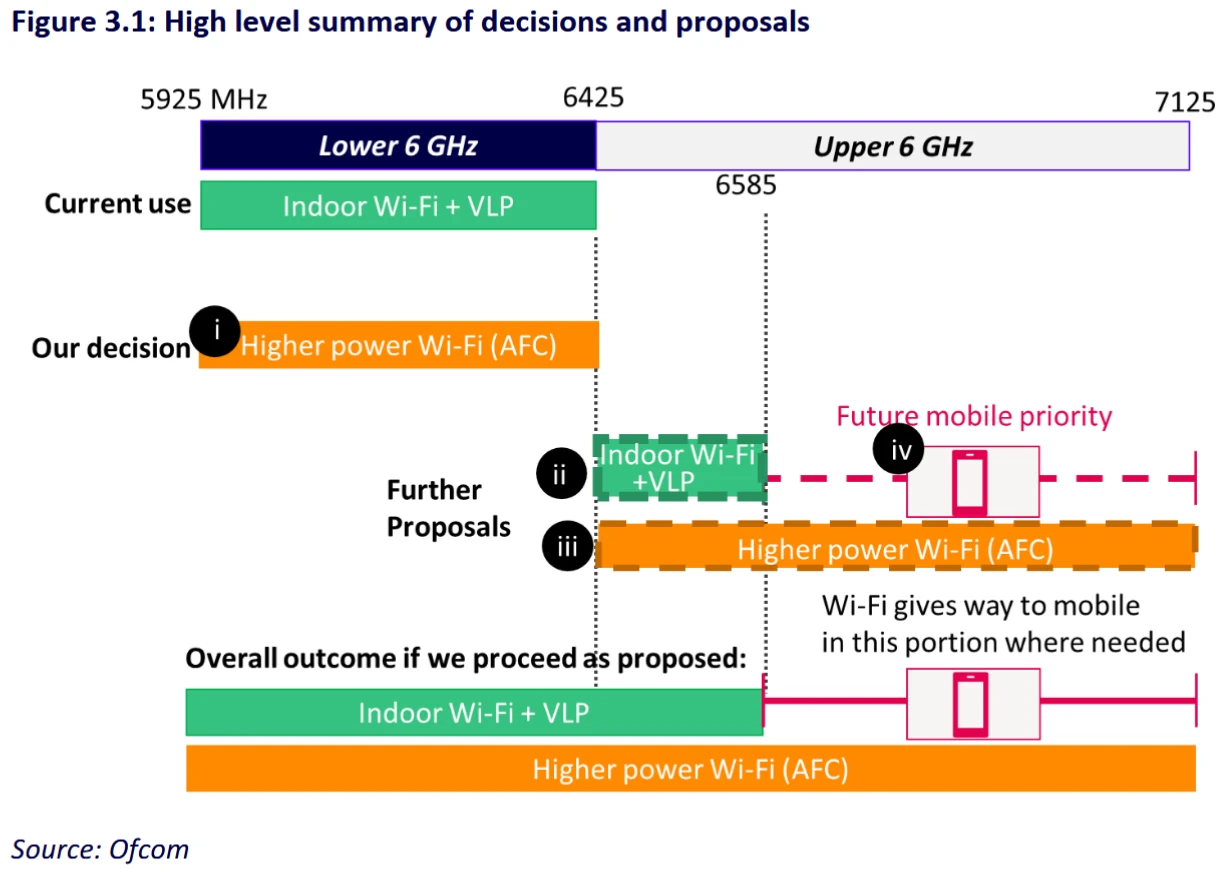
The telecoms regulator, Ofcom, has this morning confirmed that the United Kingdom will become the “first country in Europe” to adopt a proposal that allows low power indoor WiFi signals and outdoor mobile broadband (4G, 5G etc.) networks to “share” access to the Upper 6GHz radio spectrum band (6425 to 7125MHz).

Ofcom has already made the Lower part (5925 to 6425MHz) of the 6GHz band available for WiFi, such as under the latest WiFi 6E and WiFi 7 standards (here), yet the Upper part has remained the subject of some debate. Mobile operators want to harness it (licensed) to deliver faster 5G and future 6G based data speeds, while others argue it should go toward licence-exempt consumer WiFi. Existing users of the band (e.g. fixed services, satellite, radio astronomy etc.) have also expressed concerns over the risks from interference.

NOTE: The consultation also proposes to allow outdoor and higher power WiFi to operate within the Lower 6GHz band (WiFi in this band is currently limited to low power indoor use only), under the control of an Automated Frequency Coordination (AFC) database to protect other users from interference. This could improve WiFi cover for sports stadiums, factories and hospitals etc.

Suffice to say, both sides of the debate have been able to field strong arguments. However, rather than pick a side, Ofcom has instead spent the past few years exploring the middle-ground option of “hybrid sharing” (details). This could potentially enable, with some performance caveats (i.e. co-existence without causing interference is a challenge), the use of both Wi-Fi and mobile in the same Upper 6GHz band.
Ofcom-6GHz-Upper-and-Lower-UK-Band-Changes

Ofcom’s approach works by dividing up the upper 6GHz band, with Wi-Fi prioritised in one part and mobile in the other, with clear technical conditions and controls attached to limit the risks from interference. The new consultation finalises the regulator’s proposals, although implementation will be a slow process.

David Willis, Ofcom’s Group Director for Spectrum, said:

“Today’s announcements reaffirm the UK’s position as a leader in Europe in getting the most out of the airwaves we all rely on.

Sharing Upper 6 GHz would be a win for businesses and homes across the country who want both better Wi-Fi and mobile networks that are fit for the future. And our decision on lower 6 GHz will boost broadband services across the UK.

Our plans open the doors to further economic growth and investment, while supporting the delivery of crucial innovations like 6G in the future.”

What Ofcom have decided – in brief

• We will authorise, under a licence exemption, use of outdoor and higher power Wi-Fi devices (up to 36 dBm EIRP) in the Lower 6 GHz band (5925–6425 MHz) provided they are under the control of an AFC system.

• As a result, we will require implementation of an AFC system by third parties. We are separately consulting on the details necessary to implement that AFC system.

• Whilst we are consulting further on approaches to enable Wi-Fi in the Upper 6 GHz band (6425–7125 MHz), we will proceed with making low power Wi-Fi client devices available across the Upper 6 GHz band, provided they are connected to an authorised Access Point (“AP”, for example a Wi-Fi router). This decision should allow client devices to be made available for possible future use of the band, thereby helping faster adoption. Use in the band, in practice, will only become possible once we have made a decision on the proposals below to enable Access Points in Upper 6 GHz.

• We will adopt a sub-national licencing approach for mobile in the Upper 6 GHz band in the “mobile priority” portion of the band. We intend to award mobile licences in “high density” areas of the UK and expect to implement a local licensing arrangement (for example, on a first come, first served basis) outside of these high density areas. We will consult further on the specifics of this in spring 2026.

What Ofcom are proposing – in brief

• To implement prioritised spectrum sharing in the Upper 6 GHz band, with:

A “Wi-Fi- priority” portion in the bottom 160 MHz of the band (6425–6585 MHz).

A “mobile priority” portion in the upper 540 MHz (6585–7125 MHz).

• To make the Wi-Fi priority portion available on the same basis as spectrum in the Lower 6 GHz band. This includes indoor and very lower power Wi-Fi, and also outdoor and higher power Wi-Fi provided this is under the control of an AFC system.

• To enable early access for Wi-Fi in the mobile priority portion of Upper 6 GHz. In response to feedback from the February 2025 consultation, we propose to only allow this access for Wi-Fi which is under the control of an AFC system. This will ensure that we can clear Wi-Fi out of the way, in the locations and channels where mobile deploys later on.

Fully implementing all of this is clearly going to take some time, particularly when it comes to the mobile (4G, 5G and 6G) side of things. Ofcom’s approach is partly being linked to wider European efforts to harmonise use of the same band via a similar policy (expected in 2028). But in any case, the regulator doesn’t anticipate hardware support in mobile equipment until around 2030.

On the WiFi front, the need for a new AFC database will also slow down the implementation a bit. AFC works by automatically identifying frequencies that can be used by Wi-Fi without impacting existing services, therefore keeping the administrative burden of spectrum management low. The AFC system is currently in use in this band in the US and Canada, and is under consideration in other countries.

Depending upon your perspective, Ofcom’s approach may seem like either a good or bad move, since neither mobile nor WiFi will be able to fully benefit from the Upper 6GHz band in every location. But we’ll need to see how much of an impact it has in the real-world before really being able to judge.

Virgin Media UK’s TV Customers Given Free Access to Premier Sports Rugby | ISPreview UK

Original article ISPreview UK:Read More

Customers of broadband ISP Virgin Media (O2), such as those who take a Pay TV service via one of their TV 360, Stream or v6 Box platforms, may like to know that from today they will also gain free access to Premier Sports Rugby, the 24/7 rugby channel.

The channel is said to offer access to the “most comprehensive club rugby coverage available across the UK“. Virgin TV customers can now enjoy access to the Investec Champions Cup, United Rugby Championship (URC), EPCR Challenge Cup, Top14 (France), Major League Rugby and Japan Rugby League One, plus much more available via channel 553.

David Bouchier, Chief TV and Entertainment Officer at VMO2, said: “We’re offering every Virgin TV customer even more value with access to Premier Sports Rugby at no extra cost. As the only Pay TV operator to provide this, we are demonstrating our commitment to give our customers the very best access to the content they love, and to further enhancing our sports offering with coverage of the world’s biggest club competitions at their fingertips.”

Toxic Gas Disrupts Openreach’s UK Broadband Network in Aldershot | ISPreview UK

Original article ISPreview UK:Read More

Network access provider Openreach (BT) appears to have closed access to all underground structures within the Aldershot exchange (ACM) area in Hampshire (England), which occurred yesterday after they identified “suspected toxic gases” within the local underground network.

The move means that Openreach’s engineers, including those working for rival broadband and phone networks that share some of the same infrastructure, are currently prevented from doing any telecoms work (e.g. network expansion, major repairs etc.) in underground structures within this area. Suffice to say, the safety of engineers must come first.

The restrictions do not currently impact engineering work on their above ground and overhead network (telecoms poles and street cabinets), which means that some new service provisions and general repairs should be able to proceed. Openreach are currently in the process of investigating the area to identify exactly what type of gas is involved and hopefully also its source, which will then inform their next steps.

Regular readers of ISPreview may well point to the huge disruption that was caused by an underground petrol leak in the village of Bramley (Surrey), which has taken several years to tackle (here). The hope is that the situation in the town of Aldershot won’t be anything like as protracted and serious as that (hopefully it’s isolated to a small area and is a temporary issue), which does seem unlikely as Bramley was particularly extreme.

ISPreview has asked Openreach if they’re able to provide an update and will report back shortly.

Siemens and NVIDIA pledge to build ‘fully AI-driven, adaptive manufacturing sites’ | Total Telecom

Original article Total Telecom:Read More

News

Siemens and NVIDIA are broadening their strategic alliance to develop an ‘Industrial AI operating system’, which they aim to make the heart of AI-powered manufacturing

Siemens and NVIDIA said they are widening a strategic partnership to build what they described as an “Industrial AI operating system” that combines NVIDIA’s AI infrastructure with Siemens’ industrial hardware and software.

The companies announced the expansion at CES 2026, saying they would target the complete industrial products and production lifecycle, from product design and simulation to deployment and operations.

The programme will reportedly begin with the deployment of an AI-driven, adaptive manufacturing site at Siemens’ Electronics Factory in Erlangen, Germany, slated to start in 2026. This, the companies said, will serve as a blueprint for further AI factories.

According to the announcement, factories would run an “AI Brain” integrating software-defined automation, industrial operations software and NVIDIA Omniverse libraries to analyse digital twins. This would allow operational changes to be tested in a virtual environment first, then delivered across the site in near real time.

“Together, we are building the Industrial AI operating system – redefining how the physical world is designed, built, and run – to scale AI and create real-world impact,” said Roland Busch, President and CEO of Siemens AG.

“Generative AI and accelerated computing have ignited a new industrial revolution, transforming digital twins from passive simulations into the active intelligence of the physical world,” added Jensen Huang, founder and CEO of NVIDIA. “Our partnership with Siemens fuses the world’s leading industrial software with NVIDIA’s full-stack AI platform to close the gap between ideas and reality — empowering industries to simulate complex systems in software, then seamlessly automate and operate them in the physical world.”

The partnership involves a significant coupling of the companies’ technologies, with Siemens expanding support for NVIDIA CUDA-X libraries and AI physics models, while NVIDIA will provide infrastructure, simulation libraries, models, frameworks, and blueprints. The result, the companies hope, will be the delivery of larger, more accurate simulations more quickly. They also hope to advance “generative simulation” with technologies such as NVIDIA PhysicsNeMo and open models to produce autonomous digital twins capable of real-time engineering and optimisation.

Siemens also plans to add AI-assisted features to its existing tools, such as layout guidance and debug support to improve engineering productivity.

A number of customers, including  Foxconn, HD Hyundai, KION Group, and PepsiCo, are already evaluating the companies new capabilities, according to the company press release.

Financial details of the deal were not revealed.

Keep up to date with all the latest telecoms news with the Total Telecom newsletter

Also in the news
World Communication Award Winners 2025
Ofcom clears the way for satellite-to-smartphone services
LG Uplus’s AI voice call app glitch leaks user data

American investment firms bet big on Europe’s data center boom | Total Telecom

Original article Total Telecom:Read More

News

The capital is meant to accelerate a built-to-suit data center platform’s expansion across Europe as demand grows

Edited by Brad Randall, Broadband Communities

American-based investment firm KKR is putting more money into Europe’s data center boom, announcing an additional $1.5 billion equity commitment to Global Technical Realty (GTR), a built-to-suit data center platform it helped launch.

The deal also brings New York City-headquartered Oak Hill Capital aboard as a new investor, with roughly $400 million committed.

Together, the capital is meant to accelerate GTR’s expansion across the continent with growing demand for high-performance, AI-ready infrastructure.

GTR was founded by entrepreneur Franek Sodzawiczny alongside KKR in 2020.

The company has since focused on developing mission-critical, hyperscale-ready facilities in both established and emerging European markets.

Sodzawiczny said the fresh funding “marks a major inflection point” for the company. He also said the funding will allow GTR to scale its team, deepen operating capabilities, and move faster into new markets to meet rising hyperscale and AI-driven demand.

Andrew Peisch, a KKR partner, also offered comment. He said Europe needs “high-quality, power-efficient, and scalable data center infrastructure” as cloud growth and AI workloads expand, and called GTR one of the region’s “most capable developers.”

For Oak Hill, the investment additionally continues a long-running focus on telecom and digital assets.

Adam Hahn, a partner at Oak Hill, described GTR as a “differentiated platform.”

Hahn also said the firm will bring experience in digital infrastructure and telecommunications as GTR scales.

Oak Hill’s $400 million commitment makes this its fourth platform investment specifically in data centers.

AI tools from Noah Wire Services have been used to help generate this report.

Get news like this in your inbox. Subscribe to the Broadband Communities newsletter!

VodafoneThree Becomes Exclusive UK Mobile Operator in Get Connected Stores | ISPreview UK

Original article ISPreview UK:Read More

Telecoms giant VodafoneThree (Vodafone and Three UK) has today announced that they’ve extended their existing partnership with high street mobile phone and service retailer Get Connected, which will see them become the exclusive mobile operator (MNO) in 46+ Get Connected stores across Wales and parts of England (Midlands and the South West).

The 3-year extension means that visitors to the store will be able to access mobile plans and handsets from the Vodafone, Three UK, SMARTY, VOXI and Talkmobile brands. VodafoneThree’s retail presence with Get Connected in Wales will also continue to support approximately 100 in-store jobs.

Damian Cole, CEO of Get Connected, said: “I am pleased to announce that I have just signed the agreement for three years. This partnership will give us access to more products and means that the business is now secure for at least the next three years.”

Literacy Capital Sells Wireless UK Internet Provider Wifinity to Arcus | ISPreview UK

Original article ISPreview UK:Read More

Literacy Capital (BOOK) has announced that it has sold its stake in Managed Internet Service Provider Wifinity, which typically specialises in deploying WiFi style broadband networks to UK businesses and consumers, to European-focused infrastructure fund Arcus Infrastructure Partners. Under the terms, £15m will be received in cash at completion, with a further £400k expected around the end of 2026.

All of this follows Wifinity’s LDC (Lloyds Development Capital)-backed management buyout in September 2021, which has since seen the business scale its capabilities through various acquisitions and other changes. Wifinity was also one of Literacy Capital’s earliest investments, with the Fund originally acquiring a stake in December 2017.

As at 30th September 2025, Wifinity was one of the Fund’s ten largest holdings and this transaction will see the Fund sell its entire stake in line with the previously reported carrying value. The total return for BOOK shareholders from this investment, including cash distributions previously received and the contingent consideration (expected to be received within 12 months) is 5.2x Multiple of Money (Internal Rate of Return of 22.3%).

Richard Pindar, CEO of BOOK’s Investment Manager, said:

“The sale of Wifinity marks a significant milestone, both for Wifinity and Literacy Capital, with the business having been a longstanding and successful holding for the Fund.

We are grateful to the CEO, Costas Demetriou, for his excellent leadership and development of the business since joining following our original investment in December 2017, and for his role in helping to achieve this successful outcome and exit.

This transaction represents another notable realisation event for BOOK. Again, the counterparty or buyer is a substantial institutional investor, demonstrating the marked enhancement of Wifinity’s attractiveness to larger investors since Literacy Capital’s original investment eight years ago.

As has been widely discussed, M&A conditions were difficult during 2025, resulting in many transactions being delayed or cancelled. Despite this, we are pleased to be able to announce this sale and hope to announce further successful realisation events soon.

Our priority remains generating cash proceeds from longer held, more mature assets to focus capital and management bandwidth on less mature holdings that have significant potential.”

The signing and exchange of the deal has already taken place, with regulatory clearance and completion expected during the first quarter of 2026. The cash received by BOOK following completion will be used to repay amounts drawn under its Revolving Credit Facility (RCF).

Wifinity itself typically delivers more bespoke style connectivity solutions to people where ordinary broadband often doesn’t reach, including rural and remote locations such as military bases and holiday parks. The company also provides services to other multi-tenanted environments such as later living communities, education environments, Public Sector buildings, as well as Enterprise broadband and connectivity.

O2 UK Expand 5G Standalone Mobile Broadband Network to Sheffield | ISPreview UK

Original article ISPreview UK:Read More

Mobile operator O2 (Virgin Media) has this morning announced that they’ve switched-on their next-generation 5G Standalone (5GSA) mobile broadband network in Sheffield and surrounding areas in South Yorkshire (England). The move forms part of their UK-wide rollout, which is now live in a total of more than 500 locations (70% of the UK’s population or c.49 million people).

Just to recap. 5GSA networks are pure end-to-end 5G that can deliver ultra-low latency times, greater energy efficiency, better speeds (particularly uploads), network slicing, improved support for IoT devices, increased reliability and security etc. Existing 5G networks often use a Non-Standalone (NSA) approach, which is hobbled by being partly reliant upon older and slower 4G infrastructure.

NOTE: The upgrades are part of O2’s wider £700 million Mobile Transformation Plan.

O2’s 5GSA rollout first began in February 2024 (here) and typically aims to reach “at least 90% outdoor coverage” in every location they target. The same should hold true for Sheffield, where roughly 580,000 residents across the city and in surrounding areas will be able to benefit from the new 5GSA network.

The surrounding areas mentioned above are said to include Chapeltown, Mexborough, Wombwell, Swinton, Conisbrough, Dinnington, Wickersley, Rossington, Bessacarr, Armthorpe, Bentley, Maltby, Hoyland and Thurnscoe.

Dr Robert Joyce, O2’s Director of Mobile Access Engineering, said:

“Our new 5G Standalone network is now live in Sheffield, providing an impressive upgrade for local people and businesses and creating new opportunities in and around the city. We are investing every single day to improve our mobile network and provide a more reliable experience for our customers, with these upgrades futureproofing our network and paving the way for exciting innovations that lie ahead.”

As usual, O2’s upgrade will be available to customers with compatible devices “at no extra cost“.