Ookla Name Three UK Fastest and O2 Slowest for 5G Mobile Broadband in H2 2025 | ISPreview UK

Original article ISPreview UK:Read More

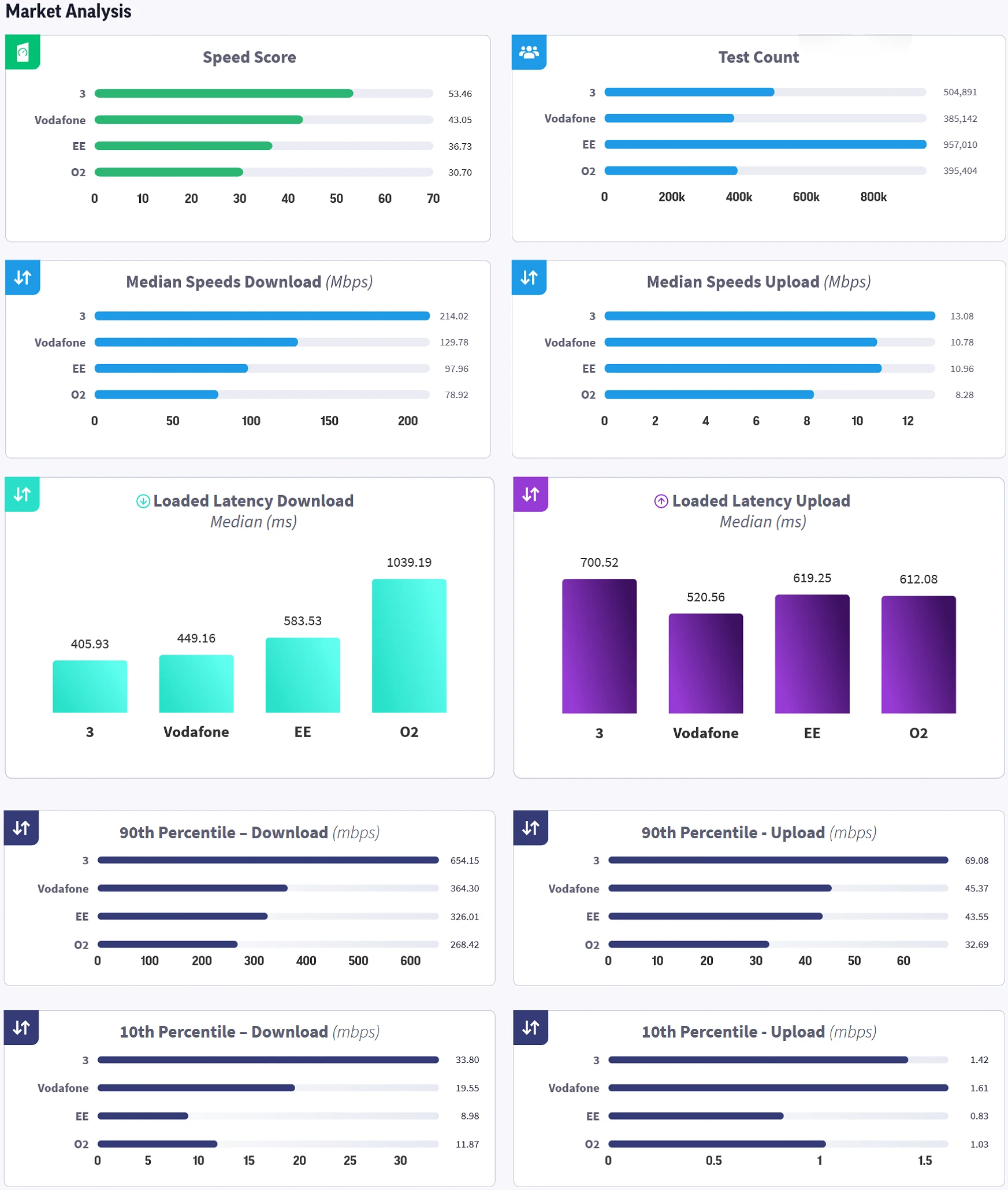
Network testing giant Ookla, which collects data from consumers via their popular broadband Speedtest.net service, have released their latest Q3-Q4 2025 (H2) study into the speed of 5G based mobile broadband networks across the United Kingdom. The results reveal that Three UK continues to be the fastest provider, while O2 (Virgin Media) was the slowest.

The catch is that mobile broadband performance can be a very difficult thing to pin down because users are always moving through different areas (indoor, outdoor, underground etc.), using different devices with different capabilities and the surrounding environment is ever changeable (weather, trees, buildings etc.). And that’s before we consider the other issues, such as network capacity and varying spectrum use at different cell sites. But these caveats are true for all the operators in this study.

NOTE: The study used data collected from 413,966 samples (users) and 2,367,423 speedtests, conducted across the UK, to identify the best performing 5G mobile operator.

Overall, Three UK once again secured the top spot with a “Speed Score” of 53.46 (down from 55.17 in H1), median average download speeds of 214.02Mbps (down from 227.77Mbps) and median upload speeds of 13.08Mbps (unchanged). The full results below also include some extra figures for all of the major mobile operators.

Just to be clear, Ookla’s Speed Score is produced using data from various metrics, including the 10th, 50th, and 90th percentiles of download and upload throughput and loaded latency. Different aspects of these have different weightings in the final score, for example, download speed is most relevant (70%) to the end result, while upload speed counts for 20% of the weighting and latency just 10%.

Fastest UK 5G Operators by Speed Score – H2 2025 (H1 2025)

1. Three UK – 53.46 (down from 55.17)

2. Vodafone – 43.05 (down from 45.04)

3. EE (BT) – 36.73 (down from 38.46)

4. O2 (Virgin Media) – 30.70 (down from 31.13)

We expect the results for Three UK and Vodafone to slowly change as they bring their respective networks together following the recent merger, but for now Ookla still list them as separate networks.

Ookla-H2-2025-5G-Mobile-Broadband-Speeds-by-Operator

Starlink Add Grok-powered AI Chatbot to Support Broadband Users on Website | ISPreview UK

Original article ISPreview UK:Read More

The Starlink service from SpaceX, which offers ultrafast broadband speeds to the UK and globally via a massive constellation of satellites in Low Earth Orbit (LEO), appears to have expanded the availability of their Grok-based AI chatbot to support customers on their website. The service was already added for users of their App a few months ago.

The chatbot can be accessed from the “Contact Support” link on the checkout page of the website, which then requires you to enter a few personal details (name, email etc.). After that you’ll be sent an email that includes a link, which opens a page with the new AI “Chat powered by Grok” support service.

NOTE: By the end of 2025 Starlink’s global network had 9 million customers (up from 6m in July 2025). The service had 110,000 customers in the UK as of July 2025 (up from 87,000 in 2024) – mostly in rural areas.

In theory, this should make it easier for customers to get answers to their technical queries without needing to manually search through the service’s mass of technical and legal documents, although we did find that it typically took between c.14-16 seconds to return a response to even basic queries. But take note that the chatbot is restricted to only being able to answer questions about Starlink’s current service (i.e. it won’t respond to queries about unrelated topics).

On the other hand, consumer sentiment toward the use of AI chatbots tends to be quite mixed, with many viewing it as being more of a negative (i.e. a way of reducing the number of actual humans that are available to provide support). On the other hand, if such systems do end up making it quicker and easier for customers to get their issues resolved, then that would still be a positive change.

Starlink currently has around 9,500 satellites in Low Earth Orbit (c.6,000 are v2 / GEN2 variants) – mostly at altitudes of between c.340-525km. Residential customers in the UK usually pay from £55 a month for the ‘Residential Lite’ unlimited data plan (kit price may vary due to different offers), which promises downloads of up to 250Mbps (175Mbps average) and uploads of c.15-35Mbps. Faster packages exist at greater cost, while cheaper, albeit more restrictive (data capped), options also exist for roaming users (e.g. £50 per month for 50 GigaBytes of data).

UK Broadband Provider G.Network Files Notice to Appoint an Administrator UPDATE | ISPreview UK

Original article ISPreview UK:Read More

Alternative network operator and UK ISP G.Network, which has deployed a gigabit speed full fibre (FTTP) broadband network across parts of London, has followed up last week’s report – that they’d been acquired by distressed debt specialist FitzWalter Capital (here) – by officially filing a Notice of Intention (NoI) to appoint an administrator.

The provider originally aspired to expand their Fibre-to-the-Premises (FTTP) infrastructure to cover 1.3 million premises in London by the end of 2026. But not unlike many other altnets, they’ve since been impacted by an increasingly competitive environment and rising costs (high build costs, high interest rates etc.), which resulted in job cuts and a greater focus on commercialisation instead of new fibre build (here). However, their efforts to commercialise will have faced some pressure from gigabit-capable rivals, such as Hyperoptic, CommunityFibre, Virgin Media (nexfibre) and Openreach (BT) in some of the same areas.

NOTE: G.Network’s latest annual accounts to March 2024 (here) said their “wholly-owned and hard to replicate FTTP ducted network” now covered 416,000 premises, of which 361,000 are said to be “connectable under the Ofcom Connected Nations definition”. But an independent estimate in Sept 2025 put them closer to 255,100 as Ready For Service (here), while reports suggest they’re home to just 25,000 customers.

Despite the challenges, the operator had continued to receive funding from long term equity investor Universities Superannuation Scheme (USS), including £85m in June 2024 (here). The company’s most recent accounts also reported an 85% increase in turnover to £10.2m in FY2024 and a gross profit of £7.3m (up 62%), with total assets of £453m (up from £394m). But they also suffered an operating loss for the year of £52.8m (down from £67.2m) and are estimated (Enders Analysis) to be carrying a net debt of over £300m.

Suffice to say that last week’s reported acquisition by FitzWalter Capital (FWC) made sense for a network that seems to be struggling to find a buyer for consolidation. As James Ratzer, Analyst at New Street Research, said: “Given the company’s losses, it is hard to see an obvious standalone business case. We presume the buyer is a short-term holder and would be keen to sell to another provider as soon as possible.”

The exact approach that FWC intended to take, with respect to tackling the company’s liabilities, didn’t become clear until Monday night when sources pointed ISPreview toward a new legal case (CR-2026-000171). In short, G.Network Communications Limited, via law firm Taylor Wessing LLP, has made a new application in the shape of a “Notice of Intention to appoint an administrator“. According to our sources, Alvarez & Marsal in London will take on the task.

Administration often occurs when a company, such as one that is in financial difficulty, is put into the hands of an administrator. The administrator then decides whether they can help the company to continue running or sell it off for a good price.

Once in administration, the company is often protected from legal action by people or organisations who are owed money (creditors). Administration can also mean that the company may not have to pay all its debts in full, but if deemed necessary, they can still be wound up.

The expectation here is that this may provide a way for FWC to sell the network and its customers to a new owner (consolidation). But it remains to be seen whether this will be a pre-packaged process (i.e. they may already have a new owner – likely a network consolidation partner in mind) or something more long winded.

ISPreview has contacted G.Network for comment and will update as soon as they respond.

UPDATE 10:22am

We’ve just received a statement from Alvarez & Marsal.

Richard Beard, Joint Administrator and MD of Alvarez and Marsal, said:

“G.Network will continue to trade as normal, with its full-fibre network operating as before and services being delivered to existing and new customers across London without interruption.

Our appointment as administrators provides a platform for a restructuring, and we will work closely with the management team to create a sustainable business. We understand that this will be an unsettling time for G.Network’s employees. We appreciate their hard work and will be keeping them updated on the restructuring process.

The Company benefits from a robust network and a strong customer base. We would like to invite any parties interested in acquiring the business to contact us.”

The announcement noted how “G.Network’s capital structure has become unsustainable in recent years and in response, the Company has been exploring options with its stakeholders, including seeking new investors“, which is of course what led to the completion of the sale of its secured debt and equity to affiliates of FitzWalter Capital in early January 2026.

The Joint Administrators state that they’ve “secured sufficient funding for the administration process, which will enable the Company to continue to trade as normal and to connect new customers. They do not anticipate that there will be any adverse impact on customers“. The Joint Administrators will be marketing the business for sale in the “coming weeks“.

Broadband and Mobile Provider EE UK Launch Multi Tech Gadget Insurance | ISPreview UK

Original article ISPreview UK:Read More

Network operator EE (BT) has today introduced a new Multi Tech Cover policy, which reflects gadget insurance that offers manufacturer-approved repairs and flexibility for customers wanting to protect an “unlimited” number of eligible devices. Naturally, they’ve accompanied this with the results of a new survey, which found 64% of Brits would prefer a single, affordable policy to cover the majority of their devices.

The new EE Multi Tech Cover is said to have been created in partnership with the insurer, Chubb, in order to deliver “maximum convenience and simple protection without a long-term financial commitment“. The policy is available as a rolling monthly term and customers can choose from two tiers, available instantly via the EE app or website:

  • Damage Cover: Includes accidental damage, extended warranty, worldwide protection, and manufacturer-approved repair or replacement. It also covers in-box, manufacturer-provided charging accessories as part of a device claim
  • Full Cover: Includes all the benefits of Damage Cover, plus protection against loss and theft

The policy protects a wide range of everyday technology and gadgets, whether it was bought new or manufacturer refurbished from EE or a third-party retailer, including:

  • Phones, Tablets, Laptops, Headphones, Smartwatches, and E-readers
  • Home Security Accessories (e.g., video doorbells) and Fitness Trackers
  • Gaming Consoles, Controllers, and VR Headsets are also included for damage-only claims

Crucially, even if a device is out of its manufacturer warranty, EE say they will “continue to provide breakdown cover for the duration of the customer’s policy for devices under five years old“.

Malcolm Cubitt, Director of Product at EE, said:

“We understand that our customers’ lives are powered by a whole ecosystem of technology, which is why Multi Tech Cover will be so beneficial to them. It brings peace of mind by allowing customers to protect multiple devices under a single, flexible policy. Whether it’s a phone, a laptop or even a fitness tracker, we want to make it simple, affordable and stress-free to look after everything that matters to you.”

As usual, all of this comes at a cost via two policies. Damage Cover costs £15.99 per month, while Full Cover will set you back £22.99 per month. Customers with Damage Cover can make up to five claims in any 12-month period. Full Cover covers lost or stolen devices, allowing customers to make up to five claims within the same timeframe, with up to three of those claims eligible for loss or theft. Customers do not need to register all their devices to make a claim.

The new cover expands among EE’s existing Single Tech Cover, which offers unlimited damage claims and allows customers to make up to two loss or theft claims (for the full cover version) in any 12-month period; providing repair or replacement for damaged devices. Single Tech Cover can last for up to five years with no minimum contract term, with Multi Tech Cover offering even greater flexibility as it continues until cancelled.

Multi Tech Cover builds on the success of EE’s existing Single Tech Cover, which offers unlimited damage claims and allows customers to make up to two loss or theft claims (for the full cover version) in any 12-month period. Providing repair or replacement for damaged devices. Single Tech Cover can last for up to five years with no minimum contract term, with Multi Tech Cover offering even greater flexibility as it continues until cancelled.

Mobile Operator Spusu UK Extend Free EU Roaming to Ukraine and Moldova | ISPreview UK

Original article ISPreview UK:Read More

The SIM-Only mobile operator Spusu, which holds a virtual operator (MVNO) agreement to harness EE’s 4G and 5G network, has today confirmed that they’ve rolled out their free EU roaming to Ukraine and Moldova from 1st January 2026. Customers in the UK who travel to those countries can now use their plans (calls, text and data) as they would at home — with no extra charges.

Alongside the roaming extension, spusu has also continued cutting roaming costs, with data now priced from just £2 per GB (GigaByte) in destinations including the US and Turkey, and has launched a new tool to make roaming prices clearer for customers. The new roaming price lookup tool (found on the roaming landing page of spusu’s website) allows customers to select the country they’re travelling to and see the cost per GB (already a fairly common feature on other many eSIM-based travel providers)

The move comes as Spusu confirmed that they’ve also frozen their prices for the third year in a row.

Christian Banhans, MD of spusu UK, said:

“Customers shouldn’t have to pay to stay connected while travelling. The addition of Ukraine and Moldova means our customers, especially those who travel frequently or have family connections abroad, can roam with ease and without worry.

The update underscores our commitment to offering flexible, transparent and fair mobile plans across a wider European roaming zone. This expansion marks a major step toward deeper digital and economic integration between the EU and its partner countries. But most importantly, it also demonstrates our belief that customers should always benefit from a fair mobile experience.”

Brady updates mobile labelling solutions to tackle telecom network maintenance challenges | Total Telecom

Original article Total Telecom:Read More

Contributed Article

Versatile mobile labelling printers allow installers to clearly label inventory regardless of environmental conditions

Telecom engineers and field crews can now print durable cable identification on site, according to labelling specialist Brady, which has updated its mobile labelling offerings to target the needs of network maintenance and installation.

Brady’s portable printers are capable of producing specialised labels for a wide range of engineering needs, from self-laminating cable labels, flags, sleeves, engraved plate replacements and Velcro-compatible BradyGrip tags. These labels are designed to remain attached and legible on cables and components for up to 20 years.

The printing devices have been built with rugged operating environments in mind, from outdoor cabinets and manholes to poles and antenna masts, and have subsequently been designed to withstand UV exposure, dust and moisture, as confirmed by in-house laboratory testing.

A second strand of the product set is a vehicle inventory and asset-tracking capability. Using passive, battery-free UHF RFID labels, the location of tools and consumables in a service vehicle can automatically be verified or flagged as missing using an RFID reader in the vehicle itself. In this way, engineers can dramatically reduce the time spent looking for misplaced equipment and save money on expensive replacements.

Long-lasting labelling has become more important as operators face denser fibre deployments and stricter traceability requirements. Unambiguous cable identification can reduce repair times and avoid accidental cuts during network works – a practical efficiency and risk-reduction benefit for operators juggling plant complexity and contracted field teams.

Brady provides a downloadable cable-identification guide aimed at helping installers meet labelling standards and streamline on-site printing workflows. The vendor positions its mobile printers as a way to avoid the delays and errors associated with pre-printed labels. For network managers evaluating field tools, durability claims and independent test data will be key to assessing whether mobile printing delivers net savings in maintenance and fault-repair operations.

Brady manufactures every element of its labelling systems, including labels, printers and software, and its offerings are already used by large telecom operators in France, Germany, Italy and the UK.


Interested in reliable identification solutions to keep telecom cables identified for up to 20 years?

Discover more here!

CypressTel talks SD-WAN, SASE, and being the gateway to China | Total Telecom

Original article Total Telecom:Read More

Interview

We caught up with CypressTel’s CEO Connee Zhang, Director of Global Business Eva Yu, and Associate Director of Partnership & Business Development Sam Ho to discuss the shifting global telecoms market and the rise of AI

Connee, you founded CypressTel almost 20 years ago – I’m sure much has changed in that time! Tell us about the company’s journey so far and its biggest changes.

(Connee): There’s been a lot of change! Over the past 18 years, CypressTel has evolved from a specialist in cross-border connectivity into a carrier-neutral partner for networks, security, and infrastructure.

Our mission has always been to deliver reliable, secure and high-performance connectivity across China, APAC, and key global hubs. Along the way, we have built a strong partner ecosystem spanning global and regional carriers, data centres, cloud providers, and security vendors. We launched our own SD-WAN solution, OneWAN SD-WAN, followed by OneWAN SASE to address cloud-first and remote-work security requirements. These efforts have been recognised through SD-WAN certifications and multiple industry awards, which provide third-party validation of our technology and operations.

Today, we are positioned as an SD-WAN + SASE + infrastructure partner with AI-driven operations, serving enterprises, carriers, and service providers, and helping them apply advanced technologies by leveraging our expertise and integrated infrastructure.

We’ve seen AI having a huge impact on telecoms companies globally. How has your business evolved following the rise of AI?

(Connee): AI is now embedded across our operations and solutions. In our NOC [Network Operations Centre], we use AI to detect issues earlier and shorten fault-handling time by analysing logs, telemetry, and alarms across multi-carrier, multi-region environments. On the OneWAN SD-WAN platform, AI helps optimise routing, capacity planning and incident response, ensuring traffic is steered over the best available paths. Within OneWAN SASE, AI strengthens threat detection, anomaly analytics and behaviour insights, giving customers more intelligent and adaptive security.  In our network operations, we have adopted AI ChatOps to achieve faster troubleshooting and improve fault resolution efficiency. AI has been used to automate configurations and minimise human errors

Overall, AI has helped us move from reactive support to a more proactive, predictive, and automated operations model. In parallel, we are actively developing AIDC (AI data centre) solutions that combine compute, network, and managed services, with the goal of building an “AI factory” across APAC.

How are you incorporating AI within your own solutions?

(Sam): AI is embedded throughout our networking and security solutions.

In network operations, AI continuously analyses telemetry, logs, and alarms to detect anomalies early, suggest likely root causes and support proactive capacity planning, helping to prevent performance bottlenecks. For customer traffic routing, AI evaluates real-time path quality and recommends — or automatically enforces — the optimal paths or even allocate bandwidth intelligently for mission-critical applications. This helps us create more self-optimising, intent-aware networks that align network behaviour with business priorities. Within our evolving SASE framework, AI-driven behaviour analytics and anomaly detection strengthen protection for users, devices and applications.

Overall, this delivers better resilience, efficiency and security for our customers, while reducing operational complexity.

What impact is the rapid growth of the data centre market having on your business?

(Eva): The rapid expansion of the data centre market, especially for AI workloads, is a major driver of our business. Customers are rolling out distributed, data- and AI-intensive workloads across multiple data centres, clouds, and regions, and they need secure, high-performance, carrier-neutral access from branches, users, and partners into these environments.

CypressTel’s core strength is aggregating last-mile access, internet, and local connectivity into data centres and clouds, using multiple carriers to build resilient and cost-effective underlay networks. Increasingly, network and compute are being planned as a single, integrated, and managed architecture.

We help customers decide where workloads should reside — whether in a DC, cloud, or at the edge — and how sites, users, and partners securely reach them over the right combination of last-mile, internet, and SD-WAN paths.

What do you see as the biggest challenge facing your customers and what can they do about it?

(Connee): The telecoms industry is in a challenging position right now. Our customers are navigating geopolitical risk, changing regulations, dynamic technology evolution and strong cost pressure, especially in sensitive regions. They worry about service continuity, data sovereignty, and compliance, while still needing to support global growth. Traditional single-carrier, MPLS-centric WANs are inflexible and expensive, so the answer is not simply swapping one carrier for another, but disrupting and de-risking the overall architecture.

CypressTel’s approach is to provide a modern SD-WAN + SASE overlay that can combine multiple underlay carriers, local internet and 4G/5G access to meet the dynamic needs of digital transformation. Unified SASE policies then ensure consistent security and governance across all regions. The result is better risk management, lower total cost of ownership and stable, secure connectivity for critical business applications.

With the global telecoms world changing so rapidly, how do you position your network infrastructure to align with global network demand?

(Eva): We have designed an integrated APAC–China network infrastructure that connects major cities across the region via a highly resilient, high-bandwidth backbone. This is supported by a versatileconnectivity infrastructure that brings together multiple carriers, data centres, and cloud on-ramps across APAC. On top of this, we work closely with global carriers and cloud providers to build a strong partner ecosystem.

Our teams are experienced in navigating complex local legal and regulatory requirements, and our bilingual, multicultural talent pool helps bridge East–West business and cultural differences. This combination makes CypressTel an ideal base for designing, negotiating and operating cross-border and regional connectivity solutions for global customers.

Do you see major regional differences in SD-WAN and private network markets?

(Eva): Yes, there are clear regional differences in market maturity and priorities. In the US and Europe, SD-WAN adoption is already mature, and the focus has shifted towards SASE, multi-cloud optimisation, and zero-trust security. In these markets, CypressTel often acts as a specialist APAC/China connectivity partners, aligning global designs with realistic local delivery.

In Asia and other emerging markets, on the other hand, many organisations are still migrating from MPLS/IP-VPN and need local know-how and diverse last-mile options. Developed markets tend to prioritise user experience, visibility, and advanced security features, while developing markets focus more on availability, cost and mobile-first access, but still want centralised control. In China and wider APAC region, customers also need expertise in China access, compliance, and cross-border performance.

CypressTel’s strength lies in being a carrier-neutral SD-WAN + SASE provider with deep China–APAC regulatory and operational experience.

How important is SASE in today’s cybersecurity environment?

(Sam): SASE has become a foundational architecture in modern cybersecurity because users and applications are now everywhere — across offices, homes, multiple countries, data centres, public cloud, and SaaS platforms. Traditional perimeter-based security cannot provide consistent protection or keep up with this level of agility. SASE converges networking and security into a cloud-delivered model, giving organisations centralised visibility and policy control across all access points. It enables zero-trust, identity- and context-based access decisions and supports both cloud-first and hybrid-work strategies.

In our view, SASE is no longer an optional add-on; for many enterprises it is the core architecture for secure connectivity, and we are well positioned to capture this growing demand.

What customers have surprised you the most, either due to their unique requirements or how they have used your technology?

(Sam): One standout example is a leading global insurance group with more than 60 offices worldwide, including a major presence in China. They were facing high legacy MPLS costs, limited flexibility, and complex traffic management between overseas locations and their China operations.

CypressTel delivered carrier-neutral last-mile and internet access in China, combined with OneWAN SD-WAN across their HQ, data centres, and branches. This reduced their overall network costs, improved visibility, and enabled clean segmentation of different business services worldwide.

What surprised us most was how quickly this highly regulated financial institution embraced SD-WAN and internet underlay once they saw the operational, security, and compliance benefits for their China–global connectivity.

What are the next steps for the company’s growth?

(Connee): Looking ahead, we will deepen our R&D in AI, SD-WAN, SASE, and AIDC, including through joint labs and innovation programmes with partners. We plan to further enhance OneWAN SD-WAN & SASE with stronger security, automation, and AI-driven operations and solutions tailored for cloud and AI workloads. We will continue to expand our APAC and global footprint with additional PoPs and tighter integration with carriers, cloud providers, and data centres.

A key focus will be building an APAC-centric partner ecosystem and co-designing solutions with regional and global technology partners for industries such as manufacturing, retail, finance and logistics. At the same time, we are investing in talent and organisational agility so that we can stay ahead of technology shifts and market changes.

Keep up to date with all the latest telecoms news with the Total Telecom newsletter

Also in the news
World Communication Award Winners 2025
Ofcom clears the way for satellite-to-smartphone services
LG Uplus’s AI voice call app glitch leaks user data

Mobile Operator EE UK Aim to Begin Switching Off 2G Network from May 2029 | ISPreview UK

Original article ISPreview UK:Read More

We’re playing catch-up today as, toward the latter part of 2025, EE (BT) updated their website (here) to confirm that they intend to “begin closing the 2G network from May 2029“. But as ISPreview reported a year ago (here), the broadband and mobile operator has already begun encouraging some 2G users to upgrade ahead of the closure.

Just to recap. The government previously agreed with EE, O2, Vodafone and Three UK to phase-out existing 2G and 3G signals by 2033 (here), which will free up radio spectrum bands so that they can be used to further improve the network coverage and mobile broadband speeds of more modern networks (4G, 5G and eventually 6G). The switch-off will also reduce the operators’ costs and power consumption.

NOTE: The older 2G services largely only carried voice and SMS (texts), although it could also handle some basic narrowband style data traffic via General Packet Radio Service (GPRS) and EDGE (Enhanced Data Rates for GSM Evolution) technologies etc. Just 0.1% of all data on EE’s mobile network is still carried over 2G.

In case anybody has forgotten, EE switched-off their final 3G sites back in February 2024 (here), which actually came before their older 2G network. The situation around 2G tends to be more complicated, not least because its signals remain useful as a low-power fallback when 4G/5G isn’t present and are still necessary for some rural areas, as well as for particular applications (e.g. certain IoT / M2M services, lift alarms, telecare systems etc.).

Suffice to say that mobile operators, particularly those like O2 with a 2G link to Energy Smart Meters, have been taking a much more cautious approach to the 2G switch-off in order to give everybody plenty of warning and ample time to adapt (while also expanding 4G/5G coverage to fill any gaps). Back in January 2025 EE could only say that they would “not be closing our 2G network until later this decade“ and indeed the latest May 2029 date appears to confirm that.

Just to be clear, mobile operators tend not to begin the actual shutdown process until well after they’ve initiated the process of encouraging all affected customers to upgrade their handsets to a 4G or 5G capable device. EE has already done this with their business customers and recently started the same for their consumer base.

The network closure is thus the last part of that process and, if the 3G switch-off is anything to go by, then it will probably take EE around a year to completely switch-off the ancient network using a phased withdrawal (i.e. likely completing in early to mid 2030).

Iran jams Starlink, enters fourth day of internet blackout | Total Telecom

Original article Total Telecom:Read More

city skyline during sunset with city skyline

News

‘Military grade’ signal jamming is reportedly being used to cripple the satellite constellation’s effectiveness

Today, Iran is heading into the fourth day of complete internet shutdown, which human rights agencies say is being used to mask the violent suppression of protestors.

On December 28 last year, rapid hyperinflation of the Iranian rial saw shopkeepers implement a general strike, which soon spiralled into nationwide protests. With demonstrations gaining momentum at the start of 2026, the state implemented a nationwide internet blackout on January 8.

These measures coincided with violent crackdowns on protesters by government troops, with security forces opening fire on unarmed civilians on Friday.

The Human Rights Activists News Agency reports 544 deaths since the protests began, with over 10,600 people having also been arbitrarily detained.

The blackout itself has seen Iran’s internet traffic plummet. According to internet traffic observation company NetBlocks, Iran has seen a 98% drop in connectivity to the outside world.

The shutdown was largely facilitated by Iran’s Telecommunication Infrastructure Company (TIC), which controls Iran’s international gateways. The company has issued “withdrawal” messages to global routers, effectively making Iranian IP addresses unreachable from outside the country.

Mobile services from the likes of MCI and Irancell have also been frozen.

Internet shutdowns by authoritarian regimes are commonplace; the Taliban, for example, imposed a two-day blackout back in September, ostensibly to ‘prevent immorality’. These measures are typically heavy-handed and indiscriminate, generally impacting everyone in the affected area. As such, these shutdowns are rarely maintained for long, since doing so brings the area to a grinding halt.

The blackout in Iran, is somewhat more sophisticated, with some high-ranking officials, members of state-run media services, and members of critical businesses reportedly been issued whitelisted SIM cards, which retain access to the internet through dedicated channels. This allows state propaganda to continue to be broadcast; the X (Twitter) profile for Iran’s head of state, Sayyid Ali Khamenei, for example, remained heavily active late last week.

Iran has long been working towards building an internal internet service akin to that China’s ‘Great Firewall’, which cuts off users’ access to major Western platforms like Googe, Facebook, and YouTube, allowing for greater levels of censorship and media control. While the country’s existing internet architecture is not quite so pervasive, it could still allow for a more stratified shutdown, which analysts suggest could extend its duration.

“If they end up implementing a whitelist, and it works as planned it may enable them to operate in some kind of degraded state for an extended period of time,” internet analyst Doug Madory told The Guardian. “What they’re doing is trying to set this up so that they don’t have to turn everything back on. They want just the bare necessities to be able to communicate and then shut everything else off.”

But while government propagandising may be able to proceed uninhibited, the day-to-day operation of the country’s economy is at a standstill. From digital point-of-sale transactions in local shops, to services like hospitals and schools,

“This ‘kill switch’ approach comes at a staggering price, draining $1.56 million from Iran’s economy every single hour the internet is down,” Simon Migliano, head of research at Top10VPN, told Forbes.

Efforts to circumvent the blackout via Elon Musk’s satellite service Starlink are also proving unsuccessful. During protests in 2022, Starlink served as a major lifeline for Iranian protestors, being widely used to communicate during blackouts. As a result, reports suggest that tens of thousands of Starlink terminals have been smuggled into the country in recent years to counter government control.

The same report, however, says that Starlink is being effectively blocked by the government, potentially by ‘military grade’ jammers. Around 30% of Starlink’s Iranian traffic was disrupted in the early hours of the protests, later rising to over 80%.

Today, Iran’s foreign minister has told foreign diplomats that the internet shutdown has helped bring the protests “under total control”, though messages and video content emerging from Tehran shows that the protests are ongoing.

Keep up to date with all the latest telecoms news with the Total Telecom newsletter

Also in the news
World Communication Award Winners 2025
Ofcom clears the way for satellite-to-smartphone services
LG Uplus’s AI voice call app glitch leaks user data
New UK Mobile Operator Rewild Mobile Launches with a Focus on Nature | ISPreview UK

Original article ISPreview UK:Read More

At present it often seems like a new eSIM (Embedded SIM) based mobile operator is launching almost every other week and today it’s the turn of Rewild Mobile, which says they’re “operating on the Three UK & Vodafone network” and intend to put any profits they make back into “rewilding nature“.

In such a crowded market, it often helps if you’re doing something a bit different from the pack, even if that might sometimes be viewed as a gimmick. “Rewild was built in response to a mobile industry that customers no longer trust. Complicated pricing, poor service and a focus on extracting profit have left most people frustrated with their mobile network. Rewild takes a different approach, building a simple, high-performance network and using its profits to fund rewilding projects around the world,” states the announcement.

At launch it appears as if Rewild Mobile’s primary UK plan is an unlimited data, calls and texts tariff that is priced from £18.50 per month on a 24-month minimum term (12-month and 30-day contracts are available at extra cost). The plan also includes support for EU roaming (20GB fair use data cap). But the provider’s Price List suggests that 4GB and 10GB UK data plans may launch in the near future.

In terms of pricing, the provider states there will be “no surprise increases. You pay the price you sign up to, and we will always be clear and upfront if anything changes in the future“.

Rewild’s Director, Anne Johnson, told ISPreview:

“We built Rewild to do exactly what it says: to rewild nature. The mobile industry feels extractive and disconnected from the real world. We wanted to prove you can build a serious tech business that does something genuinely good for the planet.

We are completely focused on building a high-performance network, but we are equally focused on where the money goes.”

Like many other virtual eSIM-only providers, Rewild Mobile states that they’re also “building a travel essentials SIM, launching soon in over 180 countries. The SIM connects to multiple local networks in the UK and internationally, including Three, Vodafone, EE, O2, AT&T and T-Mobile“. All the profits from that will also go to rewilding.

However, the T&Cs also mention a Fair Use Policy (FUP), which states that customers of their unlimited plan can use “up to 4,000 UK call minutes, up to 2,000 UK text messages (SMS) [and] up to 750GB of UK data per month” (other mobile operators have a similar clause for unlimited data, albeit not always calls and texts). But those who “repeatedly or significantly” exceed this are told that their service may be restricted in some unspecified way or “paused“.