Adani Group’s ‘foray into industrial 5G’ is total failure

black metal empty building

News

Two and a half years after acquiring the spectrum at auction, the Indian conglomerate has yet to make use of its airwaves

Reports this week suggest that Adani Group is considering surrendering it 5G mmWave spectrum after failing to turn its dream of deploying private 5G networks into reality.

According to the reports, the Department of Telecommunications (DoT) has sent multiple requests to the company asking how it intends to use the currently idle spectrum, as well as penalising it for failing to meet minimum rollout targets.

Adani Group purchased the spectrum for $27 million at India’s first 5G auction back in 2022. At the time, Adani said it would use the 400MHz of 26GH (also known as mmWave) spectrum to deploy private 5G networks for its own digital subsidiaries, as well as offering it to enterprise and industrial customers.

As part of the deal, Adani was obligated to begin offering commercial services using the spectrum within a year.

“The Adani Group’s foray into the industrial 5G space will allow our portfolio companies to offer a set of new add on services that capitalises on all the other digital segments we are building,” said Gautam Adani, Chairman of the Adani Group, after acquiring the spectrum.

Adani Group’s participation in the spectrum auction initially caused concern in some corners of the Indian telecoms sector, with onlookers speculating that success with private networks could lead to Adani’s entry into the consumer mobile space.

The reality, however, appears to have been quite different, with Adani Group having failed to make a single deployment using the mmWave 5G spectrum.

Adani has reportedly told the DoT that the spectrum’s deployment across its own industrial operations – including ports, airports, power stations, and logistics – had proven commercially unviable.

If the company continues to fail to meet rollout obligations, the company will be forced to pay fines to the DoT. As such, Adani is considering returning the spectrum licences to the DoT.

It is also worth noting that Adani did not participate in India’s latest 5G spectrum auction, which took place in summer last year and generated a lukewarm response from the country’s mobile network operators. The acquisition of additional spectrum could have made the company’s private 5G network offering more attractive and would likely have allowed them to also offer 5G fixed wireless access services, for which mmWave spectrum is typically well suited.

Failures to meaningfully commercialise mmWave spectrum is nothing new for the mobile industry. While offering considerably lower latency and capacity than typical mid-band spectrum 5G services, mmWave’s shorter range limits often limits its viability and increases deployment costs.

Indeed, even in South Korea, typically viewed as one of the most advanced mobile markets in the world, the country’s mobile operators had failed to make mmWave commercially viable at scale. After four years of lacklustre deployments, all of the nation’s operators ultimately had their mmWave licences revoked by the government.

Keep up to date with all the latest global telecoms news with the Total Telecom newsletter

Also in the news:
VEON and Starlink to launch Direct-to-Cell Satellite connectivity in Ukraine
Swisscom completes acquisition of Vodafone Italia
Equinix to buy BT’s Irish data centre business for €59m

A Spider Surprise for One of Openreach’s Engineers in Staffordshire

Spiders have an awkward habit of getting pretty much everywhere imaginable, which is probably down to their deep connection to the web. But spare a thought for one of Openreach’s UK broadband engineers in the Staffordshire village of Hixon who, while working on top of a telecoms pole, had to do a bit of extra debugging after opening up a cable box to find this surprise.

Over the years we’ve seen plenty of animal and insect related damage occurring on UK broadband networks, from swarms of Bees or Wasps occupying street cabinets (here), to Badgers blocking access to cable ducts, and hungry Rodents chewing through vital optical fibre cables (here). Nature certainly has an endless box of surprises for the budding engineer, and today is no different.

According to Openreach, one of their Patch Lead’s, Mark, had a little surprise during a coaching session. He came across this eight-legged “friend” who’d set up shop at the top of a pole in Hixon, Staffordshire. Clearly the spider didn’t realise that Halloween had already passed and instead left the engineer with a touch of extra bug-testing to perform.

Nothing a good hoover can’t resolve, of course, although Openreach are clearly being a bit more PR sensitive to this particular guest than our household would be to such issues. But each to their own, we just hope the little thing got a chance to check their webmail before being disconnected. And with that, I was out of spider puns. But then, this is what happens when you spend too much time on the web. Ok.. enough.

A Spokesperson for Openreach said:

“Our eight-legged friends are super important to the UK’s ecosystem, providing a tasty snack for lots of birds and lizards. They’re also pros at pest control! This reduces the need for pesticides and helps maintain ecological balance.

But our spidey friends are having a rough time, with their numbers dropping due to habitat loss and changes. So, when we’re working on our network, we always keep a lookout for them and keep them safe. It’s a tiny thing we can do that makes a big difference to our local environment.”

DCC and Vodafone Begin UK Trial of New 4G Energy Smart Meter Upgrade

The descriptively named Data Communications Company (DCC), which manages Britain’s national Smart Meter network(s), recently began their first live customer trials that will see existing Smart Meters in UK homes being upgraded to use Toshiba’s new 4G Communication Hub. Several suppliers, such as E.on and British Gas, are taking part.

The development was actually announced just before Christmas, so we’re playing catch-up today. At present, existing Smart Meters (SMETS 1 and SMETS 2) use a mix of wireless network technologies to communicate how much gas and electricity people are using back to a central database – better known as the Smart Metering Wide Area Network (SMWAN).

NOTE: The government wants all 2G and 3G networks to be switched-off by 2033 (here), with 3G having already been nearly phased out as it has fewer dependencies than 2G (i.e. lots of low power devices still use 2G, which also remains handy as a backup for voice calls).

For example, Scotland and the North of England are largely served by Arqiva’s Long-Range Radio (LRR) wireless network, which operates in part of the 400MHz licensed spectrum band. By comparison, O2’s (Virgin Media) old 2G and / or 3G based mobile network is typically used to cater for meters installed across the rest of England and Wales. The original 15-year O2 smart metering contract, signed 2013, was worth £1.5bn, while Arqiva’s contract for the north was worth £625m.

However, O2 will start switching off 3G services in April 2025, and they aim to complete that by the end of this year (here). But it will then take “several years” after that before their 2G services can be fully withdrawn, which is partly due to the technology’s use inside existing Smart Meters. According to the Public Accounts Committee (here), an estimated 7 million Smart Meters may need to have their 2G/3G modules upgraded to 4G to avoid a huge connectivity problem.

The Solution

Back in August 2023 we reported that DCC had signed a new 15-year agreement for Vodafone to manage Britain’s national Smart Meter network (here), which would also see the operator working alongside Toshiba, Accenture, CGI and Deloitte to upgrade the network with a cost-efficient 4G Communications Hub solution. Vodafone are providing the 4G network and management, with CGI doing the software and Toshiba the Hub itself.

Just to be clear, as other reports often get this part wrong, under DCC’s programme the meters themselves won’t be replaced, it’s just the communications “hub” (i.e. the “router” that connects the meters in the home to the network). This is still a very big job (nationally speaking), and it requires a site visit to pull off, but it’s also a quicker and simpler job than when a Smart Meter is first fully installed.

The good news is that DCC began an upgrade trial of the new 4G Dual Band Communications Hub from Toshiba a few weeks ago. Energy supplier E.on is understood to have carried out one of the first installations in Staffordshire (England) and many more are due to follow. Around 10,000 Hubs will be installed in the “coming months” as part of DCC’s validation process (mostly by the end of Feb 2025), all involving several energy suppliers.

Assuming the trial goes well, DCC said they would then begin rolling out the new Hubs as standard from summer 2025. “Given that 2G/3G networks will be phased out by 2033, that gives us and our partners eight years to ensure connection continuity for around 24 million smart meters – a huge challenge, but one we are confident we will achieve,” said DCC.

NOTE: On the surface, this seems to conflict with O2’s stated plan to “completely switch off 3G by the end of 2025“, but it’s worth noting that 3G based Smart Meters should “switch seamlessly” to 2G instead (they’re designed to use both).

Tom Stockwell, Head of Critical National Infrastructure at Vodafone, said:

“We are delighted to collaborate with DCC on this significant milestone. The installation of the first 4G Communication Hubs in UK homes marks a major step forward in future-proofing the smart metering network. We now look forward to working together to support the continued rollout of 4G Smart Hubs to millions more in the future.”

Thomas Cunliffe, COO M2M Solutions Division at Toshiba, said:

“It has been a privilege for Toshiba to design and build the 4G Dual Band Communications Hub for the DCC. We are immensely proud of not only the 4G end-product but also the way the team at Toshiba has collaborated with all the partners within the Programme. Our global supply chain is ready, and we look forward to ramping up production volumes for the mass roll-out next year.”

The 4G upgrade programme however doesn’t just seek to “replicate the old functionality with newer technology” and instead claims to have taken the chance to build something better. “We’ve collaborated … to build these 4G Hubs such that they will deliver direct benefits to energy suppliers and network operators, helping to drive flexibility, and maintain grid balance and stability, and allow deep insight into consumption patterns and network performance,” although it may take a few years to fully realise all that.

However, we should point out that gas Smart Meters also contain a lithium battery, which different sources suggest should last for 10 years or longer, although quite a few people have found them failing far sooner. But you can’t change these yourself, and another engineer visit is required. Suffice to say, there may be some cases where it would be more cost-efficient to combine the 4G upgrade with a battery replacement, yet so far as we can tell that will NOT be happening under the upgrade programme.

One final point to make is that 4G is about as future-proof as 2G and 3G were before it (many people are already on 5G mobile and 6G is just around the corner), thus this won’t be the last time that such a problem emerges. Mind you, all such hardware and systems reach end-of-life eventually.

PICTURED – TOP: DCC and E.on agents at one of the first customer upgrade sites.

Virgin Media UK and Nexfibre Expand Full Fibre to 9,000 Homes in Bath

Network operator nexfibre, which shares some of their UK parentage with retail broadband ISP partner Virgin Media (O2), has today announced that they’ve made their 2Gbps speed Fibre-to-the-Premises (FTTP) network available to more than 9,000 additional homes in the city of Bath (Somerset, England).

Bath already has a strong level of gigabit broadband coverage, albeit via somewhat of a patchwork of different network operators (not all of which overlap). The latest development means that Virgin Media and nexfibre now have some of the strongest coverage, although Openreach, CityFibre and Truespeed also have a strong level of FTTP coverage in various areas. After that, smaller altnets, like OFNL and Hyperoptic, can similarly be found in a few specific areas.

NOTE: Virgin Media is the only major ISP on nexfibre’s network via an “exclusive partnership” (here), but more should be added in the future (here). Virgin Media’s own network will also open up to wholesale via NetCo in H1 2025 (here).

Nexfibre itself has already covered 2 million premises across the UK with their new full fibre network (here) and many more will follow. Just for some context. Telefónica, Liberty Global and InfraVia Capital Partners originally set up the new £4.5bn nexfibre joint venture in 2022 (here), which aims to deploy an open access fibre network to reach “up to” 7 million UK homes (starting with 5m by 2026) in areas NOT currently served by Virgin Media’s network of 16m+ premises. The funding reflects £3.3bn of fully underwritten financing and up to £1.4bn in equity commitments.

Lyca Mobile UK Simplifies Billing by Partnering with Revolut Pay

Mobile network operator Lyca Mobile, which in the UK is a virtual operator (MVNO) on EE’s network, has taken a break from recent troubles (here) by pledging to “transform” the “payment experiences” of its customers through a new partnership with online payment provider Revolut Pay, making it the neobank’s first official MVNO partner in the UK.

The partnership promises to introduce “seamless” payment capabilities, including “automated payments for subscriptions and bills, real-time notifications for payment statuses, and one-click top-ups“. These features are said to “eliminate” the need for repeatedly entering bank details, simplifying the payment process and “ensuring a hassle-free experience“.

Revolut Pay’s advanced payment system is already said to have achieved a 100% authorisation rate for Lyca Mobile transactions in its first month of operation. Additionally, 80% of Lyca Mobile customers using Revolut Pay have adopted automatic top-ups and subscriptions.

Frank Wiemann, Group CMO at Lyca Mobile, said:

“Revolut’s focus on efficiency and innovation aligns seamlessly with our mission to deliver unparalleled connectivity solutions. This partnership is already simplifying the way our customers manage their payments, offering convenience and peace of mind. We’re excited to continue enhancing their experience with cutting-edge technology.”

Alex Codina, General Manager of Acquiring at Revolut, added:

“At Revolut, we’re obsessed with creating the best possible customer experience. We’re delighted to partner with Lyca Mobile and bring all the efficiency benefits of Revolut Pay to the world of subscription payments as we expand into the telecommunications sector.”

The move could perhaps also be seen as forming part of Lyca’s recent “strategic reorganisation” that it said aimed to “drive efficiency and foster global growth“ – this has already resulted in UK job cuts as the provider tries to tackle some big financial challenges.

London Internet Exchange Updates Pricing Structure for 2025

The not-for-profit London Internet Exchange (LINX), which handles a large chunk of UK and global data traffic through their switches via around 900 members (broadband ISPs, mobile operators etc.), has today announced an update to its pricing structure for 2025 – impacting port and service fees – that aims to “deliver greater member value“.

The new pricing structure is said to be based on member feedback and an analysis of the wider interconnection market, which LINX said had “resulted in port price cuts, more flexible and fractional peering services being added as well as increased value to the £100 per month membership fee benefits.”

The new pricing came into action on 1st January 2025 and LINX member networks will be able to log in to the portal to activate elements of the new pricing structure.  

Key Pricing Changes

  • LINX members now receive 2Gbps of peering at each global LINX operated hub included in their monthly membership fee (increased from 1Gbps previous).
  • A reduction of approximately 12% on port access fees 
  • Increase in options for peering service speeds on 10G ports and a new option of 50Gbps of peering on 100G ports 

For the full breakdown of the pricing strategy with real use cases, visit: https://www.linx.net/services/service-fees/ .

Jennifer Holmes, CEO of LINX, said:

“Here at LINX we pride ourselves on our transparency and as a not-for-profit, reinvesting in the network architecture and delivering price cuts to our members wherever possible. We spent a lot of time reviewing our member feedback over the last 12 months and working out the financials to ensure we could propose the most attractive pricing review possible.

We run an annual member survey as well as our wider team carrying out member interviews where feedback is collected and used where possible to shape future LINX strategies, not only for pricing but for product development and global expansion.”

The exchange recently reported that, during 2024, they achieved their highest-ever network traffic, with a maximum peak of over 10.841Tbps (Terabits per second), up from 9.229Tbps in 2023 and 7.424Tbps in 2022 (here).

FTTH Council Europe Summarises Copper Switch Off Progress by Country

The FTTH Council Europe has published an interesting new report that looks at the progress being made across 27 EU member states (and the United Kingdom) in switching off older copper based broadband networks as part of adopting gigabit full-fibre infrastructure. The report finds a mixed picture, with Portugal, Spain and Sweden leading the way, while others lag far behind.

The report largely seems to act has a high-level summary of policies and progress across each country, which unfortunately doesn’t tell us anything terribly new about where the UK stands because there’s a lack of key data in the report (as evident from the illustration below, although we’re probably somewhere around Italy’s position). But it does help to show just how much work is going into this across the EU and that the UK is far from being alone in its challenges.

NOTE: KCOM in the UK also has a copper switch-off programme, but its impact is strictly limited to the Hull area in East Yorkshire (the council’s report doesn’t seem to reflect them).

Regular readers of ISPreview will already be aware that the move away from copper to full fibre lines is a very gradual process and one that involves several separate, albeit complementary, phases. For example, Openreach and BT’s ongoing effort to shift consumers off traditional analogue voice (PSTN / WLR) services to digital all-IP technologies by 31st Jan 2027 could be said to form the first phase (here and here).

On top of the above phase, we also have Openreach’s “FTTP Priority Exchange Stop Sell” programme, which reflects areas where over 75% of premises are able to get full fibre lines and will thus stop selling copper-based services (latest progress). After that will come Openreach’s move to close around 4,600 old telephone exchanges under the “Exchange Exit” programme (currently in pilot), but that won’t really kick off at scale until 2030 onwards.

The council’s new report provides similar information for all the other countries it covers, which praises operators in Portugal, Spain and Sweden who have “mostly discontinued their copper networks“, while also revealing that Germany, Greece and the Czech Republic “still rely heavily on old copper infrastructure“. The UK is in a similar place to the latter group, as our own FTTP deployments are still playing catch-up with most of Europe (we started the FTTP build, at scale, quite late).

The report highlights that in only 12 countries do the incumbent operators have a plan for complete copper switch-off and in 8 of these 12 countries the plans are publicly available (the UK is one of these, so that’s a plus), while in others (e.g. Portugal) the plan is confidential.

FTTH-Council-Europe-Copper-Switch-Off-Progress-Jan-2025

We believe that fibre networks are fundamental to the digital transformation of Europe,” said FTTH Council Europe President, Roshene McCool. “Phasing out copper networks for fibre infrastructure will lower energy consumption and reduce overall operating costs, therefore making a great contribution to the achievement of the EU’s Digital Decade objectives”, Ms McCool continued.

The new tracker and report are useful for those seeking some additional context across countries, but as we say, it doesn’t really add much for the UK that we haven’t reported on many times before in various different articles. Ofcom’s next major market review is likely to take a closer look at Openreach’s currently plan, which is currently more of an industry-led process, and it’s possible we may see some additional changes as part of that effort.

The Full Report
https://www.ftthcouncil.eu/resources/all-publications-and-assets/2317/copper-switch-off-tracker-decommissioning-copper-in-the-european-union-and-the-united-kingdom

ACOME Claims to Slash Fibre Optic Cable Waste via New System

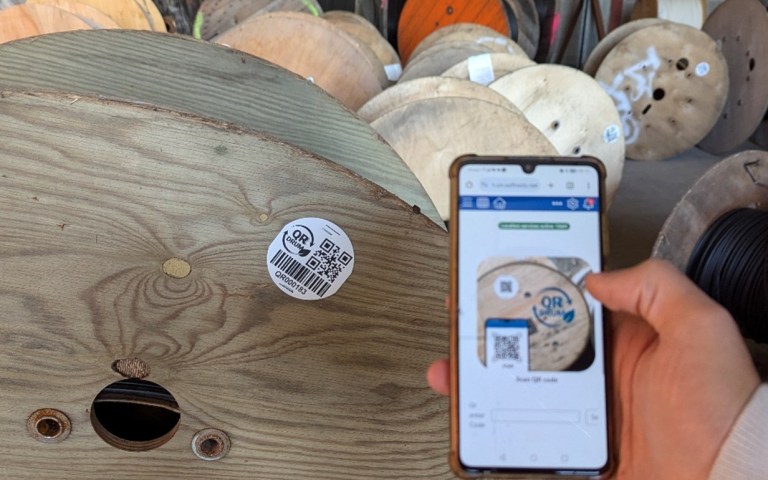
Fibre manufacturer ACOME Group has today announced the introduction of a new platform that they claim could help broadband operators to reduce the amount of expensive optical fibre cable network builders throw away each year. All you need is a QR code and an App that combine to keep a record of each cable drum and its usage.

The manufacturer claims that, every day, broadband companies “waste on average 10% of the full fibre cable they deploy” owing to a lack of knowledge of how much cable they have available in stock or on the field. The solution they came up for helping to solve this is called QR-Drum, which assigns a QR code to each cable drum to work as its digital twin (this keeps a record of cable lengths – down to the last metre, locations [cloud-based GPS tracking] and deployment history).

According to ACOME, this approach allows for a much more efficient fibre management, “cutting fibre cable waste by half or more, and saving up to 5% on cable costs“. The platform is compatible with any manufacturers’ cable-drum and caters to two types of users. Users ‘in the field’ have a mobile app to deploy and record data, and those managing stock use the desktop dashboard to monitor availability and waste in real time – taking some of the guesswork out of things.

ACOME’s QR Drum Product Manager, Delphine Dépont, said:

“Faced with higher interest rates, a need to cut costs and improve deployment efficiency, QR-Drum has been launched by ACOME Group to address a common industry issue of a lack of visibility on available cable lengths leading to overstocking issues. Reducing all forms of waste is a key element in any sustainability strategy. By limiting waste and landfill, the QR-Drum solution will help improve the environmental profile of the broadband sector.

The inability to track exact remaining cable lengths and the inordinate amount of time spent on inventories and logistics tracking, has long been a hindering factor in operational and cost efficiency in our industry.”

The new platform sounds like something that might be more useful for larger network operators, although a lot of providers already have reasonably good systems of their own in place for tracking cable usage. But clearly any new solutions that can help to minimise such issues are always welcome.

New platform slashes cable waste by 50% for FTTH-network builders

FTTH network builders can significantly reduce the amount of expensive optical fibre they throw away thanks to a new initiative from French cabling experts, ACOME Group .

Every day, broadband companies waste on average 10% of the full fibre cable they deploy owing to a lack of knowledge of how much cable they have available in stock or on the field. ACOME’s QR-Drum assigns a QR code to each cable drum which works as its digital twin, keeping a record of cable lengths, locations and deployment history. This allows much more efficient fibre management, cutting fibre cable waste by half or more, and saving up to 5% on cable costs. 

QR-Drum not only facilitates precise cable inventory management, providing information down to the last metre, it also streamlines and enhances the efficiency of the logistical process.

“Faced with higher interest rates, a need to cut costs and improve deployment efficiency, QR-Drum has been launched by ACOME Group to address a common industry issue of a lack of visibility on available cable lengths leading to overstocking issues”, said ACOME’s QR Drum Product Manager, Delphine Dépont. “Reducing all forms of waste is a key element in any sustainability strategy. By limiting waste and landfill, the QR-Drum solution will help improve the environmental profile of the broadband sector.”

QR-Drum, which is compatible with any manufacturers’ cable-drum, has been designed as close to the field as possible, with the help of operational teams, digitalising a work monitoring tool to streamline operations for on-site users and logistics teams alike.

The platform caters to two types of users. Users ‘in the field’ have a mobile app to deploy and record data, and those managing stock use the desktop dashboard to monitor availability and waste in real time. This dual-access approach helps contractors see exactly which installers still have stock, eliminating the guesswork on whether to reorder more materials.

“The inability to track exact remaining cable lengths and the inordinate amount of time spent on inventories and logistics tracking, has long been a hindering factor in operational and cost efficiency in our industry,” Delphine added.

“The QR Drum offers significant benefits by reducing both costs and cable waste,” said Thomas Cantin, Director of Digital Development at the Department Council of Ariège in Southwestern France, which used the solution. “With precise stock management, we’ve been able to avoid surplus fibre reels at project completion, achieving a 5% cost savings while minimising waste—a critical expense in cable management.

QR-Drum offers cloud-based GPS tracking, providing real-time access to data for each drum used by teams spread across the country, working for various subcontractors. Dashboards are effective tools for monitoring and controlling equipment consumption.

It also helps dispatch the right drum for the job, whether for larger projects requiring fuller drums or smaller tasks that can use partially used drums. It supports proactive stock planning by helping to avoid dead stocks and offers performance indicators as part of the platform.

For more information about QR-Drum, you can watch the video case study or visit: https://www.acome.com/en/publications/446-expert-opinions/3278-cut-fibre-cable-wastage-50-qr-drum-digital-platform


ENDS


About ACOME Group  

ACOME Group is an international industrial and cooperative company that designs and manufactures high-performing cables for the data and telecom infrastructure, building, and transport and automotive sectors.

ACOME has established itself in the UK to supply the market with FTTH telecom products based on its Nanomodule technology, which is specifically designed for UK operators and builders to help reduce costs, time and environmental impact.

With 13 factories in 7 countries, 9 logistic centres, and 2 R&D centres, ACOME employs more than 1700 people worldwide. The company turned over €558million in 2023. Find out more at https://www.acome.com/en or on LinkedIn or Twitter.


Nokia bags deal to connect new offshore wind farms 

silhouette of person standing near windmills

News 

The Finnish tech giant will provide the optical network to connect eight new renewable energy platforms in the North Sea 

Nokia has been selected by TenneT, a European offshore transmission operator, to supply key technology for a large renewable energy project in the Dutch North Sea.  

As part of the deal, Nokia will supply optical networking technology for eight new 2-gigawatt (2GW) platforms, keeping them connected to the mainland.  

The new 2GW program is designed to streamline energy transmission from offshore wind farms, creating a standardised approach to handling large volumes of renewable energy. TenneT has partnered with three consortia — Petrofac and Hitachi Energy, GE Vernova-Seatrium, and GE Vernova-McDermott — to deliver these platforms. 

Nokia will use its1830 PSS DWDM technology will reliably connect the offshore platforms to TenneT’s onshore systems, enabling TenneT to oversee and manage the platforms while ensuring steady energy transmission.  

The optical network will have long-distance un-repeatered transmission capabilities of up to 400km, with technologies designed to handle the challenging offshore environment. Nokia will also provide design, testing, and long-term support to ensure the system’s reliability. 

“At Nokia we know that ‘there’s no green without digital’. This project demonstrates that principle in action. By delivering standardised, high-performance optical networking technology that meets the unique demands of offshore environments, Nokia is supporting TenneT in providing reliable green energy to millions of homes across the Netherlands and Europe,” said James Watt, SVP and General Manager of Optical Networks business at Nokia in a press release. 

The rollout of Nokia’s technology will start in early 2025, in line with the construction of the 2GW platforms. The first platform is scheduled to become operational by 2029. 

Keep up to date with the latest international telecoms news by subscribing to the Total Telecom daily newsletter 

Also in the news:
Chinese engineers patenting submarine cable cutting tech
Myanmar’s Mytel among latest company to be added to US ‘Entity List
Uswitch highlights risks to customers as VMO2 targets 3G sunset