Football Drives London Internet Exchange to Hit 12Tbps of Global Data Traffic | ISPreview UK

Original article ISPreview UK:Read More

The not-for-profit London Internet Exchange (LINX), which handles a large chunk of UK and global data traffic through their switches via around 900+ members (broadband ISPs, mobile and CDN providers etc.), has revealed that last week’s UEFA Champions League, European League and Conference League games drove a new global internet traffic peak of over 12.069Tbps across the UK, US, Africa and Middle East.

During the football matches, LINX said they saw a new peak of 9.293Tbps (Terabits per second) at its LON1 interconnection hub in London, supporting large Content Delivery Network (CDN) members. LINX’s new peak is said to reflect the continued shift toward internet-first broadcasting, where OTT platforms, broadcasters, CDNs, ISPs and cloud providers are increasingly working together to deliver a better end-user experience.

NOTE: ISPs use sophisticated CDNs and other systems to manage the load from such events, which caches popular content closer in the network to users (i.e. improves performance without adding strain, which also keeps costs down).

The new maximum traffic peak across the LINX network also followed a new all-time traffic level in Riyadh, where LINX powers IXPs (Internet Exchanges) for center3. The exchange in Riyadh, Saudi Arabia, hit 1Tbps of traffic, proving its popularity as a hub for content in the Middle East.

LINX-Global-Traffic-16th-to-22nd-Jan-2026

Jennifer Holmes, LINX CEO, said:

“Surpassing an aggregate peak of over 12Tbps across all LINX-run IXPs is a milestone that highlights both the continued growth potential of our industry and the strength of our community. While the UK itself played a pivotal role in driving this peak, this achievement has been supported by our strategic focus in regions beyond the UK as we continue to see new peaks in Africa, North America and the IXPs we power in the Middle East.”

We should point out that LINX does not provide a complete overview of the internet traffic flow from all ISPs, but they do give a useful indication of how much extra traffic is flowing around when compared with normal conditions. Demand for data is of course constantly rising and broadband connections are forever getting faster, thus new peaks of usage are being set all the time.

Exascale to Launch UK Home Broadband Plans via CityFibre’s FTTP Network | ISPreview UK

Original article ISPreview UK:Read More

Internet provider and UK network builder Exascale, which has deployed their own gigabit speed Fibre-to-the-Premises (FTTP) network to a few thousand premises in part of Telford and Wrekin, has expanded on the recent launch of their consumer broadband brand (here) by making full fibre packages available to homes via CityFibre’s national network.

CityFibre’s network currently covers around 4.7 million premises (inc. 848,000 customers) and they’ve long aspired to reach up to 8 million UK premises – representing c.30% of the UK, although it’s not currently known whether or when they will reach that aspiration.

Exascale actually signed a partnership to harness CityFibre’s network all the way back in July 2025 (here), although they didn’t initially harness this to deliver consumer broadband packages until now. The catch is that these won’t become available to order via their website until “late February“, but we do have some early details.

Exascale’s CityFibre Packages (Overview)

– Speeds from 150Mbps through to 2.5Gbps synchronous
– Choice of terms 1 month through to 24 months
– Exascale WiFi router or bring your own

Technical Specification
– Dynamic or static IP addressing available (IPv4/IPv6)
– IPv6 allocation is /56
– Geo-redundant Cisco ASR 9900 series BNGs
– Service encapsulation is IPoE (DHCP) not PPPoE

The Exascale Network
– Present on 4 Internet exchanges in the UK
– Present on 10 Internet exchanges in Europe (Amsterdam/Frankfurt)
– Founding member of IX Midlands
– 7th largest network in the UK for AS Cone.
– 8th largest network in the UK for Peering
– We have our own fibre network in Telford, Shropshire passing thousands of homes and businesses in addition to relationships with Sky, Vodafone, ITS Technology, Virgin Media, Gigaclear and CityFibre.

About Exascale
– Have been providing connectivity nationwide since 2013
– We own and manage a UK wide network across 7 data centres in the UK and a further 2 in Europe (Amsterdam/Frankfurt).
– Our head office is based in Telford, Shropshire
– We have a dedicated customer support and account management team available on email and phone

We’re also expecting Exascale to introduce FTTP packages via Openreach and Gigaclear’s respective networks in the very near future.

Online safety-focused ISP Gigabit IQ seeking to crowdfund £270,000 | Total Telecom

Original article Total Telecom:Read More

a glass jar filled with coins and a plant

News

According to a report from ISPreview, UK ISP Gigabit IQ has opened a crowdfunding round seeking £270,000 to accelerate its expansion.

The company carries a pre-money valuation of £5 million and is offering 5.12% equity to new investors, as seen on the campaign page.

At the time of writing, the company has aready seen £243,650 committed by 40 investors.

Gigabit IQ is a retail ISP combining full-fibre connectivity with safety and device-protection services, such as FamilyGuard+ and CyberGuard+.

The company says it has an addressable reach of 1.5 million homes via various wholesale partners, including Full Fibre and F&W Networks’ networks.

The company first announced it would seek to raise cash via crowdfunding in October last year, saying the strategy reflected their community-centre approach to broadband. At that time, the company was aiming to raise £500,000.

Keep up to date with all the latest telecoms news with the Total Telecom newsletter

Also in the news
World Communication Award Winners 2025
Ofcom clears the way for satellite-to-smartphone services
LG Uplus’s AI voice call app glitch leaks user data

The post Online safety-focused ISP Gigabit IQ seeking to crowdfund £270,000 appeared first on Total Telecom.

CommunityFibre Allegedly Discouraged from G.Network Bid Over.. Rodents? | ISPreview UK

Original article ISPreview UK:Read More

The CEO of alternative UK broadband ISP and network builder CommunityFibre, Graeme Oxby, appears to have suggested that one of the reasons they opted not to make a bid for troubled rival G.Network stemmed from fears that rodents had chewed through its fibre optic cables. But the key issue may be more related to the general cost of maintenance than rats.

Just for a little context. G.Network is currently in administration after being acquired by distressed debt specialist FitzWalter Capital earlier this month (here), but we won’t recap all that again today. Both G.Network and CommunityFibre have deployed a full fibre broadband network across London, although CF’s network is significantly larger with 1.342 million UK homes covered (inc. 185k businesses within 200 metres of their network) and they’ve already overbuilt a fair bit of GN’s fibre.

NOTE: G.Network’s latest annual accounts to March 2024 (here) said their “wholly-owned and hard to replicate FTTP ducted network” now covered 416,000 premises, of which 361,000 are said to be “connectable under the Ofcom Connected Nations definition”. But an independent estimate in Sept 2025 put them closer to 255,100 as Ready For Service (here), while reports suggest they’re home to just 25,000 customers.

Suffice to say that the overbuild situation alone makes us sceptical of the business case for CommunityFibre potentially making a play for G.Network, although the goal could also have been more strategic (e.g. denying another rival entry to the area). Despite this, a new report on The Telegraph (paywall) appears to claim that CF ruled out bidding for GN “over fears that rats have chewed through its fibre-optic cables“, which may have attracted costly work to fix.

However, we suspect that the focus on rats in the newspaper’s article is more a reflection of journalistic choice, since rodents are quite a common problem for network operators to tackle and even CommunityFibre will sometimes have to deal with them.

Graeme Oxby, CommunityFibre CEO, said:

“Rodents like ducts and they like fibres which are very tasty.

It’s not something we’ve been particularly interested in because we think it’s got quite a lot of structural issues and would be quite an expensive fix.”

The same article does eventually highlight what may be the real issue, which is how G.Network has laid quite a few of its cables down the middle of some busy London roads, rather than under the pavements like most network operators. Suffice to say that this could make it more disruptive and thus costly to repair future damage, regardless of whether that’s been caused by rats or other things.

The added cost of upkeep could perhaps be seen by a potential suitor as having a negative impact upon the company’s asset value in any sale. But Oxby does also point to G.Network having “quite a lot of structural issues“, which makes clear that it’s not just rats he’s worried about, even though that’s where the Telegraph chose to place its focus.

Meanwhile, the Joint Administrators for G.Network said on 13th January 2026 that they’d “secured sufficient funding for the administration process, which will enable the Company to continue to trade as normal and to connect new customers. They do not anticipate that there will be any adverse impact on customers“. The Administrators are now starting to market the business for sale.

Finally, Oxby suggested that consolidation might not be the only option, and he believes that some alternative networks may yet survive to challenge the incumbents: “Clearly there are going to be the distressed consolidations, maybe lender-led or specialist-led, but we don’t feel that consolidation is the only answer. We set up to be successful competitors to the incumbent and introduce some competition into the market … I think that’s got lost a bit.”

G.Network’s most recent accounts reported an 85% increase in turnover to £10.2m in FY2024 and a gross profit of £7.3m (up 62%), with total assets of £453m (up from £394m). But they also suffered an operating loss for the year of £52.8m (down from £67.2m) and are estimated (Enders Analysis) to be carrying a net debt of over £300m.

CommunityFibre’s most recent accounts to the end of 2024 (here) saw revenue grow by 82.2% to £76m (2023: £41.7m), while gross profit increased by 87% to £65.9m and they reported total losses before tax fell of £118.5m (2023: £134.6m).

New Map of UK Cellular Coverage Goes Live to Help Examine Mobile Masts | ISPreview UK

Original article ISPreview UK:Read More

A group of friends in the UK cellular (mobile networks) community have launched a new interactive map – UKCellNet RF Map – that allows hobbyists and professionals to access public cellular data (e.g. location and data on mobile phone mast sites etc.) for free – sourced from places like SiteFinder, Ofcom, planning applications and council FOI / EIR requests etc.

The map, which has taken months of development, is still somewhat of an early stage work-in-progress project. The goal seems to be to provide a free and accessible alternative to paid services like Mastdata and the team are planning to implement more data, as well as features, as they go.

The map already has a few tools, such as different map layers, range of datasets, measuring tools and a Line-of-Sight (LoS) tool to draw basic coverage maps. But it’s still in beta and more futures are coming soon. For example, the website mentions future plans for “comprehensive technical data including roaming agreements, SIM information, band configurations, and operator specifications“.

Ryan D, Founder and Developer of UKCellNet, told ISPreview:

“UKCellNet, specifically the UKCellNet RF Map, is a free alternative to various paid platforms. It allows hobbyists and professionals to access public cellular data including SiteFinder and Ofcom WTR data all in one centralized map at no cost.

Our map currently features basic tools that allow users to change the map source, filter datasets, measure distances and azimuths, and generate Line of Sight (LoS) overlays for a general idea of a cell’s coverage in a 360° radius.

We plan to improve the mobile experience and add further map tools. We are also developing a street cabinet guide for the main UKCellNet page – including their respective model numbers – covering both CTIL and MBNL infrastructure.”

We think this looks like a very promising project and are keen to see how it evolves over the coming year(s), although you do have to sign up on the website before being able to view the map.

Openreach Exchange Fire Disrupts Broadband Services in Strathaven | ISPreview UK

Original article ISPreview UK:Read More

Broadband internet connectivity, phone and some Ethernet services being delivered by the Strathaven Telephone Exchange in South Lanarkshire (Scotland) have been disrupted after the site was hit by a serious fire. Approximately 1,500 customers on Openreach’s (BT) local network are understood to have been impacted.

The fire is said to have occurred during Saturday morning (24th Jan 2026) and an industry briefing, seen by ISPreview, indicates that “significant damage” has sadly been done to the building. But thankfully nobody was hurt and firefighters have since put the fire out.

Details of the incident are currently still in short supply because Openreach has had to wait for the building to be made safe and investigated by the emergency services before they can fully assess things. But the cause is NOT currently believed to be related to faulty equipment and early indications suggest some sort of 3rd party involvement.

An Openreach spokesperson told ISPreview:

“We’re aware of a fire at our site in the early hours of Saturday morning and our teams continue to assess the damage and making the area safe. We’re doing everything we can to minimise the impact on people who use our phone and broadband services. Engineers are only able to begin work as soon as it’s safe, and we’ll provide further updates as soon as we’re able.”

The site is currently closed and, due to the ongoing investigation and the extent of the damage, Openreach are not yet able to confirm a full restoration timescale. More updates are expected to follow during the early week as the operator’s restoration teams get to work.

Altnet Broadband ISP Gigabit IQ Starts UK Crowdfund to Raise £270,000 | ISPreview UK

Original article ISPreview UK:Read More

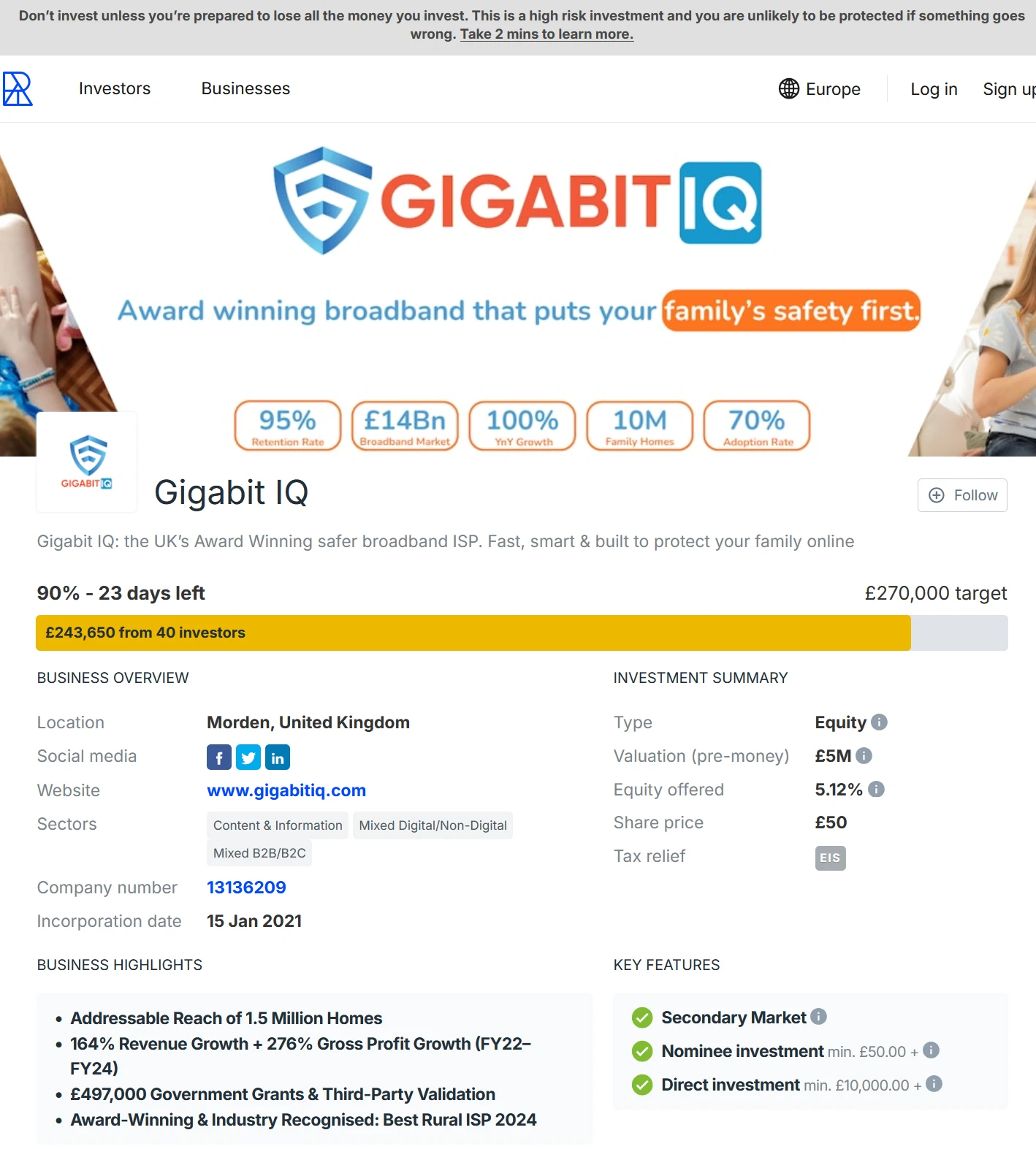
Internet access and online security provider Gigabit IQ (formerly Grayshott Gigabit) has officially launched their promised crowdfunding campaign, which aims to raise fresh investment of £270,000 to help grow and expand the business via the “next generation of safe, reliable broadband for the country“.

Readers might recall that we first covered Gigabit IQ’s then tentative plan back in October 2025 (here). At the time we remarked that the idea of crowdfunding in this way was rather unusual for a broadband provider and isn’t likely to scale as well as shares or direct investment agreements (e.g. private equity, debt, bank loans, public subsidy etc.), but it could still have some benefits, provided investors are willing to take the risk.

Speaking of risk, the original notification email from last year also rightly warned that this would be a “high risk investment” and one where those who make a commitment are “unlikely to be protected if something goes wrong“. All of this is very important because Gigabit IQ isn’t yet a large, familiar brand like some of the market’s other players.

However, despite the challenges of such an approach, the provider has just informed ISPreview that they went live on Republic Europe last week with their first EIS-eligible (Enterprise Investment Scheme – tax relief) crowdfunding round to help them “scale nationally“. The pre-promotion work also seems to have paid off as, at the time of writing, some 40 investors have already committed £243,650 of the £270k target with 23 days left to run.

Gigabit-IQ-Investment-page-Republic-Screenshot

The campaign mentions the provider as having an “addressable reach” of 1.5 million homes, which we’re told reflects the “total capacity” of all the alternative wholesale fibre networks they currently work with to deliver their services (e.g. Freedom Fibre’s alternative FTTP network and others).

According to the details, the company appears to be offering Equity of 5.12% in the business, which is the percentage of the company’s shares being issued in return for the amount of investment raised. Individual investors can commit anything from as little as £50 (price of one share) and upwards, although unfortunately you have to sign up to the Republic Europe site to see all the details.

The targeted level of funding (£270k) isn’t all that huge in today’s landscape of expensive broadband altnets and retail provider expansions, so it instead seems to be more focused on development of their existing internet security services and systems / platform (we’re checking this). We’ll keep an eye on this one to see how it fares.

Ofcom UK Probe WhatsApp Over Inaccurate Information in Biz SMS Market Review | ISPreview UK

Original article ISPreview UK:Read More

The UK telecoms and internet content regulator, Ofcom, has opened an investigation into Meta’s WhatsApp Business messaging service after provisionally finding that the information they supplied – as part of a recent review into the wholesale market for business bulk SMS messages – “may not have been complete and accurate“.

Just to recap. Ofcom’s recent review examined the wholesale prices of automated text (SMS) messages that organisations send to people (A2P – application-to-person). Such messages are often sent, for example, by the NHS when issuing medical appointment reminders, as well as parcel delivery notifications or one-time passcodes etc.

Back in October 2025 the regulator found that wholesale prices for the termination of these messages (A2P SMS termination rates) had increased significantly in recent years, jumping as much as 70% since 2021. Ofcom also identified that mobile operators had Significant Market Power (SMP) in this area, including the “ability and incentive to increase their termination prices to an excessively high level“. A voluntary agreement was later reached with EE, O2, Sky and VodafoneThree (Vodafone and Three UK) to stabilise the wholesale prices of such messages (here).

However, as part of that review, Ofcom also issued formal information requests to Meta concerning their WhatsApp Business messaging service. The move was intended to help the regulator understand more about the alternative business messaging services that are now available and their impact upon the market.

Ofcom Statement

The available evidence suggests that Meta may not have complied with certain requirements imposed under section 135 in that some of the information provided by Meta in response to the Notices may not have been complete and accurate. Ofcom’s investigation will examine whether Meta has failed to comply with the statutory requirements imposed by the Notices.

Such investigations tend to take quite a while to fully run their course, so we probably won’t learn the outcome until around the latter half of this year. If Ofcom identifies that a breach has occurred, then it could potentially impose financial penalties (up to £18 million or 10% of qualifying worldwide revenue) or merely direct the company to improve their processes, depending upon the severity. Criminal charges are also an option, but such an outcome is usually only reserved for the most serious breaches and obstructive companies, which is highly unlikely to be the case with Meta.

Broadband ISP Group TalkTalk Starts Talk Talking to Potential UK Bidders | ISPreview UK

Original article ISPreview UK:Read More

A new report has this afternoon claimed that the debt strained TalkTalk Group, which last year reportedly appointed advisers PJT Partners to help sell off its remaining operations (here), have now allegedly begun talks with several prospective bidders for their various divisions.

The group has certainly had an eventful few years, which was headlined by the demerger of their businesses (Talk Talk Consumer, PXC [Wholesale] and Talk Talk Business Direct) and last year’s signing of a crucial £400m refinancing package, which enabled them to avoid a default on their debts until 2027 (here, here). This was later followed up by a £120m funding deal to help tackle ongoing financial pressures (here).

NOTE: The Group’s latest annual accounts (here) revealed that TalkTalk made a statutory loss before tax of £465m for the year ended 28th February 2025 (up from £153m last year). The overall level of net debt (excluding leases) has also hit £1.2bn – rising to £1.96bn if you include leases.

More recently they’ve also launched a major brand refresh and advertising push for their consumer broadband ISP business (here). At the same time the group is still doing everything it can to cut costs and tackle their underlying debt problem, including the possible disposal (sale) of its remaining businesses and more job cuts (here).

According to Sky News, the embattled group has now moved to the next phase by allegedly opening tentative discussions with potential buyers for their various divisions. The talks are expected to attract interest from a number of suitors, such as Vodafone and Virgin Media (O2), although it’s too early to know if anybody will place a serious bid.

At present, the likes of Vodafone and Sky Broadband are probably better fits for TalkTalk’s consumer base than BT or Virgin Media, partly due to their packages, pricing and network selection being more closely aligned; at least in some respects. But a deal with BT can probably be ruled out due to competition concerns.

In addition, it’s unclear whether Vodafone would be willing to take on the added complications of a retail consolidation, while also still being busy with their Three UK mobile merger. TalkTalk declined to comment on the Sky News report. Credits to forum member Ionide for pointing us to this development.

Open Cosmos launches first satellites for new LEO constellation | Total Telecom

Original article Total Telecom:Read More

Press Release

Open Cosmos, the company building satellites to understand and connect the world, has today launched the first satellites in its new proprietary low-Earth-orbit (LEO) telecom constellation, just one week after securing high-priority Ka-band spectrum.

The two satellites, launched by Rocket Lab from Mahia Peninsula, New Zealand on its Electron rocket for the mission named ‘The Cosmos Will See You Now’, represent the first activation phase of Open Cosmos’ future-ready satellite network – a programme designed to deliver scalable, resilient and coordinated space-based services for Europe and the world.

Lift-off took place as scheduled at 10:52 (GMT) / 11:52 (CET) / 23.52 local time (NZDT) on 22 January, ushering Open Cosmos from constellation design and manufacturing into on-orbit validation – sitting at 1050km circular Earth orbit.

Beyond the technical achievement, the launch serves as a powerful proof point for Open Cosmos’ constellation readiness. It confirms that the system design, manufacturing processes and operational model are flight-ready – laying the groundwork for the phased roll-out of the wider network in the months ahead.

Commenting on the launch, Rafel Jordà Siquier, Founder and CEO of Open Cosmos, said:
“This launch is a major milestone for Open Cosmos and a critical step in our mission to provide secure, sovereign connectivity for Europe and the world. Moving from spectrum to satellites in-orbit demonstrates not only the maturity of our system, but our ability to turn strategic ambition into operational capability extremely fast.

“These first satellites lay the groundwork for a resilient network designed to support governments, institutions and commercial partners with dependable space infrastructure when it matters most.”

The first two satellites are the result of a truly pan-European effort, with teams across the UK, Spain, Portugal and Greece contributing to the programme. Together, they showcase Open Cosmos’ vertically integrated approach – from mission design and satellite production to operations. The satellites will operate under Spain’s regulatory framework for satellite registration and operational licensing.

Rocket Lab Founder and CEO, Sir Peter Beck, said: “What a great way to start off the year, by welcoming a new customer and launching a mission tailored just for them. We’re proud to deliver their payload to orbit and with Rocket Lab’s proven track record of consistent quality and 100% mission success in recent years, I’m confident to say they made the right choice. Partnering with Open Cosmos is an exciting opportunity, and we look forward to supporting our European partners in achieving their launch goals.”

From spectrum to space
The launch follows Open Cosmos’ recent (14th January) award of scarce High-Priority Ka-band spectrum filings from the Principality of Liechtenstein, a critical enabler for the company’s constellation ambitions. With the satellites now in orbit, Open Cosmos can begin testing and validating the system performance in real operational conditions.

In orbit, the satellites will be used to:

  • Test satellite operations and first testbed demonstrations
  • Validate system developments across the wider future network
  • Demonstrates proof-of-concept for Open Cosmos constellation readiness

Together, they form the foundation for a scalable, multi-satellite architecture designed to meet growing global demand for reliable space-based capabilities.

By combining in-house manufacturing, European engineering talent and access to strategically valuable spectrum, Open Cosmos is positioning itself as a new kind of constellation builder: agile, collaborative and focused on delivering practical, deployable space infrastructure providing secure connectivity and critical data.

Keep up to date with all the latest telecoms news with the Total Telecom newsletter

Also in the news
World Communication Award Winners 2025
Ofcom clears the way for satellite-to-smartphone services
LG Uplus’s AI voice call app glitch leaks user data

The post Open Cosmos launches first satellites for new LEO constellation appeared first on Total Telecom.