BT Scrap Pilot to Convert Openreach UK Broadband Cabinets to EV Chargers

Only a few months have passed since BT’s awkwardly named UK digital incubation team, Etc., “powered up” their first Electric Vehicle (EV) charger under a 2-year pilot, which was one of potentially tens of thousands that could have been established by repurposing Openreach’s old broadband street cabinets. But it’s now being powered down and the whole scheme shelved.

Just to recap. The pilot scheme had been in the works since mid-2023 (here), although the process of actually getting it underway didn’t officially start until January 2024 (here) and the first EV car charger then didn’t do live until May 2024 (here). The core idea was for BT and Openreach to “convert or upgrade” up to 60,000 street cabinets (from a potential pool of 90,000). BT previously clarified to ISPreview that the focus here is on their FTTC (VDSL2) / DSLAM broadband cabinets, rather than older Primary Connection Points (PCP).

NOTE: Openreach’s FTTC cabinets tend to only serve their hybrid fibre broadband services, while PCPs are more focused on phone services (although some did carry G.fast broadband too).

The charging solution itself – offering up to 7.8kW – worked by retrofitting the cabinets with a device that enabled renewable energy to be shared to a charge point alongside the existing broadband service, with no need to create a new power connection. EV charging could thus, it was hoped, be deployed to cabinets that are in-use for current copper broadband services, or in those due for retirement, depending on the space and power available to the unit. Such a use case would only grow as more cabinets were decommissioned as part of the wider transitional to full fibre (FTTP) broadband ISP lines.

The first pilot EV charger ultimately went live on Monkmains Road in East Lothian (Scotland) and plans were already in motion for the next phase to focus on the deployment of up to 600 trial sites across the UK, starting in West Yorkshire (England). But Fast Charge broke the news yesterday (credits to Jon for the tip) that the pilot had been “killed” and, according to a notice sent to users of the supporting Evve Charge app, the single pilot cabinet in Scotland would be decommissioned on 14th February 2025.

A BT Spokesperson said:

“Our EV charging trials have focussed on how we might help address the charging needs EV drivers face across the UK. By adopting a pilot process we have been able to test and explore a great deal about the challenges that many on-street EV drivers are facing with charging and where BT Group can add most value to the UK EV ecosystem.

Other emerging needs we’ve identified include the Wi-Fi connectivity challenge surrounding EV’s – our pilots will now shift in focus to explore this further.”

Naturally, this approach was never going to work in every location, since not all cabinets are suitably positioned and there may be other obstacles too (e.g. issues of council approval, road access, physical location etc.). Suffice to say that pilots are useful ways of testing all of the possible caveats and working out whether the business model is viable. But the reality is that such pilots don’t always live up to expectations, as seems to be the case here.

At the time of writing, BT still has not – in our view – provided a proper explanation for specifically why the pilot has been scrapped and so soon after it first went live. But the above statement does appear to be suggesting that one problem could be in ensuring that the chargers and drivers were able to access a reliable data connection (necessary for payments and managing the charge etc.). Nevertheless, this wouldn’t be an obstacle for every location, thus we suspect it simply didn’t make economic sense.

Neos Networks Helps LightSpeed Expand UK FTTP Broadband Network

Alternative network operator and ISP LightSpeed Broadband, which has built a gigabit-capable (FTTP) network across 250,000 premises in the East of England, has today signed a new agreement that will enable them to expand their services by gaining access to Neos Networks dark fibre, 100Gbps and 10Gbps optical links, and backhaul services etc.

Neos currently runs one of the biggest (34,000km long) business fibre networks in the UK – spanning 550 exchanges, 90+ data centres and 676 Points of Presence (PoPs). The operator is already working to help support a number of other alternative networks with their services, and LightSpeed has just become the latest to join that club.

NOTE: LightSpeed, which was acquired by Kompass Kapital in July 2023 (here), aims to extend their full fibre network to cover around 400,000 homes by 2027. The provider claims to have deployments across parts of 32 market towns in South Lincolnshire, Norfolk, Suffolk, Essex, Cambridgeshire and Rutland.

According to the announcement, greater availability of LightSpeed’s services is now being developed utilising Neos Networks’ extensive UK-wide network, providing its wholesale customers greater access and choice when purchasing connectivity. But that’s not all.

The partnership is said to enable LightSpeed Networks to “expand into new regions like North Staffordshire” and “connect to critical data centres in London, Manchester, and Birmingham“. As a result, LightSpeed said they will also be able to offer bespoke wholesale services and managed solutions to other ISPs, delivering alternatives to incumbent providers.

Chris Tagg, CTIO at The LightSpeed Group, said:

“Partnering with Neos Networks allows us to bring faster, more reliable connectivity to homes and businesses in the East Midlands and beyond. This collaboration equips us with the flexibility and scalability to expand rapidly into new markets while staying true to our commitment to exceptional service delivery – especially in areas where traditional options like BT Openreach are unavailable.”

Lee Myall, CEO at Neos Networks:

“Our collaboration with LightSpeed is a prime example of how advanced network infrastructure can support providers in reaching underserved areas. By delivering tailored connectivity solutions, we’re enabling LightSpeed to expand their footprint and bring high-quality broadband to more communities and businesses.”

Take note that the LightSpeed Group operates through two entities: LightSpeed Networks, which builds and manages the infrastructure for its retail and growing wholesale services, and retail ISP LightSpeed Broadband, which provides gigabit-speed connectivity directly to homes and businesses across the Midlands and East of England.

BT’s First Real-World UK Deployment of 5G Standalone Network Slicing

Telecoms giant BT has today said they recently conducted their “first real-world deployment” of a 5G Standalone (5GSA) mobile broadband network using network slicing technology, which formed part of a trial that brought “superfast payments” to the Belfast Christmas Market last month.

Just for some context. 5G SA networks are pure end-to-end 5G that remove the legacy of 4G connectivity and can thus deliver ultra-low latency times, greater energy efficiency, better upload speeds, network slicing, improved support for Internet of Things (IoT) devices, support for Voice over New Radio (VoNR or Vo5G) and increased reliability and security etc. EE has already begun to deploy 5G SA across busy parts of various UK cities (here).

As for network slicing, this is a related feature that allows for multiple virtual network slices across the same physical network. Each slice is isolated from other network traffic to give dedicated performance, with the features of the slice tailored to the use case requirements (online gaming, enhanced mobile broadband etc.).

In this case, BT conducted a 2-week trial, located in Lavery’s Beer Tent at the Belfast Christmas Market, which harnessed their 5G SA network and network slicing in order to support eight mobile payment terminals, enabling faster and more resilient card and mobile payments for thousands of customers at the busy market.

The trial demonstrated the capability of network slicing to help bypass congestion in busy locations and keep businesses connected through dedicated quality of service.

Paul Murnaghan, BT Group’s Northern Ireland Director, said:

“Businesses increasingly rely on technology that’s able to cope with the demands of the ever-pervasive digital world, securely. We have all visited a retailer and had the awkward ‘wait while we check’ to see if a payment has been completed correctly. Network slicing helps tackle this problem by enabling consistently fast and smooth connectivity, critically giving certainty to both traders and customers even when the network is busy in specific locations like Belfast Christmas Market.”

The catch here is that 5G SA networks are still in their infancy and so the opportunities for using network slicing in this way remain limited, although this will grow as the availability of such features expands. Vodafone last year conducted a similar trial at the far more challenging Glastonbury Festival (here).

Ofcom Begin Process of Imposing Age Verification on UK Internet Sites

The UK telecoms and media regulator, Ofcom, has today moved forward with implementation of the government’s tedious new Online Safety Act (OSA) by publishing industry guidance on how websites and social media services should introduce “effective age checks“. The goal is to prevent children from encountering online porn and protect them from other harmful content.

The focus around the new age verification requirement is frequently expressed as being something targeted towards pornography services, which must introduce age checks by July 2025 at the latest. But some of the new requirements also stretch to “all user-to-user and search services” in scope of the act (e.g. social media, online forums, tube sites, cam sites, and fan platforms) – both big and small sites alike.

NOTE: Ofcom have decided NOT to introduce numerical thresholds for highly effective age assurance “at this stage” (e.g. 99% accuracy), which in any case would be a very difficult thing to judge with any accuracy.

The regulator’s new guidance sets out how the new legal duty will work and makes clear that any age-checking methods deployed by services must be “technically accurate, robust, reliable and fair” in order to be considered “highly effective“.

Previous methods, including self-declaration of age and online payments that don’t require a person to be 18, are deemed NOT highly effective. By comparison, Ofcom says that open banking, photo ID matching, facial age estimation, mobile network operator age checks, credit card checks, digital identity services and email-based age estimation are highly effective.

What are online services required to do, and by when?

The Online Safety Act divides online services into different categories with distinct routes to implement age checks. However, the action we expect all of them to take starts from today:

  • Requirement to carry out a children’s access assessment.  All user-to-user and search services – defined as ‘Part 3’ services – in scope of the Act, must carry out a children’s access assessment to establish if their service – or part of their service – is likely to be accessed by children. From today, these services have three months to complete their children’s access assessments, in line with our guidance, with a final deadline of 16 April. Unless they are already using highly effective age assurance and can evidence this, we anticipate that most of these services will need to conclude that they are likely to be accessed by children within the meaning of the Act. Services that fall into this category must comply with the children’s risk assessment duties and the children’s safety duties. [i.e. they must record the outcome of their assessment and must repeat the children’s access assessment at least annually].
  • Measures to protect children on social media and other user-to-user services. We will publish our Protection of Children Codes and children’s risk assessment guidance in April 2025. This means that services that are likely to be accessed by children will need to conduct a children’s risk assessment by July 2025 – that is, within three months. Following this, they will need to implement measures to protect children on their services, in line with our Protection of Children Codes to address the risks of harm identified. These measures may include introducing age checks to determine which of their users are under-18 and protect them from harmful content. 
  • Services that allow pornography must introduce processes to check the age of users: all services which allow pornography must have highly effective age assurance processes in place by July 2025 at the latest to protect children from encountering it. The Act imposes different deadlines on different types of providers. Services that publish their own pornographic content (defined as ‘Part 5 Services) including certain Generative AI tools, must begin taking steps immediately to introduce robust age checks, in line with our published guidance. Services that allow user-generated pornographic content – which fall under ‘Part 3’ services – must have fully implemented age checks by July. 

As part of this, Ofcom have also opened an age assurance enforcement programme, albeit focusing their attention “first” on Part 5 services that display or publish their own pornographic content. If sites fail to act, the OSA allows Ofcom to impose financial penalties worth up to 10% of a company’s annual worldwide turnover (max of £18m) and they could also implement “business disruption measures” against third-parties, such as by imposing restrictions via internet search engines, payment providers or by requiring broadband ISPs to block the website.

In addition, porn providers are effectively also forbidden from directing or encouraging people to use circumvention measures (VPN, Proxy Servers, DNS changes etc.), although anybody under 18 who does go actively seeking such content (let’s face it, there will be a lot of active seeking) will have no difficulty finding and using circumvention measures, as has always been the case. The horse on this one bolted a long.. time ago.

Dame Melanie Dawes, Ofcom’s CEO, said:

“For too long, many online services which allow porn and other harmful material have ignored the fact that children are accessing their services. Either they don’t ask or, when they do, the checks are minimal and easy to avoid. That means companies have effectively been treating all users as if they’re adults, leaving children potentially exposed to porn and other types of harmful content. Today, this starts to change.

As age checks start to roll out in the coming months, adults will start to notice a difference in how they access certain online services. Services which host their own pornography must start to introduce age checks immediately, while other user-to-user services – including social media – which allow pornography and certain other types of content harmful to children will have to follow suit by July at the latest.

We’ll be monitoring the response from industry closely. Those companies that fail to meet these new requirements can expect to face enforcement action from Ofcom.”

As usual Ofcom, just like the government, are still giving the impression above that this is only impacting “companies“, which remains very misleading as many of the rules also catch small blogs and forums that may have nothing to do with porn content – often imposing an intolerable level of legal liabilities and complexity on those least able to be able to understand, afford or handle it. This is to say nothing of the wider problems.

One of the risks above stems from the fact that users of some services may end up being forced to share their private personal details with companies connected to unreliable porn peddlers. The infamous “Ashley Madison” data breach in 2015 highlighted just how dangerous such information could be in the wrong hands (multiple cases of blackmail and suicide etc.).

Ofcom does state that all age assurance methods must be subject to the UK’s privacy laws, including those concerning the processing of personal data – as enforced by the Information Commissioner’s Office (ICO). Porn services must also keep written records explaining how they protect users from a breach of these laws. But we suspect that won’t provide end-users with much reassurance, given the frequency of modern data breaches – even at state level.

Back in 2023 the European Policy Information Center (EPICENTER) published a report that summed these challenges up quite nicely, not least by highlighting the tendency of politicians to “promise the impossible without fully understanding the dynamics of what they are trying to regulate and without giving sufficient consideration to the side-effects of the proposed solutions.” That’s really the OSA, in a nutshell.

At the same time there’s a concern about treating all under-18’s so generically as merely “children” in the realm of any internet content. This is something that many in their late teens (particularly the 15-18 bracket) will no doubt find to be quite insulting. It could also make it harder for them to engage online in even safe communities that having nothing to do with porn or harmful adult content, as site owners will be thinking first of their own liability etc.

Finally, many have questioned whether such a system is even necessary, since all of the major broadband and mobile providers already offer optional network-level filtering systems that cover porn and adult content (e.g. gambling) – these are usually enabled by default.

Lest we also forget that there could be unintended impacts in other areas too, such as on sex workers (i.e. pushing them off-line and back onto the streets). Likewise, there’s the question of freedom of expression, not least with respect to the debate over what is and what is not porn (i.e. general nudity, medical content and erotic stories). The puritanical approach being taken by the Government does seem to create a few grey areas.

Report Examines Customer Take-up of Openreach vs AltNet Broadband ISPs

Strategic consultancy firm Eight Advisory has today launched a new Takeup Tracker, which examines the steady rise in take-up across the UK’s many alternative full fibre broadband (altnet) networks and compares it with that of incumbent operator Openreach (BT). The new tracker paints a mixed picture, albeit one with some positives to share.

Overall, altnet penetration has slowly increased over the last 6 months, along with their focus on profitability. While some continue to build at pace, many altnets have slowed or stopped build during 2024. Altnet penetration at aggregate level was estimated to be 17% in September 2024 (up 1 point from the 16% reported in May 2024). But there remains significant variation between providers and individual cohorts.

In the same timeframe, Openreach’s FTTP take-up rose to 35% (up 3 points since May 2024), which is despite the operator accelerating build as they “continue to enjoy an incumbency advantage for new orders and migrations that comes from accessing 80% of the retail market” (via major ISPs like BT (EE, Plusnet), TalkTalk, Sky Broadband and Vodafone etc.). This is important as 90% of the Consumer ISP market continues to be served by just five large brands.

Openreach are clearly doing well above, as a rapid network roll-out will often contribute to help suppress take-up figures, particularly when expressed as a percentage (i.e. build will often add premises at a greater rate than customers can adopt it). The loss of customers can also cause take-up figures to fall.

However, despite Openreach’s strength and the challenging market environment (high interest rates, rising build costs and competition), some altnets have clearly been making progress. For example, CommunityFibre, Fibrus and Ogi have all exceeded the 25% take-up mark. On the flip side, Hyperoptic’s take-up seems to have fallen from 30% in 2021 to 20% today, which isn’t explained in the report (but it could be at least partly due to the ‘stop-and-start’ phasing of their build, as well as some customer bleeds in existing areas).

Eight-Advisory-2025-summary-of-UK-full-fibre-network-takeup

At a market level, broadband retail pricing was also found to be down by 4% in real terms in the year to September 2024, as competition hots up for new customers. But overbuild between networks is “becoming increasingly challenging“, with Thinkbroadband previously publishing analysis showing 69% of premises had FTTP networks – with 22% having two networks, 2.8% with three and 0.2% with four. This makes growing take-up harder.

Despite the aforementioned issues, altnets are still collectively – albeit slowly – stealing customers away from some of the established ISP brands, although it should be pointed out that both TalkTalk and Vodafone do sell packages via more than just Openreach. For example, Vodafone also sells via Cityfibre, and so does TalkTalk (Sky will join them later this year), but TalkTalk also works with several other altnets. Suffice to say that expressing altnets as one group, as occurs in the chart below, may not be fully representative.

Eight-Advisory-2025-summary-of-UK-isp-market-share-vs-altnets

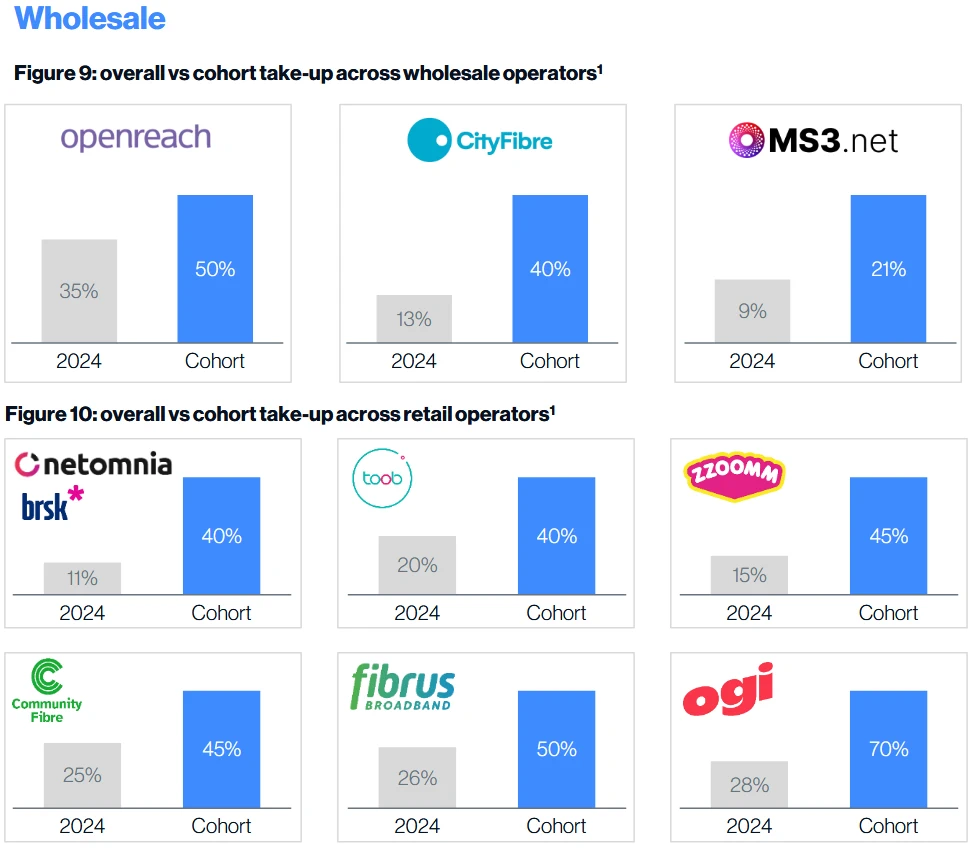
The new Takeup Tracker and associated report doesn’t only look at the aggregated totals and also, for the first time, includes a cohort analysis. A cohort typically refers to a group of customers that are part of a specific phase in the network roll-out or marketing campaign. Each operator will define the customer cohorts differently, thus like-for-like comparisons remain difficult.

The consultancy firm interviewed senior leaders across UK operators to understand cohort-level detail and has included some data from that, albeit framed with the aforementioned caveat.  For example, following discussion with Netomnia’s (inc. Brsk) CEO, the report noted how they now have three of their more mature cohorts achieving high take-up levels, above 30%. Some other vertically integrated Altnets have also been able to achieve cohort performance between c.40-70%.

Netomnia also added a similar number of subscribers to Vodafone in Q3 2024 through their YouFibre & Brsk ISPs, making them the fastest growing ISP of any size. “With Altnet total adds of 160k, they are taking around a 30% of the adds from about 15% of the Altnet footprint,” said the report.

Meanwhile, BT (Openreach) report over 50% take-up on their oldest cohorts, which date back to June 2020. In Milton Keynes, CityFibre’s most mature market, where the build programme started in 2018 and completed in 2022, more than 30% of the homes have already chosen to move over to CityFibre’s network with the first areas served at approximately 40% with growth month-on-month.

Eight-Advisory-2025-summary-of-UK-full-fibre-network-takeup-cohorts

Clearly, given enough time and the right locations, altnets can attract plenty of interest and punch above their weight, which will get them closer to the take-up levels needed for EBITDA breakeven and profitability.

Adam Bradley, Partner & European Telecoms Lead at Eight Advisory, said:

“Driving Take-up to improve profitability and achieve breakeven is the top priority of most altnets and a critical consideration for the many active fibre financing and refinancing processes.

With the slowdown of build for many in 2024, the expected market consolidation is also taking longer than many expected. In the meantime, many altnets continue to outperform their national market share expectations at a local cohort level.”

At the time of writing, we don’t yet have the link to Eight Advisory’s new Takeup Tracker (it wasn’t live), but we’ll aim to add this shortly.

Netgem TV Adds Sports Channels via Supporting UK Broadband ISPs

Digital entertainment platform provider Netgem TV has today announced that their IPTV box and service, which is typically bundled by broadband ISPs like Brsk, TalkTalk, Connect Fibre, CommunityFibre and a few others, will benefit from a new partnership with Sports Studio that adds more than 40 free sports channels from its Free Live Sports streaming platform their TV Guide.

The set-top-boxes that they provide – like the Netbox 4K (inc. HDR, bluetooth pairing, Ethernet, WiFi, USB and Dolby Atmos sound) – tend to be similar to some of those supplied by rival video streaming companies and include an often familiar array of premium content, apps (iPlayer, itvx, 5, UKTV play, Amazon Prime Video etc.), live TV channels (Freeview) and catch-up content.

The new Free Live Sports offering is said to be “available at no charge to viewers” (we’re probably not talking about super premium content here) and is said to include a broad range of live sports channels. Netgem added that they’re the “first European platform to partner with Sports Studio” and the new content will cover everything from Football to Motorsports, and MMA to competitions like Pickleball, Esports, Competitive Slapping (yes.. they said that) and Billiards.

The platform’s new channel lineup includes Big 12 Studios, MTRSPT1, PFL, Tennis Channel, Horse & Country, TNA Wrestling, and many more.

Sylvain Thevenot, Chief Commercial & Customer Officer at Netgem Group, said:

“We’re excited to be the first European platform to partner with Sports Studio and bring the Free Live Sports offering to our viewers in the UK and Ireland. This partnership enhances our commitment to providing a wide variety of premium content, with no subscription required, making world-class sports coverage more accessible.”

We only have one question, does ‘Competitive Slapping’ involve any UK politicians?

BT Confirms Revised Annual Mid-Contract Price Hikes Policy for 2025

Broadband, TV, phone and mobile provider BT (inc. EE) has today reiterated their policy on annual UK price increases, which readers may recall was first introduced last year (here and here). This is intended to align with Ofcom’s ban on mid-contract price hikes that are linked to confusing inflation and percentage-based changes (here).

Just to be clear. Ofcom’s change is NOT designed to stop mid-contract hikes completely, and is more about making future pricing clearer and simpler. But it does require providers to tell customers precisely what any future price increases would be when they sign up (“in pounds and pence“). This rules out changes to ‘core subscription’ prices that are linked to unknown future inflation values or percentages.

One of the catches with this change is that consumers may find themselves, depending upon the state of their existing contract, being impacted by either the old or newer policies (i.e. Pounds and Pence vs CPI + 3.9%) because the market is currently in a state of transition. Some providers, like Virgin Media, have got around this by pushing existing customers on to the new policy, while most others, like BT, are allowing customers to make their own decision when re-contracting or upgrading.

BT’s update today merely confirms that they haven’t made any changes to the policy that was first adopted in the spring of last year, so they’re not really saying anything particularly new. But some may find the information they’ve issued useful.

BT’s Pricing Policy Statement

So, from 31 March 2025, for new and re-contracting mobile customers on the Pounds and Pence model, this annual increase will be an extra £1.50 a month. It will be £1.50 a month for connected devices (including laptops, tablets and smart watches), £2 a month for TV customers, and £3 a month for broadband customers.

There will be customers on our CPI+3.9% model, because they were already in contract before we introduced the Pounds and Pence change. There will also be some customers with a mix of the two models across different products.

For CPI+3.9%, we use the December rate calculated by the Office of National Statistics to calculate our price change. This was 2.5%, which means a price change of 6.4% (CPI:2.5% + 3.9%). On average, this year’s change is around £2 to £3 per month – a very small part of an average household’s bill.

A total of 2.6 million customers will be excluded from price change. This includes our Social Tariff customers, landline only customers who don’t have broadband with us or another provider, and those with PAYG on mobile.

For everyone else, this small increase means we can keep giving our customers even more with the latest tech across fibre and mobile as we roll out 5G standalone and Wi-Fi 7 – setting a new standard for connectivity in and out of the home – continue to invest in our network and keep our most financially vulnerable customers connected.

We’re the UK’s best mobile network for 11 years in a row, and one of the country’s fastest broadband providers. The quality of those network is the foundation that means we can bring our customers so much more as demand continues to increase. Average mobile data useage, for example, has more than trebled in the past five years, and mobile download speeds have doubled.

With customers using more data and getting faster speeds, these relatively small price increases mean we can give them the networks they need.

As we’ve previously reported, most of those broadband customers on the older CPI+3.9% model will probably be better off than those who are subject to the new policy (here), which reflects the fact that a static £3 per month increase will often be greater than +6.4%. The other catch is that those on the cheapest entry-level packages will be hit the hardest by the new policy as the £3 increase is the same for everybody, regardless of how much you pay per month.

The policy also only applies to the core subscription prices and not optional add-ons, out of bundle charges or call prices. Suffice to say that, during this transitional period and even after it, there’s still plenty of scope for consumer confusion to creep in. Meanwhile, savvy consumers may be able to use the change to renegotiate a lower price – your milage on this front may vary, but it’s always worth a try (the worst they can say is “no”).

On the flip side, BT and others will always argue that they need to raise prices because their own costs keep going up due to network upgrades, new regulations, new features / content and rising service delivery costs (e.g. energy bills more than doubling over the last two years) etc. Inevitably, those increases end up being passed on to consumers.

However, not all providers adopt the same approach and many smaller ISPs, particularly newer alternative networks (altnets), often promote packages with simple fixed price terms. Choice does exist in the market, at least for most people.

Dorset UK Council Celebrate Completion of £23.6m Broadband Project

After 11 years and £23.6m of public investment, the Dorset Council in the South of England has today celebrated the completion of their Superfast Dorset project (now part of the wider ‘Digital Dorset’ scheme), which helped to extend “superfast” and “ultra-fast” broadband networks to an additional 85,000 premises.

At present around 98% of premises in Dorset (excluding Bournemouth, Christchurch and Poole) have access to a 24-30Mbps+ capable fixed “superfast broadband” service, which rises to 61% for gigabit speeds (1000Mbps+). But while most of that has come from commercial investment, the Superfast Dorset contract(s) with Openreach (BT), which helped to extend FTTC and FTTP coverage into rural areas, did play a big part.

NOTE: Dorset Council’s related broadband contracts were awarded to Openreach in 2013, 2015 and 2017 – made possible thanks to £11.6m investment from the UK government, £10m from Dorset Council and its predecessor councils and £2m from Dorset LEP.

The council is today marking the end of that roll-out programme, which has also seen an additional £5.3m returned to the county “as part of a ‘cash back’ deal with Openreach” (i.e. clawback from BT Group due to high customer take-up of the state aid funded network build).

Dorset Council’s Deputy Leader, Cllr Richard Biggs, said:

“I am incredibly proud of the success of our broadband rollouts and the impact they have had on boosting the economy and improving people’s lives.

As a direct result of people connecting to broadband under these contracts, Openreach has paid back £5.3m to the council, some of which we have re-invested into delivering more connectivity.

We know there are still areas of our county that need better connectivity, and we continue to work with central government to help make that happen.”

Martin Williams, Openreach Partnership Director for the South West of England, added:

“We know how important fast reliable broadband is for modern day life and our engineering team are immensely proud to have connected 85,000 premises in partnership with Dorset Council through the superfast programme.”

The focus has now switch to the Government’s £5bn follow-on Project Gigabit broadband programme. Speaking of which, rural ISP Wessex Internet recently announced that they’d begun the build phase of their new £33.5m state aid supported Project Gigabit contract for Dorset and South Somerset (here), which will extend their gigabit speed full fibre (FTTP) network to cover 21,400 hard-to-reach premises.

BT quietly scraps EV charging pilot 

black car in tilt shift lens

News 

Almost exactly a year after launching a pilot scheme to convert street cabinets into EV charging stations, BT have scrapped the project 

The cabinets, which are rapidly becoming obsolete as the UK’s full fibre network rollout increasingly brings the infrastructure directly to the end user’s home, were seen as an opportunity by BT, who announced a pilot project to turn them into EV charging stations. 

The first unit was installed in East Lothian, Scotland, in February last year. The plan was for 600 additional test points will be installed throughout the UK, to be used commercially as normal by EV drivers. If these deployments proved successful, over 60,000 of BT’s 90,000 cabinet units would be repurposed. 

In reality, however, it appears the scheme stopped after that initial installation.  

No explicit reason for the project’s cancellation has been given, although cost is heavily suspected.  

In its financial results for the half year ending on 30 September 2024, BT also confirmed that its workforce has been cut by 2,000, or 4% year-on-year, to 118,000. Reported profit before tax sits at £1 billion, down 10%. This was “primarily due to lower revenue, higher specific costs and higher net finance expenses,” 

Additionally, Chancellor Rachel Reeves’ latest budget proved to be an additional hurdle for the operator. CEO Allison Kirkby said that the rise employers’ National Insurance contributions is set to cost the company BT an additional £100 million per year. 

 “Our EV charging trials have focussed on how we might help address the charging needs EV drivers face across the UK,” said a BT spokesperson. 

“By adopting a pilot process we have been able to test and explore a great deal about the challenges that many on-street EV drivers are facing with charging and where BT Group can add most value to the UK EV ecosystem.  

“Other emerging needs we’ve identified include the Wi-Fi connectivity challenge surrounding EV’s – our pilots will now shift in focus to explore this further. This is in line with BT Group’s core focus on connectivity.” 

Keep to date with this discussion by attending this year’s Connected Britain, secure tickets now!  

Also in the news:
Nokia bags deal to connect new offshore wind farms 
Adani Group’s ‘foray into industrial 5G’ is a complete failure
Sparkle signs deal to recycle 22,000km of submarine cable

“European competitiveness has one foot in the morgue,” warns Nokia CEO

News

In a summit today, the CEOs of both Nokia and Ericsson called for greater investments into network technology to support European innovation

In a rare display of unity, today the CEOs of telecoms tech rivals Nokia and Ericsson both took to the stage at the New Industrial Ambition for Europe summit in Brussels, arguing that Europe needed major reform to ensure competitiveness on the global stage.

The event saw Pekka Lundmark, President and CEO of Nokia, and Börje Ekholm, President and CEO of Ericsson, argue that European authorities need to make sweeping changes to regulations and align more closely on strategy to create a more digital single market.

“European competitiveness already has one foot in the morgue,” said Lundmark. “Our real GDP is 30% less than the U.S.’s, the EU’s share of the Fortune Global 500 is still falling and our digital future looks less certain than ever. The good news is that we can still turn this tanker around. Europe must create an environment in which businesses want to invest, especially on technologies such as AI, cloud and advanced connectivity. This cannot be a decade-long endeavour. Europe must act right now on issues like the 5G Toolbox and telco mergers. If Europe gets this right, it’s a massive opportunity. Draghi and Letta already provided the framework. So, let’s act.”

The crux of the group’s message was clear: Europe needs to increase its innovation and R&D spend to be more competitive – something the continent’s technology sector cannot do effectively with an oppressive regulatory regime.

The group called for a rethink and increase in scale of public spending around European “disruptive innovation”, a softer regulatory approach to market consolidation, and a greater focus on developing the digital infrastructure (i.e., networks) needed to support the tech sector.

The summit built upon the contents of the Draghi economic report published in September last year. The report, penned by ex-prime minister of Italy and previous president of the European Central Bank Mario Draghi, paints a picture of Europe severely lagging behind its global rival in terms of technology and economic growth.

A major problem, the report points out, is the sheer scale of the US tech giants, whose R&D budgets dwarf their Europea would-be rivals. According to a report from the McKinsey Global Institute, European companies trail in R&D and capital formation by an €450 billion in tech alone, with US companies investing around 60% more than their European counterparts in R&D.

It is worth noting here that Europe has not created a company with a market capitalisation over €100 billion in the past fifty years. This can be partially explained by the fact that successful European tech companies are typically acquired or otherwise relocated to the US, where they can scale more rapidly. According to the report, between 2008 and 2021, around 30% of the European startup unicorns (i.e., start-ups that went on the be valued at over $1 billion), relocated their headquarters abroad.

In this sense, both the Draghi and the CEOs of Nokia and Ericsson all agree that Europe must do more to make itself a welcoming – and permanent – home for tech innovation.

“Companies like Ericsson already invest disproportionally more in R&D in Europe. If other regions continue to race ahead this model cannot survive,” said Ekholm. “Those regions are embracing opportunity through investment, policy, and regulatory support. Europe is not. Yet the solution is well known. The EU must implement the Draghi and Letta Report recommendations to enable the technology sector to play our part in delivering future European prosperity.”

The summit was notably attended by a number of high-profile European stakeholders, including Henna Virkkunen, the European Commission’s Executive Vice President for Tech Sovereignty; Dariusz Standerski, Deputy Minister of Digital Affairs for Poland; and former Italian Prime Minister, Enrico Letta.

Virkkunen was appointed Executive Vice-President for Tech Sovereignty, Security and Democracy in December last year as part of the cohort of European Commissioners.

Keep up to date with the latest international telecoms news by subscribing to the Total Telecom newsletter 

Also in the news:
Adani Group’s ‘foray into industrial 5G’ is a complete failure
Sparkle signs deal to recycle 22,000km of submarine cable
Nokia bags deal to connect new offshore wind farms