Vodafone UK Trial Simultaneous Use of Multiple 5G Standalone Network Slices

Mobile operator Vodafone has announced that they’ve completed a new trial that showcased their ability to deliver multiple 5G Standalone (SA) network slices simultaneously for different use cases. This included one that delivered a seamless live video stream and another that was required to ensure guaranteed upload speeds for a photography agency at the same site.

At present, most existing 5G networks in the UK are Non-Standalone (NSA) based, which means they’re still partly reliant on older and slower 4G infrastructure. By comparison, 5GSA reflects a pure end-to-end 5G network that can also deliver improvements such as lower latency times (fast), better mobile broadband upload speeds, network slicing capabilities, improved support for Internet of Things (IoT) devices, increased reliability and security.

NOTE: Network slicing allows for multiple virtual network slices across the same physical network. Each slice is isolated from other network traffic to give dedicated performance, with the features of the slice being tailored to the use case requirements.

In this new trial, Vodafone dedicated two portions of its new 5G SA network during the Wales vs. Ireland Guinness Men’s Six Nations match at Principality Stadium to provide dedicated connectivity using network slicing (a good test as the network will have been under heavy load for such an event).

As part of this, Welsh rugby legend, Ellis Jenkins hosted a seamless livestream watch-along made possible on a reserved slice of Vodafone’s network. At the same time a second slice was dedicated to support “guaranteed upload speeds and separation from wider network congestion” for Huw Evans Picture Agency, the WRU’s official in-house photography agency.

Nick Gliddon, Business Director at Vodafone UK, said:

“Network slicing allows us to work with our customers and adapt the network to suit their needs. This is a huge advantage of 5G Standalone – customers can define their own experience with a network which is built for them. As a result, businesses can expect to improve the efficiency of operations, help drive productivity gains and introduce new services to their customers that would not be possible otherwise.”

The network slice was created in partnership with Vodafone’s technology partner Ericsson, separating a portion of the capacity connecting to Ericsson technology on Vodafone’s mobile site. Sadly, Vodafone didn’t release any technical or performance data from the trial, but we should add that all operators deploying 5G SA should be able to deploy similar solutions.

Hiya Finds 32 Percent of Unknown UK Calls are SPAM in Q4 2024

The Q4 2024 Global Call Threat Report from Hiya, which works with broadband ISPs and mobile operators (BT, EE, O2, Virgin Media etc.) to help tackle SPAM and fraud calls, has revealed that UK residents received 4 spam calls per person each month (unchanged from Q3) and the percentage of unknown calls that are spam hit 32% (up from 28%).

Overall, the latest report found that 3% of all UK calls were classified as “fraud calls” (unchanged), while 29% were “nuisance calls” (up from 25%) and the remaining 68% reflected all other (normal) calls – reflecting a spam flag rate of 32% (up from 28%). Generally, fewer spam/scam calls are making it past the network-level filtering systems being adopted by various phone providers, but they aren’t perfect and not everybody uses them.

The good news is that this means the UK has one of the lowest SPAM call rates in Europe, while the proportion of unknown calls that are fraud (3%) is also low compared to other European countries. Similarly, the level of spam and scam calling fell sharply toward the end of 2024, although tax scams impersonating Her Majesty’s Revenue and Customs (HMRC) were still the most common.

Interestingly, the fourth most commonly reported unwanted calls in Q4 came from mobile phone providers, often offering a discount. Most users reported these as fraud calls, while some reported them as telemarketing, which helps to highlight how difficult it can be to tell the difference.

In addition, 26% of British respondents said they had experienced an audio deepfake, often on a personal or work call. This is a newer class of scam and one that may even involve the use of AI, which in some cases can go so far as to duplicate the voice of a family member in order to sound more authentic. Suffice to say, it’s getting harder to trust modern phone calls.

Hiya-Spam-and-Fraud-Calls-in-Europe-Q4-2024

London Ranks Bottom in MedUX Test of UK and EU 5G Mobile Performance

Network testing and benchmarking firm MedUX has today previewed a new study, which examined the performance and quality of 5G (mobile broadband) networks from EE, O2, Vodafone and Three UK across London. Sadly the results, which also tested 14 other major European cities, put the UK’s capital at the very bottom of the table.

The measurement campaign is said to have consisted of drive tests that were conducted during Q2 and Q4 2024 in 15 major cities across Europe, covering more than 5,500km and 1,700km2 to understand how mobile operators cover the most important European capitals. The tests, which involved several 5G Standalone capable Smartphones, measured network availability, accessibility, download / upload speeds (broadband), gaming and more to reach a QoE (Quality of Experience) score.

NOTE: MedUX’s team conducted a total of 19,065 tests while in London.

The research revealed that Porto and Stockholm share the top spot in Europe for overall QoE, a measure of user satisfaction, each scoring 4.78 out of 5. By comparison, London sits firmly at the bottom of the table for 5G performance (the same as they did last year), and was also found to have one of the lowest levels of 5G availability.

The full report is due to be published at MWC25 in Barcelona (Spain) on Monday 3rd March, although it’s formatted in quite a tedious way, which makes it difficult to summarise in a deeper way that would make sense.

MedUX-5G-QoE-Scores-for-15-EU-and-UK-Cities

MedUX-5G-Availability-15-EU-and-UK-Cities-Final

Wireless Broadband Provider Dyfed Telecom Hit by Winding Up Petition

Kidwelly-based wireless broadband provider and supplier Dyfed Telecom Limited, which over the past few years has helped to connect various premises in rural Wales to broadband using a mix of mobile (EE powered 4G/5G), satellite (Starlink) and WiFi based solutions, has suffered a blow after HMRC filed a winding-up petition against the business.

For those who may be unfamiliar with this process, a Winding Up Petition (WUP) is a legal action that is usually taken by a creditor or creditors, which in this case appears to be the UK tax authority – HM Revenue and Customs (HMRC), against a company that owes them money. Such petitions are an expensive approach and so are usually only considered as a last resort (e.g. when all other approaches to settle a debt have failed).

According to The Gazette, the petition was presented to the High Court of Justice (Chancery Division) on 21st January 2025 by the Commissioners for HMRC. The case itself is expected to be heard at the Royal Courts of Justice in London on 5th March at 10:30am.

At the time of writing, it’s not clear what caused the situation, although it’s possible they could have been put under strain by the Welsh Government’s (WG) August 2024 suspension of the long-running Access Broadband Cymru (ABC) grant scheme (here). This offered funding to help rural homes get a faster broadband service installed in areas of slow connectivity.

The company’s most recent annual accounts, which cover the year to 30th September 2023 (published 1st Dec 2023) stated that the company had net liabilities of £28.5k (2021: £137.6k) and was continuing to “explore funding options to allow it to continue to meet its ongoing liabilities, including HMRC, and has the continued support of its directors and certain financial institutions“. But under the section for “Creditors: amounts falling due within one year“, there was a total of £1.193m listed. Sadly, these accounts are now quite old, and so we don’t know what the situation is today.

ISPreview has attempted to contact Dyfed Telecom in the hope of securing a comment, and we will report back once that arrives.

Algeria Telecom partners with Huawei to deliver 400G WDM national backbone network, accelerating digital economy development

Press Release

[Algiers, 21 Feb, 2025] Algeria Telecom and Huawei jointly announced the official launch of the national 400G WDM project, building an all-optical premium transmission foundation covering the whole country, helping Algeria accelerate the development of its national digital economy.

As the largest telecommunications operator in Algeria, Algeria Telecom has always been committed to promoting the national digital transformation. This cooperation with Huawei aims to enhance the level of Algeria’s network infrastructure by introducing the most advanced 400G ultra-high-speed optical network technology to provide stronger support for the development of the digital economy. Additionally, this network is future-oriented, laying an ultra-high-speed, low latency and sustainable foundation towards intelligence era.

Huawei, as a leading global provider of information and communication technology solutions and smart devices, has rich experience and technical accumulation in the field of optical communication. The 400G ultra-high-speed optical network solution provided by Huawei for Algeria Telecom will have the characteristics of large bandwidth, high reliability, and low latency, which can meet the growing digital business needs in Algeria.

More specifically, the implementation of this project will help Algeria achieve the following goals:

  • Improve network speed and capacity: The 400G ultra-high-speed optical network will provide higher bandwidth and transmission speed than the existing network, enabling Algeria to better cope with the increasing data traffic demand.
  • Promote the development of the digital economy: The ultra-high-speed optical network will provide a solid foundation for the development of Algeria’s digital economy and promote the vigorous development of emerging industries such as e-commerce, cloud computing, and big data.
  • Improve people’s livelihood services: A high-speed and stable network will provide better Internet experience for the Algerian people and promote the improvement of digital service levels in fields such as education, medical care, and government affairs.

Algeria Telecom and Huawei will cooperate closely to jointly promote all-optical network development. Both sides will give full play to their respective advantages to ensure the smooth delivery and stable operation of the network. It is believed that with the joint efforts of both sides, Algeria will embrace a more digital and intelligent future.

UK ISP Virgin Media Suffers Broadband Outage After Routing Issue

Broadband ISP Virgin Media (O2) should now be coming back online after some of the provider’s customers suffered a partial outage of their internet connectivity this morning. This appears as if it could have stemmed from a peering/routing issue with some of their network partners (this may have also impacted other online services / providers).

According to Down Detector, the outage itself started at around 10am and only began to improve just before midday. A spokesperson for Virgin Media said: “We’re aware that some customers are experiencing intermittent issues with their services. We apologise for any inconvenience and are working to fix this as a priority.”

Feedback from customers indicates that some were able to get around the problem by switching to a third-party Domain Name System (DNS) provider, while others found that using a Virtual Private Network (VPN) was able to avoid the issue. In other words, the problem wasn’t so much with the physically broadband connection, but rather with how Virgin Media or their network / peering partners were routing the traffic.

At this stage it’s not clear precisely what caused the issue, although the majority of Virgin Media’s broadband customers don’t appear to have been affected and most should now be back online. But we are still seeing reports from customers who cannot access remote office VPN systems or other services, such as Microsoft 365. Anything Azure-hosted seems to be problematic.

TOTSCo Clarifies Status of Change Freeze in UK ISP Switching Process

The industry-led One Touch Switching Company (TOTSCo), which is the central messaging platform for implementing Ofcom’s recently launched (Sept 2024) solution for easier and quicker consumer switching between broadband and phone providers (One Touch Switching), has caused some head scratching after clarifying the status of a key change freeze.

Regular readers will already know that OTS has had a bit of a bumpy start. One of its biggest challenges has flowed from the difficulty of getting the “matching process” to work properly, which exists to ensure that customer switches are correctly verified and then migrated between providers. But this process sometimes fails, occasionally even when ISPs have entered the correct data, which can make it difficult to tackle bugs and other issues.

NOTE: Ofcom states that all communications providers switching a UK residential customer’s Internet Access Service and/or Number-based Interpersonal Communications Service, which is provided at a fixed location, are in scope of their OTS rules, and must follow the OTS process.

Ofcom has tended to shift a lot of the blame for such issues on to ISPs and called on them to improve their testing and implementation of the platform. On the flip side, ISPs have privately complained that TOTSCo’s system does not make testing and correcting for errors as easy and transparent as it could be.

Such issues may not have been helped by the prior understanding that key documentation was still stuck in a “change freeze“, which makes it difficult to get certain defects addressed (i.e. unfreezing this would help to introduce some much-needed fixes and clarifications by the process group). But a new bulletin (81) from TOTSCo appears to contradict what many providers had previously been led to believe.

TOTSCo Bulletin 81

We would like to clarify that the document freeze, which was announced in Bulletin 30 and began on 6 October 2023, ended at One Touch Switch go-live on 12 September 2024. The document freeze applied to all mandatory OTS documents, listed in the table below.

TOTSCo API Specification 1.1a
OTS Message Specification 1.1c
OTS Response Codes 1.0
OTS Industry Process 4.3
OTS Industry Process Flows 4.3
One Touch Switch Message Delivery Policies 1.0

We are now therefore ready to process change requests relating to these documents and indeed across all aspects of our OTS processes and systems. All change requests will follow the rigorous OTS Industry Change Control Process to ensure they are carefully managed and assessed.

Needless to say, some ISP’s have privately expressed surprise, not least because TOTSCo’s own representatives have long been expressing to them, often while trying to get defects in the system resolved, that the freeze was still in place. The original bulletin (30) didn’t mention an end date for the freeze, either.

On the other hand, it’s good that TOTSCo has finally clarified this, which will hopefully enable providers to make a bit more progress on resolving some of the remaining defects.

Starlink Quietly Add £8 Roaming Plan to UK Satellite Broadband Service

SpaceX’s Starlink service, which offers ultrafast broadband speeds via a mega constellation of satellites in Low Earth Orbit (LEO), appears to have quietly added a new and super cheap £8 per month roaming plan for customers in the UK. But as usual, there are a few catches to consider.

At present Starlink has over 7,000 satellites in Low Earth Orbit (c.3,00 are v2 Mini / GEN 2A) – mostly at altitudes of c.500-600km – and they’re in the process of adding thousands more by the end of 2027. Customers in the UK typically pay from £75 a month for a 30-day term, plus £299 for hardware on the ‘Standard’ unlimited data plan (inc. £19 postage), which promises latency times of 25-60ms, downloads of 25-100Mbps and uploads of 5-10Mbps.

NOTE: By the end of 2024 Starlink’s global network had 4.6 million customers (up from 2.3m in 2023) and 87,000 of those were in the UK (up from 42,000 in 2023) – mostly in rural areas.

However, Starlink has previously also introduced a couple of ROAM plans for “RVs, nomads, and campers, and working on the go“, which tends to cost either £50 per month with a 50GB (GigaByte) monthly usage allowance or £96 if you want unlimited usage (plus £299 to £399 for the hardware and £19 shipping). Service performance on ROAM can be more variable, but it does support in-motion use, international travel and the ability to pause your service when not in use. Handy.

The big news today, as spotted by Stewart on ISPreview’s discussion forum (here), is that Starlink appears to have added a third roam plan that only costs £8 per month with a 20GB usage allowance (not much, but ideal as a short-term backup)! The catch is that this plan doesn’t currently show up for new customers, but existing subscribers seem to be shown the option when they attempt to unpause an already paused service.

In an ideal world, we’d like to see Starlink offering something similar to this plan on their Standard fixed location package. But this is still going to be very attractive for those who only need it as a backup or for limited usage in rural areas, as well as travel. Hopefully the provider will make this available to new sign-ups too, although there’s still the cost of hardware to consider.

EU commits €8 billion to strengthen submarine cable security 

blue and yellow star flag

News 

The European Commission has announced an €8 billion investment to improve the security and resilience of submarine cables

This includes major funding for projects such as the Baltic Synchronisation (€1.23 billion), the Great Sea Interconnector (€658 million), Bornholm Energy Island (€645 million), the Biscay Bay Interconnector (€578 million), and the Celtic Interconnector (€531 million). 

Speaking in Helsinki, Executive Vice-President Henna Virkkunen outlined the EU’s plan to protect submarine cables amid rising security concerns. “In response to growing geopolitical tensions, particularly in regions such as the Baltic Sea, the European Commission is taking decisive action to safeguard our critical submarine cable infrastructure. With this Action Plan, we are taking a significant step forward to strengthen their security. We want to make sure Europe is equipped not only to prevent and detect sabotage to cables but also to actively deter, repair and respond to any threat to critical infrastructure that is key to our economy and collective security,” she confirmed. 

Recent incidents, including suspected sabotage in the Baltic Sea in December 2024, have highlighted the risks to these vital links. As 99% of intercontinental internet traffic and a growing share of Europe’s energy supply dependent on subsea cables, their protection is now a priority.  

Throughout this year and 2026, the Commission and the High Representative will work with Member States and the EU Agency for Cybersecurity (ENISA) to map existing and planned submarine cables, assess risks, develop security measures, and identify key projects for investment. 

Keep up to date with the latest international telecoms news by subscribing to the Total Telecom newsletter

Also in the news:
Navigating the depths: Strategies for delivering successful subsea cable projects
Vodafone–Three reveals leadership team
French energy giant EDF offers up land for data centre projects


Study Compares UK and EU 5G Standalone and NSA Mobile Broadband Speeds

Network testing firm Ookla (i.e. Speedtest.net, Downdetector.co.uk) has today published an interesting new report that examines the adoption and performance of 5G Standalone (5GSA) based mobile broadband networks across the UK and Europe. This also compares the new technology against existing Non-Standalone (NSA) 5G networks.

Just for some context. 5G SA networks are pure end-to-end 5G connections that remove the legacy of slower 4G connectivity (still present in current NSA networks) and can thus deliver lower latency times, greater energy efficiency, better upload speeds, network slicing, improved support for Internet of Things (IoT) devices, support for Voice over New Radio (VoNR or Vo5G) and increased reliability and security etc.

Vodafone was the first UK mobile operator to launch 5GSA technology during mid-2023 (here), and they’ve since been followed by both EE (BT) and O2 (Virgin Media). By contrast, we have spotted several Three UK sites with 5G SA support, but they haven’t yet officially launched this service and are instead aligning their deployment plans with Vodafone as part of the recently agreed merger.

As usual, customers need supporting hardware (mobile handsets / routers etc.) in order to benefit from 5GSA. The initial focus of all these deployments has also tended to be on the busiest parts of various UK cities and large towns, although until now we haven’t seen a lot of data on the real-world performance difference between newer 5GSA and older NSA networks.

Comparing 5G SA and NSA Performance

The good news is that Ookla’s new report (PDF), which evaluates the UK and Europe’s progress on 5GSA deployments with other parts of the world (conducted in collaboration with Omdia), does finally give us a look at the key performance differences it can bring. The list of countries isn’t very long below because many have yet to start major 5GSA deployments.

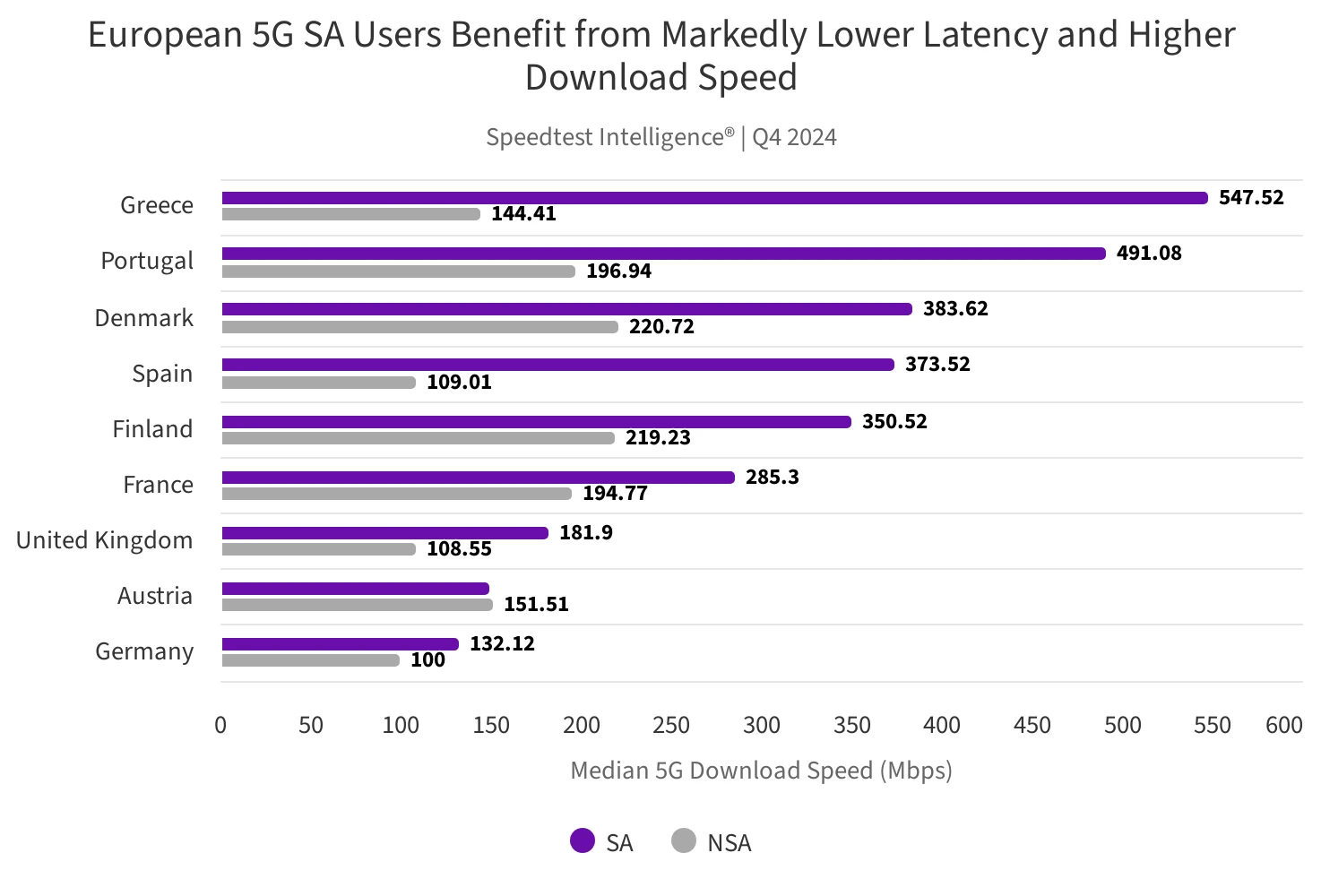
For example, in terms of median download speeds (Megabits per second), regular 5G NSA networks in the UK delivered 108.55Mbps but on SA networks this jumps to 181.9Mbps. Some countries, such as Greece, show an even bigger performance gap, which is often due to the accompanying released of additional radio spectrum bands. On the flip side, the UK still sits quite low in the table below.

Ookla-Feb-2025-5G-Standalone-vs-Non-Standalone-Speeds-in-EU-and-UK

Within Europe, while 5G SA rollout progress remains highly varied, the best outcomes have been observed in countries that have specific policies intended to incentivize 5G SA deployment. Germany, the United Kingdom, and Spain—all four-player markets benefiting from targeted 5G SA-specific fiscal stimuli or coverage obligations— lead Europe in terms of 5G SA rollout across multiple operators,” said Ookla (this is clearly more of a reference to coverage than network performance).

Meanwhile, Southern and Central European countries have supplanted the Nordics at the forefront of this phase of the 5G cycle, with Greece (547.52Mbps) leading on median download speed in Q4 2024 thanks to its 3.5GHz usage, and Spain and Austria excelling in rural 5G SA coverage on the back of intensive deployments of the 700MHz band.

The next useful metric to check is latency (i.e. the response time between servers) and here the UK saw a median (average) 5G latency on older NSA networks of 47ms (milliseconds), while SA networks were able to achieve an even faster time of 35ms. However, once again, the UK is still far from being the fastest 5G SA or NSA country for latency performance.

Ookla-Feb-2025-5G-Standalone-vs-Non-Standalone-Latency-in-EU-and-UK

Ookla adds that European operators at the forefront of business model evolution with 5G SA – “such as BT’s EE in the UK, Deutsche Telekom in Germany, Elisa in Finland, and 3 in Austria” – are said to be leveraging the technology to consolidate their positions at the premium end of the market and stimulate average revenue per user (ARPU) growth. But clearly the UK still has plenty of room for improvement.

In terms of performance, Ofcom currently has several auctions planned, which will release more radio spectrum for 5G mobile services, such as in the millimetre wave (mmW) friendly 26GHz and 40GHz bands (here). Some lower frequency mobile bands, such as in part of 6GHz, may also become available for use by mobile networks in the future. Suffice to say that this should help to boost 5G performance in the UK over the next few years.