Gigaclear Makes Progress on Cotswolds Project Gigabit Broadband Build | ISPreview UK

Original article ISPreview UK:Read More

Rural broadband ISP Gigaclear, which has so far deployed their full fibre (FTTP) network to cover 612,000 UK premises (inc. 160,000 customers), has just put their new network live in the Cotswolds village of Kemble. The deployment forms part of Project Gigabit’s £10.81m East Gloucestershire (Lot 18) contract to upgrade 3,547 premises in hard-to-reach areas.

The original contract was first awarded all the way back in February 2024 (here) and was initially valued at £16.6m (state aid), with a goal of extending gigabit-capable broadband to an additional 4,400 premises in remote rural areas. But this shrank in size during August 2025 “due to [the] removal of 899 premises” from its scope (here) and the construction phase then didn’t start until October 2025 (here).

NOTE: Gigaclear is principally owned by Infracapital, together with Equitix and Railpen. The company previously had investment commitments estimated to be worth up to around £1.1bn (here) and in late 2023 secured a £1.5bn debt facility (here). The provider holds several Project Gigabit build contracts in Oxfordshire (here) and East Gloucestershire (here).

However, today’s announcement seems to slightly contradict the October 2025 news, by stating that work began “earlier this year” across the 18 rural areas in the county, including Kemble, with the first homes and businesses now able to benefit from Gigaclear’s ultrafast service. Residents and businesses can now access speeds of up to 900Mbps.

The other locations set to benefit include Alderton, Andoversford, Aston Somerville, Brockhampton, Cold Aston, Coln St Aldwyns, Great Rissington, Hawling, Lower Slaughter, Miserden, North Cerney, Quenington, Stanton, Tarlton, Teddington, Upper Slaughter and Woodmancote.

Telecoms Minister, Liz Lloyd, said:

“Connecting the first customer in Kemble to lightning fast broadband is a fantastic milestone for Project Gigabit’s rollout in Gloucestershire.

Reliable, fast broadband transforms lives, supporting local businesses to grow, and opening up new opportunities in our rural communities. I look forward to seeing many more homes and businesses across Gloucestershire benefit from this investment.”

Nathan Rundle, Chief Executive Officer at Gigaclear, said:

“Connecting the first customer in Kemble is a great achievement and one that will help close the gap further for the digital divide in rural Gloucestershire. Kemble is one of many villages that has historically been overlooked when it comes to broadband investment, leaving residents with services that simply haven’t kept pace with modern life.

Our Project Gigabit build is changing that. By delivering reliable, ultrafast full fibre where it has previously been absent, we’re enabling people to work from home, commute less and spend more time with family and friends. This in turn means they are more present in their communities which positively supports local businesses. We’re delighted to see the first premises go live and look forward to connecting many more as the rollout continues.”

The original contract indicated that Gigaclear’s roll-out is expected to reach completion by Spring 2027, although it’s unclear if this target still stands.

Residential customers of the service currently pay from £17 a month (£43.50 after 18-months) for a symmetric 200Mbps broadband package and speeds go up to 900Mbps.

Virgin Media and O2 Set to Merge UK Customer Communities Together | ISPreview UK

Original article ISPreview UK:Read More

Broadband ISP Virgin Media and mobile operator O2 are about to begin an impactful change as part of their previous merger, which will bring their once entirely separate community discussion forums together for the first time. The operators also plan to move to a “new platform” during the process as their “agreement with the current provider is ending“.

Most of the major broadband and mobile operators run customer communities, which are often a useful place to find help and advice. In fact, we tend to view it as a big plus when telecoms providers are able to provide their customers with such a venue, although some prefer not to give their customers a place to engage and raise problems (e.g. Vodafone had an excellent forum until they unceremoniously nuked it last spring).

Similarly, both Virgin Media (here) and O2 (here) have long run their own community forums. O2 doesn’t appear to have changed their forum for a long time, while the last time Virgin Media upgraded their own forum occurred a year ago (here), when they switched from using the older Khoros ‘Classic’ platform over to the modern ‘Aurora’ one (call us old-fashioned, but we much preferred the look and feel of the old one).

However, the network operators are both now starting the process of changing platform again, but this time it’s more than a mere upgrade. The platform itself is being changed (no details have been provided on the new one) and, more significantly, they intend to merge both of their communities together at the same time (posts, stats, member accounts etc.).

VMO2’s Joint Community Statement

Just a heads‑up that the community will have some downtime at the end of the month. We’re moving to a new platform as our agreement with the current provider is ending. This migration will take a little while as we move everything over. The community will switch to read‑only next week before going offline for a bit.

We’re also taking this opportunity to bring the Virgin Media and O2 communities together. Our aim is to merge as much as we can – posts, stats, member accounts, the lot.

Thanks so much for everything you’ve contributed so far. From me and the whole community team, we really appreciate it – and we’ll see you on the other side!

Anybody who has any experience of trying to do what O2 and Virgin Media are about to attempt with such a large database of historic customer content will know that it can be a nightmare to pull off smoothly. Complex database migrations and mergers of this type rarely go without problems, to say the least. This perhaps explains why neither operator has specified how long the downtime will last, because they can’t be sure themselves.

At present, it’s not known precisely what the new platform will look like or if everything will be placed under a new website, but we should have those answers soon.

North Africa’s 5G wave continues with Libya launch | Total Telecom

Original article Total Telecom:Read More

News

The launch means all African nations on the Mediterranean have now launched 5G

This week, Libya’s second largest state-owned telco, Almadar Aljadid, has announced the launch of 5G in parts of the capital, Tripoli.

For now, the launch is limited to just central parts of the city, but citywide coverage – and, indeed, nationwide coverage – will take place in stages, according to the company.

The company said the launch represents a significant boost in service quality for customers, as well as noting the technology’s potential to support key industries like healthcare and education.

2025 was a remarkable year for North Africa’s mobile markets, with Tunisia launching 5G in February, Egypt in June, Morocco in November, and Algeria in December. Now, with Libya’s launch, the entire region has formally entered the 5G era.

Keep up to date with all the latest telecoms news with the Total Telecom newsletter

Also in the news
World Communication Award Winners 2025
Ofcom clears the way for satellite-to-smartphone services
LG Uplus’s AI voice call app glitch leaks user data

The post North Africa’s 5G wave continues with Libya launch appeared first on Total Telecom.

South Korean memory-makers warn of AI supply chain crunch | Total Telecom

Original article Total Telecom:Read More

a close up of a pattern of small squares

News

Despite efforts to expand capacity, semiconductor players are struggling to keep pace with demand

As the AI boom continues to gain momentum, two of the world’s leading chipmakers, SK Hynix and Samsung Electronics, are warning that their expansion plans will not move fast enough to ease supply chain bottlenecks.

The companies, both which reported their latest financial results this week, said that the memory chip supply crisis would be unlikely to alleviate for the next two years despite their best efforts.

“We are planning a substantial increase in our capital expenditure in 2026 as AI-driven demand is likely to continue,” said Kim Jae-june, executive vice-president of Samsung’s memory business, as reported by the Financial Times. “But supply shortages are likely to worsen as capacity expansion is expected to be limited this year and next.”

SK Hynix has plans to invest 19 trillion won ($12.9bn) in the construction of a semiconductor packaging facility in Cheongju, while Samsung is investing 60 trillion won ($41.5 billion) in its P5 factory in Pyeongtaek, South Korea, which broke ground in November last year.

Both investments are driven by the surge in demand for High Bandwidth Memory (HBM), a crucial part of AI accelerators and data centre GPUs, as well as other memory chip technology; SK Hynix says it expects the HBM market to continue to grow significantly between 2025 and 2030, with projections indicating a compound annual growth rate of 33% until 2030.

However, the additional capacity being generated from these new facilities will take time to realise.

“Demand is growing sharply, but it takes time to expand capacity, so the mismatch in demand and supply is worsening, pushing chip prices higher,” added Song Hyun-jong, president of SK Hynix, in the same FT report.

The extent of the memory bottleneck is already being felt acutely across the world. The cost of dynamic random access memory (DRAM), for example, has skyrocketed since 2024, and is set to double again this year.

At the same time, the industry is also in the midst of a significant shift, moving from the current HBM3E technology to the more advanced HBM4. These next generation memory chips will offer higher data transfer speeds (exceeding 1 TBps per stack) and more than double the bandwidth of HBM3E, making them ideal for AI data centres.

SK Hynix is currently the global leader in this latest memory design, accounting for roughly 60% of the overall market, according to Macquarie Equity Research. Samsung, however, is expected to soon challenge this position, beginning production of its own HBM4 chips next month.

Needless to say, this memory bottleneck is making both SK Hynix and Samsung very rich.

SK Hynix reported a net profit of 97.15 trillion won ($67.9 billion), up 46.8% year-on-year, while Samsung saw profits rise to 45.21 trillion won ($31.6 billion, up 31.2% year-on-year.

Keep up to date with all the latest telecoms news with the Total Telecom newsletter

Also in the news
World Communication Award Winners 2025
Ofcom clears the way for satellite-to-smartphone services
LG Uplus’s AI voice call app glitch leaks user data

The post South Korean memory-makers warn of AI supply chain crunch appeared first on Total Telecom.

London FTTP Broadband Network CommunityFibre Reports Strong Growth | ISPreview UK

Original article ISPreview UK:Read More

Network operator and UK ISP CommunityFibre, which has invested c.£1bn to deploy a 5Gbps speed full fibre (FTTP) network across 1.342 million homes (inc. 185k businesses within 200 metres of their network) – mostly in London, has today announced a “record year” of annual revenue growth (up 48% to £113m) and their customer base hit 429,000 (up 26% for a take-up rate of just under 32%).

The provider’s preview of its annual results to the end of 2025, which aren’t currently scheduled to be published until September 2026, also revealed that they’d reported an adjustment in earnings before interest, tax, depreciation and amortisation (EBITDA) to £49.8 million, up by an impressive 530% from 2024. The company has been EBITDA positive since April 2024 and expects to be “cash flow positive before financing costs in H1 2026“.

NOTE: Community Fibre is backed by shareholders Warburg Pincus LLC, DTCP, Railpen and NDIF, and its lenders, including recent backers JP Morgan and Barclays etc. The operator’s network is predominantly focused on London.

CommunityFibre added that their OpEx (Operating Expenses) were also 12% lower year-on-year despite rapid customer growth, a positive wholesale launch with VodafoneThree and customer satisfaction. “As London’s fastest and second fastest provider with a new wholesale partner in the pipeline, Community Fibre expects continued growth throughout the year,” said the announcement.

Graeme Oxby, Chief Executive Officer of CommunityFibre, said:

“Community Fibre is converting rapid customer growth and great customer service into strong financial results. These results are important to the wider Altnet industry, as it supports the Government’s desire to bring viable competition to the UK broadband market. Community Fibre has proven that new broadband competition can not only be financially sustainable in the long run, it can also deliver meaningful advantages to UK society.”

The provider has come through somewhat of a rough patch due to the rising cost of build, strong market competition and high interest rates (a common challenge in the market). All of this previously caused a slowdown in network build and related redundancies (here and here), which resulted in CF pivoting their strategy to focus more on growing customer uptake (commercialisation). So far that appears to be working for them.

The flip side of this is that today’s results preview doesn’t include any detail on the other side of their accounts, such as in terms of debt and losses etc.

EE Wins Big in Opensignal Study of Best 4G and 5G UK Mobile Networks | ISPreview UK

Original article ISPreview UK:Read More

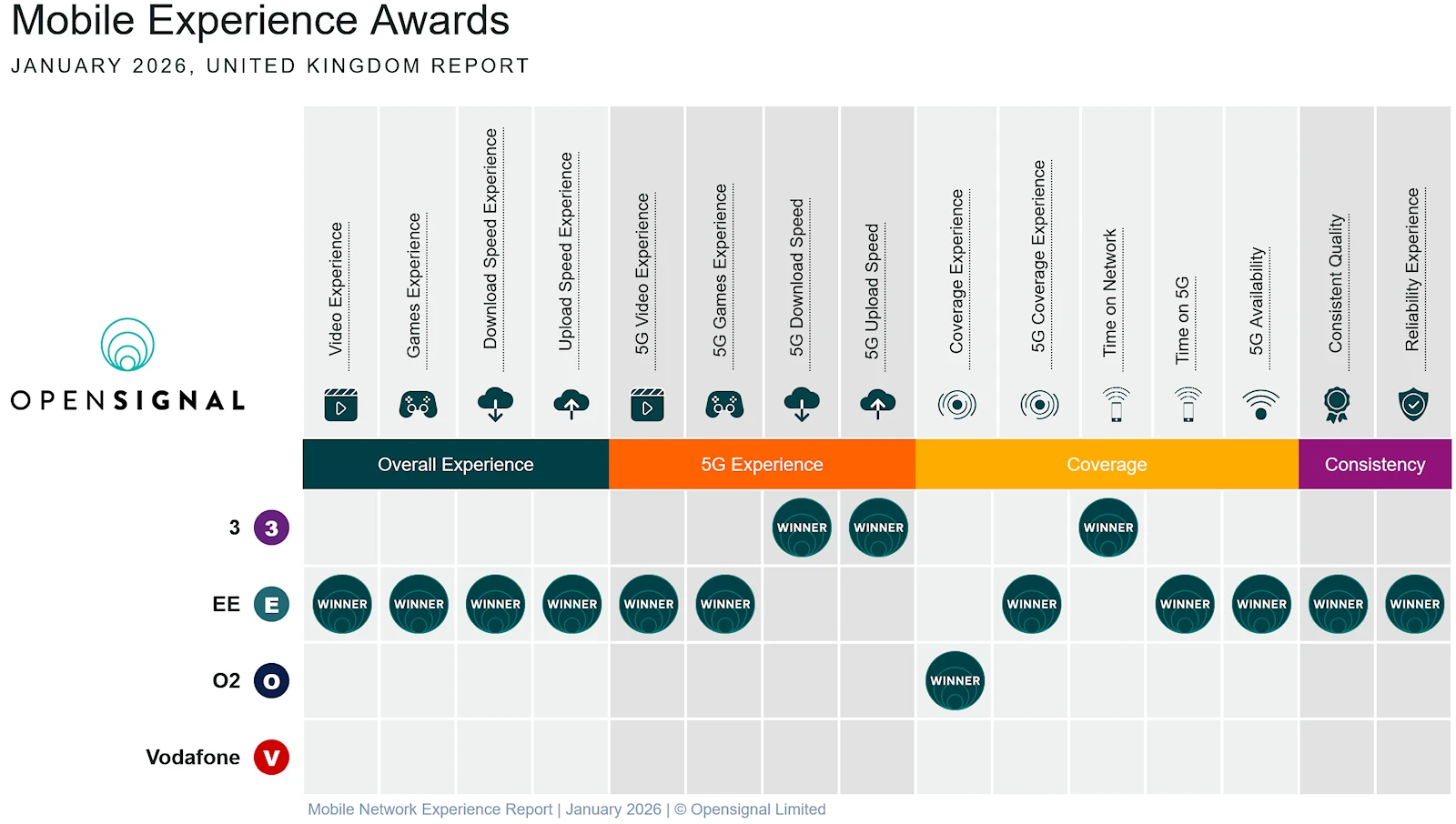
Network benchmarking firm Opensignal has this morning published their first Mobile Network Experience Report for 2026, which measured the 4G and 5G (mobile broadband) services of all the primary network operators – EE, O2 and VodafoneThree (Vodafone and Three UK) – to determine which delivers the best performance. Overall, EE won most, but not all, of the categories.

The study is based off crowdsourced data gathered from users on hundreds of thousands of devices (Smartphones etc.) between 1st October and 29th December 2025. The results were then processed to reveal how the primary mobile network operators compared across various categories.

The study continues to be predominantly focused upon the combined performance of 4G and 5G networks, but it does also examine the speed of 5G-only connections. Overall, EE (BT) once again secured most of the performance categories in the primary study, with the operator doing particularly well to win both the ‘Reliability Experience’ and ‘Consistent Quality’ awards outright, scoring 915 points (on a 100-1000 scale) for Reliability and 78.6% for Quality.

Meanwhile, Three UK delivered the fasted 5G download and upload speeds, as well as the highest ‘time on network’ figure, but otherwise they lagged behind their rivals. Finally, O2 (Virgin Media) scooped one award for ‘Coverage Experience’, while Vodafone failed to win anything.

Opensignal uk mobile awards Jan 2026

We’ve summarised some of the key results below.

Download Speed Experience – All Mobile Connections

1. EE 53.2Mbps
2. Three UK 51Mbps
3. Vodafone 37.5Mbps
4. O2 32.8Mbps

Download Speeds – 5G

1. Three UK 187Mbps
2. Vodafone 130.9Mbps
3. EE 92.2Mbps
4. O2 89.9Mbps

Upload Speed Experience – All Mobile Connections

1. EE 10.4Mbps
2. Three UK 9.3Mbps
3. Vodafone 7.4Mbps
4. O2 6.4Mbps

Upload Speeds – 5G

1. Three UK 20.2Mbps
2. EE 16Mbps
3. Vodafone 14.1Mbps
4. O2 11Mbps

Time on Network %

(what proportion of time people have a network connection)

1. Three UK 99.4%
2. EE 99%
3. O2 98%
4. Vodafone 97%

UK 5G Availability %

1. EE 77.4%
2. O2 57%
3. Three UK 38.9%
4. Vodafone 29.6%

Mobile speeds remain a difficult thing to study because end-users are always moving through different areas (indoor, outdoor and underground), using different devices with different capabilities and the surrounding environment is ever changeable (weather, trees, buildings etc.). All of this can impact signal quality and that’s before we consider any differences in network (backhaul) capacity or spectrum usage between locations.

Suffice to say, performance testing like this may not always tell the whole story, although Opensignal are one of the better organisations at analysing such data. The result also echoes similar studies from other groups, such as Ookla.

O2 UK Deploy 5G Standalone Mobile Broadband Network to 5 Towns in Dorset | ISPreview UK

Original article ISPreview UK:Read More

Mobile operator O2 (Virgin Media) has this morning announced that they’ve just switched-on their next-generation 5G Standalone (5GSA) mobile broadband network across five “major towns” in the county of Dorset (England). The operator’s 5GSA network is now live across a total of more than 500 UK locations (70% of the population, or c.49 million people).

O2’s 5GSA rollout first began in February 2024 (here) and they usually aim to reach “at least 90% outdoor coverage” in every location they add. The same should hold true for the five towns in Dorset, where roughly 380,000 residents will now be able to benefit from the 5GSA network. The towns include Bournemouth, Poole, Dorchester, Swanage, and Christchurch.

NOTE: The upgrades are part of O2’s wider £700 million Mobile Transformation Plan.

Just to recap. 5GSA networks are pure end-to-end 5G that can deliver ultra-low latency times, greater energy efficiency, better speeds (particularly uploads), network slicing, improved support for IoT devices, increased reliability and security etc. Existing 5G networks often use a Non-Standalone (NSA) approach, which is hobbled by being partly reliant upon older and slower 4G infrastructure.

Dr Robert Joyce, Director of Mobile Access Engineering at O2, said: “Our new 5G Standalone network is now live in Dorset, providing an impressive upgrade for local people and businesses and creating new opportunities in and around the county. We are investing every single day to improve our mobile network and provide a more reliable experience for our customers, futureproofing our connectivity and paving the way for exciting innovations that lie ahead.”

Concerns Over UK Funding Shortfall for Gigabit Broadband Raised in Parliament | ISPreview UK

Original article ISPreview UK:Read More

The Conservative MP for Bridgwater, Sir Ashley Fox, this week informed other Ministers that Openreach (BT) had raised “concerns that there is a shortfall in funding from the last spending review“, which he said meant there is a “risk that the Government do not meet their 99% gigabit-coverage target by 2032“.

The vast majority of gigabit broadband coverage has so far been delivered via commercial deployments (private investment) and that continues to be the case today, with the likes of Openreach and Netomnia taking the lead. On top of that, both the present Government has also been running the £5bn Project Gigabit scheme (setup by the previous Gov in 2021), which aims to help make 1000Mbps+ (gigabit) broadband speeds available to c.99% of UK premises by 2032 (this was already pushed back from 2030 last year).

NOTE: Project Gigabit is designed to focus on areas of market failure, mostly reflecting premises in the final 10-20% in hard-to-reach rural areas. Some 89.6% of UK premises can already access such a network (here), with Ofcom forecasting between 91% and 97% by January 2028 (here).

According to the Government’s most recent Spending Review (here), which covers the period from 2026/27 to 2029/30, some £1.9 billion of public investment was still available for the Building Digital UK (BDUK) agency to deliver the next phase in the transformation of the country’s digital infrastructure (i.e. gigabit broadband and mobile).

Some of that £1.9bn has since been allocated to related projects, such as the Single Supplier Framework they have with Openreach for Project Gigabit that recently increased in value from “up to” £800m to c.£1.2bn (here). But the latest suggestion is that more funding may be required to achieve the Project’s ultimate target on time.

Conservative MP Sir Ashley Fox said:

“Many villages are still looking at waits until 2030 for the roll-out of broadband, and I worry that some might have to wait even longer. Openreach has shared with me its concerns that there is a shortfall in funding from the last spending review, meaning that there is a risk that the Government do not meet their 99% gigabit-coverage target by 2032, which is already an unacceptably long time for my constituents in remote rural areas to wait to be connected. It would be intolerable if it were to be delayed further.

Will the Minister clarify in his response whether he believes he has sufficient funding to meet the 99% target? When will the Government bring forward their statement of strategic priorities for Ofcom, which is a critical step to shape the next phase of the UK’s digital infrastructure journey? The Minister will know that the consultation on this ended in September; we await his Department’s response. This Government are quick to issue a consultation, but they seem rather slower to act.”

Just for some context on the impact of Government schemes on gigabit broadband coverage. As at the end of September 2025, over 1.3 million premises in rural and hard-to-reach areas across the UK had already been upgraded to gigabit networks through publicly subsidised programmes. In addition, over 1 million premises are now included in signed Project Gigabit contracts worth £2.4bn in total, although we’re expecting this to rise.

However, the suggestion above is that the revised target of 99% coverage by 2032 may also be missed, although the government’s representative in this week’s debate, Kanishka Narayan (MP for the Vale of Glamorgan), was quick to point out that “Openreach has not made that representation to me“.

The MP added that the “Government are squarely focused on reaching the 99% target, and we are doing all we can to make sure that all providers are in a place to do so. I am happy to engage with Openreach if it wants to make a representation to me“. Naturally ISPreview queried this with Openreach, which provided the following response.

A spokesperson for Openreach said:

“Openreach welcomed the Government’s commitment to retain funding for Project Gigabit in the last spending review. BDUK is working constructively with industry on how the programme can help sustain the build momentum needed to reach the Government’s target of 99% gigabit coverage by 2032, and Openreach stands ready to work with Government to deliver that goal.

A failure to fund these upgrades as initially intended would put economic growth in these areas at risk, while increasing the taxpayer’s exposure if deployment takes longer as supply chains begin to be stood down.”

At present it’s not clear how much of a funding shortfall may actually exist and that will partly depend upon several uncertain factors, such as in terms of precisely how far commercial operators will deploy by 2032 (without recourse to public investment) and the same for those holding various contracts under the subsidised Project Gigabit scheme. The Building Delivery UK (BDUK) agency currently tracks future deployment plans for the next 3 years and anything past that tends to be more uncertain.

In addition, we’ve already seen a number of smaller alternative networks retreat from their Project Gigabit contracts (e.g. Freedom Fibre, Voneus, FullFibre Ltd.) and others may yet follow. Some of those will end up being absorbed into Openreach’s Cross-Regional (Type C) framework under the same scheme. But the more remote the area, the greater costs tend to rise – disproportionately so – until they fall out of economic viability.

If we consider the current contracts and delivery plans, then ISPreview can roughly estimate that the UK may be on course for around 95-97% coverage of gigabit-capable broadband by 2030; but there’s plenty of room for variability in that. The economic climate has changed a lot since Project Gigabit was founded in 2021 and not for the better, so what was once possible under the old budget may no longer be the case, hence the potential for a shortfall.

At the same time, we shouldn’t forget that Openreach’s own commercial target of reaching “up to” 30 million UK premises with full fibre (FTTP) by 2030 is currently being linked by the operator to the need for a favourable outcome from Ofcom’s forthcoming Telecoms Access Review 2026 (TAR). Suffice to say that there may be a mix of both industry and regulator negotiation, as well as real-world economics, at play in all this.

The lengthy time horizon involved could also carry some political relevance, since it’s currently unclear whether the existing government would be either willing or able to pump more public investment into the project to ensure that the pace of build remains strong enough to reach the 2032 target. Such things may end up being perceived as a problem for the next government to tackle, which could mean delays. Time will tell.

Vodafone Idea finally looks ‘beyond survival’ after AGR ruling | Total Telecom

Original article Total Telecom:Read More

flock of birds flying under blue sky during daytime

News

Government tax relief could open the door for Idea to find fresh funding

Vodafone Idea could finally be primed for ‘revival’ following the government’s adjusted gross revenue (AGR) relief, according to chairman of Aditya Birla Group, Kumar Mangalam Birla.

Aditya Birla Group currently owns a roughly 9.5% stake in Vodafone Idea.

“For the first time in years, the fog has cleared, allowing the business to look beyond survival and focus on sustainable growth,” wrote Birla in a recently published ‘Annual Reflections’ note.

“A healthy, competitive telecom industry is essential to India’s digital future. India deserves 3 private telecom players. India deserves a successful Vodafone Idea. And this is, once again, an idea whose time has come,” he added.

On December 31, 2025, the Indian government announced that it had frozen Vodafone Idea’s adjusted gross revenue (AGR) dues at ₹87,695 crore (~$9.5 billion), following a ruling by the Supreme Court.

The decision means Idea must repay repay just ₹124 crore (~$135 million) per year for the next six years, with further repayments then staggered until 2042.

The government is also reviewing the total owed by Idea, suggesting it could yet be reduced.

The decision not only has huge implications for Idea’s long-term survival, but also for its immediate cash flow, removing a ₹16,400 crore (~$1.78 billion) payment previously due in March 2026.

Vodafone Idea has been struggling to compete under the weight of AGR repayments since they were first announced in 2019. At that time, revised taxes meant the players across the telecoms sector owed roughly a combined $11 billion combined, with Vodafone Idea’s debt the lion’s share.

India’s largest telco, Reliance Jio – then still a relative newcomer to the market – paid off its AGR dues quickly, leaving Idea and rival Bharti Airtel to begin a years-long saga to have the debt reassessed and deferred.

Airtel continued to grow in the years that followed, but Idea was essentially crippled, seeing revenue slide and a steady decline in subscribers as it struggled with cash flow. It also notably hindered the company’s 5G launch; Idea launched 5G in 2025, roughly three years after Reliance Jio and Bharti Airtel.

Finally, last year, after years of Idea failing to find additional funding to pay its debts, the Indian government converted a portion of its debt into equity, becoming Vodafone Idea’s largest stakeholder.

Now, with long-term tax relief secured and the immediate liquidity crisis over, Idea may finally be able to seek fresh external investment and plot a path to sustainable growth.

Naturally, this is great news for Idea – and arguably the competitiveness of the Indian telecoms sector at large. However, Idea’s rivals, Bharti Airtel and Tata Group, are frustrated, arguing that they too should receive equitable debt relief from the government. They have even threatened not to pay the latest tranche of repayments.

Their please appear to be falling on deaf ears, however, with Communications Minister Jyotiraditya Scindia saying the companies must first receive a directive from the Supreme Court and should not approach the government directly.

Airtel and Tata owe around ₹48,103 crore ($5.24 billion) and ₹19,259 crore ($2.1 billion), respectively, with repayments due in March.

Keep up to date with all the latest telecoms news with the Total Telecom newsletter

Also in the news
World Communication Award Winners 2025
Ofcom clears the way for satellite-to-smartphone services
LG Uplus’s AI voice call app glitch leaks user data

The post Vodafone Idea finally looks ‘beyond survival’ after AGR ruling appeared first on Total Telecom.

CalMac Ferry Passengers in Scotland to Get Faster Onboard Broadband | ISPreview UK

Original article ISPreview UK:Read More

People travelling on CalMac‘s (Caledonian MacBrayne) ferries, which serve the Islands and Peninsulas on Scotland’s west coast, look set to benefit from faster onboard WiFi internet connectivity after Clarus Networks secured a major 12-month contract to provide Starlink (LEO satellite) connectivity to the UK’s largest ferry operator.

The contract, awarded via Public Contracts Scotland, will see Clarus deliver a “pooled Starlink data service” across CalMac’s operational fleet, offering high-speed, low-latency broadband connectivity designed to enhance operational performance, crew welfare, and passenger experience on board.

Operating 29 routes to more than 50 destinations across 200 miles of Scotland’s west coast, CalMac’s fleet completes around 136,000 sailings each year – often providing a vital lifeline service to remote communities and supporting Scotland’s tourism sector. In such a geographically dispersed and operationally demanding environment, resilient connectivity is vital.

Chris Schonhut, Director of Maritime and Energy at Clarus Networks, said:

“We’re delighted to partner with CalMac to enhance connectivity across their fleet. Starlink’s LEO satellite network offers huge potential for improving maritime operations, and our Aavora platform ensures it can be managed simply and effectively at scale. This contract is a great example of how technology can support critical infrastructure and communities in remote parts of Scotland.”

David Gammie, IT Director at Calmac, said:

“Reliable connectivity is a foundational element of the Technology & Digital infrastructure to run a modern ferry service that supports both crew operations and customer needs. Clarus’ experience in maritime deployments and their fleet-wide connectivity management capabilities will help us deliver a better-connected service across the ferry network.”

Sadly, the announcement doesn’t provide any sort of timeline for the deployment, although it’s worth noting that many of their Ferries do already have onboard WiFi (i.e. it may only be the satellite backhaul that needs an upgrade to Starlink for passenger connectivity to benefit).

Under the agreement, Clarus will deliver:

• Starlink satellite connectivity for each vessel, using a pooled data model to maximise efficiency and minimise cost across the fleet.

• Configuration and technical support for all Starlink hardware and associated systems.

• Access to Aavora, Clarus’ proprietary Starlink fleet and terminal management platform, designed to give CalMac complete visibility and control of all vessel connections in one place.

• Fleet-wide pooled data – allowing dynamic bandwidth allocation across all vessels, ensuring that high-demand routes receive additional capacity when needed, reducing costs and enhancing overall service quality to crew and customers.

• Proactive monitoring and 24/7 support to ensure service continuity and optimise performance in real time