Virgin Media O2 UK’s Owners Close in on £2bn Broadband Deal for Netomnia | ISPreview UK

Original article ISPreview UK:Read More

European telecoms giants Telefónica and Liberty Global, the joint owners of Virgin Media and O2 in the UK, have reportedly now joined with private equity firm InfraVia Capital to progress their previously proposed £2bn bid to buy alternative full fibre broadband network Netomnia toward conclusion. The deal is likely to offer the altnet more than rival CityFibre could muster, but competition issues could be raised.

Just to recap. Netomnia (Substantial Group) is one of the UK market’s largest altnets and has deployed their Fibre-to-the-Premises (FTTP) based broadband service to cover 3 million UK premises RFS (inc. 445,000 customers) – available across parts of 98 cities and towns. The group aims to cover 5m UK premises by the end of 2027 (inc. 1m customers by 2028).

NOTE: The Substantial Group is backed by over £1.6bn of equity and debt from investors Advencap, DigitalBridge, and Soho Square Capital etc.

By comparison, Virgin Media operates a gigabit-capable fixed line broadband network that covers over 16 million premises (mix of hybrid fibre coax and full fibre connections), although they’re aiming to upgrade all of that to full fibre (FTTP) by 2028.

In addition, Telefónica, Liberty Global and InfraVia Capital also jointly own the semi-separate nexfibre business, which has rolled out an open access (wholesale) full fibre network to 2.5 million premises in areas NOT currently served by Virgin Media’s own network. But at the time of writing, the only two retail ISPs selling services via nexfibre are all part of the same parentage (Virgin Media and giffgaff).

Back in October 2025 reports emerged that VMO2’s parents and CityFibre appeared to be battling over a major network consolidation deal to acquire Netomnia (here). According to today’s FT (paywall) report, VMO2 now appears to be leading with the most attractive offer (CityFibre may be more constrained on this front) and is allegedly close to signing a deal, although none of the parties involved have officially commented on this.

On the surface such a deal would not appear to make much sense, since quite a bit of Netomnia’s fibre has already overbuilt the combined nexfibre and VMO2 footprint (over half of Virgin Media’s gigabit network is overlapped by Netomnia, albeit less so on the nexfibre side). But the move, if confirmed, would also remove a major competitive player in the alternative network space and will, crucially, prevent CityFibre from securing its own merger with the operator and thus growing the scale it needs; this alone could be seen as a win for VMO2, albeit a potentially expensive one.

On the flip side, customers of Netomnia’s network, many of which will have used them to escape from legacy incumbents like Virgin Media and their cycle of inflation busting mid-contract price hikes, will probably be less than pleased about such a transaction and the future impact it may have upon their services.

Indeed, for consumers, a deal between Netomnia and CityFibre is likely to have been much more palatable. This due to the limited level of overbuild and shared position as lower cost broadband disruptors, which makes for a more competitive market. But if CityFibre can’t deliver the most attractive offer, then none of that matters.

The next big question mark remains over how the Competition and Markets Authority (CMA) would view such a deal, since it’s hard to imagine them treating the networks of Virgin Media and nexfibre as being truly separate, due to the shared parentage. The CMA is likely to consider the wider competitive ramifications of such a major operator buying into control of the altnet space like this, and you can bet CityFibre will raise a complaint.

This is all before we even consider the usual complexities and costs for VMO2/nexfibre when it comes to tackling any differences in network infrastructure, retail ISP relationships and technology. All of this could create issues for later network and customer base integration (e.g. what do they do about those areas of network overlap – discard them and migrate customers or discard their own network and migrate the other way).

However, it’s worth remembering that such deals aren’t unexpected in today’s market, particularly with so many altnets being under pressure from competition, rising build costs and high interest rates. Netomnia has been one of the few altnets to continue building through this phase of the market, seemingly with some success, but they’re not immune to the challenges.

As it stands, the FT’s wording appears to suggest that a deal is now all but signed, but nothing’s done until it’s done and that’ll be down to Netomnia’s decision in the next few days or weeks. What they decide may have a noticeable impact upon the wider competitive landscape and force CityFibre to focus on different, and possibly less attractive, consolidation targets; growing the scale they need thus may become harder.

Openreach launches app to keep engineers safe from abuse | Total Telecom

Original article Total Telecom:Read More

News

The app provides GPS location tracking and an SOS button to quickly contact the police

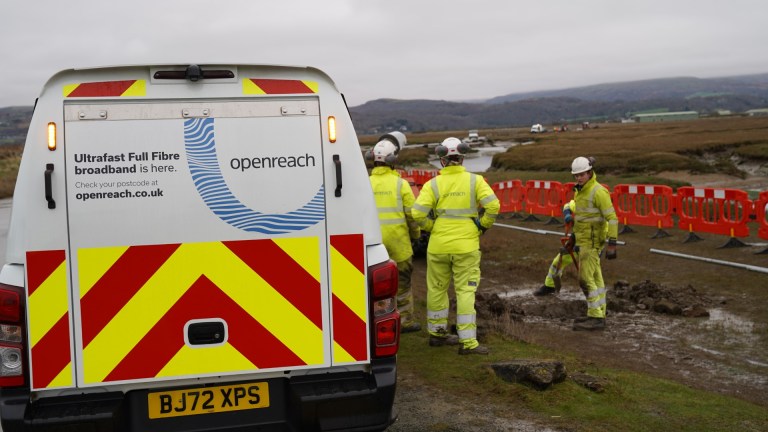
Today, Openreach has announced the launch of a new worker safety app aimed at tackling the rampant abuse its engineers face while on the job.

The app, created in partnership with Peoplesafe, includes various safety features designed to support staff in the field. These include an SOS button and fall alarm connecting to a 24/7 control centre, GPS tracking for accurate emergency response, two-way audio and direct police dispatch, and commute monitoring and critical event alerts.

The app will be installed on all devices carried by Openreach engineers and will be optional for office staff.

“Fall alarms are activated by sensors in the person’s mobile phone, while the SOS alarms can be set off with a simple press of the handset. Emergency services can be on their way within minutes which is just incredible,” said Adam Elsworth, Safety Director at Openreach. “While Peoplesafe will only be mandatory for our field teams (due to the nature of their work) we hope all of our people will use the app to have peace of mind and support if and when they need it.”

Openreach recorded 700 incidents of either physical or verbal abuse since April last year. These include “being spat at, pushed down stairs, threatened with dogs and knives, punched and kicked and even barricaded into homes and vans”.

The company also says it has seen an increase in racially motivated incidents.

“The Peoplesafe app gives our people an added layer of safety while on the job and particularly for many of our colleagues that work alone for long periods of the day. It also helps us to address an area we have less control: attacks by members of the public,” said Elsworth.

Keep up to date with all the latest telecoms news with the Total Telecom newsletter

Also in the news
World Communication Award Winners 2025
Ofcom clears the way for satellite-to-smartphone services
LG Uplus’s AI voice call app glitch leaks user data

The post Openreach launches app to keep engineers safe from abuse appeared first on Total Telecom.

KKR–Singtel consortium near $10bn deal for STT GDC | Total Telecom

Original article Total Telecom:Read More

worm's eye-view photography of ceiling

News

The move seeks to capitalise on Southeast Asia’s booming date centre market

This week, media reports suggest that a consortium led by KKR and Singtel is closing in on a deal to acquire ST Telemedia Global Data Centres (STT GDC).

Negotiations, which are already at an “advanced stage”, would value the data centre business at around $10.22 billion.

“Singtel, as part of a consortium, continues to have discussions in relation to STT GDC. While these discussions are at an advanced stage, there is no certainty that such discussions will lead to any definitive or binding agreement,” said Singtel in a statement on Sunday.

STT GDC owns and operates around 100 data centres in over 20 markets, including Singapore, Malaysia, India, Germany, Italy, and the UK, according to the company website

Rumours that KKR and Singtel were in discussions to acquire STT GDC were first reported in July last year.

Both companies already hold stakes in the business, having jointly invested  $1.3 billion in 2024, with KKR owning 14.1% and Singtel 4.2%. The remaining majority stake in STT GDC is held by ST Telemedia, itself owned by Singapore’s state-owned holding company Temasek.

For Singtel, the deal would represent the operator’s latest step in its drive to become a regional AI data centre powerhouse.

The company’s Digital InfraCo unit was rebranded as Nxera in 2024, with the company aiming to expand its data centre capacity in Southeast Asia to 200MW by the end of 2027 in partnership with Nvidia.

By combining Nxera’s existing and planned data centre assets in Singapore, Malaysia, Thailand, and Indonesia with those of STT GDC, Singtel would immediately become one of the region’s largest digital infrastructure players.

KKR, on the other hand, already owns roughly 155 facilities with a pipeline of 12-gigawatts of capacity. The company has been on a spending spree in recent years to grow this capacity even further, most recently including a $1.5 billion investment in Global Technical Realty, a company specialising in building bespoke facilities for hyperscalers like Amazon, Microsoft, and Google.

How is the data centre landscape evolving in 2026? Join the industry in discussion at Total Telecom’s Hyperscale Live event!

Also in the news
World Communication Award Winners 2025
Ofcom clears the way for satellite-to-smartphone services
LG Uplus’s AI voice call app glitch leaks user data

The post KKR–Singtel consortium near $10bn deal for STT GDC appeared first on Total Telecom.

Openreach Rolls Out New Safety App to Help Protect UK Broadband Engineers | ISPreview UK

Original article ISPreview UK:Read More

Network access provider Openreach (BT) has today announced the launch of a new mobile safety app to help combat a surge in abuse and assaults on its UK telecoms engineers. Since April last year, there’s been around 700 incidents of either physical or verbal assaults and threats, including some cases where people have needed time off work to recover.

The sort of incidents involved here tend to vary and in the past we’ve heard of it covering everything from verbal abuse to threats with scissors, assault (e.g. being pushed down some stairs, punched or shaken off ladders), racism, spitting, swearing, homeowners preventing staff from leaving (i.e. barricading them inside homes or vans), as well as inappropriate or threatening behaviour toward female engineers etc.

The sadly growing problem (in the previous year the number of incidents was closer to 450) has previously caused Openreach to trial panic alarms with some their 27,000 employees (here) and they’ve now evolved that approach by launching a new app, created by Peoplesafe.

The app will help protect Openreach’s engineers and office-based staff in the event of safety incidents when they’re working alone, at height or just on their commute to and from home. The app, which has already been through a successful trial in the company’s Service Delivery unit, offers several features.

Features of Openreach’s New Engineer Safety App

  • SOS and fall alarms connecting directly to a 24/7 control centre
  • GPS tracking for emergency responders to pinpoint locations
  • Instant two-way audio and direct police dispatch
  • Commute monitoring and critical event alerts

Admittedly, it’s extremely sad that such an app is even needed, but it’s better to have it than not. The app will be installed on all devices carried by Openreach’s engineers, as well as being offered as an optional safety precaution for its office-based staff.

Adam Elsworth, Safety Director at Openreach, said:

“Nothing’s more important than the safety of our people and making sure everyone gets home each day safe and well. That’s why we’re constantly looking at ways to protect our people as they go about their work, whether that’s through training, PPE, specialist kit like climbing harnesses or new technologies.

“The Peoplesafe app gives our people an added layer of safety while on the job and particularly for many of our colleagues that work alone for long periods of the day. It also helps us to address an area we have less control: attacks by members of the public.”

Adrian, Openreach Engineer, explained:

“Recently I was working in the street to reconnect a vulnerable customer which involved a road closure, when a local resident furious at having to wait a short time started throwing traffic cones around and swearing. He got into his car drove along the pavement and then directly at me.

I was genuinely frightened for my safety, so I pressed the SOS button on the Peoplesafe app and thankfully the police arrived within minutes and diffused the situation, so I was able to continue work. It’s really reassuring to know that I can get help with just the press of a button.”

We should point out that this problem is by no means unique to Openreach, with engineers from other fixed line and mobile network operators also becoming subject to similar events. Some such cases do get reported to the police, although it’s unclear how many people have ever been prosecuted as a result.

Either way, the rise in abuse is incredibly disturbing, although it’s possible that some of this might be related to the fact that Openreach’s engineers are currently much more active and visible due to being in the peak phase of the operator’s national full fibre broadband roll-out.

Nevertheless, it’s important to remember that engineers are human beings too and only doing their jobs, so if somebody has a complaint then there are formal ways to raise it.

nPerf Name EE and Three UK as Fastest Mobile Broadband Networks for 2026 | ISPreview UK

Original article ISPreview UK:Read More

French internet connection benchmarking firm nPerf has this morning published the results from their annual 2026 crowdsourced study into UK mobile broadband (4G, 5G) performance. The results see both EE and Three UK being named as delivering the country’s “best Mobile Internet performances“.

The latest nPerf study (PDF) is based on masses of tests carried out – between January and December 2025 – exclusively by customers of the various mobile network operators, using tools on both nPerf’s website and via their dedicated mobile testing apps for Android and iOS. The results are said to reflect “users in real conditions” from across the United Kingdom, although they only include the major national operators with a test share above 5%.

However, there are caveats to this sort of data, such as the fact that it could be impacted by any limitations of the devices being used, which hampers the ability to adopt a common type of hardware in order to establish a solid baseline of performance. But those caveats are shared by all operators in the study.

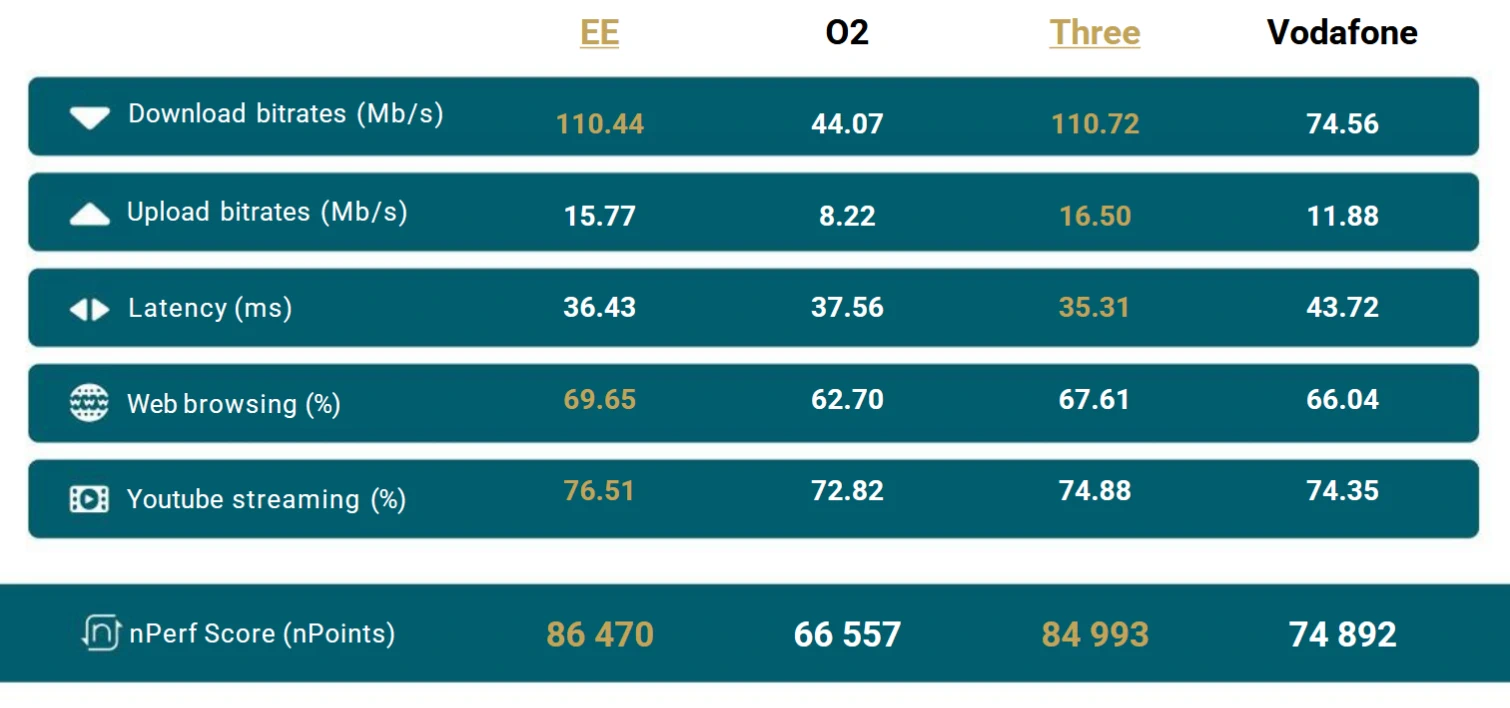
Overall, EE and Three UK were both top of the pack and virtually neck and neck for performance. The United Kingdom’s mobile internet sector displays an average score of 78,222 nPoints. EE and Three UK share the leadership positions with 86,470 and 84,993 nPoints respectively, dominating across download speed (both exceeded 110Mbps in download speeds), upload speed, and latency.

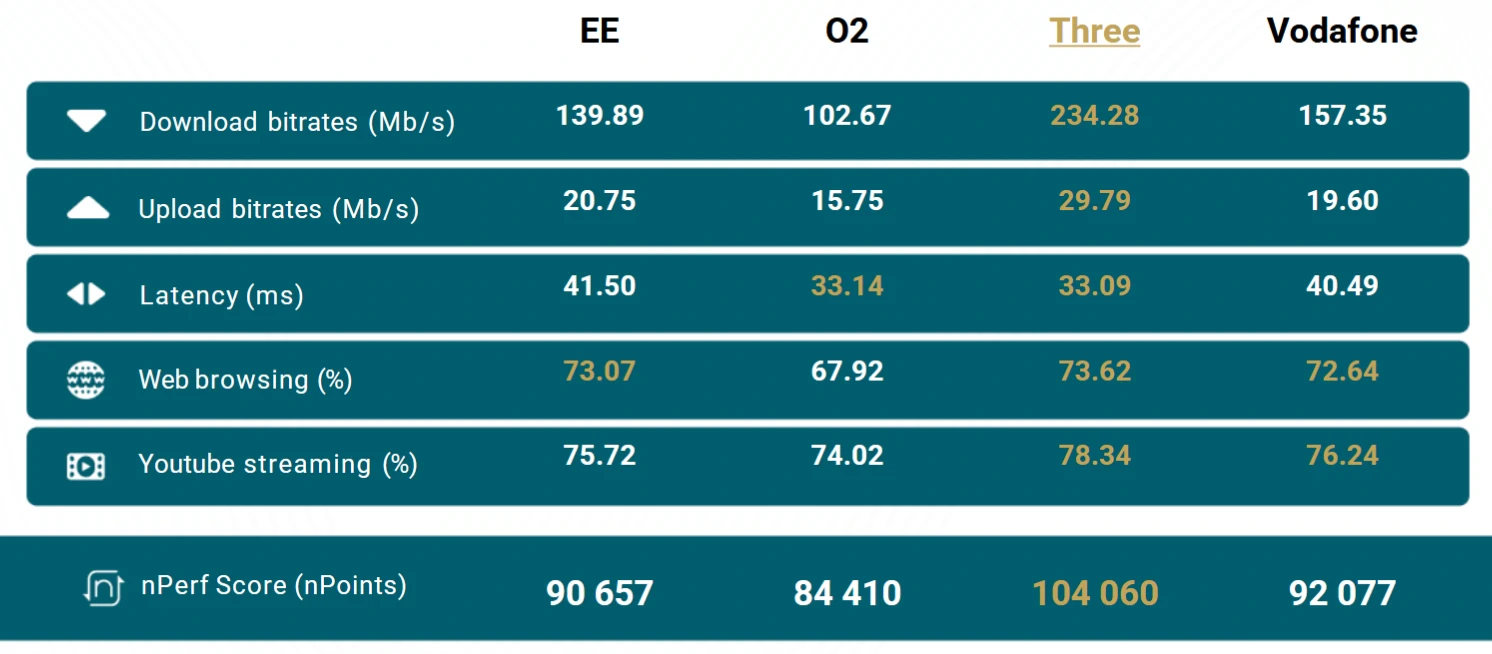
By comparison, Vodafone scored 74,892 points, while O2 once again found itself at the bottom of yet another mobile performance study with a score of just 66,557 points. The full results can be found below, which includes a second set of results for 5G-only connections (Three UK pulls out in front on that one).

2026 nPerf UK Mobile Benchmark (All Connections)

nPerf-UK-Mobile-Broadband-benchmarks-2026

2026 nPerf UK Mobile Benchmark (5G-only Connections)

nPerf-UK-5G-Mobile-Broadband-benchmarks-2026

One other thing to consider above is that Vodafone and Three UK began to merge their networks during the latter half of 2025. This is a slow multi-year process, but it may well start to impact the results for next year’s study.

The UK mobile market demonstrates strong competition at the top, with both leaders delivering comprehensive performance and user experiences that benefit from high-speed connectivity across all key indicators“, states Sébastien de Rosbo, CEO of nPerf.

Broadband ISP Voneus See UK Turnover Rise to £6.33m as Losses Hit £38m | ISPreview UK

Original article ISPreview UK:Read More

Alternative rural network provider Voneus, which has built a mix of full fibre (FTTP) and wireless (FWA) broadband networks across some remote parts of Wales and England, have published their annual accounts to the end of March 2025. The figures show that turnover increased 43% to £6.33m due to customer growth, but they suffered a loss before tax of £38m.

Just to recap. Voneus was last year hit by some redundancies and a slowdown in their network build (here), due to many of the same pressures as other altnets have been facing (rising build costs, competition and high interest rates etc.). Back in 2024 they also withdrew (here) from the publicly funded Project Gigabit broadband build contract for Mid West Shropshire (Lot 25.01), which has since been picked up by Openreach (here).

NOTE: Voneus has received investments from Macquarie Asset Holdings, the Israel Infrastructure Fund (IIF) and Tiger Infrastructure Partners (principal shareholder of Rural Broadband Solutions) etc. The operator originally aspired to cover 370,000 homes with their gigabit networks, but they’ve so far done 100,000 (Feb 2025) and are home to 26,000 customers (Nov 2025).

However, at the end of last year they did manage to strengthen their position for “long-term growth” with a business reorganisation, which was said to have secured their funding through to 2030. This involved the renegotiation of an existing £70m loan facility with banking partners, which is intended to support future network commercialisation.

The company’s latest annual accounts help to show why they needed to strike the aforementioned agreement and Voneus’ directors say they now have a “reasonable expectation that the company has adequate resources to continue to operate in the foreseeable future“.

Summary of Key Figures – Voneus Accounts (March 2025)

➤ Turnover increased 43% to £6.33m due to customer growth (2024: £4.41m).

➤ Gross profit increased to £800k (2024: £768k), although gross profit margin declined to 13% (2024: 17%).

➤ Employees grew to 275 (2024: 238).

➤ Losses before tax increased to £38m (2024: £36.6m).

➤ Government grant receipts (gigabit vouchers etc.) increased to £2.25m (2024: £1.12m).

➤ Net assets worth £136.18m

Voneus are currently in the process of conducting a “business reorganisation to ensure operational efficiency and future scalability“, which is already known to include the “outsourcing of some business functions” and may result in a “limited number of redundancies“ (here).

The Curious Case of Openreach’s Vanishing UK FTTP Broadband Coverage | ISPreview UK

Original article ISPreview UK:Read More

Independent data analysis has recently revealed a curious trend where patches of Openreach’s full fibre (FTTP) broadband network, often within urban areas and usually but not always associated to installs that require a more complex stage 2 process, suddenly vanish after somebody places an order. The issue is estimated to be impacting 0.3% of UK premises.

Regular readers will know that there are already various reasons why areas that have already gone live with FTTP may suddenly, albeit temporarily, cease to be available. For example, availability can be impacted if the local distribution nodes (e.g. Connectorised Block Terminals / CBT) run out of spare ports or nearby telecoms poles have no space for new cables. This often causes a delay in availability until engineers can deploy a solution, albeit usually only for a very small area (e.g. one side of a street or a handful of homes).

NOTE: Openreach’s Fibre-to-the-Premises network, which is costing £15bn to build, currently covers 21 million premises and aims to cover 25m by December 2026 (there are c.32.5m across the UK), before possibly rising “up to” 30 million by the end of 2030 (regulatory conditions allowing).

However, the cases we’re looking at today concern a different issue or set of issues, which can often impact a wider area (e.g. several streets or postcodes). The problem, which was picked up by Andrew Ferguson over at Thinkbroadband (here, here, here and here), concerns areas where Openreach have deployed FTTP, but then latter identify additional complexities after somebody places an order.

Often these will be areas that have already been designated as falling under a stage 2 (KCI2) installation process. Just for context, a stage 1 process tends to reflect a normal property that is expected to be installed within a single engineering visit, while stage 2 usually reflects those that are expected to be more complex (i.e. may require additional external engineering work before a connection can be made to the inside of the property).

During stage 2 installs, engineers may also come across various often unexpected issues, such as cable ducts that are blocked or don’t exist (e.g. the cable may be directly buried in the ground). Properties marked as stage 2 are usually considered to be covered if Openreach have built their FTTP network to the area, but that last little hop into homes can still throw up problems. In some cases this has been causing Openreach to remove some sizeable patches of coverage from areas where the service was previously marked as “available” (RFS).

A Spokesperson for Openreach told ISPreview:

“We’ve temporarily paused new Full Fibre orders at a small number of previously enabled premises as we don’t want customers there to face long delays when they order. These particular locations have proved more complex to connect than a typical order, so we’re taking a closer look at the reasons for that to make sure we can give people the right service experience from day one. Existing customers and inflight orders aren’t affected, and we’ve already made some paused locations available again. We plan to the remainder as quickly as possible.”

Openreach are certainly not the only network operator to run into this sort of problem, although until recently it wasn’t really possible to get a feel for how much of an impact it was having. However, Andrew’s recent mapping efforts have changed that, which has increasingly identified areas across the UK where the operator’s FTTP coverage figures have been going backwards. Andrew said: “We’ve had plenty of networks where everything says yes and they’ll actually take peoples money to then find out a street has been removed from footprint.

For example, over in Plymouth (Devon) it was identified that this issue had recently resulted in full fibre coverage dropping from a peak of 80.21% to 79.15% (a reduction of c.1,300 premises), which has created islands of vanishing availability within the city. But nationally, Thinkbroadband estimates that it may only impact around 0.3% of UK premises, although it’s not clear how long it usually takes for operators to resolve such issues and Andrew is still working to fully map the impacted areas.

Suffice to say, full fibre coverage is turning out to be a bit more dynamic than we originally expected, although the above challenges should perhaps be considered par for the course on any network that’s still in the process of building.

Broadband Satellite ISP Starlink Prep Free Stargaze Data to Avoid Space Collisions | ISPreview UK

Original article ISPreview UK:Read More

The Starlink service from SpaceX, which operates a mega constellation using thousands of ultrafast broadband internet satellites in Low Earth Orbit (LEO) for the UK and globally, has revealed that they’re about to start making data from their Space Situational Awareness (SSA) system, called Stargaze, available for free to other satellite operators.

Starlink currently has around 9,600 satellites in Low Earth Orbit (c.6,150 are v2 / GEN2 variants) – mostly at altitudes of between c.340-525km. Residential customers in the UK usually pay from £35 a month for the ‘Residential 100Mbps’ unlimited data plan (kit price may vary due to different offers), which also promises uploads of c.15-35Mbps and low latency connectivity. Faster packages exist at greater cost, while more restrictive (data capped) options also exist for roaming users (e.g. £50 per month for 100 GigaBytes of data).

NOTE: By the end of 2025 Starlink’s global network had 9 million customers (up from 6m in July 2025). The service had 110,000 customers in the UK as of July 2025 (up from 87,000 in 2024) – mostly in rural areas.

However, one of the growing concerns with such large constellations is that they may increase the risk of a Kessler Syndrome style event, which is a theoretical situation in which a runaway chain reaction of collisions in low Earth orbit (LEO) creates a cloud of space debris density. This then damages many other satellites and potentially renders Earth’s orbit unusable for satellites and future space missions / rockets.

SpaceX thus operates a novel Space Situational Awareness (SSA) system, called Stargaze, which they say enhances the safety and sustainability of satellite operations in LEO. The system uses data collected from nearly 30,000 star trackers, each of which makes continuous observations of nearby objects, resulting in approximately 30 million transits detected daily across the fleet.

The system autonomously detects observations of orbiting objects and are then aggregated to generate accurate orbit estimates and predictions of position and velocity for all detected objects in near real-time. These predictions integrate into a space-traffic management platform that identifies potential close approaches between objects in space and generates Conjunction Data Messages (CDMs). The system can provide conjunction screening results within minutes, compared to the current industry standard of several hours.

Such systems are necessary because there are all sorts of hazards for Earth’s increasingly crowded satellite space to consider. Practices — such as leaving rocket bodies in LEO, operators manoeuvring their satellites without sharing trajectory predictions or coordinating with other active satellites, and countries conducting anti-satellite tests — have all heightened the risk of collision, necessitating improvements in space-traffic coordination.

The problem is that conventional methods typically observe objects only a limited number of times per day, causing large uncertainties in orbital predictions, further compounded by volatile space weather. So in order to address this, Starlink has gone a step further by announcing that its screening data will be made available to the broader satellite operator community “free of charge in the coming weeks.

Starlink Statement

To maximize safety for all satellites in space, SpaceX will be making Stargaze conjunction data available to all operators, free of charge, via its space-traffic management platform. This platform has been in a “closed beta” with over a dozen participating satellite operators, allowing low-latency ephemeris sharing and conjunction screening.

Starting this spring, operators that submit ephemeris (trajectory predictions) to the platform will also receive CDMs against Stargaze data, in addition to ephemeris from other participating operators. This ensures that operators have low-latency access to the best available data for conjunction assessment.

Stargaze already has a proven track record in its utility for space safety. In late 2025, a Starlink satellite encountered a conjunction with a third-party satellite that was performing maneuvers, but whose operator was not sharing ephemeris. Until five hours before the conjunction, the close approach was anticipated to be ~9,000 meters—considered a safe miss-distance with zero probability of collision.

With just five hours to go, the third-party satellite performed a manoeuvre which changed its trajectory and collapsed the anticipated miss distance to just ~60 meters. Stargaze quickly detected this manoeuvre and published an updated trajectory to the screening platform, generating new CDMs which were immediately distributed to relevant satellites. Ultimately, the Starlink satellite was able to react within an hour of the manoeuvre being detected, planning an avoidance maneuver to reduce collision risk back down to zero.

With so little time to react, this would not have been possible by relying on legacy radar systems or high-latency conjunction screening processes. If observations of the third-party satellite were less frequent, conjunction screening took longer, or the reaction required human approval, such an event might not have been successfully mitigated.

Despite the development and improvements of their system, SpaceX have recently become keen to encourage other satellite operators to start sharing their data on satellite trajectories and now appear to be trying to lead by example (partly because their huge network also makes them among the most vulnerable to such dangerous events).

Starlink ephemeris is updated and shared publicly every hour, and all other operators should do the same,” said the company. “By providing this ephemeris sharing and conjunction screening service free of charge, we hope to motivate operators to take similar steps towards ephemeris sharing and safe flight.”

Is a BEAD conflict brewing between NTIA and Starlink? | Total Telecom

Original article Total Telecom:Read More

ray of light near body of water

News

Starlink, a subsidiary of SpaceX, is trying to change the government’s broadband playbook, a new leaked document reportedly reveals.

By Brad Randall, Broadband Communities

States are being sent riders from Starlink that list caveats to the service the company will eventually give to broadband serviceable locations (BSLs) under government’s massive broadband push, known as the BEAD program.

The revelation comes after several “concerned states” reached out to broadband.io, according to Doug Adams, an admin for the website.

Adams said the riders, which he posted a copy of online, were marked as confidential.

His post describes the brewing conflict the riders signal, which also demand that Starlink be paid 50% upfront.

“Even though the rider insists that Starlink is paid 50% upfront, Starlink isn’t required to increase capacity before it is requested by BSLs,” Adams wrote. “This flies in the face of the NTIA’s June 6 guidance”

In his post, Adams also said multiple contacts at state broadband offices told him NTIA was urging states not to sign the riders.

His analysis of the rider continued.

“Starlink is asking to be paid (in arrears) for BSLs already subscribed and if at any point in time, a BSL tried service but cancelled, Starlink still wants these locations to be considered ‘served’.”

SpaceX, which operates Starlink as a wholly owned subsidiary, has thus far been granted more than any satellite provider in the program, according to Connected Nation’s BEAD tracker.

As has been previously reported, revised guidance to BEAD last year ordered bureaucrats to find more cost-efficient means of delivering broadband. As a result, the attractiveness of low-Earth orbit satellite connectivity has boosted for states seeking cheaper alternatives to fiber.

Of proposals analyzed by Connected Nation so far, Starlink has thus far been awarded over $733 million.

Get news like this in your inbox. Subscribe to the Broadband Communities newsletter!

The post Is a BEAD conflict brewing between NTIA and Starlink? appeared first on Total Telecom.

Sparkle and Valencia Digital Port Connect: Agreement to Land Barracuda Subsea Cable at Genoa Landing Platform | Total Telecom

Original article Total Telecom:Read More

Rome/Valencia, 30 January 2026

Sparkle, the first international service provider in Italy and among the top global operators, and Valencia Digital Port Connect (VDPC), the Spanish telecommunications infrastructure company developing the Barracuda submarine cable project in collaboration with private equity firm Teset Capital, announce a strategic agreement to land the Barracuda submarine cable at Sparkle’s Genoa Landing Platform.

The Barracuda project will establish the first direct high-capacity, low-latency submarine route between Spain and Italy, creating a 1,070 km digital bridge between Valencia and Genoa. Designed with an “open cable system” architecture, Barracuda will feature 12 fibre pairs, each with a capacity of 32 Tbps (Terabits per second). The project has an estimated total investment of €100 million and is scheduled to be completed in three years, with operations expected to begin in 2028.

Under the agreement, Barracuda will land at Sparkle’s Genoa Landing Platform, a scalable infrastructure designed to offer a turnkey, highly resilient and secure submarine cable landing on the Western European coastline. Through this infrastructure, the cable will reach Sparkle’s Genoa Digital Hub in Lagaccio, an open and neutral colocation facility and interconnection point with other submarine cables and European terrestrial networks as well as Internet Exchange Points already present in the facility. By landing in Genoa, VDPC will gain immediate access to major European hubs, avoiding the cost, time and administrative complexity of deploying a proprietary landing infrastructure.

As part of the broader agreement, Sparkle will also acquire infrastructure assets on the Barracuda submarine cable system between Valencia and Genoa and colocation in Valencia Cable Landing Station, a fully neutral, scalable infrastructure designed for Barracuda and up to three additional submarine cable systems. This additional capability will strengthen Sparkle’s connectivity in the Iberian Peninsula, serving the local as well as the growing West African market, thus further reinforcing its strategic footprint in the Mediterranean region.

This agreement represents an important step in our strategy to position Genoa as a key gateway to Europe,” said Enrico Bagnasco, CEO of Sparkle. “The landing of Barracuda will strengthen and expand the city’s digital ecosystem, while the additional capacity on the system allows us to further expand our resilient, high-performance Mediterranean network and better serve international connectivity demand”.

Enrique Martín, CEO at Valencia Digital Port Connect said “This agreement with Sparkle marks a key milestone in the Barracuda project and confirms that we are advancing in line with our strategic roadmap. Securing Genoa as our landing point and welcoming Sparkle as a long-term customer reinforces Barracuda and Valencia Cable Landing Station as strategic assets for international partners confirming the credibility of. our ambition to have the system fully operational by 2028”.


About Sparkle

Sparkle is TIM Group’s Global Operator, first international service provider in Italy and among the top worldwide, offering a full range of infrastructure and global connectivity services – capacity, IP, SD-WAN, colocation, IoT connectivity, roaming and voice – to national and international Carriers, OTTs, ISPs, Media/Content Providers, and multinational enterprises. A major player in the submarine cable industry, Sparkle owns and manages a network of more than 600,000 km of fiber spanning from Europe to Africa and the Middle East, the Americas and Asia. Its sales force is active worldwide and distributed over 32 countries.

Find out more about Sparkle following its X and LinkedIn profiles or visiting the website tisparkle.com


About Valencia Digital Port Connect, S.L.

VDPC is a Spanish telecommunications infrastructure company headquartered in Alicante. Its mission is to establish a next-generation, neutral, and sustainable international connectivity hub in the Valencian Community through the deployment of advanced colocation infrastructure, terrestrial interconnection networks, and submarine connectivity solutions. VDPC is leading the development of the Barracuda submarine cable connecting Valencia with Genoa, including a data center and neutral cable landing station on the Valencian coast. The team is composed of seasoned professionals with executive backgrounds in telecom multinationals, the industrial sector, and academia.

Find out more about VDPC following LinkedIn profiles or visiting the website valenciadigitalport.com 

Sparkle Media Contacts

sparkle.communication@tisparkle.com

X: @TISparkle

Valencia Digital Port Connect Media Contacts

Pablo de Santiago

  1. +34.679.607.604
  2. pablo@desantiago.com


The post Sparkle and Valencia Digital Port Connect: Agreement to Land Barracuda Subsea Cable at Genoa Landing Platform appeared first on Total Telecom.