RootMetrics Research Name EE as the Top UK Mobile Network for H2 2025 | ISPreview UK

Original article ISPreview UK:Read More

Mobile network benchmarking firm RootMetrics (Ookla) has today published their H2 2025 study of UK mobile networks (calls, texts etc.) and mobile broadband (4G, 5G) speeds. The results once again name EE as the best mobile operator after they scooped up the highest scores and fastest data speeds across most categories, while O2 languished at the bottom but has improved.

The study itself is based on the results of over 619,000 tests (some 786 indoor locations were tested and 22,800 miles driven on roads), conducted by a team of testers using off-the-shelf Smartphones between July and December 2025 (drive and walk tests), to measure the real-world performance of mobile operators in the United Kingdom. However, this study is focused on the results from 16 of the UK’s largest metropolitan markets, which isn’t much good at reflecting the impact of slower connectivity in rural areas.

The results shown below are typically split into several categories (network reliability, speed, data, call and text quality etc.) and each is assigned a score out of 100 (higher numbers = better). In terms of the UK-wide results, EE came top in every single category, with Three UK supplanting Vodafone as the runner-up (ironic perhaps, given their merger). By comparison, O2 echoed their results in other studies by coming bottom of almost everything.

In terms of the overall results, all but one mobile operator managed to improve their scores over the previous biannual study, with the biggest improvement being recorded by O2. By comparison, Vodafone was the only operator to see a fall in their score, although it wasn’t a huge fall. Otherwise, EE delivered the fastest median mobile broadband download speed of 114.1Mbps (up from 110.8Mbps), followed by Three UK on 53.8Mbps (up from 45.7Mbps), Vodafone on 47.7Mbps (down from 48.4Mbps) and O2 on 44.1Mbps (up sharply from 36.2Mbps).

Overall Scores for H2 2025 (vs H1 2025)
1. EE – 94.1 (93.2)
2. Three UK – 85.2 (84.2)
3. Vodafone – 84.2 (85.8)
4. O2 – 82.7 (80.1)

The below results summary also includes a performance split between England, Wales, Scotland and Northern Ireland.
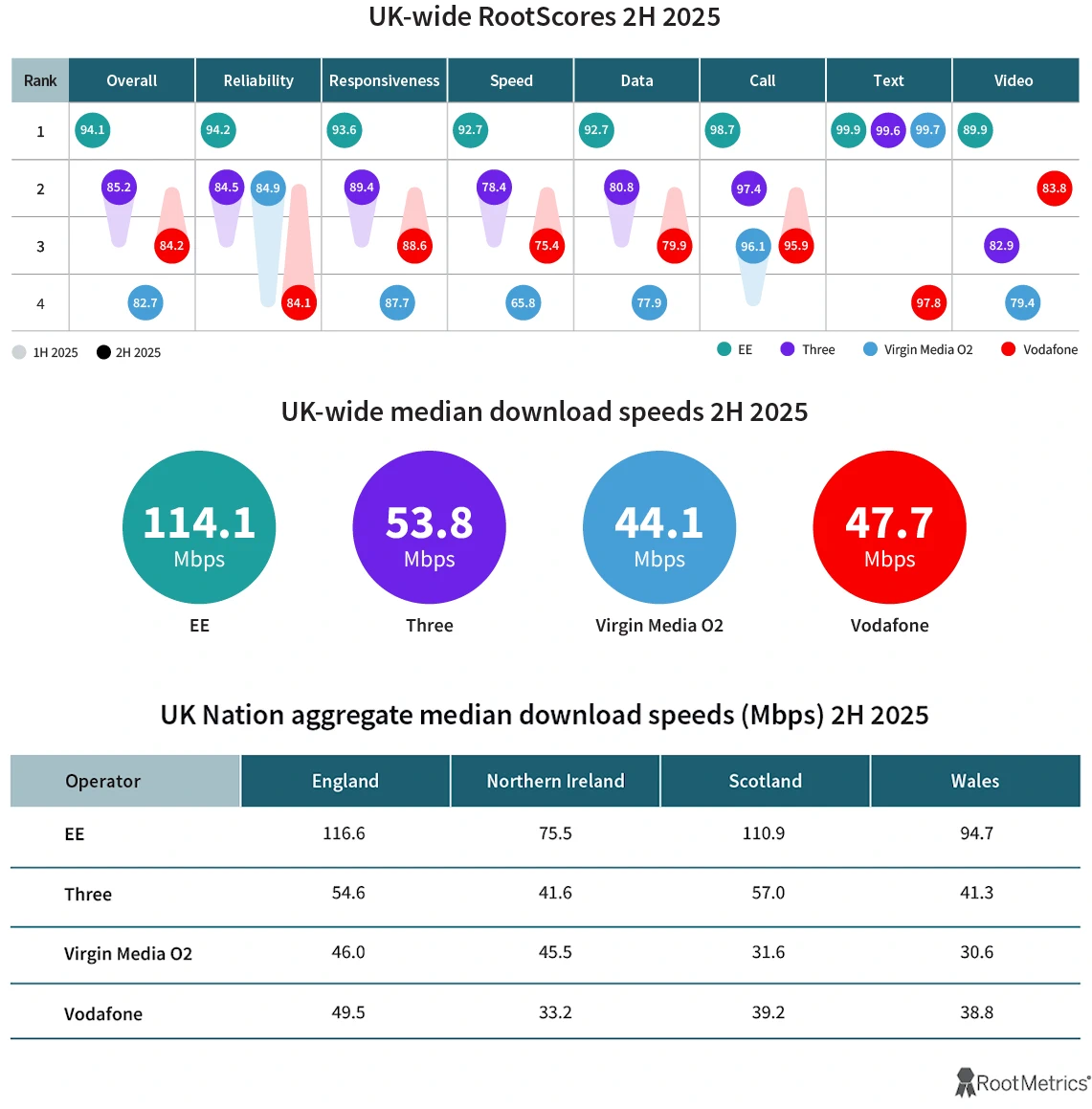
Rootmetrics-H2-2025-UK-Mobile-Network-Ranking

The study also provided some results when looking at 5G-only mobile connections, which saw EE deliver the fastest median average download speeds of 236.7Mbps, followed by Three UK on 189.3Mbps, then Vodafone on 144.3Mbps and finally O2 on 111Mbps.

Mobile operators also continued to expand 5G availability for users across the UK. At the UK-wide level, both EE and O2 recorded a little over 75% 5G availability in 2H 2025, while Three UK followed at 66.1% and Vodafone trailed at 57.0%.

Looking back one year for greater context, UK-wide 5G availability among the operators ranged from 48.3% to 66.8% in 2H 2024, compared with 57% to 76.1% in 2H 2025, highlighting the continued expansion of 5G across the country.

However, Ookla’s RootMetrics report only provides bits and pieces of selected information, while we would have preferred to see a bit more detail (e.g. upload performance and latency) and a reflection of performance in rural areas too. But that is often the caveat with this type of scientific, albeit very manual, testing – there’s simply not enough data to give a complete picture of the UK.

One final point to make is that the results for Vodafone and Three UK are likely to go through some big changes over the coming year(s) as the two continue their post-merger network integration.
Virgin Media O2 Deploy AI Tech to Minimise Downtime on UK Mobile Network | ISPreview UK

Original article ISPreview UK:Read More

Mobile operator O2 (Virgin Media) has announced that they’re working with Zinkworks to deploy AI-driven automation technology to “minimise downtime” across their 4G and 5G mobile network. The move is said build on “proven results” with their fixed broadband network, where similar automation has already had a big impact.

The expansion to the mobile side of their network means that the new Artificial Intelligence (AI) based monitoring tools will be used to predict and prevent network issues. This is said to work by “identifying patterns and behaviours, detecting and resolving issues faster, and anticipating faults before they escalate into service issues.”

The system will be particularly useful during periods of high demand, allowing operational decisions to be made “before customers are even impacted“. By comparison, the same sort of solution on their fixed broadband network is said to have reduced repair times by more than a third and cut the need for engineer visits by 12%.

The new technology is set to be deployed across key parts of O2’s mobile network, including radio access, core systems and network operations. “By combining real-time network data with intelligent automation, the network can continuously monitor itself, anticipate potential problems, and take corrective action, with engineers retaining complete oversight,” said the announcement.

Jeanie York, CTO of VMO2, said:

“At Virgin Media O2, we are investing every single day to improve our mobile network and provide a more reliable experience for our customers. Greater automation will help us predict and prevent issues and allow us to better spot and fix problems when they arise, reducing downtime and ensuring customers can trust us to deliver the dependable mobile experience they rely on.”

The initiative, which is leveraging the core Google Cloud platform and features such as Gemini and Vertex AI to deliver autonomous network capabilities, sounds as if it could be one of the better examples of how such technologies can be used to enhance existing broadband and mobile networks. The announcement doesn’t mention it, but we suspect there may also be a cost-cutting angle too.

ISP Sky Broadband and Sky TV Confirm Annual UK Price Hikes for 2026 | ISPreview UK

Original article ISPreview UK:Read More

Customers of Sky UK’s (Sky Broadband, Comcast etc.) internet, phone and TV products are being informed about the provider’s latest round of annual price hikes, which will once again be introduced from 1st April 2026. For example, broadband customers will face a flat hike of £3 to their monthly bills, which is the same as or lower than most of their largest rivals.

As for Sky’s Pay TV services, Cinema will be subject to a £1 increase per month when taken with a TV product, and Triple Play packages will see a £3 increase per month (as per the Broadband price rise). The move is different from last year, when Sky imposed a percentage based average annual price increase of 6.2% (Ofcom banned that approach), which at least had the benefit of being able to scale across lower cost and more expensive packages.

By comparison, a fixed price increase like the new one for 2026 tends to hit those on cheaper packages the hardest. The good news, if you can call it that, is Sky will give their broadband and talk (phone) customers who are unwilling to accept this hike some 31 days from the point of being notified to terminate their contract early without penalty (not applicable to their TV customers, unless bundled with broadband).

Consumer who are hit by mid-contract hikes like this could alternatively try haggling for a lower price when the notification drops (Retentions – Tips for Cutting Your Broadband Bill), which Sky does usually entertain. Meanwhile, those on benefits (Universal Credit etc.) also have the option of taking a cheaper Social Tariff – see our Quick Guide to UK Social Tariffs (Sky have these too and they’re not impacted by today’s hike).

However, it’s worth remembering that broadband, phone and TV providers are NOT immune to cost increases. Providers, much like consumers, are also suffering under the burden of rising supplier (e.g. wholesale) and lease costs, high inflation, high energy prices, the cost of adding all sorts of new services (e.g. FTTP) and catering for new regulations etc.

Broadband ISP Brsk Start Notifying UK Customers of YouFibre Merger | ISPreview UK

Original article ISPreview UK:Read More

Several weeks have now passed since ISPreview revealed that one of the UK’s largest alternative full fibre broadband networks, Netomnia (Substantial Group), had decided to merge their two retail broadband ISPs – Brsk and YouFibre – into a single brand (here). Brsk have now begun to notify customers that they’re adopting YouFibre’s name.

Netomnia (YouFibre) and Brsk originally operated as separate companies – both with their own full fibre networks and vertically integrated retail ISPs. But this changed in June 2024 after the two operators, which shared a connected investor in the shape of Advencap, announced their intention to merge and create one of the market’s largest altnets (here).

NOTE: The Substantial Group is backed by over £1.6bn of equity and debt from investors Advencap, DigitalBridge, and Soho Square Capital etc. The group already covers 3 million UK premises (inc. 445,000 customers) with “full fibreFTTP and are aiming for 5m by the end of 2027 (inc. 1m customers by 2028). The service is currently available across parts of 98 cities and towns.

Since then there’s long been somewhat of an expectation that the two retail brands might be merged, particularly since they’ve been gradually coming closer together over the past year. Brsk’s recent data breach may well have encouraged that process a bit too (here).

As previously reported on these pages, the business will continue to be led by Group CEO, Jeremy Chelot, and joint Managing Directors, Ryan Battle (Marketing and Sales) and Giorgio Iovino (Customer Experience and Field Services).

In addition, the previous update noted that there would be “no immediate changes” to Brsk customers’ contracts, plans or pricing, points of contact, or day-to-day operations. A phased transition to the unified brand will take place over H1 2026 (our sources said it would begin from 1st March), ensuring a “smooth and considered experience for Brsk customers“.

The main development this week is that Brsk have begun informing their customers of this change, although the new letter doesn’t add much to what we already reported and doesn’t clarify whether YouFibre plans to adopt Brsk’s Netgem based pay TV solution. Credits to marcusnaw and Shaukat for the tip.

Brsk’s Customer Email

What’s pink is becoming green – still the fastest on the scene.

Hi XXXXXXXXXXXXXX,

We burst onto the broadband scene in 2021 and since then have grown quickly, bringing better broadband to over 160,000 happy customers, all whilst keeping up an Excellent Trustpilot rating. I am so proud of what we have achieved.

We’re now at the next stage of our journey, and to strengthen our impact in the UK and our service to you, we are joining forces with another provider who has had similar success to Brsk.

I am excited to announce that soon Brsk is becoming YouFibre.

What does this mean for you?

Don’t worry, your broadband stays on. Your price stays the same. Nothing is switching off or slowing down, and your contract terms continue.

For now, you do not need to do anything, we just wanted to let you know about the change, because you will soon start to see YouFibre in the area, selling to new customers.

We’ll share more details soon, including what to expect and when. In the meantime, please rest assured that you’ll continue to receive the same reliable service from the same teams you know and trust.

Who is YouFibre?

YouFibre is a fast-growing full fibre provider, delivering fast, fair broadband to over 280,000 customers in nearly 100 towns across the UK. Recently, they were crowned Uswitch Regional Provider of the Year 2025.

We’ve been working alongside YouFibre since we announced a merger in 2024, so you will be in safe hands. This change will now bring us together under the single YouFibre brand, strengthening our UK-wide presence.

YouFibre offer everything you’re used to with Brsk, plus a few extras:

A fixed price promise: No surprise price rises mid-contract.

Rewarding your loyalty with great deals when it’s time to renew.

Excellent Trustpilot score.

Brilliant support from boffins, not bots.

YouFibre App including a range of features like checking your broadband status, making a payment and App Chat.

What happens next?

This is the first step to let you know what is coming, we will keep you informed every step of the way, whilst pink becomes green.

Thank you for being a valued customer and for coming on this journey with us. We look forward to creating an even bigger story together, with you at the centre.

Giorgio Iovino
CEO

(For more FAQs, visit this link)

Sky UK to Resuscitate Once Popular Sky One TV Channel on 24th February 2026 | ISPreview UK

Original article ISPreview UK:Read More

Sky (Sky Broadband, Sky TV etc.) has this morning announced that they’re bringing back the once popular Sky One channel to their Pay TV platform, which was the oldest non-terrestrial TV channel in the UK until Sky retired it in 2021 as part of a key branding and channel shake-up of their Electronic Program Guide (EPG).

In case anybody has forgotten, Sky One used to be home to some of Sky’s most popular TV shows and originals, although in the years leading up to its demise it became ever more diluted as Sky increasingly split their content across an ever-increasing array of other premium channels (e.g. Sky Atlantic, Sky Showcase etc.). Until eventually Sky One itself was retired in September 2021.

Since then, Sky has increasingly moved away from satellite-based TV provision to focus more on broadband-based disruption via their Sky Glass and Sky Stream platforms, although they continue to face growing competition from rival streaming providers and now appear to be looking to the past for inspiration.

Sky has thus announced that Sky One is to return to its channel 106 position on 24th February 2026. The channel is to play host to new shows, such as “The Dyers’ Caravan Park” and “Gemma Collins: Four Weddings and a Baby”, as well as “Rob & Romesh Vs..”, “The Paper” and “Ted”. Sky One will also host comedy show Saturday Night Live UK (SNL UK), launching “later this year“.

Carli Kerr, MD of Sky TV & NOW TV, said:

“Our goal is to make it easier than ever for Sky TV customers to find and enjoy the shows they love. Building on the iconic heritage of Sky One, the channel will be a one-of-a-kind destination that’s big, bold and bursting with energy.”

The return of Sky One replaces Sky Showcase and Sky Max, although Sky Atlantic, Sky Comedy, Sky Witness, Sky Crime, Sky Nature and Sky Documentaries will remain separate. Sky One will be available for Sky Ultimate TV, Sky Signature and Sky+ customers.

Changes to channel numbering are as follows:

➤ For Sky Q: Sky Comedy moves to channel 113, Sky Documentaries moves to channel 114, Sky Crime moves to channel 121, Sky Arts moves to channel 122, Challenge moves to 130, and Sky Sci-Fi moves to channel 145

➤ For Sky Glass and Stream: Sky Comedy moves to channel 109, Sky Documentaries moves to channel 110, Sky Crime moves to channel 111, Sky Arts moves to channel 112, Challenge moves to channel 116, and Sky Sci-Fi moves to channel 114.

ISP Grain Doubles its UK Full Fibre Broadband Speeds to 2000Mbps | ISPreview UK

Original article ISPreview UK:Read More

Carlisle-based alternative broadband ISP Grain, which has so far rolled out their point-to-point full fibre (FTTP) network to cover 270,000 UK premises (aiming for 600,000 in the future) and in 2025 secured a £225m funding boost (here), has today doubled their top symmetric package speeds to 2Gbps (2,000Mbps).

The new package starts at just £29.99 per month, plus a six-month introductory offer of £10 off, meaning six months at just £19.99. The new Full Fibre 2000 package also comes with all of Grain’s usual features, such as a fixed price 18-month minimum term contract, unlimited downloads, included installation and router, no up-front costs or credit checks and a fibre that is not shared with your neighbour (direct point-to-point).

NOTE: Grain has so far secured funding deals worth somewhere around £500m via Equitix, Albion Capital, Pinnacle Group, German Landesbank Nord L/B, HPS Investment Partners, LLC etc.

The new package doesn’t yet appear to be available across Grain’s entire network footprint, with the altnet instead saying it “will be rolled out widely across Grain’s network throughout 2026“.

Richard Cameron, CEO of Grain, said:

“We are constantly reviewing our products alongside customer needs and expectations. In today’s modern, tech-heavy homes, customers demand a first-class broadband experience – this means fast, reliable and hassle-free service that can cope with gaming, streaming, working and multiple users at once. We are proud to be the lowest priced UK network for speeds up to 2000Mbps.

Customers can optionally add either a Static IP address or Wi-Fi extender for just £3 more (or +£5 if you want both at the same time).

Common Wholesale Platform Sells UK Assets and Brand to Digital Destiny | ISPreview UK

Original article ISPreview UK:Read More

The Common Wholesale Platform (CWP), which is a non-profit member-owned organisation that helps alternative UK broadband networks to connect with the retail ISP market, appears to have gone through a Creditors’ Voluntary Liquidation. The company is now in the process of having its members, assets and brand scooped up by Digital Destiny Ltd.

The CVL is a formal, director-initiated insolvency process, which is often used to close down a company that cannot pay its debts. This usually involves appointing a licensed insolvency practitioner to sell assets and repay creditors in the most orderly way possible, and is an alternative to the more compulsory course of court-ordered liquidation.

According to a message that was recently sent to members of the service, which has been seen by ISPreview: “CWP has found it hard to provide a viable service and the CWP Board have made the difficult decision to place the Company into creditor’s voluntary liquidation … The primary cause of this were the launch delays of the [One Touch Switching] Hub, causing increased debt and insufficient growth in members generating insufficient revenue.”

The good news is that a solution has been found, with the members, brand and assets of CWP now being transferred to Digital Destiny Ltd since 1st February 2026. The new company was only incorporated on 29th January 2026 and its sole Director is listed as Lloyd Felton, who was previously a Director of CWP until 1st June 2024 and is perhaps best known for being the former boss of rural England focused altnet County Broadband.

ISPreview has also been informed that the One Touch Switching Company (TOTSCo), which is the industry-led company responsible for helping to deliver Ofcom’s solution for easier and quicker UK switching between home broadband and phone providers on different networks (One Touch Switching), have agreed in principle to appoint Digital Destiny to be a Managed Access Provider (MAP) – an organisation that helps other ISPs interface with TOTSCo’s central messaging Hub.

This is a first time that any MAP has had to go through such a CVL process and so all sides seem to be working hard to make the transition as seamless as possible. As the company’s proposed liquidator said in a recent message to all of CWP’s customer members: “I have been advised that your service will continue to be delivered with the same support team using the same platform at the same price and I further understand that the new Company will announce more details of its development plans moving forward.

The new company also appears to have plans to develop a switching solution for business connections too, although there’s currently little information available.

Study Finds Amazon Leo’s Broadband Satellites are a Bit too Bright | ISPreview UK

Original article ISPreview UK:Read More

A new study has provisionally found that Amazon Leo (formerly Project Kuiper), which is in the early stages of launching a new mega constellation of ultrafast broadband satellites into Low Earth Orbit (LEO) for the UK and globally, suffers from an all too familiar problem of being a bit too bright – potentially enough to disrupt observational sciences (astronomy).

The new service is currently in the commercial beta phase and will start to launch properly through 2026. The service currently has approval to deploy and operate their own initial constellation of 3,236 LEO satellites (altitudes of between 590km to 630km). A total of over 180 Kuiper satellites have already been placed into orbit (they need at least 500 for basic global coverage) and many more are due to follow over the next few years.

NOTE: Amazon Leo is expected to cost up to around $20bn (£14.9bn) to deliver, using a mix of rockets from ULA, Arianespace, Blue Origin and even SpaceX, by around 2030/31.

However, a new study from a group of astronomers affiliated with the International Astronomical Union (IAU) suggests that Amazon’s service, which is designed to compete with the likes of SpaceX’s Starlink constellation, also appears to suffer from the same brightness problem that we’ve seen occurring across various LEO satellite networks – some more than others.

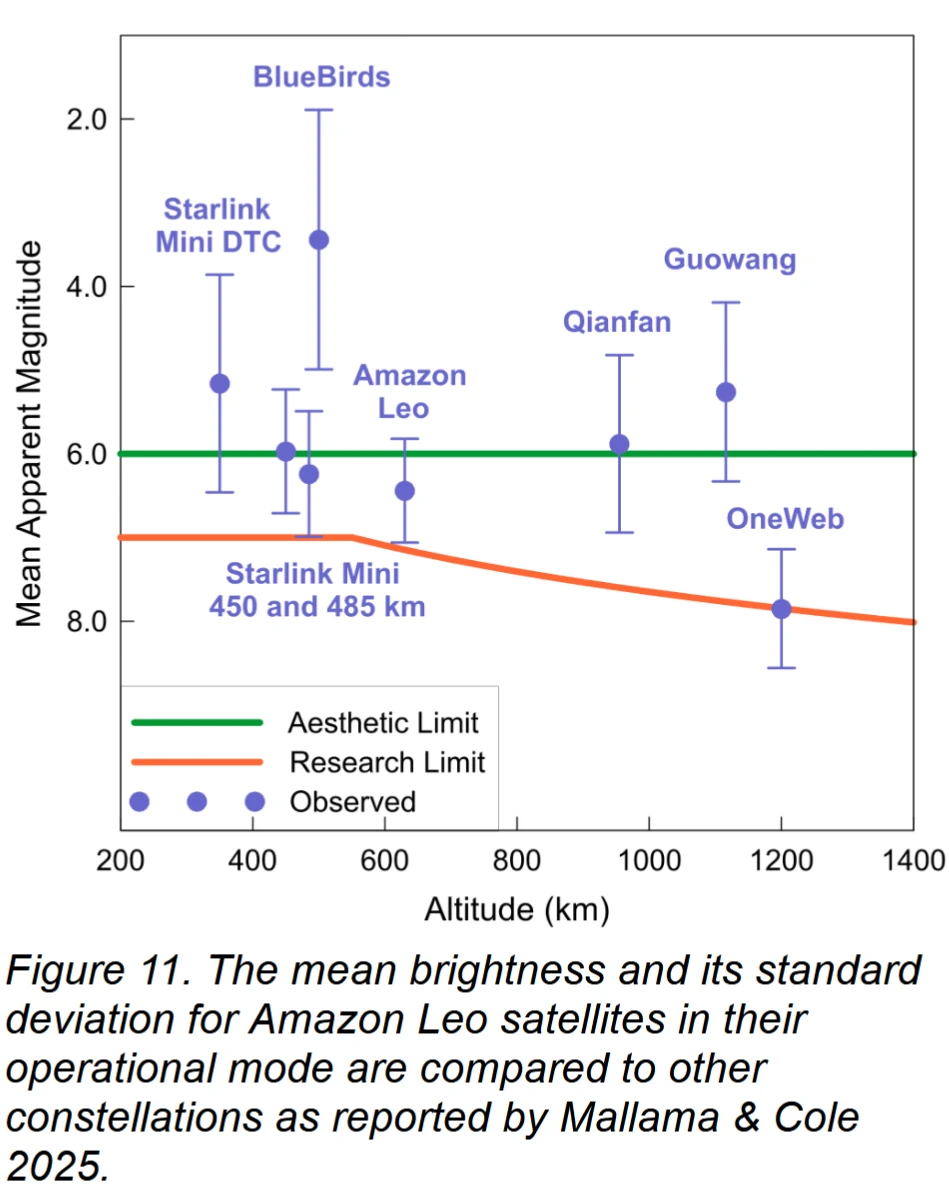
Just to recap. The IAU recommends that LEO satellites should have a maximum brightness of magnitude +7 at altitudes of up to 550km. On this scale, the brightest objects actually have the smallest numbers (e.g. brilliant Venus can reach up to -4.6, while the North Star is dimmer at +2). If satellites are too bright then that can make it much harder to picture the night sky and do other things, such as to spot dangerous asteroids or detect key celestial events.

According to the new study, which used data collected from nearly 2,000 observations of Amazon’s new satellites, the brightness distribution of satellites at 630km was compared against the IAU’s recommended limits. “For satellites in their operational mode, 92.0% of observations exceed the research limit, while 24.7% exceed the aesthetic limit,” said the study.

The aesthetic limit reflects a Magnitude of 6 (i.e. objects that can be seen at locations where the sky is minimally affected by light pollution). You can see how the various constellations compare below.

LEO-Satellite-Magnitude-Readings-Feb-2026

Study Conclusion

The mean apparent magnitude of all Amazon Leo satellites is 6.28 based on 1,938 observations. For spacecraft in their operational mode, 92% exceeded the IAU brightness limit for interference with research, while 25% distract from aesthetic appreciation of the night sky.

The reflective characteristics are similar to Version 1 Starlink spacecraft. Both strongly scatter sunlight forward and backward. Based on private communication, Amazon is working on reducing satellite brightness.

The Amazon Leo constellation spacecraft are potentially impacting astronomical research and aesthetic appreciation of the night sky.

Brightness statistics for all major satellite constellations are kept up to date at our website, https://satmags.netlify.app/ .

At present this is less of a concern because Amazon has only launched 180 satellites, but it becomes more of a problem once thousands are up in the sky. For its part, Amazon Leo says they’re working with astronomers to help reduce the brightness problem, which has included “applying a custom dielectric film and non-reflective coating on all of our operational spacecraft,” said a spokesperson (credits to PC Mag). But by the sounds of it, this is already present on their existing satellites. Suffice to say, more changes may be required.

Broadband AltNet Aggregator Flexgrid Now Supports 24 UK Networks | ISPreview UK

Original article ISPreview UK:Read More

Brighton-based Flexgrid, which describes itself as the UK-focused connectivity aggregator for the channel market, has announced that they’ve launched a new website and now support the ability for partners to compare and order full fibre broadband services through a total of 24 alternative network (altnet) providers and suppliers.

The list of current partners now includes the likes of Zayo, PXC, Openreach, Virgin Media, CityFibre, CommunityFibre, Gigaclear, ITS Technology, Netomnia, MS3, Airband, FullFibre Ltd, Elevate, Freedom Fibre, F&W Networks, Glide, Hyperoptic, Fibrus (Hyperfast GB), KCOM, LightSpeed Broadband, Zzoomm, Quickline and Neos Networks.

Flexgrid’s altnet ecosystem, alongside Openreach’s network, is now said to reach approximately 70% of UK businesses, extending full fibre broadband beyond many traditional wholesale networks. The portfolio of products includes services from Ethernet to FTTP, SD-WAN, cellular and also satellite connectivity services.

Frazer Cannadine, Sales Director at Flexgrid, said:

“Many ISPs are still defining how to approach AltNets, but Flexgrid has built one of the most comprehensive AltNet platforms available to the channel and is already working with several ISPs and MSPs to deliver full fibre broadband for their customers. We are offering services at L3 today and aim to have L2 available for the end of Q1 26. Our channel partners can take a wires only service, deploying their own edge equipment or take a managed service for an end to end experience“.

We should point out that there are a variety of altnet aggregators out there today (Zen’s Fibre Hub, PXC etc.), although these are difficult providers to accurately compare.

The Trouble with Switching from Virgin Media UK to Giffgaff Broadband | ISPreview UK

Original article ISPreview UK:Read More

Over four months have now passed since mobile operator giffgaff, which is owned by Telefónica UK, become the only other retail ISP after Virgin Media (O2) to start selling fixed broadband packages over nexfibre’s new full fibre (FTTP) network (here). But despite this welcome development, customers on Virgin Media are still struggling to switch.

Just to recap. Nexfibre was established a few years ago as part of a £4.5bn joint venture between Telefónica, Liberty Global and InfraVia Capital Partners (here). The operator has since built FTTP to cover 2.5 million premises – supported by Virgin Media’s engineers (Telefónica is also co-owner of VMO2). But the operator’s original plan to cover “up to” 7 million UK homes (starting with 5m by 2026) recently stalled and future build remains uncertain (here).

NOTE: In the future giffgaff should also become available in non-nexfibre areas that are served by Virgin Media’s own separate XGS-PON / FTTP network, but it’s unclear when that will occur. Virgin are still in the process of upgrading their old coax areas to support XGS-PON (due to complete by 2028).

Despite the uncertain climate, many of those covered by nexfibre’s network welcomed the arrival of giffgaff’s service, not least because they appear to have adopted simpler packages with clearer pricing, as well as short (flexible) monthly contracts and the ability to use a third-party router directly from the Optical Network Terminal (ONT) on your wall (officially this is NOT yet supported, but various customers say it works).

However, it wasn’t long before some interested consumers, who happened to still be customers of Virgin Media in the same nexfibre areas, found that they were unable to order and directly switch to giffgaff’s service (giffgaff’s support staff also echoed this). The only way around this was to cancel their Virgin Media connection first and then place an order for giffgaff’s service as a new line, which is far from the smoothest thing to do and often involves some downtime.

Speculation has been rife about the reasons for this. Some people suggested it could be down to limitations of their order management system / processes and others have indicated it may be more of a competitive decision, such as to avoid giffgaff hoovering up Virgin Media’s existing base with ease. Initially we thought it was just a post-launch teething issue, but the problem remains today and continues to attract complaints.

A spokesperson for VMO2 told ISPreview:

“There’s nothing preventing Virgin Media customers from switching to giffgaff, it’s just not currently a fully automated switching experience. We are working on a solution which we hope to have live soon.”

The above should perhaps be considered a joint statement, since it was given with the approval of giffgaff, although it’s currently unclear how long it will take to resolve the issue. In the meantime those in this boat who wish to switch to giffgaff will need to follow the manual cancellation route and all the extra hassles that may entail.