UK ISP TalkTalk Business Recovers Email After Long Outage | ISPreview UK

Original article ISPreview UK:Read More

Customers of broadband ISP TalkTalk Business (TTB) are once again able to use the provider’s email service after a protracted service outage, which lasted nearly a full week and appears as if it was caused by a misconfiguration of their Domain Name System / Servers (DNS).

The outage, which started on Wednesday of last week (9th April 2025), didn’t seem to get fully resolved until the start of this week. According to feedback shared via The Register, TTB initially blamed the problem on an unspecified “global outage“, before later admitting to the ironically named ‘Very Good Email Company‘ (TTB customers) that they had “made a mistake in changing the settings for a number of Domains that they host“.

One of TTB’s customers suggested that the problem appears to have been caused after the provider’s name servers were changed to Cloudflare, with no configured DNS records and no ability for users to change those records themselves. But misconfigurations of that sort are normally resolved within hours, rather than days, which leads us to suspect that there may be a little more to it.

We did request a comment from TTB before publishing, but unusually they declined to provide one. The ISP itself remains under strain following the recent demerger and financial challenges (here).

A Northern Ren-AI-ssance | Total Telecom

Original article Total Telecom:Read More

Partner Article

As the UK’s most geographically diverse digital infrastructure provider, Pulsant champions regional thinking.  Every day, there’s a push for technological innovation to go beyond the M25 and drive the brightest businesses nationwide.

This has led to our focus in the Northern Powerhouse. Pulsant have invested extensively in data centres across Manchester, Rotherham, and Newcastle.  Across all their sites, Pulsant have seen the same thing: a wave of businesses poised to capitalise on digital commerce and artificial intelligence (AI) opportunities, leading to a revival of innovation, employment, and growth.

Manchester takes the lead

It is no surprise that Manchester is set to lead this Northern Renaissance. The UK’s second city recently took the crown of the most AI-ready metropolis [1].

The city of bees now boasts the most AI-related companies outside of London and the most significant number of AI technology-focused events. Opportunities for employment in data science and cloud analytics are a rich seam of possibilities for people seeking careers and a powerful driving force for new learning facilities and courses in AI disciplines.

Flagship initiatives such as the use of AI at Manchester United, collaborating with Manchester Metropolitan University[2], have catapulted Manchester to the forefront of AI discussions. And, tellingly, Manchester lies at the heart of a powerful new northern geography, with Leeds, Salford, and Liverpool all appearing in the top ten AI cities for 2024[3].

Investment in infrastructure

The level of investment in the digital infrastructure that this AI demands has been equally diverse. At one extreme, US investment outfit Blackstone has committed to a £10 billion investment to build a major AI data centre under the QTS brand in Cambois, Northumberland, on the site of a former power plant[4].

Elsewhere, the Singapore-backed Elite UK REIT has submitted a planning application to build an 80MW facility at Peel Park in Blackpool[5]. Blackpool Council is also progressing the Silicon Sands scheme within the Blackpool Airport Enterprise Zone. This 40-acre data centre cluster has the potential to bring billions of pounds of investment into one of the most deprived areas of the UK.

The driving force behind both these examples – and others – is proximity to both power and connectivity. For example, Silicon Sands is incredibly close to the landing point for the CeltixConnect-2 subsea fibre-optic internet cable that connects the USA, UK, and Ireland. CeltixConnect2 is part of the North Atlantic Loop, which also includes Manchester. That proximity means low latency connection for intensive AI workloads and more.

High-speed, high-capacity connectivity is at the heart of AI – something seen in the 150 networks on the London Internet Exchange (LINX) interconnection fabric hosted at Pulsant’s Manchester facility. Pulsant’s partnership with LINX via their facility in Old Trafford and the LINX Scotland regional interconnection hub based at Pulsant South Gyle enables regional businesses to evolve their network using the connective power of peering and more.

Pulsant and LINX are committed to improving the infrastructure and processes that underpin digital business success and economic growth for every region in the UK.

Networks that connect into an Internet Exchange Point (IXP) like LINX means that the traffic is kept local for lower latency, enhanced performance and increased control amidst a hive of media, content, and enterprise networks.

And make no mistake, it will be AI and the associated advanced data connection and collaboration capabilities that drives the next chapter in the history of businesses in the North.  Data has been referred to as ‘the new oil’.  But, in the case of Northern England, AI is the new industry that it feeds.

The potential of AI and digital business to come to be considered alongside the coal, steel, and manufacturing sectors that have dominated the Northern industrial heritage, is very real – and remarkably close to being realised. The Ren-AI-ssance has begun.

Find Pulsant at stand 47b at this year’s Connected North, taking place at Manchester Central on 23-24 April


[1] See SAS AI Cities Index 2024 – where is the most AI ready in the UK? | SAS UK

[2] See Manchester United aim to use AI for ‘on-pitch advantage’ in university link-up – Manchester Evening News

[3] See SAS AI Cities Index 2024 – where is the most AI ready in the UK? | SAS UK

[4] See Blackstone gets green light for £10bn QTS data center in Northumberland, UK – DCD

[5] See 80MW data center proposed in Blackpool, UK – DCD

Ookla Study Finds London 5G Mobile Performance Lags Behind Other UK Cities | ISPreview UK

Original article ISPreview UK:Read More

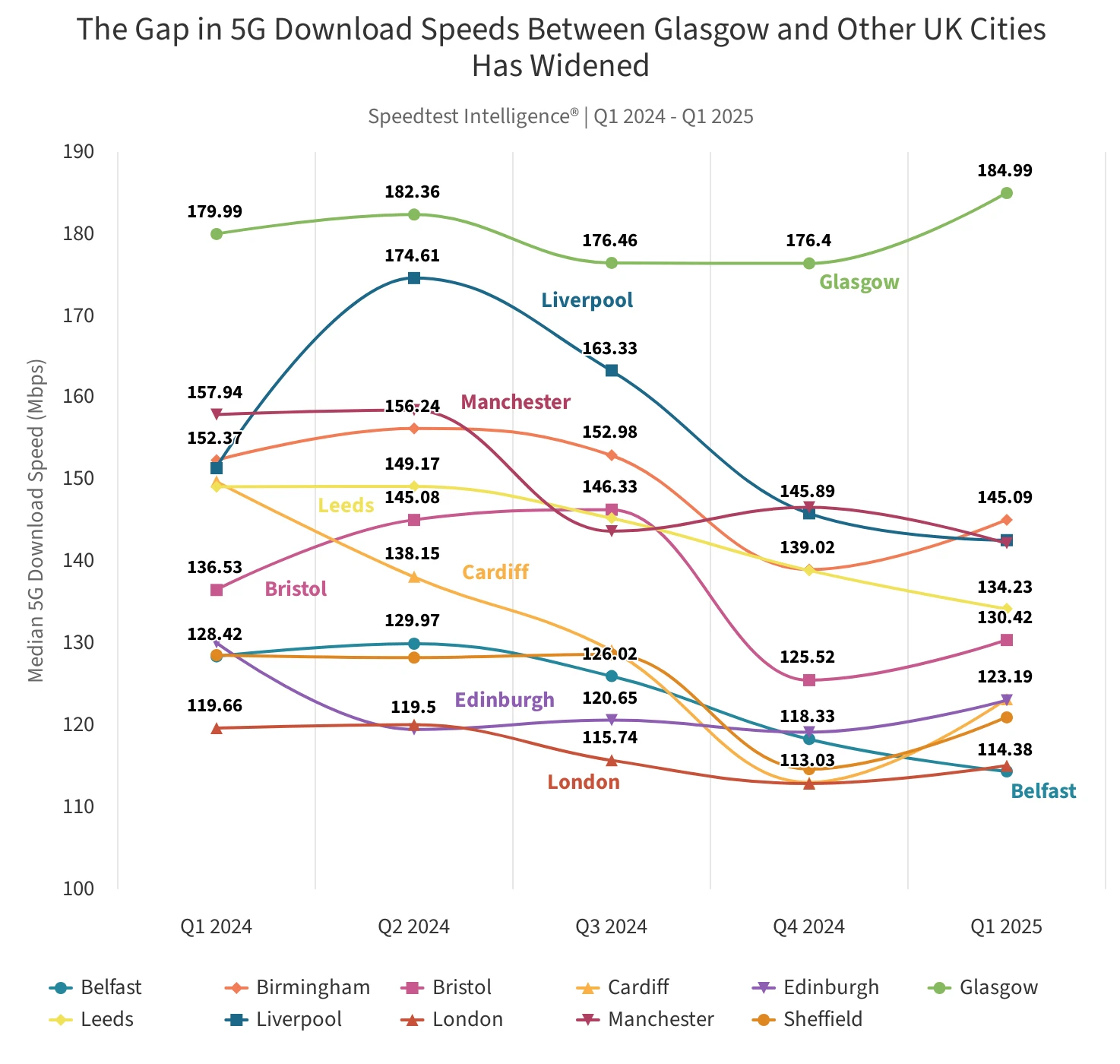
Network testing firm Ookla (i.e. Speedtest.net, Downdetector.co.uk) has today published a new study that examines the performance of 5G mobile (mobile broadband) networks across the major UK cities of Belfast, Birmingham, Bristol, Cardiff, Edinburgh, Glasgow, Leeds, Liverpool, London, Manchester and Sheffield. But the UK’s capital city was found to be lagging behind.

The new study uses crowdsourced data collected during the first quarter of 2025 via Ookla’s various Speedtest.net linked websites and apps. But it’s worth reminding readers that mobile data performance remains notoriously difficult to pin down because end-users are always moving through different areas (indoor, outdoor, underground etc.), using different devices with different capabilities and the surrounding environment is ever changeable (weather, trees, buildings etc.).

All the above can impact your signal and service quality, and that’s before we even consider other issues like network (backhaul) capacity at different cell sites or differing spectrum ownership between operators and masts. Suffice to say that benchmarking mobile networks can be a bit of a challenge, although Ookla are usually able to collect enough data to produce some meaningful results.

Overall, the new study found that London “lags behind the UK’s largest cities across key 5G performance indicators“, and the gap to top-performing Glasgow seems to be widening. The UK’s capital city was found to be trailing behind other cities for 5G network consistency, median downloads and upload speeds (e.g. London delivered a median 5G download of 115Mbps, which compares poorly with Glasgow’s 184.99Mbps).

On the flip side, median (average) 5G download speeds also fell by more than 7% on average across major UK cities between Q1 2024 and Q1 2025. This is speculated to be reflecting the impact of shifting network load from older technologies onto 5G (e.g. the withdrawal of 3G), which contributed to broader improvements in overall mobile network performance in most UK cities during the same period.

Ookla-5G-Download-Speeds-in-Major-UK-Cities-Q1-2025

Average (Median) 5G Download Speed by Major UK Cities
Glasgow 184.99Mbps
Birmingham 145.09Mbps
Liverpool 142.61Mbps
Manchester 142.24Mbps
Leeds 134.23Mbps
Bristol 130.42Mbps
Cardiff 123.19Mbps
Edinburgh 123.05Mbps
Sheffield 120.98Mbps
London 115.08Mbps
Belfast 114.38Mbps

Mobile users in London were also found to be spending more time in signal not-spots with no service than residents of other UK cities, reflecting “lingering coverage gaps indoors and across key transport routes“. The proportion of Londoners spending the majority of their time in locations with no service has, however, improved significantly due to operators investing in network densification through small cells and upgrades to transport links (e.g. London Underground).

Ookla-Time-Spent-in-UK-Mobile-Notspots-Q1-2025

Time spent on 2G networks increased across several UK cities over the last year, including Birmingham and Manchester, as the advancement of the 3G sunset in the UK contributed to greater propensity for 2G fallback.

Ookla-Time-Spent-on-2G-in-Major-UK-Cities-Q1-2025

However, the gap in 5G availability between the UK’s major cities and the national average has significantly narrowed over the past year. For example, Leeds led UK cities in 5G availability, with a 21 percentage point gap above the national average. By Q1 2025, London had taken the lead in 5G availability among major UK cities, and that gap above the national average had narrowed to 13 percentage points.

This trend reflects progress in 5G network expansion in smaller UK towns and rural areas in recent months, which has moved at a faster pace than coverage improvements in larger cities. But sadly we don’t get a more detailed summary of 5G availability across the listed cities, which would have been helpful.

Big Move as UK Civil Engineering Giant M Group Acquires Telent | ISPreview UK

Original article ISPreview UK:Read More

Street works firm M Group, which was last year acquired by private equity firm CVC (here) and also harbours a telecoms (broadband and mobile) focused division, has today announced that they’ve acquired rival UK and Ireland focused technology, telecoms and civil engineering firm Telent for an undisclosed sum.

On completion of the transaction, which is currently still subject to regulatory approval, M Group said they would be “even better placed to tackle the evolving challenges of the ageing infrastructure across the UK and Ireland“, not least by combining M Group’s infrastructure service offering with Telent’s technology and digital solution capabilities.

Telent has somewhat of a “differentiated position” in mission-critical communications, network infrastructure and end-to-end cybersecurity services, which will complement M Group. “It also expands M Group’s reach into attractive adjacent markets, including the public sector, defence, emergency services and education,” said the announcement.

The hope is that bringing Telent into the M Group family will “strengthen longstanding relationships with shared customers“, including Transport for London (TfL), National Highways, Network Rail, Virgin Media / O2, BT, EE and Openreach.

Andrew Findlay, CEO of M Group, said:

“This is a hugely transformative deal for M Group and I am delighted Telent is joining us.

We recognise the strength of Telent’s differentiated capabilities, market position and talented people that make it a great business. With the acquisition of Telent, M Group will be even better placed to deliver essential infrastructure services for life.

Our ambitious growth strategy reflects a combination of organic and inorganic growth and this acquisition builds on our strong track record of strategic M&A. It will enable us to deliver even greater value and expertise to our clients and so help the people, communities and economies of the UK and Ireland adapt to a changing world.”

Jo Gretton, CEO of Telent, added:

“Joining M Group marks an exciting new chapter for Telent, reinforcing our leading position in network and technology solutions.

Telent is a business with a long trading heritage and an excellent reputation. With M Group’s extensive infrastructure expertise and scale, we are well placed to accelerate our growth and continue to be a trusted partner for organisations at the forefront of the digital revolution.”

The civil engineering sector, particularly on the telecoms side of things, has been under a lot of strain recently due to high interest rates, competition and rising build costs. This has in turn has caused a lot of network operators to slow and even pause some deployments as they revaluate their future strategies, which has had a knock-on impact for a lot of linked civil engineer firms (job cuts, contract cancellations etc.). Some of this may well be driving today’s deal.

EE and BT to Raise Price of UK Social Broadband Tariffs After Earlier Denial | ISPreview UK

Original article ISPreview UK:Read More

Broadband ISP EE (BT) has this morning caused a degree of surprise by appearing to reverse last week’s denial (here) and announcing a price increase of £1 per month across their low-cost home broadband social tariffs for those on state benefits (Home Essentials). The provider had previously indicated to ISPreview that no such price increases would be introduced in 2025.

The Home Essentials plans reflect a mix of “fibre” (FTTC/P) and call bundles that are usually only available to those receiving Universal Credit (and certain legacy benefits). The plans included unlimited data, the ability to cancel anytime without penalty and speeds of 36Mbps (dropping back to 16Mbps in ADSL-only areas) or 67Mbps for just £15-£20 or £23 per month respectively. A Call Only (no broadband) plan also exists for £10 per month, while those on “zero income” (no income) only pay £15 for the 36Mbps option.

Last week we reported on how BT had updated the T&Cs on their website to announce a series of changes to their social tariffs, which among other things included a £1 per month price increase on two of their plans (36Mbps and 67Mbps) and the removal of their “zero income” option. The changes were all due to be introduced from 2nd May 2025.

The above came as a surprise, not least because BT had previously made a bit of a song and dance about how their social tariffs would NOT be increasing in price when they confirmed their latest round of annual price hikes in January 2025 (here). BT then responded to the news reports by informing ISPreview that their website was “not correct and [had] been updated in error”.

ISPreview later asked EE / BT to confirm whether it was indeed the case that “none of the changes” previously showing on their T&C pages would be introduced this year. In response, a spokesperson for the operator told us “that is correct” and we then updated our article accordingly.

So, you can imagine our surprise at receiving the following message from EE / BT this week, which confirmed that their broadband social tariff, Home Essentials, would indeed be increasing in price by £1 per month for new eligible customers from 2nd May 2025. In other words, their zero income plan becomes £16, while the Fibre Essentials plan (36Mbps) will now be £21, and you’ll pay £24 for 67Mbps on the Fibre 2 Plan.

A BT / EE spokesperson told ISPreview:

“We’re committed to providing support to our customers when they need it most – so we’re continuing to offer low-income customers a range of connectivity options. From 2nd May 2025, new customers can now join our broadband social tariff Home Essentials, which offers the cheapest quality connectivity for zero income customers from £16 a month. Our yearly eligibility checks ensure we’re offering customers the right tariffs at the right time.”

The provider said they were making the changes to help support their continuing investment in the business and to “bring customers a better, more reliable experience and the best value for money“. The provider added that they’d “kept the price for our social tariffs flat for a number of years, but our own costs continue to increase, so adjusting what we offer and how much for allows us to continue supporting customers“.

On the plus side, there’s no change to remove the “zero income” (no income) tariff this time, which is a good thing. But given the above U-turn, we now can’t help but wonder whether the writing may be on the wall for that plan too. The price increase itself is fairly small and is perfectly understandable given recent cost increases (inflation etc.), but clearly BT / EE could have done a better job on the communication side of things (both internally and externally).

Finally, a quick reminder. We know social tariffs can be a divisive topic for some, but that is not an excuse to abuse the comment system in order to post offensive remarks toward those who take state benefits. Such posts are against our rules and will be removed.

Opensignal Find Ultrafast UK Broadband ISPs More Reliable vs Superfast Ones | ISPreview UK

Original article ISPreview UK:Read More

Network benchmarking firm Opensignal has today published a new report that examines how the UK’s broadband experience varies across speed tiers, with homes on “ultrafast” (300Mbps+) connections enjoying a “smoother and more reliable” service than those on “superfast” (30-300Mbps) ones. ISPs EE, Vodafone and Plusnet topped the performance rankings.

Opensignal typically leverages crowdsourced data collected via end-users on their benchmarking app and services. Naturally there are some caveats to consider because such testing can be impacted by a lot of variable factors, such as poor home wiring (ADSL and FTTC lines), the end-user’s choice of package (e.g. 1Gbps could be available, but people may pick a slower / cheaper tier), local network congestion and slow home WiFi etc.

NOTE: The results reflect data gathered between 1st December 2024 and 28th February 2025.

The report then attempts to categorise its results by making three key measurements of the modern home broadband experience: Consistent Quality, Reliability Experience and Video Experience. For example, the ‘Consistent Quality’ metric uses six key performance indicators to produce a score, including download and upload speed, latency, jitter, packet loss and time to first byte.

However, one other catch with this study is that it only covers the seven largest ISPs, including PlusNet, Virgin Media, BT, Vodafone, TalkTalk, EE and Sky Broadband. This is disappointing as some of the best service and support quality can often be found on smaller providers and networks.

The Results

In terms of the data, the results found that “Superfast” connections delivered ‘Consistent Quality‘ some 83.6% of the time, but this rises to 89.9% for those on “Ultrafast” lines (they’re using Ofcom’s speed definitions for this report). As for the ‘Reliability Experience‘, superfast providers scored 733 out of 1,000 points, but this rises to 853 on ultrafast lines. Finally, in terms of the ‘Video Experience‘, superfast providers scored 76.2 out of 100 points, which rises to 78.8 for ultrafast providers.

The difference isn’t vast and most likely stems from the fact that the “superfast” (30-300Mbps) speeds category will be catching a lot of users on older and slower hybrid-fibre connections, such as Fibre-to-the-Cabinet (FTTC / VDSL2) technology and a tiny amount of G.fast. By comparison, those on “ultrafast” lines are much more likely to be using gigabit-capable Fibre-to-the-Premises (FTTP/B) or Hybrid Fibre Coax (HFC) connections.

As for the ISP specific rankings, it’s fair to say that most of the major providers actually manage to perform at a similar level, with only a relatively small to modest gap between the front-runners and bottom dwellers. But broadly speaking EE, Vodafone, and Plusnet do appear to do quite well below, even if the margins aren’t always very big. All seven ISPs are also statistically tied for Video Experience on ultrafast lines.

Opensignal-Top-Broadband-ISPs-for-H1-2025-Speed-Experience

Broadband ISP PlusNet UK Set to Trial IPv6 on High Touch Network | ISPreview UK

Original article ISPreview UK:Read More

Internet service provider PlusNet, which is part of the wider BT Group, has informed customers that they’re “now ready” to finally start trials of Internet Protocol v6 (IPv6) addressing on their “High Touch” broadband network. The ISP has previously only conducted a small scale technical trial on their “Low Touch” network (here) – used by c. 90% of customers.

Just for context. IP addresses help to connect your software and devices with others around the online world – like an ID number for your connection. The issue these days is that the existing IPv4 address space has been exhausted, which makes it difficult to add new connections without compromising by sharing IPs between many users (CGNAT, MAP-T etc.) or spending big to buy additional v4 addresses.

The long-term solution to the above challenge is adoption of IPv6 addresses, which are not directly compatible with IPv4 and so require a bit of an investment in order to make both work properly side-by-side (e.g. Dual Stack or other methods). So far both of PlusNet’s parents, BT and EE, have long since deployed IPv6 and that has left their smaller sibling to look a little out of sorts.

The good news, as spotted by ISPreview, is that PlusNet’s Enterprise Architect (Network & OSS), Dave Tomlinson, has now announced that they are finally “ready to trial IPv6 on our High Touch broadband network“. The ISP operates 2 slightly different broadband networks, one for dynamic IP addresses (“Low Touch” – most of their customers) and one for customers with static IP address, have the broadband firewall turned on and a few other things (“High Touch“).

Dave Tomlinson said:

“We’ve been testing IPv6 internally on high touch and would now like to open up the trial to a few customers so that we can get some feedback and see how it works with people with different devices and different setups.

Spaces for the trial are limited so we might have to cap the number of applicants if there’s a lot of interest.

Trial criteria to take part is:

➤ You must currently have a static IPv4 address (or a 4 or 8 block)

➤ You must have an IPv6 capable router (Plusnet Hub 2 is fine or one of your own)

➤ We recommend you have at least one PC/Mac running Mac OS, Linux or Windows 10/11 in case you need to diagnose any issues.”

Dave later confirmed that they’re running a dual stack IPv4/IPv6 setup, so your (customer) router will get allocated both the existing static IPv4 and also a /56 IPv6 prefix. Devices on your LAN will continue to be allocated a private IPv4 address e.g. 192.168.1.x or 10.0.0.x, but will also be allocated one or more public IPv6 addresses where they support IPv6.

Dave explained:

“I’ve got a mixture of devices on my network where some support IPv6 like my Linux server, Mac and iPhone and some don’t like my lightbulbs and TV. The ones that don’t support IPv6 just work exactly as they did before I had IPv6. LAN traffic is IPv4 and then it’s NAT’d out to the Internet using the IPv4 public IP.

For the devices that do support IPv6 then where the service they are connecting to supports IPv6 like this forum or Netflix or Google then the traffic should favour IPv6. And where the service doesn’t support IPv6 like www.plus.net then it will favour IPv4. That’s mostly done at a DNS level, where if you get a AAAA DNS record with an IPv6 address it should try IPv6 first and where there’s only IPv4 DNS records it’ll just do IPv4.

There are other ways of doing IPv6 and IPv4 where you might only get an IPv6 address on your router and no IPv4 public address or you get a CG-NAT IPv4 and IPv6, we aren’t trialling any of those so on our trial you should see every device either getting both IPv4 and IPv6 or just IPv4 (potentially there are some IoT devices that just do IPv6 but unless you already have an IPv6 tunnel broker account or similar we probably don’t need to think about those at the moment).”

Customers who wish to take part should express their desire via this Plusnet Forum Thread, although only a small portion of their base are currently using the provider’s High Touch network. At this stage we don’t know how long this trial will last or when the final change may be fully deployed, but given that this is PlusNet then it’s probably best not to speculate (they’re infamous for long-running trials and IPv6 was first tested back in.. 2011! here).

EE UK Launch Tech Drops – Giving Big Discounts on Modern Technology | ISPreview UK

Original article ISPreview UK:Read More

Mobile operator and broadband ISP EE has updated their online “Tech Store“, which sells a mix of extra services and gadgets (e.g. TVs, games consoles, laptops etc.), to introduced “Tech Drops“. This is a new monthly scheme that sees their store “offer a huge saving on a limited amount of stock of the hottest tech“, purchased via their App on a “first-come-first-serve basis“.

For example, the first “Tech Drop” will be on the Beats Studio Pro headphones on 17th April 2025, which will be reduced to just £149 (less than half the price of the £349.99 RRP). Just to be clear, these monthly Tech Drops discounts will be available to both EE and non-EE customers via the EE App. But select existing EE mobile and home broadband customers “will be alerted up to 24 hours before each drop” (useful as there will be limited stock for the special sales).

Sam Kemp, Director of Gaming and Consumer Electronics at EE, said: “As part of our mission to offer customers access to the best tech, we’re excited to unveil our new monthly Tech Drops initiative. Launching this week, our first EE Tech Drop will give thousands of people the chance to make huge savings on one of the hottest pieces of tech on the market – but they must be quick as the deals only runs for a limited time period. All customers need to do is download the EE App and look out for the next Tech Drop.”

ASA Ban Vodafone UK Ad Over Misleading “The Nation’s Network” Claim | ISPreview UK

Original article ISPreview UK:Read More

The Advertising Standards Authority (ASA) has banned an advert on UK mobile and broadband operator Vodafone’s website. This occured after EE complained that its claim of being “The Nation’s Network” was an “implied comparative superiority claim“, which was ultimately deemed to be “misleading“.

The ad in question appeared in December 2024 on the www.vodafone.co.uk/network page, which was headed “Connecting you this Christmas on The Nation’s Network”. Some small text stated, “The Nation’s Network: Vodafone UK, supporting the nation since 1984” and linked to “Full verification”. Bold text alongside stated, “The Nation’s Network”.

Text further down the same web page in a sub-section stated, “Why we’re The Nation’s Network Since 1984, we’ve gone from strength to strength to support the nation. Today, we’re proud to call ourselves The Nation’s Network” and listed “Firsts in the telecommunication industry”, “Supporting our emergency services” and “Reliable, award-winning network”.

In addition, text in another sub-section of the web page stated, “Staying connected on The Nation’s Network We’re helping you stay connected, whether you’re at home or travelling” and listed “99% UK home coverage”, “international roaming” and “our growing 5G network”.

Vodafone argued that the use of “The Nation’s Network” was in reference to their heritage as the UK’s “first and most long-standing mobile telephone network“. But the ASA ruled that “there were several possible consumer interpretations” of their statement and that a “significant minority of consumers were likely to view the claim” as being more a reference to comparisons of greater reliability, superior coverage and better connectivity than rivals. But in that case they’d need to be able to substantiate such a position, which they could not.

ASA Ruling (REF: A24-1271366 Vodafone Ltd)

“The CAP Code required that comparisons with identifiable competitors must objectively compare one or more material, relevant, verifiable and representative features of those products. As such, we expected the ad to objectively compare one or more verifiable features. Because we considered that the claim, as it was presented in ad (b), was likely to be understood by consumers in a range of ways (including as a comparison against all other UK networks, for example that Vodafone was the most popular network in the UK, had the most customers or had better coverage or reliability than its competitors), we considered the ad failed to objectively compare one or more material, relevant, verifiable and representative features and concluded that the claim “The Nation’s Network”, as it appeared in ad (b), breached the Code.

We also considered market research submitted by Vodafone. The ASA Council noted that rule 1.7 of the CAP Code stated that “Any unreasonable delay in responding to the ASA’s enquiries will normally be considered a breach of the Code”. The ASA Council considered that Vodafone’s submission of consumer research in this case was at a very late stage of the investigation, and did not provide evidence for Vodafone’s argument that the average consumer would not associate the ‘’The Nation’s Network’’ with an implied comparative superiority claim.

The ASA considered that the themes measured in outcome 1 suggested that the participants felt that the ad was showing things that could reasonably be viewed, as objectively measurable factors with a potential comparative element. For example, 10% of respondents were grouped in the theme “info about Vodafone services and products”, 7% in “network reliability”, 6% in “affordable pricing”. We noted that this question did not ask specifically about the claim “The Nation’s Network”.

We considered that the results in outcome 2 suggested the claim was potentially interpreted by a significant minority of participants (39%) as being about specific objectively measurable features or characteristics of Vodafone’s service, such as the 8% grouped in “Customer satisfaction”, 25% in “Vodafone’s coverage”, 3% in “Telco/service quality”, and the 3% in Broadband services.

The questions did not specifically ask about comparability, and the research outcomes did not provide evidence that participants did not associate “The Nation’s Network” as a superiority claim, as Vodafone suggested. We considered that the research was not sufficient to provide a basis for suggesting that the average consumer would not associate the ‘’The Nation’s Network’’ with an implied comparative superiority claim, as argued by Vodafone. Therefore, our assessment remained that at least a significant minority of consumers were likely to interpret the claim “the Nation’s Network” as being an objective comparative claim against the UK’s other network providers.”

As usual, the ASA banned the advert in its current form and told Vodafone to “ensure they objectively compared one or more material, relevant, verifiable and representative features if making an implied comparative claim“.

EE also lodged a similar claim against a TV ad that featured some of the same wording. But the ASA did not uphold the complaint against that one because Vodafone was deemed to have provided sufficient contextual information to support the statement.

Sky UK Refreshes VIP by Launching Exclusive Discounts Marketplace | ISPreview UK

Original article ISPreview UK:Read More

Sky (Sky Broadband, Sky TV etc.) has refreshed their Sky VIP scheme, which typically offers special discounts and rewards to existing customers. This began after the My Sky App introduced (9th April 2025) a new “first-for-Sky discounts marketplace“, exclusively available to their VIP customers.

The change means that Sky VIPs can now access a variety of “best in-market discounts” through the VIP hub on the My Sky app, including ‘Monthly Changing Discounts‘ (i.e. offers that refresh every month), special ‘Seasonal Offers‘ (i.e. discounts tailored to be seasonal and ‘No Minimum Spend‘ promotions (i.e. discounts without any minimum spend conditions).

NOTE: Discounts will change on the first Tuesday of the month, every month from Tuesday 6th May 2025.

Sky plans to offer various related discounts and rewards across lots of different categories, such as Sports, Gaming, Entertainment & tech, Home, Food and drink for at home, Magazines/books, Leisure & attractions and also Pets.