Vodafone Launch UEFA Champions League Travel eSIM for Football Fans | ISPreview UK

Original article ISPreview UK:Read More

Mobile and broadband telecoms giant Vodafone UK has announced the launch of a new Champions Travel eSIM, which forms part of the operator’s major new multi-year partnership with UEFA and UC31 to support the development of women’s and men’s European football.

The Champions Travel eSIM apparently aims to “provide worry-free travel with global data connectivity in 206 countries“, including UEFA’s 55 member associations. The Champions Travel eSIM includes unlimited data and multiple top-up options, as well as the opportunity to create WiFi hotspot zones and a dedicated customer service desk.

Vodafone said they will also offer Champions Travel eSIM customers the opportunity to win free match tickets via periodic lucky draws.

Ahmed Essam, CEO of European Markets at Vodafone, said:

“It is great to once again be associated with European football. We are excited to sponsor women’s football, which is one of the fastest growing sports globally. As an official licensee of the men’s flagship club competition, Vodafone will help to further enhance the experience for fans, and we will launch the Champions Travel eSIM, with a range of benefits for football fans around the world.”

The announcement points to their global travel.vodafone.com service for more details, which reveals two data-only ‘Champions‘ eSIMs (follow the UEFA link at the very top). The first eSIM costs £9 and that will give you just 5GB (GigaBytes) of data to use over 5 days, while the second eSIM offers “unlimited” data for £21 to be used over 5 days.

You could of course pick Holafly’s “unlimited” data eSIM for Europe at just £17 for 5 days and save money, but the catch is that this only works across 33 countries and so you’ll need to consider if that works for your travel plans or not first. The Holafly service also limits WiFi Hotspot (tethering) sharing to 500MB per day, which is a pretty big caveat (500MB doesn’t get you very far in 2025).

Ofcom Celebrate as 1.6 Million UK People Switch Broadband or Phone via OTS | ISPreview UK

Original article ISPreview UK:Read More

The UK communications and media regulator, Ofcom, has this morning hailed the fact that 1.6 million consumers have now switched landline (phone) or broadband provider using their new One Touch Switch (OTS) process since it launched for the first time exactly one year ago.

The OTS system, which went live on 12th September 2024 – after over 17 months of delays (here), remains a Gaining Provider Led (GPL) process, where the customer contacts their new (“gaining“) ISP to start and manage the process on their behalf. But unlike the old system, which was primarily geared toward Openreach’s network, the new one expanded that to work across the UK’s increasingly diverse market of alternative networks.

NOTE: Ofcom states that all communications providers switching a UK residential customer’s Internet Access Service and/or Number-based Interpersonal Communications Service, which is provided at a fixed location, are in scope of their OTS rules, and must follow the OTS process.

The process itself, which still has some problems to overcome, was then implemented through the industry-led The One Touch Switching Company (TOTSCo), which operates a centralised messaging platform (hub) for internet and phone providers to harness. TOTSCo are also developing a separate solution for switching between business connectivity providers, which is currently in testing and due to go live in early 2026 (here).

The OTS process also got rid of notice-period charges beyond the switch date, as providers must now coordinate the switch over date. “This can save both time and money, as people do not need to coordinate this themselves,” said Ofcom. And providers must also compensate customers if there’s a delay to the start of the new service, or if they are left without a connection for more than one working day.

Cristina Luna Esteban, Ofcom’s Telecoms Policy Director for Networks and Comms, said:

“It’s never been simpler to switch, so we’re pleased that millions of customers have taken advantage of One Touch Switch in the last year and got themselves a new deal.

But there are still many customers who are out of contract and could be missing out on savings. So, we’re urging people to check their contract, compare the offers out there and if changing provider gives them the best deal to switch and save.”

We should point out that the figure of 1.6m is up from 1m at the start of May 2025 and 1.5m in mid-August 2025. Sadly, it’s difficult to know how much of a positive impact OTS has had on switching itself, since there wasn’t a lot of comparable data available on the activity before the OTS system was introduced. But a few ISPs have anecdotally told us that they haven’t seen much of a change in the level of migration activity, although this may vary across the wider market – often for reasons other than OTS itself.

First UK Project Gigabit Broadband Contract Completes in North Northumberland | ISPreview UK

Original article ISPreview UK:Read More

The UK Government have this morning confirmed that GoFibre has become the first network operator to complete one of their subsidised roll-out contracts under the £5bn Project Gigabit broadband rollout scheme. The announcement relates to GoFibre’s £7.3m (state aid) contract to deploy a full fibre (FTTP) network across 3,750 hard-to-reach premises in North Northumberland.

The smaller Type A (Local) contract for North Northumberland (Lot 34.01) was originally announced in October 2022 (here) and construction finally got underway the following Spring. GoFibre has since installed 415 kilometres of new fibre optical cable to dozens of rural communities in north Northumberland, from Seahouses to Wooler, covering “over” 3,800 premises.

NOTE: GoFibre, which is supported by a private funding of £289m from Gresham House, Hamburg Commercial Bank and the SNIB (here and here), has so far covered 123,000 premises (RFS) across over 30 “local areas” in rural Scotland and North England. But they’re also got £145m (state aid) in Project Gigabit contracts (here, here, here and here).

Over 300 businesses in the region – including factories, farms, pubs, and even wedding venues – can now also access the same network. GoFibre also offered a number of free connections to important community facilities in the region (e.g. Harbottle Village Hall, East Ord Village Hall and Lucker Village Hall).

Neil Conaghan, CEO of GoFibre, said:

“On behalf of the outstanding team at GoFibre, I’m tremendously proud that not only is GoFibre the first provider to have successfully completed the build for a Project Gigabit contract in the UK, but we’ve done it an incredible four months ahead of schedule.

This means that thousands of homes and businesses across North Northumberland, including in underserved and rural areas, can now get access to the very fastest full fibre broadband available on the GoFibre network, with all the benefits that brings.

The GoFibre team have brought expertise and hard work to ensure quality project delivery, and most importantly the collaboration with everyone from government, to the local authority, public bodies and the local community have ensured we’ve completed this project, swiftly, smoothly and effectively. Our significant base in Berwick-upon-Tweed, where our industry-leading customer service team is based, has also been a real enabler for delivery.”

DSIT Minister, Ian Murray, said:

“We committed to end the digital postcode lottery, and today’s milestone in Northumberland shows we’re not just making promises – we’re keeping them.

Whether you’re streaming your favourite show or running a business from the kitchen table, lightning-fast broadband means no more buffering and more getting on with your day.”

Breaking news.. more to follow..

Court rejects Verizon’s appeal over $46.9m data sharing fine | Total Telecom

Original article Total Telecom:Read More

brown wooden smoking pipe on white surface

News

The court ruled that Verizon’s actions had clearly triggered the Communication Act’s privacy protections

This week, the US Court of Appeals for the 2nd Circuit as rejected Verizon’s appeal to overturn a $46.9m fine issued to it last year for illegally handing customer location data to third parties without consent.

In its appeal, Verizon said that the FCC’s decision had been “arbitrary and capricious”, arguing that the location data was not protected under the law used by the FCC to issue the fine. The operator also said the fine was excessive and violated its Seventh Amendment right to a trial by jury.

The three judges, however, unanimously rejected these accusations.

“We disagree [with Verizon],” the court ruling said. “The customer data at issue plainly qualifies as customer proprietary network information, triggering the Communication Act’s privacy protections. And the forfeiture order both soundly imposed liability and remained within the strictures of the penalty cap. Nothing about the Commission’s proceedings, moreover, transgressed the Seventh Amendment’s jury trial guarantee. Indeed, Verizon had, and chose to forgo, the opportunity for a jury trial in federal court. Thus, we DENY Verizon’s petition.”

The ruling relates to an FCC decision last year, which saw the regulator issue fines totalling almost $200 million to T-Mobile, AT&T, and Verizon for sharing customer data to ‘aggregators’ without prior consent. These data aggregators, such a LocationSmart and Zumigo, then resold or syndicated this data to third parties.

At the time, the FCC summarised its findings by saying the carriers had failed to take “reasonable measures” to protect their customers’ data from unauthorised use.

“The FCC Enforcement Bureau investigations of the four carriers found that each carrier sold access to its customers’ location information to “aggregators,” who then resold access to such information to third-party location-based service providers,” explained the FCC in its findings. “In doing so, each carrier attempted to offload its obligations to obtain customer consent onto downstream recipients of location information, which in many instances meant that no valid customer consent was obtained. This initial failure was compounded when, after becoming aware that their safeguards were ineffective, the carriers continued to sell access to location information without taking reasonable measures to protect it from unauthorized access.”

The regulator was first made aware that the mobile network operators were sharing location data to these aggregators in 2018. Fines were first proposed in 2020, but disagreements within the Commission led to delays in their implementation until 2024.

T-Mobile faced the lion’s share of the fines, with the FCC ordering it to pay roughly $80 million, plus a further $12 million on behalf of Sprint, with whom they merged in 2020. AT&T and Verizon were fined $57 million and $47 million, respectively.

All three operators appealed the fines. In April, AT&T successfully had its fine overturned, in part due to the process denying the operator the option of a jury trial. T-Mobile was less fortunate, however, with the U.S. District Court of Appeals for the District of Columbia rejecting their appeal last month.

The US telecoms sector is changing rapidly in 2025. Join the ecosystem in discussion at Connected America 2026

Also in the news:
US judge rules Huawei must face charges of fraud and racketeering
Optus ditches football rights to focus on telecoms
Nokia launches digital twin platform Enscryb to digitalise energy sector

Openreach Gives Rival Networks Access to Improved Underground PIA Process | ISPreview UK

Original article ISPreview UK:Read More

Openreach has announced that rivals looking to run new fibre optic broadband lines via their existing UK cable ducts and poles (i.e. Physical Infrastructure Access) will shortly be able to benefit from a new Underground (UG) process. This is aimed at managing retrospective UG self provide (SPO) Network Adjustment (NA) orders.

The Network Adjustment process, which is part of PIA, usually reflects situations where Openreach are required to make their network useable (e.g. repairing / clearing out duct blockages or decluttering poles to relieve congestion) in specific permitted circumstances. But sometimes rivals can also do some of this work themselves (self provide).

The new Underground focused PIA process, which has been in trial for a while following an industry request and is now due to become officially available from 1st October 2025 (system development will be live from 22nd September), allows their customers (e.g. alternative networks) to submit underground network adjustments AFTER blockages are cleared. The goal is greater efficiency through less transactional processes.

The Proof of Concept (PoC) test for this has already been running for a year, with over 22,000 Network Adjustment orders submitted (equating to 75% of Openreach’s PIA volumes). Openreach told ISPreview that this has helped to drive improved order quality, improved Whereabouts compliance, and seen c.91% of orders closed with payment to the communications provider.

This collaborative approach has been a real success, and we’re delighted it’s been shortlisted for the Connected Britain ‘Barrier Buster’ award,” said a spokesperson for Openreach. A related, albeit quite vague, briefing on this can be found here.

Rural UK Broadband ISP Airband Launch 1Gbps Wireless Package | ISPreview UK

Original article ISPreview UK:Read More

Rural internet provider Airband, which has deployed a full fibre (FTTP) and fixed wireless (FWA) broadband network to cover various parts of Wales and South West England, has today announced that they’ve launched a 1Gbps speed package for those homes and businesses covered by their latest wireless networking technology.

Apparently four of their existing FWA sites have already been upgraded in Shropshire and Wrexham to take advantage of the new “hyperfast 1Gbps wireless broadband” product. The new FWA network technology is said to already cover over 11,000 properties, with a further 30,000 to be enabled before the end of 2025.

NOTE: Airband is backed by investor abrdn, which has put over £200m into growing the business.

Just to put this in context. Airband stated last year that their UK broadband network now spanned “more than 440,000 premises in over 200 communities across 7 counties“ (here), which we were told breaks down as being 175,000 premises via “fibre” (FTTP) and 265,000 premises via wireless (FWA) – all Ready for Service (RFS). The latest update today confirmed the same split of figures (i.e. no change in coverage).

Otherwise, the provider said they’ve been busy testing their new wireless service in Tenbury Wells, close to the brand’s Worcestershire base, with Paul Birkin of The Crow pub being amongst those already benefiting – experiencing speeds of up to 2.3Gbps during the testing phase.

Kash Rahman, Managing Director of Airband, said:

“This is a gamechanger for rural areas that haven’t previously had access to gigabit capable broadband. Residents no longer have to wait for fibre, thanks to our ever-evolving portfolio of services, we can now offer speeds of up to 1Gbps via wireless technologies for the first time ever.”

The provider finished by saying that their FWA offering had been “revolutionising broadband accessibility” by diversifying its service across Devon, Herefordshire, Shropshire and Worcestershire over the last year. The latest speed improvements reflect their move to embrace evolving millimetre wave (mmWave) solutions in the 60GHz band, with the provider saying they’ve “now hit the 1Gbps milestone over a range of several kilometres“.

Residential customers on the FWA side of their network typically pay from £16.50 per month on a 24-month term (£33 thereafter) for download speeds of 40Mbps with an included router and free installation, which goes up to £29 (£58 after 24-months) for their new 1000Mbps tier.

Altnet Broadband ISP Lightning Fibre Expand FTTP Cover on CityFibre’s Network | ISPreview UK

Original article ISPreview UK:Read More

Eastbourne-based alternative broadband network and UK ISP Lightning Fibre, which is building a new gigabit speed full fibre (FTTP) service across parts of Sussex and Kent in England, has today announced that they’ve also expanded their existing wholesale partnership with CityFibre to help them reach “thousands of new premises” in towns across the South Coast of England.

The altnet, which has built to a number of locations like Eastbourne, Brighton and Hove, Worthing, Lancing, Hastings and St Leonards, Heathfield, Hellingly and Broad Oak, Hailsham and Polegate, originally planned to cover 140,000 premises with their gigabit-capable network. But it remains unclear how many premises they’ve reached, and they’ve since had to slow their network build due to various challenges (here and here).

NOTE: Lightning Fibre was acquired by existing backer Foresight Group in early 2024 and put under a new company called LF Holdco2 Ltd. The same group also backs other altnets, such as Connect Fibre and F&W Networks.

However, last year saw the provider join CityFibre’s national FTTP network in order to expand their off-net reach (here), although their initial coverage expansion under this agreement was limited to the Brighton & Hove and Worthing areas. But today’s announcement confirms an expansion of that partnership, which will “soon” see their retail broadband packages becoming available to premises in Polegate, Eastbourne and Hastings.

As a vertically integrated network operator with its own fibre network, Lightning Fibre said they would continue to use their own infrastructure where available. The wholesale agreement with CityFibre enables it to significantly expand its serviceable footprint, “enabling it to acquire new customers and retain more home movers” (reducing churn).

Rob Reaks, Chief Commercial Officer at Lightning Fibre, said:

“We are delighted to be able to extend our footprint by leveraging CityFibre’s robust infrastructure. This agreement will enable us to reach even more homes and businesses with ultrafast and ultra-reliable full fibre technology.”

George Wareing, Chief Sales Officer at CityFibre, added:

“It’s great to see Lightning Fibre build on their success over our network. With CityFibre infrastructure across the South East, they now have a far larger footprint over which to offer their services, and residents and businesses will now have an even greater choice of provider.”

Which? Reveals Best and Worst UK Areas for Mobile Signal via New MAP | ISPreview UK

Original article ISPreview UK:Read More

Consumer magazine Which? has today teamed up with crowdsourced network benchmarking firm Opensignal to produce a new UK map of mobile network quality. The map uses real-world data to create a percentage score for how consistent the signal is in each postcode area in the year to August 2025 – split by EE, O2, Three UK and Vodafone.

The map itself is said to be based on over 17 million network tests taken across the UK over the last 12 months from users of Opensignal apps, which is partly the same sort of data that was recently used to help create Ofcom’s new Map Your Mobile tool. The data unsurprisingly reveals that the quality of mobile coverage varies dramatically across the country, and this can be significantly impacted by your choice of mobile operator.

However, we must also remember that mobile network coverage and performance remains a difficult thing to study, not least because end-users are always moving through different areas (indoor, outdoor and underground), using different devices with different capabilities and the surrounding environment is ever changeable (weather, trees, buildings etc.).

All of the above can impact signal quality, and that’s before we even consider any differences in local network (backhaul) capacity or spectrum usage between mast locations (cell sites). But despite this, Which?’s study of the new map and data was able to reveal that postcodes in Wales and the South West (England) were rated as having the “patchiest and most unreliable mobile experiences” in the UK.

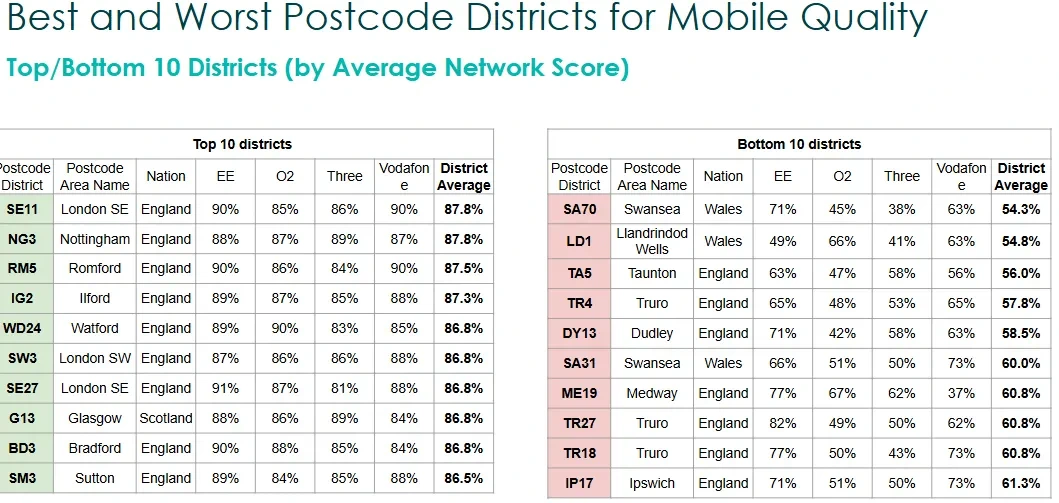
For example, SA70 in Tenby – a popular seaside tourist destination – was named the worst postcode for mobile network quality. Mobile users only experienced a good connection 54.3% of the time (i.e. 38% on Three UK, 45% on O2, 63% on Vodafone and 71% on EE).

On the flip side, SE11 in London delivered the best postcode score of 87.8% (i.e. EE + Vodafone on 90%, Three UK on 86% and O2 on 85%), but it was closely tied with NG3 in Nottingham. It’s no surprise that the big urban areas typically achieve the best mobile signals.

Which?'s Best-and-Worst-UK-Postcode-Districts-for-Mobile-Quality-2025

The map itself colour codes each postcode district to show which mobile operator delivered the best network signal (i.e. EE is a darker green, Vodafone is red, Three UK is purple and O2 is a dark blue), although sadly it doesn’t allow users to split the results by mobile broadband technology (e.g. 4G vs 5G).

Finally, we must remember that signal quality doesn’t always reflect the data / broadband performance of an operator. Sometimes you can have an excellent signal, but still get slow data speeds, such as due to limits on local capacity etc.

Which?’s Mobile Quality Map
https://www.which.co.uk/…/mobile-phone-coverage-map

UK ISP Zen Internet Boost Core Network with 400Gbps Neos Networks Link | ISPreview UK

Original article ISPreview UK:Read More

Connectivity provider Neos Networks, which runs one of the biggest 34,000km long and 400Gbps capable business fibre networks in the UK – spanning 550 exchanges, 90+ data centres and 600+ Points of Presence (PoPs), has boosted their partnership with broadband ISP Zen Internet by providing a 400Gbps upgrade between Manchester and London.

The “strategic upgrade” is said to be designed to ensure that Zen’s core network is ready for the future, while also supporting the UK’s growing bandwidth requirements as data centre investment, AI adoption, and full fibre broadband rollouts increase across the nation.

Beyond the Manchester to London link, Zen also continues to benefit from Neos’s upgraded core and exchange-backhaul services, which are said to be “critical for delivering ultrafast, resilient connectivity“. Together, these investments should support Zen’s ongoing efforts toward making quality fibre networks and services more widely available to UK businesses and consumers.

David Bruce, CRO at Neos Networks, said:

“Our long-standing partnership with Zen Internet highlights the vital role of advanced fibre infrastructure when it comes to meeting the UK’s AI ambitions. Zen’s mission to become the country’s leading altnet aggregator is well aligned with the breadth, quality, and reliability of our backbone networks, and by working together, we’re ensuring an ecosystem that will ultimately benefit the UK as a whole.”

John Lyons, Technical Director at Zen Internet, said:

“In Neos we have a partner that not only delivers robust, high-capacity network solutions, but also real agility and collaboration, helping us deliver for our end users. Our collaboration is built on open communication, rapid provisioning, and shared engineering standards like equipment duplication, diverse routing, and true east-west redundancy. This approach means we can rely on Neos to deliver a network that consistently meets the high standards our customers expect”.

The upgrade may also help to complement Zen’s new Fibre Hub, which essentially aggregates access to a number of major and smaller alternative full fibre broadband networks for their partners (e.g. ISPs) to harness.

Wi-Fi Alliance Launch New Certification for Smart Home and IoT Devices | ISPreview UK

Original article ISPreview UK:Read More

The Wi-Fi Alliance has launched a new “Wi-Fi for Matter” certification for Smart Home and IoT (Internet of Things) products, which is intended to help consumers and manufacturers identify when a particular device supports a key set of features – delivering a stronger level of confidence in their capabilities.

Several existing Wi-Fi Alliance certifications have actually been combined to deliver the new Wi-Fi for Matter certification. These all meet the Connectivity Standards Alliance’s (CSA) baseline Wi-Fi requirements for Matter certification. The access point (AP) focused certification currently consists of the following elements:

NOTE: The Wi-Fi for Matter certification also has support for battery operated devices (useful for IoT / sensors kit etc.).

Wi-Fi for Matter (Core Certification Requirements)

➤ Wi-Fi CERTIFIED 6

➤ Extended Sleep

➤ IPv4 Proxy Address Resolution Protocol (ARP)

➤ IPv6 Proxy Neighbour Discovery Protocol (NDP)

The new device certification also adds WPA3 security, and supports the life of IoT devices with improved power management requirements. Wi-Fi Certified devices should be able to conserve energy and maintain a connection with the access point. In addition, Matter Network Infrastructure Managers (NIMs) are supported with extended sleep, ARP, and NDP features.

All of this is broadly intended to support the CSA’s new technical ‘Matter‘ standard for smart home and IoT devices. The goal of this is to improve interoperability and compatibility between different manufacturers and security, while always allowing local (off-line) control as an option. Spreading that to WiFi is thus of key importance, as this is often used for network connectivity. Credits to one of our readers (Steve) for spotting this development.