VodafoneThree Sign £2bn UK Network Upgrade Deal with Ericsson and Nokia | ISPreview UK

Original article ISPreview UK:Read More

Mobile operator VodafoneThree (Vodafone and Three UK) has this morning announced that they’ve signed two multi-billion-pound and 8-year long partnerships with network technology suppliers Ericsson and Nokia. The deals will see both suppliers provide radios and other cell / core network kit and services for 17,000+ mobile sites across the United Kingdom.

The announcement forms part of VodafoneThree’s post-merger plan to invest £11bn into upgrading the UK’s 5G mobile infrastructure and coverage over the next decade (here, here and here). The combined business has also previously stated that it aspires to reach more than 99.95% of the UK population with their 5G Standalone (5GSA) network by 2034 and push fixed wireless access (mobile home broadband) to 82% of households by 2030, among other things.

NOTE: VodafoneThree is a private company – 51% owned by Vodafone and 49% owned by CK Hutchison Holdings (Three UK). It encompasses all businesses and assets, including Vodafone UK, Three UK, VOXI, SMARTY and Talkmobile.

As part of the above, today’s deal reflects the fact that two leading global communications technology suppliers, Ericsson and Nokia, have now been appointed as key partners in the delivery of all this. In addition, four additional British-based telecoms site-build partners – Beacon Communication Services Limited, Circet Wireless Limited, M Group Limited and WHP Telecoms Limited – will support delivery of the vital work.

The overall project is described as being “one of Europe and the UK’s largest privately-funded infrastructure builds” and one that will help boost the UK economy by “up to£102bn between 2025 and 2035, creating as many as 13,000 jobs in engineering and construction (74% of the roles will be outside of London and the South East). But it’s always wise to take such big economic claims with a pinch of salt, as they can be hard to prove.

The deal was not unexpected as both Ericsson and Nokia were strategic suppliers to both operators before the merger, which was naturally something that needed updating post-merger to reflect the combined network strategy.

Max Taylor, CEO, VodafoneThree, said:

“We said we would deliver at pace and, just a few months in, we are delighted to announce our strategic partners, Ericsson and Nokia, that will work with us to deliver our ambition of building the UK’s best network. They bring the scale and expertise needed to accelerate the delivery of a resilient, secure, world-class and future-ready network, and together, we are laying the foundations for the UK’s digital future.”

Börje Ekholm, President and CEO, Ericsson, said:

“We are proud to partner with VodafoneThree as their primary vendor to power them with the most advanced programmable network products, software and solutions in the world. Trusted high-performing programmable networks are critical to success for the UK’s digital economy. AI, automation and virtual/augmented reality won’t reach their potential without them.”

Justin Hotard, President and CEO at Nokia said:

“Today’s networks need new levels of performance, trust, and resilience. We are pleased that VodafoneThree has chosen our industry-leading network solutions to build a future-proof 5G Standalone network across the UK to meet the needs of customers today and as the AI supercycle accelerates.”

As part of the agreement, Ericsson will deploy its next generation, high-performing Radio Access Network (RAN) and core network solutions across the UK, reaching over 10,000 sites. This is in addition to modernising existing 4G and 5G infrastructure. Meanwhile, Nokia will supply equipment from its ultra-performance RAN portfolio to approximately 7,000 sites and will also “modernise part of VodafoneThree’s voice core“.

The two partners make up the majority, but not the entirety (some of the missing bit may reflect Vodafone’s OpenRAN deployment), of VodafoneThree’s network build, which will culminate in a greater number of sites. The result should not only deliver better mobile coverage for consumers, but also a more reliable network, with more capacity and of course faster mobile broadband speeds.

UPDATE 7:43am

We understand both deals are worth a combined £2bn.

MS3 Hit 20,000 Customer Milestone on Hull UK FTTP Broadband Network | ISPreview UK

Original article ISPreview UK:Read More

Hull-based alternative UK network operator MS3, which has deployed their full fibre (FTTP) broadband ISP network across 234,000 premises (207k RFS) in the North of England, has announced that they’ve just connected their 20,000th customer in the Hull and Humber region (up from 19,000 on 3rd July 2025).

The announcement partly reflects the fact that MS3 has been focusing more on commercialisation of their existing network than rolling out new fibre over the past few months (here). At the same time it’s clear that quite a few people in the region do appreciate the fact that they now have more choice than KCOM’s local network.

NOTE: MS3 is backed by unspecified funding from Asterion and supported by ISPs such as TalkTalk, Open Fibre, Squirrel Internet, MTH Networks, Hull Fibre, Octaplus, Home Telecom etc.

Tony Jopling, MS3’s COO, said (Thisishull): “Our investment in the rollout of our full fibre network across Hull and beyond was a direct result of the long-standing monopoly in the region. We’ve always known market competition would benefit local residents by improving service quality and driving down prices, and the news of the 20,000th connection to our network is a clear sign that’s been the case. We’re delighted to have saved local people millions of pounds in recent years.”

Channel Islands Customers on Airtel Vodafone Start Migration to Sure | ISPreview UK

Original article ISPreview UK:Read More

Mobile and broadband operator Sure, which serves the English Channel Islands of Jersey and Guernsey, has confirmed that customers of the Airtel Vodafone service have started to be migrated on to their network. The move follows last year’s £48m deal to build a new “world-class5G mobile broadband network across the islands as part of Sure’s acquisition of the operator.

Readers may recall that the original deal (here) only became possible after the States of Guernsey voted to temporarily suspend local competition law in order to allow the merger (here). The agreement also required Sure to make several legally binding commitments to help protect local competition, which among other things included some pricing protection measures and a requirement to launch a new virtual mobile operator (mvno) with the Channel Island Co-Op (Coop Mobile).

NOTE: Jersey and Guernsey are small islands and British Crown Dependencies in the English Channel, just off the northern coast of France.

The big news this week (credits to BBC News) is that Airtel Vodafone’s customers yesterday began their migration over to Sure’s platform, which is occurring in phases and due to run for the next few days. “From Sunday 21 September to Wednesday 24 September, all Airtel accounts will be moved to Sure systems. There’s nothing you need to do. Your mobile, broadband, and landline will continue to work as normal. If you have any trouble connecting to the Airtel network during this time, please restart your phone,” said a statement on Sure’s website.

Sure has pledged that customers impacted by this change will continue to receive the same network, service and support as before. The main change for now is that they’ll begin to receive their monthly bills from Sure instead of Airtel. Customers will also be able to manage their accounts via Sure’s online portal.

Broadband Group TalkTalk Set to Appoint PJT Partners to Oversee UK Break-up | ISPreview UK

Original article ISPreview UK:Read More

The debt strained TalkTalk Group, which has already been through a demerger of its businesses and last year secured a £400m refinancing package to avoid a default on its debts (here, here) – not to mention the latest £120m funding deal to help tackle recent financial pressures (here), is reportedly set to appoint advisers PJT Partners to help sell off its remaining operations.

The long-established UK internet and phone provider – home to 3.2 million broadband customers (down c.400k from last year) – has spent the past few years trying to find ways of dealing with the pressure from its existing debt pile. Over that time we’ve seen the group being demerged into three separate businesses (Talk Talk Consumer, Talk Talk Business Direct and PXC [Wholesale]), as well as various asset sales, job cuts, offshoring of support, cost-cutting / efficiency savings and all sorts of other measures to try and fix the foundations.

NOTE: The Group’s latest annual accounts (here) reveal that TalkTalk made a statutory loss before tax of £465m for the year ended 28th February 2025 (up from £153m last year). The overall level of net debt (excluding leases) has also hit £1.2bn – rising to £1.96bn if you include leases.

Suffice to say that the group is still not out of the woods. In fact, not a year seems to go by when we don’t hear word of their continuing efforts to hunt a buyer for different parts of their business (here), albeit so far without much success.

The latest development, according to Sky News, is that TalkTalk appear to be in the process of appointing investment bank PJT Partners to conduct a Strategic Review of their operations, which will be aimed at securing a disposal (sale) of its remaining businesses. Regular readers might be forgiven for experiencing a strong sense of deja vu.

Selling off the group’s consumer broadband ISP (TalkTalk) and wholesale division (PXC) has so far proven to be more than a little difficult and is expected to take some time. TalkTalk’s Ethernet subsidiary (currently part of PXC) could potentially also be sold off on a standalone basis, according to insiders.

Finding a buyer for such a large retail provider would be difficult, not least since most of their base often comes linked to their own wholesale (PXC) platform / network and any alternative networks with an interest would need to figure out how to migrate those (PXC might not like that idea). Equally, even some of the biggest retail ISPs would need to scale-up rapidly in order to take on the extra support and service burdens that come with such a sizeable base.

At present, the likes of Vodafone and Sky Broadband are probably better bets than BT or Virgin Media for TalkTalk’s retail base, partly due to their packages and operations being more closely aligned with TalkTalk’s retail business. But Sky has just cut hundreds of jobs (here) and so may not be in the best position, while it’s unclear whether Vodafone would have the appetite while their teams are already busy integrating operations after their merger with Three UK.

Finally, competition and other market regulators (e.g. Ofcom) are likely to take an interest in such a deal, which probably rules out BT (their existing retail scale would make this very difficult). Time will tell. TalkTalk is said to have declined Sky’s request for a comment.

Grain Adds Town of Nelson to UK Full Fibre Broadband Rollout Plan | ISPreview UK

Original article ISPreview UK:Read More

Carlisle-based broadband ISP Grain, which recently secured a major £225m funding boost to continue their expansion (here), has today announced that they’ve added the Lancashire (England) town of Nelson – home to a population of almost 30,000 people – to their build plan for a new full fibre (FTTP) network.

Nelson is an interesting choice given the existing collection of networks. For example, both Openreach and Virgin Media (nexfibre) have already covered most of the area with gigabit-capable broadband. At the same time, Netomnia (Brsk) are known to be actively building in the town and IX Wireless also sells ultrafast broadband via their hybrid wireless network. The ITS Technology Group’s network is also present on a local business estate.

NOTE: Grain has so far secured funding deals worth somewhere around £500m via Equitix, Albion Capital, Pinnacle Group, German Landesbank Nord L/B, HPS Investment Partners, LLC etc.

As for Grain, the announcement doesn’t reveal anything much about their deployment plan for the town, although we can see that they’ve already covered a few premises around the Vantage Court area. But other than that, we’re currently unable to identify any significant future build activity from them in the town, which will hopefully change over the coming days or weeks.

The operator’s FTTP broadband network is currently home to over 43,000 customers and covers 270,000 UK premises (aiming to reach 600,000 in the future).

Data centre operators face infrastructure reckoning as AI drives 10x power demand growth | Total Telecom

Original article Total Telecom:Read More

Water and sustainability are issues for data centres

Press Release

A comprehensive new analysis warns that data centre operators and telecom infrastructure providers face their most challenging decade yet, as AI workloads create unprecedented demands on power, water, and regulatory systems that threaten traditional operating models.

The strategic report “From Infrastructure to Intelligence” by StrategyARX Managing Director Roland da Silva argues that AI workloads now represent 20-25% of data centre capacity and are growing at 300% annually, demanding GPU-dense architectures that consume 10x more power per rack than traditional enterprise workloads.

Infrastructure Bottlenecks Reshape Market Dynamics
The analysis identifies critical infrastructure constraints now defining market entry strategies:

  • Grid Access Crisis: New facilities facing 2-7 year lead times for grid connections and water access, with Northern Virginia experiencing particular strain
  • Water Resource Scarcity: Water consumption has increased 3-5x for AI-optimized facilities, triggering regulatory pushback in water-stressed regions
  • Regulatory Timeline Extensions: Development timelines in developed markets have extended to 5-7 years due to planning processes, environmental reviews, and community resistance

Competitive Landscape Transformation
The report projects significant market consolidation, with the top 10 players controlling 80-85% market by 2030. However, new entrants including utilities, sovereign wealth funds, and government entities are disrupting traditional competitive dynamics through superior resource access and regulatory relationships.

Utility companies particularly pose a strategic threat, offering 22% lower power costs through direct generation integration and average 18-month approval timeline vs. 42 months for traditional operators.

Geographic Arbitrage Opportunities
The analysis highlights emerging regulatory arbitrage opportunities, with jurisdictions like Estonia offering 6-month approval process versus Ireland’s 7-year moratorium. This regulatory fragmentation creates what da Silva terms “generational wealth transfer” opportunities for operators willing to target Tier 2 and Tier 3 markets.

Technology Investment Strategy Framework
The report recommends a three-horizon technology investment approach:

  • Horizon 1 (70%): Proven systems including current-generation cooling and power infrastructure
  • Horizon 2 (20%): Emerging technologies such as advanced immersion cooling and small modular reactor partnerships
  • Horizon 3 (10%): Breakthrough options including quantum-ready infrastructure and direct air capture integration

Financial Impact and Investment Requirements
Market entry investment requirements vary significantly by tier:

  • Tier 1 Markets: $500M-$2B+ with 4-15% IRR expectations
  • Tier 2 Markets: $200M-$1B with 8-18% IRR potential
  • Tier 3 Markets: $100M-$500M targeting 10-25% returns

The report emphasizes that development timeline and utilization rate have 2x greater impact on returns than power costs, contradicting industry focus on energy efficiency optimization.

Strategic Framework for Market Leadership
Da Silva proposes a new success equation: Intelligence × (Power + Water + Permission) × Social License = Market Leadership, emphasizing that future market leaders must excel across technology capability, resource access, regulatory approval, and community acceptance.
“The winners will not be those who predict the future most accurately,” states da Silva, “but those who build adaptive capabilities that perform well across multiple possible futures.”
Industry Implications

For telecom infrastructure providers and data centre operators, the analysis suggests:

  •  Immediate Action Required: 3-year window for first-mover advantages in emerging markets
  • Partnership Strategy: Utility partnerships and government relationships becoming strategic necessities
  • Technology Hedging: Balanced approach between proven systems and innovation pilots
  • Community Engagement: Social license to operate now critical for long-term viability

The full report “From Infrastructure to Intelligence: Strategic Pathways for Data Centres in the Age of AI, Energy Scarcity, Water Constraints, and Digital Sovereignty” is available from StrategyARX Advisory.

About StrategyARX Advisory
StrategyARX Advisory is a boutique strategy consulting firm specializing in telecommunications and technology

Welsh Full Fibre Broadband ISP Ogi Confirms Departure of Current CEO | ISPreview UK

Original article ISPreview UK:Read More

Infracapital-backed UK ISP Ogi, which is rolling out a 10Gbps capable full fibre (FTTP) broadband network across South Wales (110,000 RFS premises passed by end of 2024), has today announced the departure of their current Chief Executive Officer (CEO) and founding member, Ben Allwright, after 5 years in the post.

Ben said he was “immensely proud of what we have achieved at Ogi” and spoke of how he was now “excited to explore new challenges and contribute to the industry in different ways, while staying firmly embedded in the vibrant community that defines the sector.” The baton will now be picked up by colleague and co-founder, Sally-Anne Skinner, who currently holds the position of Chief Revenue Officer (CRO) at Ogi.

NOTE: Ogi is home to over 20,000 customers (13th May 2024) and backed by £200m via Infracapital, as well as a £45m financing package from Cardiff Capital Region (here). The ISP employs c.150-200 staff and originally aimed to cover 150,000 premises in South Wales by 2025.

Sally-Anne first joined Ogi in 2020 as CRO and over the past five years she has played a leading role in shaping the business’s commercial strategy. This has included designing and delivering the go-to-market strategy across all channels, launching digital e-commerce and self-serve platforms, and taking on CMO responsibilities to integrate brand, communications and acquisition marketing.

However, Sally-Anne will only be taking on the CEO role in an interim capacity, which means that Ogi will be going on the hunt for a replacement.

Sally-Anne said:

“Having spent the last five years helping to shape and drive Ogi’s success as CRO, I am excited and energised to step into my new role. I look forward to leading the next phase of our journey, with a clear focus on accelerating growth and delivering strong financial performance, whilst keeping customer centricity at the heart of our strategy.”

The move comes just ahead of when Ogi are normally due to publish their annual accounts, which will be interesting to watch as we haven’t had many updates on their future network coverage plans or customer take-up levels this year.

Cross-Party Inquiry Finds UK Unprepared for Attacks on Subsea Fibre Cables | ISPreview UK

Original article ISPreview UK:Read More

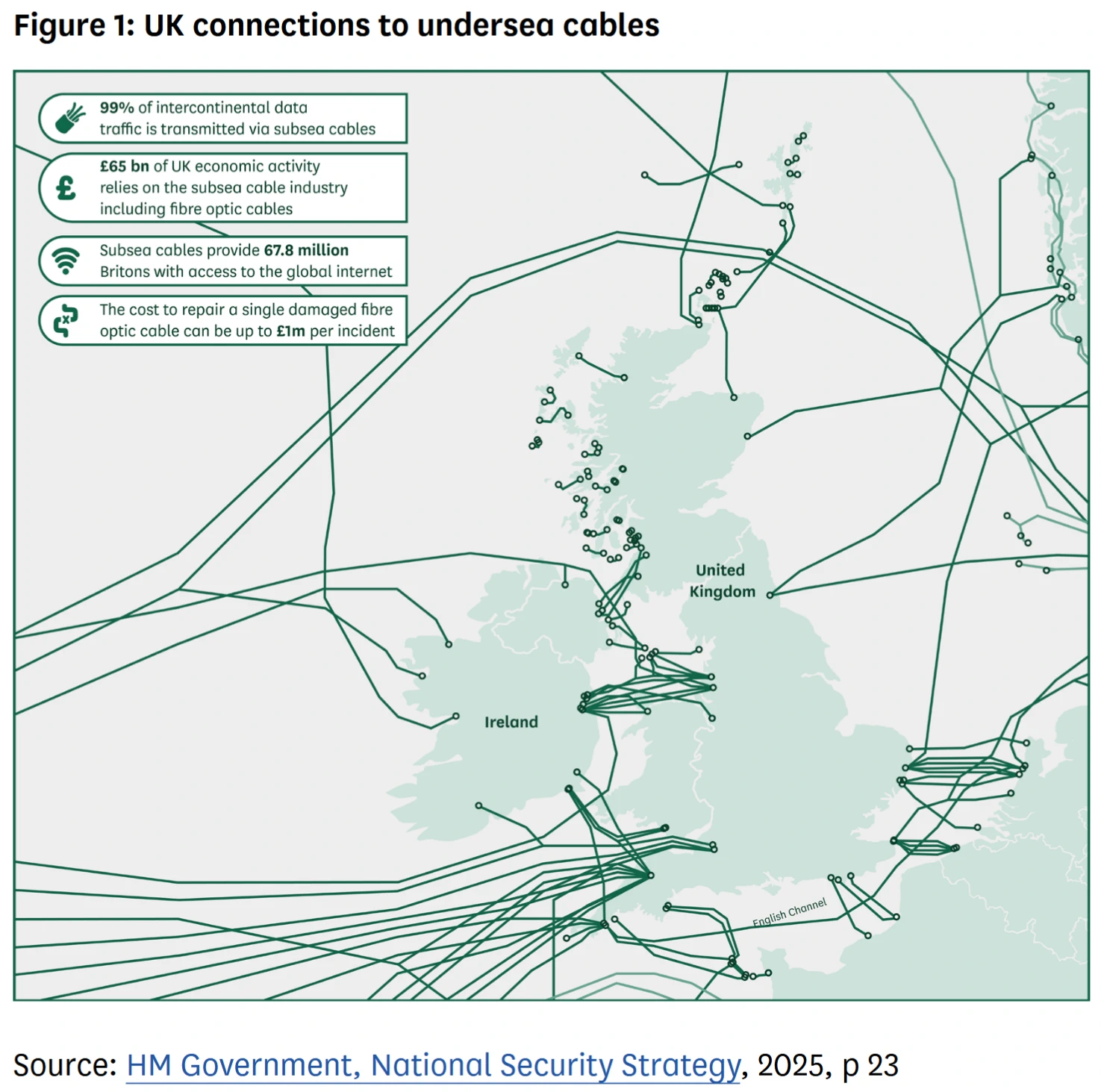
The Joint Committee on the National Security Strategy (JCNSS) has today published the results of their cross-party inquiry into the growing threats facing the country’s undersea fibre optic data cables. The report finds that the UK has “plenty of cable routes and good repair processes” for routine breakages, but the UK can’t protect all of it from adversaries and must improve.

Damage to submarine cables is, sadly, not uncommon. According to the United Nations ICPC (here), an average of 150 to 200 faults occur globally each year and require about three cable repairs per week. In addition, it usually takes a few weeks to fix a break, but this depends upon the type of break, its depth, weather conditions and various other factors.

NOTE: The UK government previously stated that the cost to repair a single damaged fibre optic cable is around £1m, and 99% of the UK’s international data traffic is transmitted via subsea cables. Backups exist via various Microwave (wireless) and Satellite broadband links, but those cannot directly replace all undersea fibres (particularly on longer links, such as to the USA).

Most of the cable breaks occur due to accidents by deep sea fishing trawlers, as well as ships accidentally dragging their anchor over them. Not to mention abrasion, equipment failure or marine life deciding to take a nibble (the latter is only really an issue for smaller / older cables that haven’t been buried). But over the past year, the act of deliberate sabotage has also become a much more real concern (example).

Meanwhile, the existing Submarine Telegraph Act 1885 can only impose a £1,000 fine, which is hardly much of a deterrent against costly cable damage accidents related to negligence or even sabotage, particularly those that occur in the gray zone of conflict (e.g. deliberately using civilian vessels to cause damage). Not to mention the problem of extending any law beyond the UK’s territorial waters.

Findings of the inquiry

The new inquiry found some things to commend. The UK has “plenty of cable routes and good repair processes for business-as-usual breakages“. Ministers and officials are also said to be working with industry on mitigating risks; schemes to monitor cables are gathering pace and plans to test resilience are maturing. But security vulnerabilities remain a significant problem.
UK-Connections-to-Undersea-Cables-2025-Government-Map-190925

In particular, the inquiry noted how “there is a limit to how much cables can be protected from adversaries using civilian vessels to ‘accidentally’ drag anchors over the seabed“. It also noted how there are particular vulnerabilities around the UK’s outlying islands, military cables and the financial sector. The trend towards critical amounts of data – supplying home and business broadband users – being concentrated in new high-capacity cables is also expected to create a small set of “high-value targets“.

Onshore infrastructure is a further concern. Cables come ashore via landing stations, which remain “vulnerable to unsophisticated sabotage“. Many onward terrestrial links converge towards data centres, creating “worrying levels of concentration … This all presents risks for low-level deniable attacks which – while not causing national disruption – would be costly, provocative and hard to prevent,” said the report.

Extract from the Summary

We were disturbed about the level of scepticism we encountered in some parts of industry and government about the value of preparing for more extensive co-ordinated attacks. Some suggested we should focus on fishing accidents or low-level hybrid sabotage. We are not persuaded that this is a good basis for mitigating catastrophic risk: there needs to be a much clearer acceptance about the UK’s strategic vulnerability in the event of hostilities.

We agree that severe disruption risks are low, and hype is unhelpful. Extensive damage is not likely outside a period of heightened tension. But given the deteriorating security environment and the UK’s growing military role in Europe, we can no longer rule out the possibility of UK infrastructure being targeted in a crisis. We are also not confident that the UK could prevent such attacks or recover within an acceptable time period.

We accept that individual industry operators have few incentives to advocate costly resilience measures for a crisis that may never come. The Government, by contrast, has a duty to prepare competently for low-likelihood high-impact events. We caution strongly against the Department for Science, Innovation and Technology favouring a ‘business as usual’ industry view of aggregate national security risk.

We also believe the Government’s resilience concept focuses too much on having ‘lots of cables’ and pays insufficient attention to the system’s actual ability to absorb unexpected shocks. We found general uncertainty about how much damage the system can sustain before data stops rerouting properly. We estimate the impacts of data rerouting failures would vary across sectors, ranging from moderate to catastrophic.

The reality today is that cutting lots of transatlantic fibre optic cables within the same short period of time, while a risk, is something that would be both extremely difficult to completely prevent and to actually carry out. On the other hand, the more such attacks take place, the greater the strain on limited resources for repairs, which could result in a build-up of cumulative delays and thus connectivity problems.

The same sort of attacks and strategies could then of course be used against an aggressor. The fact that so much international trade is carried over the internet also means that other countries are likely to be harmed by such an activity, which in a conflict may end up including the attacking state or its allies to some extent (i.e. directly or indirectly).

Nevertheless, the report is right to push for improvements, and it includes a useful list of recommendations, which we’ve summarised below. The government are will probably take this onboard as they draft new laws to better address the growing risk of deliberate sabotage against our vital subsea fibre optic cables.

Report Recommendations

➤ The Government should update its public and private risk scenarios to cover extensive co-ordinated sabotage to subsea and terrestrial internet infrastructure, including onward connections to Europe.

➤ The National Protective Security Authority (NPSA) and National Cyber Security Centre should require all UK landing stations to be target-hardened to sufficient levels to deter state-backed sabotage. They should require landing station operators to develop within 12 months an emergency ‘good enough’ repair plan to recover from co-ordinated attacks. The NPSA should also conduct a similar exercise with European counterparts for relevant landing stations on the continent.

➤ To help mitigate risks around the clustering of high value targets, the Government should encourage subsea cable providers to connect to landing stations, terrestrial routes and data centres outside high-concentration points.

➤ The Government’s resilience plans should focus in more detail on the level of immediately available capacity in the cable system during a security crisis. The Department for Science, Innovation and Technology should request operators to provide regular updates on the scale and type of data each cable carries, short notice rerouting capacity and their ability to prioritise critical services. It should further develop detailed contingency plans for rerouting data through the Channel Tunnel, including in scenarios where high-concentration terrestrial routes are temporarily disabled.

➤The Government should acquire a genuinely sovereign cable repair ship by 2030. This could be leased to industry on favourable terms during peacetime and made available for Government use in a crisis. The Government should set out a timetable for this in response to this Report.

➤ The Royal Navy should establish a cadre of reservists and serving personnel to learn cable repair skills on commercial repair vessels. These could be called on in periods of heightened tension.

➤The Department for Science, Innovation and Technology should ensure all lead departments have detailed sector-by-sector technical impact studies on areas most likely to be affected and response plans—notably finance, maritime and air traffic, communications, defence and supply chains including food and fuel. We suggest such assessments are handled securely given their value to hostile actors. We note that some cascading impacts may not be immediately obvious—it may therefore be helpful to begin with an underpinning assessment of internet failure modes and how this would affect critical systems. The Cabinet Office resilience teams could usefully help to co-ordinate and audit these assessments.

➤ Emergency services should ensure their business continuity plans highlight any areas of critical reliance on foreign internet servers, and account for temporary internet disruption in the event of a security crisis.

➤ The Government’s review of legislation must pay particular attention to strong deterrents, such as major fines and criminal liability, that can be applied to private actors suspected of working for or on behalf of foreign states.

➤ The Government should explore new options for taking a more robust approach to interdicting suspicious vessels—for example applying piracy provisions to cables that land in the UK or seeking a limited extension of domestic criminal law jurisdiction. It should commission a legal opinion on options and risks, and publish this within six months for consultation with industry and international partners. The Government should, however, remain cautious about the risks of reciprocal action from adversaries and we do not endorse any particular option at this stage.

➤ The Foreign, Commonwealth and Development Office and the Department for Business and Trade should apply diplomatic and economic pressure to press for adequate investigations from flag states and states where vessels suspected of cable damage enter port. The Government should also work with partners, particularly the International Maritime Organization, to make greater use of port state controls as a deterrent—for example by expanding mechanisms to share data on vessels’ behaviour at sea and ensuring these are then thoroughly integrated into port inspections.

➤ The Government should support the subsea cable industry in rolling out more extensive cable monitoring technology and should explore incentives to encourage such investment. This could include Government commitments to make better use of existing measures and data—for example more proactive identification and investigation of vessels switching off Automatic Identification Systems. We also encourage industry to engage closely with the Ministry of Defence to ensure underwater monitoring does not unduly compromise defence activity.

➤ The UK’s military deterrence concepts are too timid. They need to place greater emphasis on prevention and punitive consequences that go beyond private or public attribution. Otherwise, aggressors that are content with ‘implausible deniability’ can cause damage with minimal risk to themselves. The Government should work with NATO to ensure that monitoring schemes are designed to enable speedy data sharing with law enforcement authorities—which in turn should support timely investigations, and more direct physical interdiction and prosecution where needed.

➤ The Ministry of Defence should work with international partners to ensure there are viable plans to escort cable ships without degrading wider NATO taskings. This plan could usefully include heightened surveillance of suspicious vessel activity, rules of engagement enabling a low threshold for physical interdiction of civilian and autonomous vessels, and input from industry. The Royal Navy should also practice live escorting exercises with cable repair ships to build confidence about their deployment in a security crisis.

➤ The Government should seek to provide a joined-up subsea cables function providing a centralised point of contact for industry and international partners. This body should co-ordinate, not duplicate, cross-government work—bringing together departments and agencies covering subsea infrastructure operations, policy, security, resilience and contingency planning. In the first instance this could involve upgrading the Subsea Infrastructure Response Group into a formal, standing co-ordination and oversight body, reporting into an inter-ministerial group jointly led by the Department for Science, Innovation and Technology and the Ministry of Defence

➤ The Government should further explore cable protection zones for critical areas of cable concentration, policed by early warning indicators and heightened monitoring and response capabilities. This would require close co-operation with European partners, given the need to manage other maritime activities proportionately.

Owners of Fishing Trawler Ordered to Pay Virgin Media £346k Over Cable Break | ISPreview UK

Original article ISPreview UK:Read More

The High Court of Ireland has ruled that the owners of an Irish-registered fishing trawler, MV The Lida Suzanna, should pay the wholesale division of broadband provider Virgin Media some $397,514 (£346k) to cover the cost of repairing a key undersea fibre cable that runs between the UK and Ireland.

The 218.7km long cable in question is Sirius South, which was originally deployed in 1998 by NTL (they later became part of Virgin Media after the merger with Telewest) and contains 48 optical fibre strands. Virgin also operates a second cable on a similar route called Sirius North, which affords them some redundancy should one of the two links end up being damaged.

NOTE: Credits to the Submarine Cable Map site for the screenshot of the Sirius South map.

Sadly, cable breaks are not uncommon on subsea routes. Most such damage occurs due to accidents by deep sea fishing trawlers, as well as ships dragging their anchor over them or even rare cases of deliberate sabotage. Suffice to say that a whole industry exists to repair such cables, but it often takes a few days or weeks, and a fair bit of money, to fix serious damage.

Back in June 2024 we reported that Virgin Media had decided to sue the owners of the Lida Suzanna for €800k (i.e. mostly reflecting the cost of repairs) after they were accused of damaging Sirius South (here). The case had actually been filed all the way back in 2018, which itself followed a few years after the incident took place on 26th January 2015 at approximately 11:41am.

The owners of the trawler argued that the location was an “area of fishing ground established centuries past” and that they were doing nothing more than the lawful exploitation of fishing rights. The owners also claimed that Virgin Media had no entitlement to expect or demand that fishing be modified, or stopped, just because it laid a cable across the same area.

On the flip side, Virgin Media argued that shipping regulations require such vessels to carry publications that would have alerted the vessel’s owners to the location of subsea cables, and that there was also an alleged failure to ensure the skipper and/or crew were adequately aware of the location of such cables.

The presiding Judge, Mr. Justice Denis McDonald, yesterday ruled that the owners of the fishing trawler were “negligent” and that Virgin Media is “entitled to recover from the defendants the costs of repairing the damage to the cable“, which was assessed to reflect the sum of $397,514.02 (£346k) together with the additional sum of £9,000.

Mr. Justice Denis McDonald said:

“I have come to the conclusion that the plaintiff is the owner of the cable and that the damage to the cable that was sustained in the period around 11:41hrs on 26th January 2015 was caused by the Lida Suzanna. I have also come to the conclusion that the defendants were negligent and in breach of their duty of care by dredging over the cable and that the Lida Suzanna ought have hauled its gear before crossing the cable.

As a consequence, the plaintiff is entitled to recover from the defendants the costs of repairing the damage to the cable which I have assessed in the sum of $397,514.02 together with the additional sum of £9,000. There will be judgment against the defendants in favour of the plaintiff for the euro equivalent of those sums but I refuse to award interest to the plaintiff under s. 22 of the 1981 Act.”

The judge ordered both parties to liaise with each other and agree the euro amount for which judgment is to be given and to discuss the issue of costs, which must be done by noon on 7th October 2025.

A Virgin Media spokesperson said last year: “As a business with millions of customers who rely on fast and reliable connectivity, we hope that through taking this action, third parties will be better aware of the cost that can be involved and disruption it can cause when our cables are damaged.

Virgin has previously also filed a similar case against the MV Willie Joe trawler, which was settled back in 2022.

New UK Broadband ISP NuFibre Adopts WiFi 6 Home Routers from Genexis | ISPreview UK

Original article ISPreview UK:Read More

New internet provider NuFibre, which was recently established by the existing owners of Yayzi Broadband (here), have signed an agreement to adopt broadband routers and mesh WiFi extenders from European network kit manufacturer Genexis. The ISP will thus become the first such UK provider to deploy the Genexis Elite HX30 residential gateway (router) and Home CX30 WiFi extender.

The Genexis Elite HX30 is a WiFi 6 device (peak wireless speeds of 3Gbps) with support for 2.5Gbps LAN/WAN speeds, while the Home CX30 supports the same WiFi performance but is limited to 1Gbps on its LAN/WAN ports. We’ll put some more specs on the Elite HX30 below, but you can also click the links in this paragraph to download the full data sheets (PDF).

Both devices are said to be equipped with essential features such as real-time remote management through TR-369/USP.

Elite HX30 – Core Specifications

Key features
• Wireless standards:
IEEE 802.11b/g/n/ax 2.4 GHz
IEEE802,11a/n/ac/ax 5 GHz
• Signal rate:
2.4 GHz: Up to 600 Mbps
5 GHz: Up to 2400 Mbps
• 1 x 10/100/1000/2500 ETH WAN
• 1 x 10/100/1000/2500 ETH LAN
• 3 x 10/100/1000 ETH LAN
• 1 x FXS VoIP
• 1 x USB 2.0
• 2 x 2 antennas on 2.4Ghz 802.11ax
• 3 x 3 : 2 antennas on 5Ghz 802.11ax
• 256Mb NAND and 512Mb RAM

WLAN interface
• 2×2 MU-MIMO 802.11ax 2.4 GHz
• 3×3 MU-MIMO 802.11ax 5 GHz
• EasyMesh
Wireless features
• Wireless Protected Setup (WPS)
• WPA2/WPA2/WPA3 with TKIP & AES
• Security type
• MU-MIMO support

Voice
• Section Initiating Protocol (SIP)
• G.168 echo cancellation

At present NuFibre still seems to be in somewhat of a trial launch phase, although some of Yayzi’s broadband customers have recently also reported being offered NuFibre branded packages.

Martin Gardner, NuFibre CEO, said:

“We’re excited to partner with Genexis and the innovative solutions they bring to the market. The HX30 and CX30 routers are not only well-designed and high performing, but also offer exceptional flexibility from core infrastructure to end-user delivery. This combination delivers more than just a leading product; it reflects a shared commitment to continuous innovation and development. As our teams work together seamlessly, it truly feels like Genexis is an extension of the NuFibre team.”