

Original article ISPreview UK:Read More
Network testing firm Ookla, which collects broadband performance data from consumers via their popular Speedtest.net service, has examined the onboard WiFi performance of train services across Europe (inc. some Asian rail networks) and found that the United Kingdom delivers some of the slowest internet speeds on trains.
Regular readers will already be aware that the quality of onboard WiFi across the UK’s various rail networks and operators can be a bit of a patchwork. The previous government once pledged, in 2017, to make “uninterrupted” WiFi and Mobile (5G) speeds of up to 1Gbps (Gigabits per second) available on all mainline train routes by 2025. But this never materialised, and only a very few rail operators have achieved such an outcome.
The current government recently circled back to this area as part of their Infrastructure Strategy for the next 10 years, which among other things committed £41m to “introduce low-earth-orbit satellite connectivity on all mainline trains, significantly improving both the availability and internet data connection speeds for Wi-Fi connected passengers“. But it’s unclear when this will be delivered.
In the meantime, Ookla’s latest study found a wide gap in the best and worst European train operators for onboard WiFi performance during Q2 2025. Sweden was named the fastest in Europe for Wi-Fi with a 64.58Mbps median average download speed, followed by Switzerland (29.79 Mbps) and Ireland (26.33 Mbps). But at the bottom end of the table came laggards like Spain (1.45Mbps), the UK (1.09Mbps) and the Netherlands (0.41 Mbps).
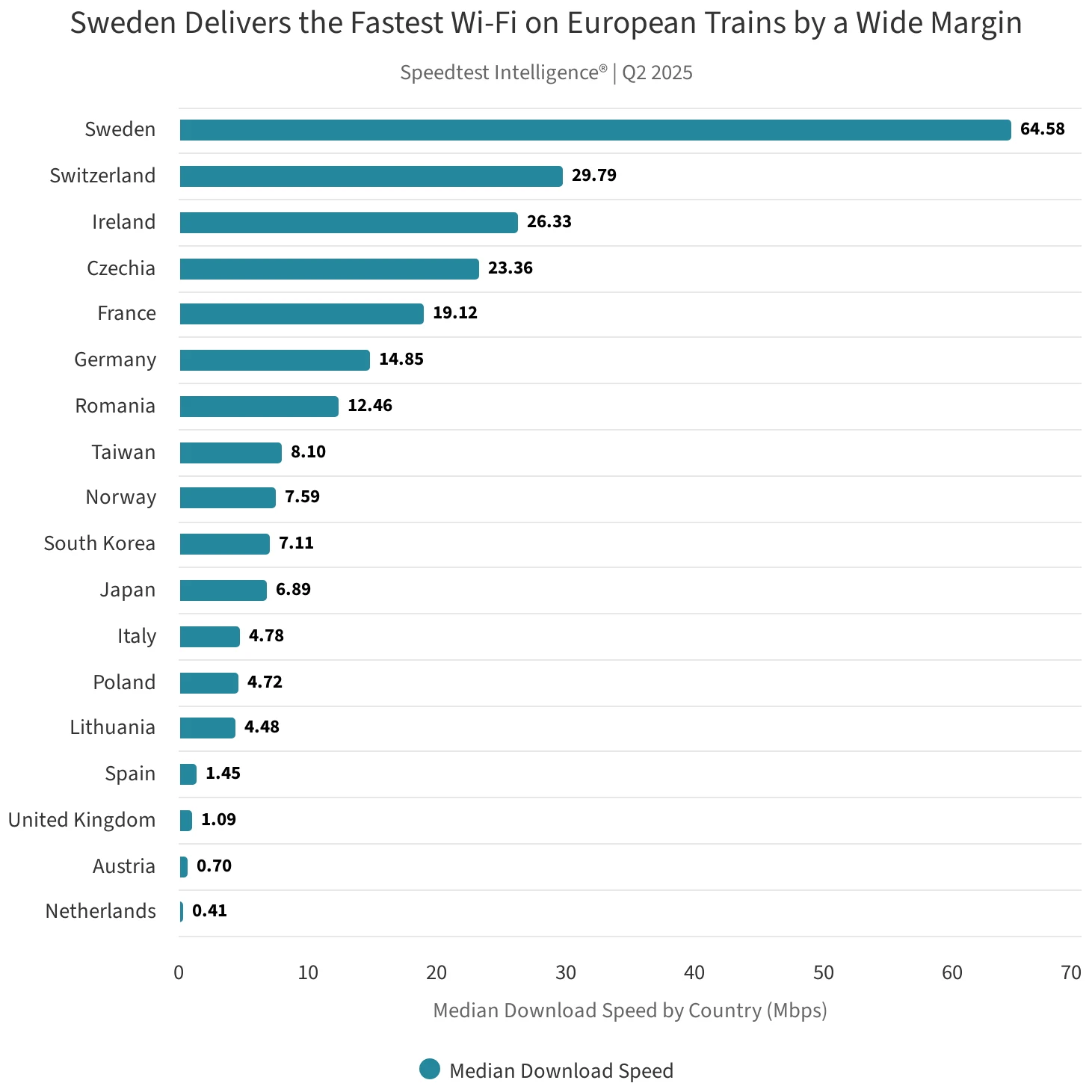
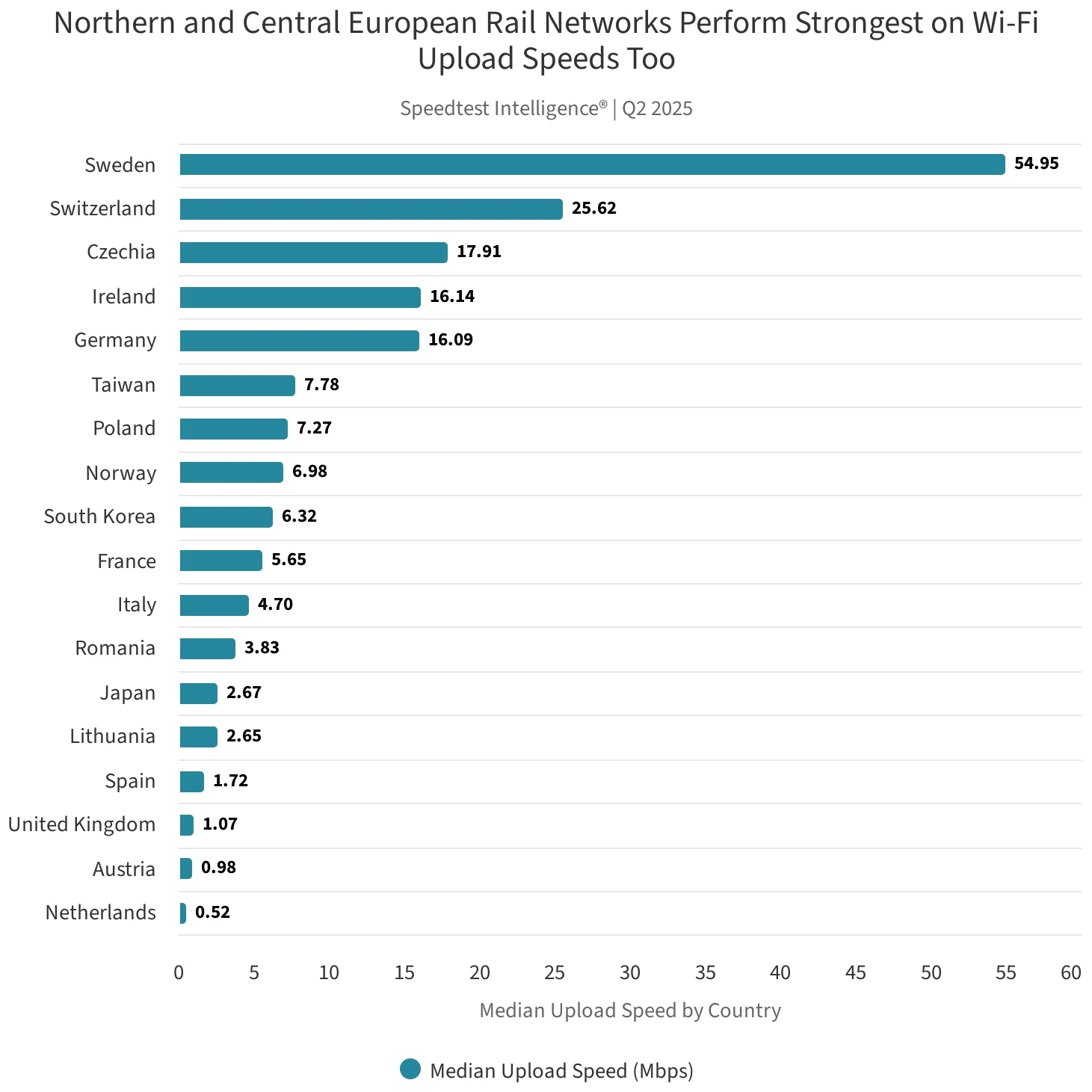
Part of the problem in the UK could be that many rail operators are still using older Wi-Fi 4 based connectivity, while 38% of those are on the most congested and slowest 2.4GHz band. On the other hand, some countries that feature a more modern Wi-Fi mix and thus drive greater use of the 5GHz band, like Spain and Italy, clearly still underperform on speed. This is often because their backhaul capacity can’t keep pace due to poor satellite or trackside infrastructure, which is the key factor for onboard performance.
The picture is a bit more varied when we look at latency performance, where the UK places about upper mid-table with an average response time of 49ms (milliseconds). However, given the super slow onboard broadband speeds, having a modestly faster latency isn’t quite so important. Taiwan delivered the fastest latency times of just 13ms, while the slowest came from Poland at 92ms.
Ookla’s full report goes into a lot more detail, including about the materials used in the construction of train carriages and onboard network design, although it’s clear from the report that political leadership and policy makes a big difference in this area. As does the adoption of satellite broadband connectivity from Low Earth Orbit (LEO), which is of course something that the UK government is now pushing (but this won’t help in tunnels).
Ookla’s Onboard Train WiFi Study
https://www.ookla.com/articles/train-wifi-2025