

Original article ISPreview UK:Read More
The FTTH Council Europe has this afternoon published their latest annual (2026) update on the progress being made across 27 EU member states (inc. the United Kingdom, Norway and Switzerland) in switching off older copper based broadband networks, which forms part of the wider move to adopt gigabit full-fibre (FTTP/H/B) infrastructure.
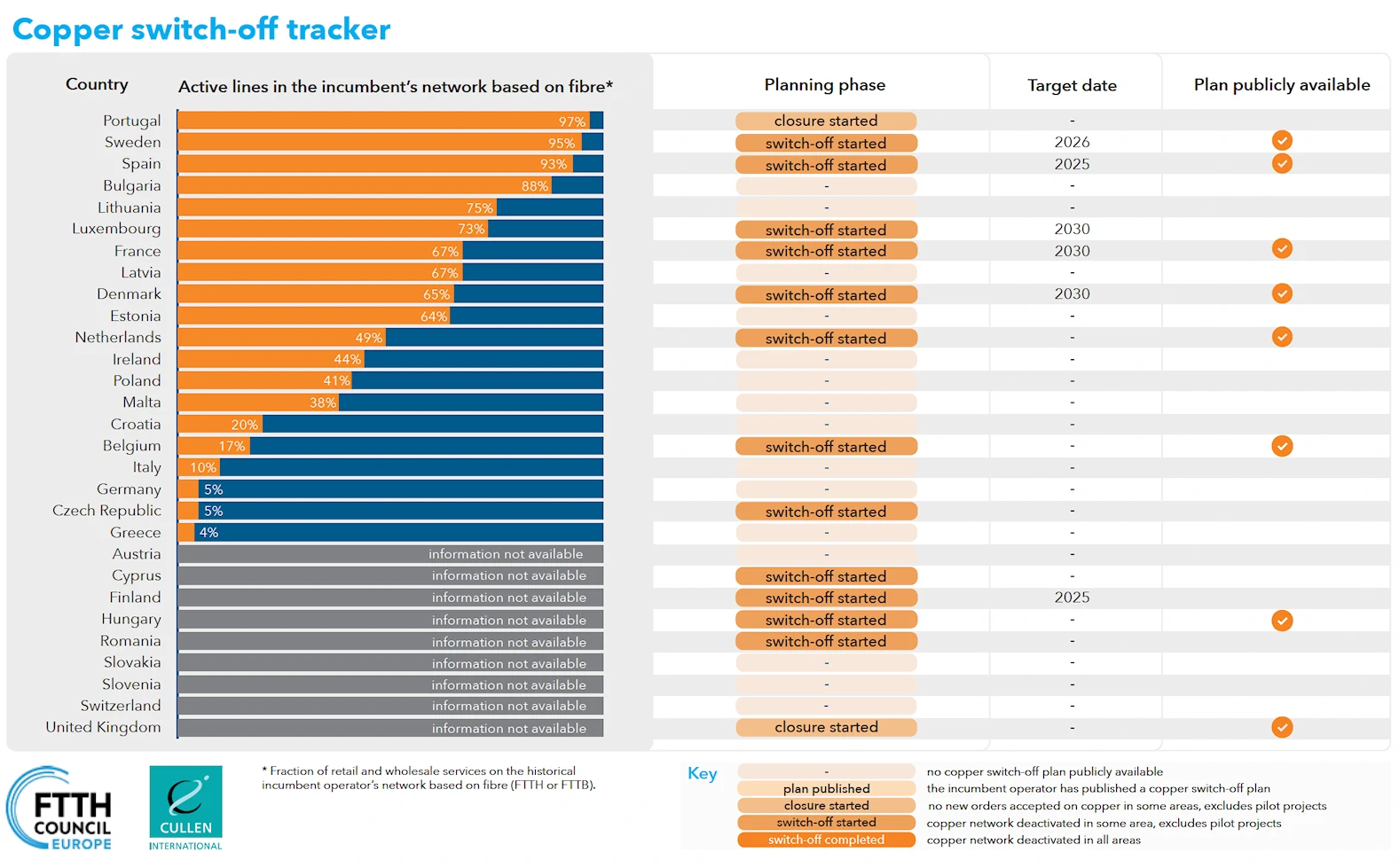
The full report, which was conducted by Cullen International, largely seems to act has a high-level summary of policies and progress across each country, which unfortunately doesn’t tell us anything terribly new about where the UK stands in this because there’s a lack of key data in the report (as evident from the illustration below). But it does help to show how much work is going on across Europe and finds quite a mixed picture.
Overall Portugal, which has 97% of active lines in the incumbent’s network now based on FTTP/H/B, seems to be leading the way, followed by Sweden (95%), Spain (93%) and Bulgaria (88%). But sadly quite a few countries, including the UK, don’t yet have any figures to show their progress and part of that’s because we were one of the last countries to deploy full fibre lines at scale (progress has been rapid since it started, but being late does create a longer time lag for the copper switch-off).
Regular readers of ISPreview will already be aware that the move away from copper to full fibre lines is a very gradual process and one that involves several separate, albeit complementary, phases. For example, Openreach and BT’s ongoing effort to shift consumers off traditional analogue voice (PSTN / WLR) services to digital all-IP / VoIP style phone technologies by 31st Jan 2027 could be said to form the first phase (here and here).
After that we have Openreach’s “FTTP Priority Exchange” programme, which reflects areas where over 75% of premises are able to get full fibre lines and will thus stop selling copper-based services (latest progress). Finally will come Openreach’s move to close around 4,600 old telephone exchanges under the “Exchange Exit” programme, but that won’t really kick off at full scale until 2030 onwards.
Francesco Nonno, FTTH Council Europe President, said:
“Having a clear and orderly plan towards copper switch off will drive further investments and accelerate full adoption of fibre networks across Europe. As our report shows, these conditions are not yet met in all European markets.”
The new tracker and report are useful for those seeking some additional context across countries, but as we say, it doesn’t really add much for the UK that we haven’t reported on many times before. Ofcom’s next major market review, due next month, will take a closer look at Openreach’s current plan, which is more of an industry-led process, and it’s possible we may see some additional changes as part of that effort.