

Original article ISPreview UK:Read More
Consultancy firm FarrPoint has published their fourth annual (2026) survey of digital leaders at councils across England, Scotland and Wales. The results reveal that expanding the coverage of gigabit broadband remains the top priority for most local authorities, just as it was last year. But ensuring better digital inclusion, a key aim of the current government, has now also become a priority.
The report – UK Local Government Connectivity Survey 2026 (PDF) – found that most respondents chose gigabit broadband (1000Mbps+) as their number one priority, while getting 100% of their area covered by at least “superfast” (30Mbps+) connectivity continues to feature as the second-highest priority for councils, followed by the expansion of 4G mobile coverage. On the flip side, ensuring digital connectivity is aligned with net-zero targets has disappeared off this year’s list of priorities.
Top Digital Priorities for 2026 (Councils)
1. More areas covered by gigabit broadband
2. Ensuring 100% of premises in the area have at least superfast connectivity
3. More areas covered by 4G
4. Ensuring better digital inclusion and adoption in the region
5. More areas covered by 5G
6. Ensuring better regional connectivity network resiliency
7. Developing new smart (IoT) projects
8. Attracting data centres to the area
The overwhelming majority of local authority respondents (80%) reported that digital connectivity remains a top priority within their region, with only 5% reporting that they felt connectivity was established enough that there was little left to do. But it should be noted that none of the respondents thought the rollout of digital infrastructure was fully complete and 15% reported a lack of understanding of the scale of the remaining issues. In addition, over 85% of surveyed local authorities now have a digital champion, which is up from 76% last year. But not all such roles are dedicated ones.
However, alongside the usual challenges with digital infrastructure coverage, the report also revealed that 9 in 10 councils have not yet been able to measure the economic or social impact of improved connectivity. While 70% of councils would like to undertake formal impact assessments, many are said to “lack the internal capacity and usable frameworks needed to do so“. Admittedly, assessing the economic impact of faster broadband and better mobile is notoriously difficult, not least since most premises won’t be starting from a point of zero connectivity.
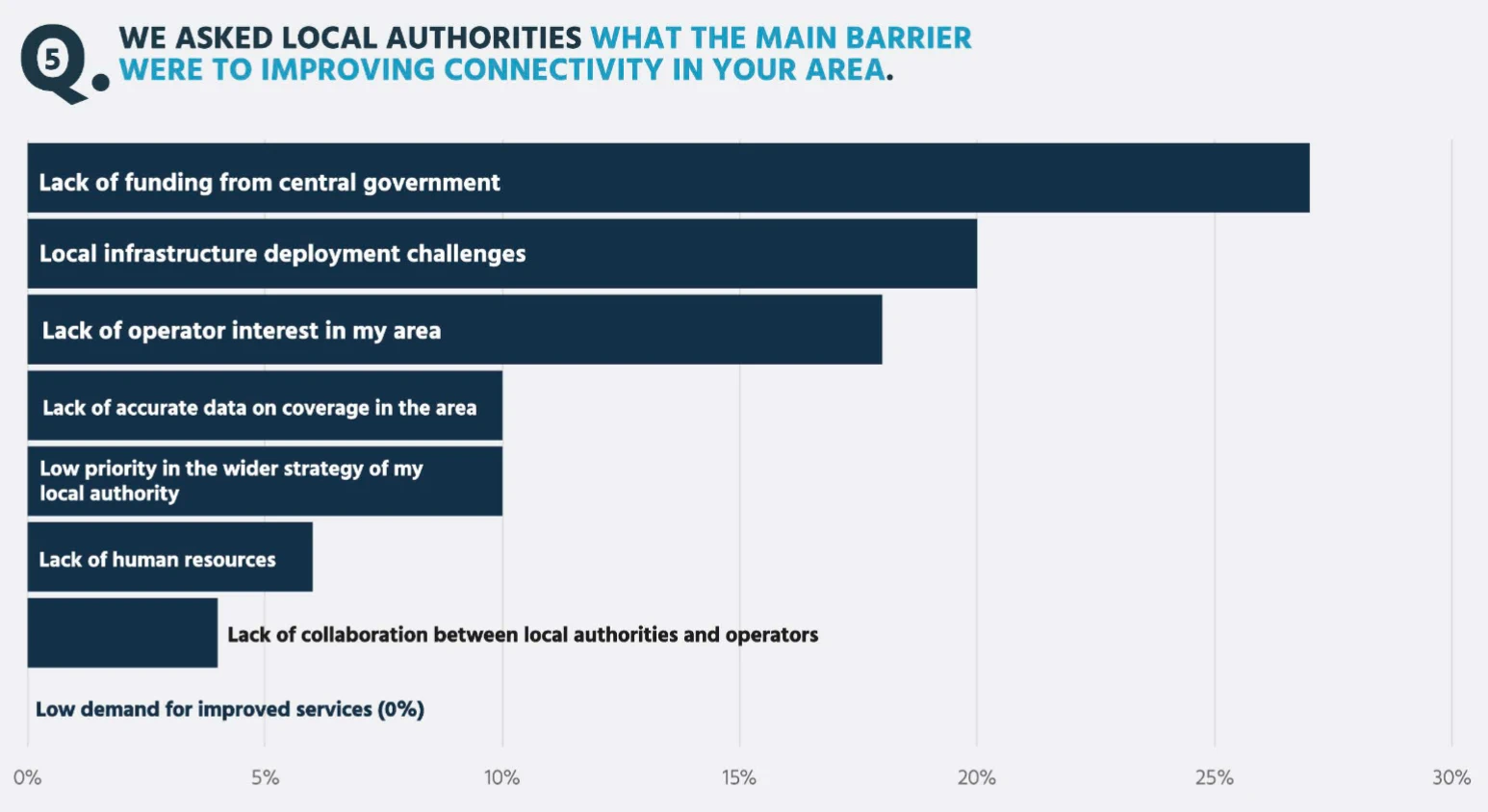
Unfortunately, it continues to be the case that most local authorities identified lack of funding from central government as being one of the main barriers to improving digital connectivity, which was followed by challenges with local infrastructure deployments. In recent years the UK government has tended to centralise control of funding for major mobile and broadband infrastructure projects.
Elsewhere, some barriers to better digital inclusion remain. Councils identified low digital skills and confidence (31%), affordability (26%) and lack of access to devices (19%) as the biggest challenges to unlocking connectivity benefits. These findings underline that simply building infrastructure does not guarantee progress without parallel investment in capability and uptake.
Three quarters of respondents also flagged growing concerns around network resilience, particularly in the wake of weather-related outages. However, many were uncertain over where responsibility lies for telecoms infrastructure recovery and contingency planning.
Data centre development remains another relatively low priority for most councils, despite the sector’s recent designation as Critical National Infrastructure (CNI). That said, 35% of authorities said they are actively trying to attract data centre investment, while a further 25% are working directly with developers. Only 15% of councils reported having conducted formal economic appraisals on the potential benefits of data centre siting.
Finally, AI is another area of evolving interest. While 75% of councils believe artificial intelligence could help improve connectivity delivery and uptake, none reported using AI tools to shape or optimise interventions.
Dr Andrew Muir, Chief Executive of FarrPoint, said:
“What’s striking this year is that councils are increasingly moving towards inclusion and day‑to‑day reliability. The conversation is shifting from infrastructure to determining whether people can participate in modern life.
Connectivity is still a strategic enabler of economic growth, public service reform and regional resilience, but councils say they need clearer signals and stronger partnership from industry and central government if they’re to turn ambition into delivery.”
The full survey is worth a read as it offers a unique insight into how local authorities perceive the current state of digital connectivity, its impact and implementation.