

Original article Total Telecom:Read More
Interview
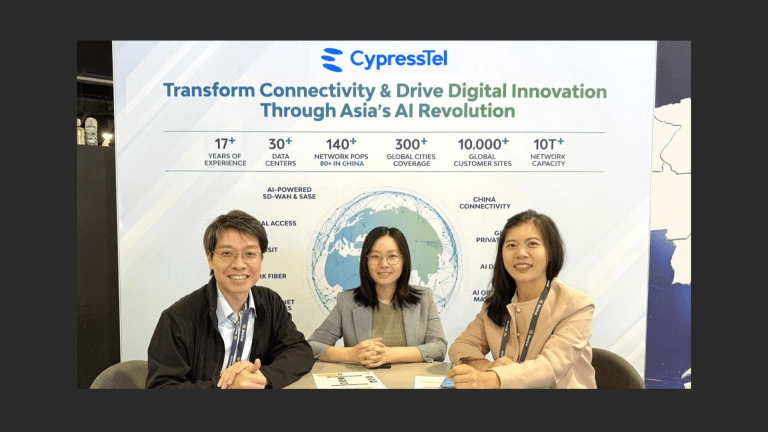
We caught up with CypressTel’s CEO Connee Zhang, Director of Global Business Eva Yu, and Associate Director of Partnership & Business Development Sam Ho to discuss the shifting global telecoms market and the rise of AI
Connee, you founded CypressTel almost 20 years ago – I’m sure much has changed in that time! Tell us about the company’s journey so far and its biggest changes.
 (Connee): There’s been a lot of change! Over the past 18 years, CypressTel has evolved from a specialist in cross-border connectivity into a carrier-neutral partner for networks, security, and infrastructure.
Our mission has always been to deliver reliable, secure and high-performance connectivity across China, APAC, and key global hubs. Along the way, we have built a strong partner ecosystem spanning global and regional carriers, data centres, cloud providers, and security vendors. We launched our own SD-WAN solution, OneWAN SD-WAN, followed by OneWAN SASE to address cloud-first and remote-work security requirements. These efforts have been recognised through SD-WAN certifications and multiple industry awards, which provide third-party validation of our technology and operations.
Today, we are positioned as an SD-WAN + SASE + infrastructure partner with AI-driven operations, serving enterprises, carriers, and service providers, and helping them apply advanced technologies by leveraging our expertise and integrated infrastructure.
We’ve seen AI having a huge impact on telecoms companies globally. How has your business evolved following the rise of AI?
(Connee): AI is now embedded across our operations and solutions. In our NOC [Network Operations Centre], we use AI to detect issues earlier and shorten fault-handling time by analysing logs, telemetry, and alarms across multi-carrier, multi-region environments. On the OneWAN SD-WAN platform, AI helps optimise routing, capacity planning and incident response, ensuring traffic is steered over the best available paths. Within OneWAN SASE, AI strengthens threat detection, anomaly analytics and behaviour insights, giving customers more intelligent and adaptive security. In our network operations, we have adopted AI ChatOps to achieve faster troubleshooting and improve fault resolution efficiency. AI has been used to automate configurations and minimise human errors
Overall, AI has helped us move from reactive support to a more proactive, predictive, and automated operations model. In parallel, we are actively developing AIDC (AI data centre) solutions that combine compute, network, and managed services, with the goal of building an “AI factory” across APAC.
How are you incorporating AI within your own solutions?
 (Sam): AI is embedded throughout our networking and security solutions.
In network operations, AI continuously analyses telemetry, logs, and alarms to detect anomalies early, suggest likely root causes and support proactive capacity planning, helping to prevent performance bottlenecks. For customer traffic routing, AI evaluates real-time path quality and recommends — or automatically enforces — the optimal paths or even allocate bandwidth intelligently for mission-critical applications. This helps us create more self-optimising, intent-aware networks that align network behaviour with business priorities. Within our evolving SASE framework, AI-driven behaviour analytics and anomaly detection strengthen protection for users, devices and applications.
Overall, this delivers better resilience, efficiency and security for our customers, while reducing operational complexity.
What impact is the rapid growth of the data centre market having on your business?
 (Eva): The rapid expansion of the data centre market, especially for AI workloads, is a major driver of our business. Customers are rolling out distributed, data- and AI-intensive workloads across multiple data centres, clouds, and regions, and they need secure, high-performance, carrier-neutral access from branches, users, and partners into these environments.
CypressTel’s core strength is aggregating last-mile access, internet, and local connectivity into data centres and clouds, using multiple carriers to build resilient and cost-effective underlay networks. Increasingly, network and compute are being planned as a single, integrated, and managed architecture.
We help customers decide where workloads should reside — whether in a DC, cloud, or at the edge — and how sites, users, and partners securely reach them over the right combination of last-mile, internet, and SD-WAN paths.
What do you see as the biggest challenge facing your customers and what can they do about it?
(Connee): The telecoms industry is in a challenging position right now. Our customers are navigating geopolitical risk, changing regulations, dynamic technology evolution and strong cost pressure, especially in sensitive regions. They worry about service continuity, data sovereignty, and compliance, while still needing to support global growth. Traditional single-carrier, MPLS-centric WANs are inflexible and expensive, so the answer is not simply swapping one carrier for another, but disrupting and de-risking the overall architecture.
CypressTel’s approach is to provide a modern SD-WAN + SASE overlay that can combine multiple underlay carriers, local internet and 4G/5G access to meet the dynamic needs of digital transformation. Unified SASE policies then ensure consistent security and governance across all regions. The result is better risk management, lower total cost of ownership and stable, secure connectivity for critical business applications.
With the global telecoms world changing so rapidly, how do you position your network infrastructure to align with global network demand?
(Eva): We have designed an integrated APAC–China network infrastructure that connects major cities across the region via a highly resilient, high-bandwidth backbone. This is supported by a versatileconnectivity infrastructure that brings together multiple carriers, data centres, and cloud on-ramps across APAC. On top of this, we work closely with global carriers and cloud providers to build a strong partner ecosystem.
Our teams are experienced in navigating complex local legal and regulatory requirements, and our bilingual, multicultural talent pool helps bridge East–West business and cultural differences. This combination makes CypressTel an ideal base for designing, negotiating and operating cross-border and regional connectivity solutions for global customers.
Do you see major regional differences in SD-WAN and private network markets?
(Eva): Yes, there are clear regional differences in market maturity and priorities. In the US and Europe, SD-WAN adoption is already mature, and the focus has shifted towards SASE, multi-cloud optimisation, and zero-trust security. In these markets, CypressTel often acts as a specialist APAC/China connectivity partners, aligning global designs with realistic local delivery.
In Asia and other emerging markets, on the other hand, many organisations are still migrating from MPLS/IP-VPN and need local know-how and diverse last-mile options. Developed markets tend to prioritise user experience, visibility, and advanced security features, while developing markets focus more on availability, cost and mobile-first access, but still want centralised control. In China and wider APAC region, customers also need expertise in China access, compliance, and cross-border performance.
CypressTel’s strength lies in being a carrier-neutral SD-WAN + SASE provider with deep China–APAC regulatory and operational experience.
How important is SASE in today’s cybersecurity environment?
(Sam): SASE has become a foundational architecture in modern cybersecurity because users and applications are now everywhere — across offices, homes, multiple countries, data centres, public cloud, and SaaS platforms. Traditional perimeter-based security cannot provide consistent protection or keep up with this level of agility. SASE converges networking and security into a cloud-delivered model, giving organisations centralised visibility and policy control across all access points. It enables zero-trust, identity- and context-based access decisions and supports both cloud-first and hybrid-work strategies.
In our view, SASE is no longer an optional add-on; for many enterprises it is the core architecture for secure connectivity, and we are well positioned to capture this growing demand.
What customers have surprised you the most, either due to their unique requirements or how they have used your technology?
(Sam): One standout example is a leading global insurance group with more than 60 offices worldwide, including a major presence in China. They were facing high legacy MPLS costs, limited flexibility, and complex traffic management between overseas locations and their China operations.
CypressTel delivered carrier-neutral last-mile and internet access in China, combined with OneWAN SD-WAN across their HQ, data centres, and branches. This reduced their overall network costs, improved visibility, and enabled clean segmentation of different business services worldwide.
What surprised us most was how quickly this highly regulated financial institution embraced SD-WAN and internet underlay once they saw the operational, security, and compliance benefits for their China–global connectivity.
What are the next steps for the company’s growth?
(Connee): Looking ahead, we will deepen our R&D in AI, SD-WAN, SASE, and AIDC, including through joint labs and innovation programmes with partners. We plan to further enhance OneWAN SD-WAN & SASE with stronger security, automation, and AI-driven operations and solutions tailored for cloud and AI workloads. We will continue to expand our APAC and global footprint with additional PoPs and tighter integration with carriers, cloud providers, and data centres.
A key focus will be building an APAC-centric partner ecosystem and co-designing solutions with regional and global technology partners for industries such as manufacturing, retail, finance and logistics. At the same time, we are investing in talent and organisational agility so that we can stay ahead of technology shifts and market changes.
Keep up to date with all the latest telecoms news with the Total Telecom newsletter
Also in the news
World Communication Award Winners 2025
Ofcom clears the way for satellite-to-smartphone services
LG Uplus’s AI voice call app glitch leaks user data