

Original article ISPreview UK:Read More
SpaceX has revealed that its “greatly enhanced” second generation (GEN2) of Direct to Cell (DtC) capable Starlink broadband satellites, which are due to launch in 2027, will aim to support 5G connectivity and deliver peak data speeds of 150Mbps (Megabits per second) per user.
Starlink currently has around 9,800 satellites in Low Earth Orbit (LEO) – mostly at altitudes of between c.340-525km. Residential customers in the UK usually pay from £35 a month for the ‘Residential 100Mbps’ unlimited data plan (kit price may vary due to different offers), which also promises uploads of c.15-35Mbps and low latency connectivity. Faster packages exist at greater cost, while more restrictive (data capped) options also exist for roaming users (e.g. £50 per month for 100 GigaBytes of data).
Some 650 of those satellites also support their first generation (GEN1) DtC (aka – Direct to Device) service, which delivers a basic (limited data and messaging etc.) global 4G mobile roaming service to unmodified Smartphones on the ground, typically alongside supporting mobile operators (e.g. O2 Satellite in the UK). The goal with this is to keep mobile users connected even in remote areas, where terrestrial mobile signals may struggle to reach.
However, SpaceX’s satellite policy lead Udrivolf Pica, as part of a video speech at the International Telecommunication Union’s (ITU) Space Connect conference, yesterday revealed how their GEN2 DtC service would look to harness more radio spectrum (e.g. 2GHz MSS Band – 1980-2010MHz / 2170-2200MHz, acquired from EchoStar) and deploy 5G capable satellites that are “aiming at peak speeds of 150Mbps per user“.
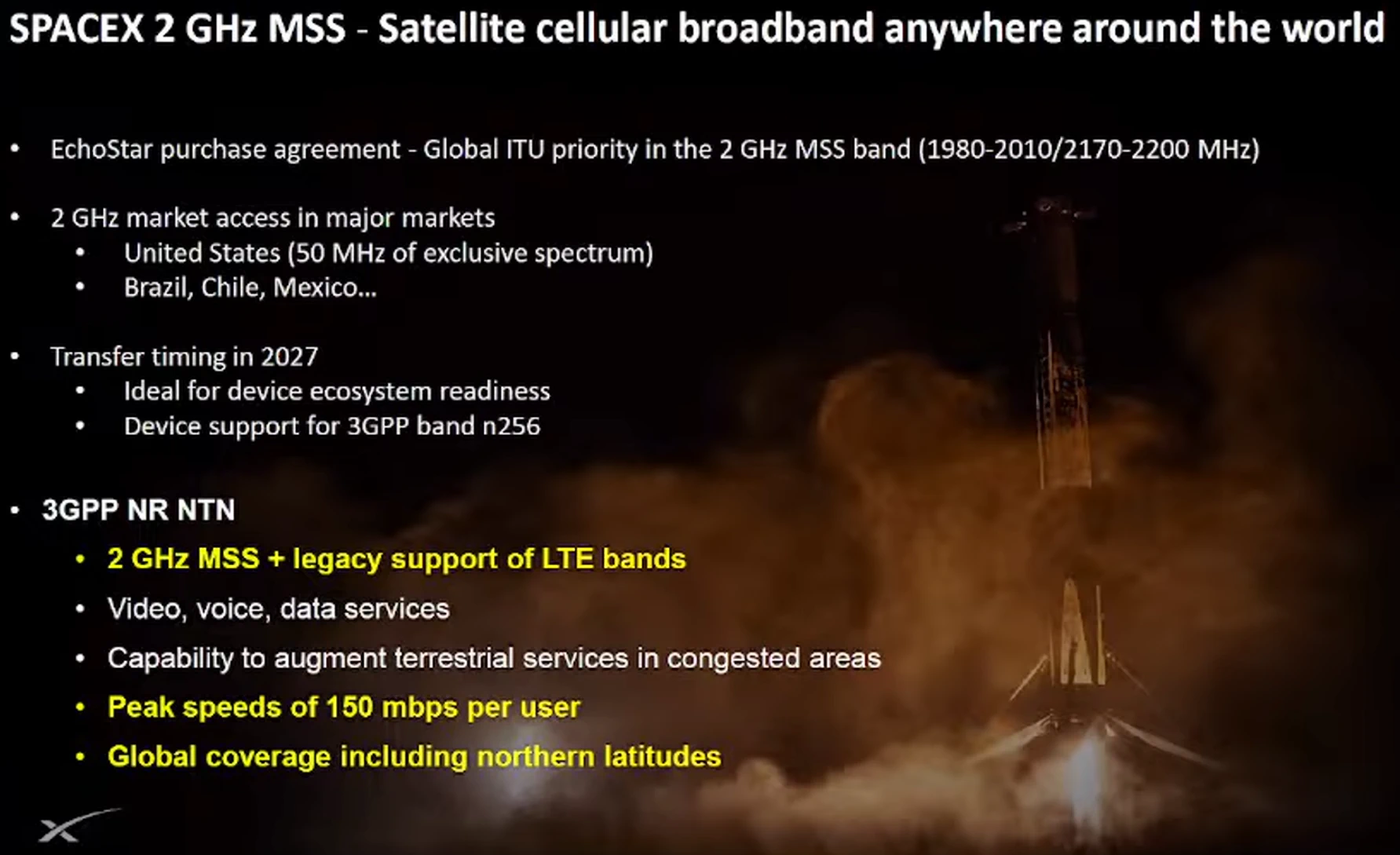
On the one hand 150Mbps is slower than what a lot of modern terrestrial 5G networks can currently achieve. But when coming from satellites, all sitting hundreds of kilometres up in space, it’s much more of a technical marvel to be able to deliver that sort of performance to individual users. In fact many UK users in rural areas often struggle to get even close to such speeds, even when they have good coverage. The attraction is obvious.
You can see the full video below and the Starlink part starts at the 23:28 minute mark. In addition, AST Space Mobile, which is being adopted by Vodafone in the UK to rival Starlink, also gives a presentation at the 15:28 minute mark. But AST is currently only aiming to deliver peak speeds of 120Mbps “per coverage cell” (for context – each one of AST’s next gen BlueBird satellites will have 2000+ active cells).